We are developing the social individualist meta-context for the future. From the very serious to the extremely frivolous... lets see what is on the mind of the Samizdata people.
Samizdata, derived from Samizdat /n. - a system of clandestine publication of banned literature in the USSR [Russ.,= self-publishing house]
|
I won’t name the guy – he was talking to me in a private setting and such things should remain private – but a friend of mine came up with this rather bizarre defence of the recent fact, as unearthed by Snowden et al, that the US and other powers engage in massive, unauthorised spying on their citizens:
Governments have always done this, so why the fuss now? Accept it and pour yourself a beer.
The world is “massively overpopulated, so with all these ghastly people infesting the planet, governments need to, and will find it easier to, spy on them.
Spying on people, even in ways we find scary, is inevitable, so relax and stop getting oxidised about it.
The second of the arguments interests me because it blends the Malthusian panic about too many humans (and begging the question of what “should be done” about them), pessimism about the inevitability of spying and other outrages, and a sort of world-wearying acceptance of big government. Quite an achievement.
Of course, it maybe that the person making this argument was just trying to be a knob and wind me up (he is familiar with my libertarian views and regards them, patronisingly, as a sort of jolly enthusiasm). But his opinions are probably quite wildely held out there among people who consider themselves to be “realists” and “sophisticated”.
After the My Lai massacre, only one person, William Calley, was charged, and then only after enormous public outcry. He ultimately served 3.5 years in house arrest for ordering and participating in the murder of at least 347 and possibly as many as 504 Vietnamese civilians, presuming he had no knowledge of the gang rapes and mutilations of bodies, which seems unlikely given eyewitness accounts.
The events of My Lai were initially covered up, itself a crime, but no one was ever charged for participating in the coverup.
During the massacre, Hugh Thompson, Jr. saved countless lives by ordering his helicopter crew to protect innocent civilians from execution. For his trouble, he was initially given a medal for a non-existent event in an attempt to shut him up, then condemned in public once the true events were revealed. The Chairman of the House Armed Services Committee, Congressman Mendel Rivers, went so far as to say that Thompson was the only person in the incident worthy of punishment.
Has the world changed much?
Today, it was announced that Bradley Manning, whose chief de facto offense was providing the US public with evidence of multiple war crimes, will be serving ten times the length of William Calley’s punishment, 35 years, and in a real prison rather than house arrest. The people who committed the war crimes he revealed evidence of will never be charged.
(On the latter, if you have any doubts that he revealed criminal activity, compare, as just one example, the video of the helicopter machine gunning of two Reuters reporters in Baghdad with the official DoD investigation report of the incident, which had full access to said video. Even if one can bring oneself to believe that the incident itself was not a crime (although it almost certainly was), the subsequent investigation was a fabricated tissue of lies. The events in the video and those described in the investigation report are manifestly not the same. Presumably those engaging in this coverup believed they could never be caught because the video was improperly classified to aid in the coverup, itself a crime. The coverup itself was a felony — but no one was charged but the messenger.)
The State protects its own. It cannot be trusted to police itself.
If there was a Nobel Prize for Double Standards, Britain’s chattering classes would win it every year. This year, following their expressions of spittle-flecked outrage over the detention of Glenn Greenwald’s partner David Miranda by anti-terrorism police at Heathrow airport, they’d have to be given a special Lifetime Achievement Award for Double Standards.
For the newspaper editors, politicians and concerned tweeters now getting het up about the state’s interference in journalistic activity, about what they call the state’s ‘war on journalism’, are the very same people – the very same – who over the past two years cheered the state harassment of tabloid journalists; watched approvingly as tabloid journalists were arrested; turned a blind eye when tabloid journalists’ effects were rifled through by the police; said nothing about the placing of tabloid journalists on limbo-like, profession-destroying bail for months on end; said ‘Well, what do you expect?’ when material garnered by tabloid journalists through illegal methods was confiscated; applauded when tabloid journalists were imprisoned for the apparently terrible crime of listening in on the conversations of our hereditary rulers.
For these cheerleaders of the state’s two-year war on redtop journalism now to gnash their teeth over the state’s poking of its nose into the affairs of the Guardian is extraordinary. It suggests that what they lack in moral consistency they more than make up for with brass neck.
Everything that is now being done to the Guardian has already been done to the tabloid press, a hundred times over, and often at the behest of the Guardian.
– Brendan O’Neill
The year being 1913, of course.
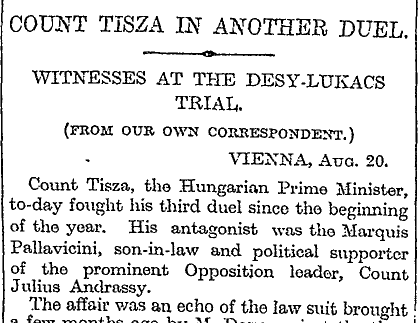 The Times, 21 August 1913 p4
The whole business seems to be a bit stylised although still dangerous.
There is a Samizdata team joke that the difference between American arrogance and British arrogance is the British think they run the world, whereas the Americans think they are the world.
Well just last week I started doing some business with a European bank… a quite mainstream one I might add… and discovered something remarkable. I had to sign a series of statements that I did not do business in the USA, had no assets in the USA and was not a US citizen or resident. Only then would they do business with me. Indeed I had to sign more papers regarding this than any actually pertaining to the business I was doing with them.
And this is why…
The Internal Revenue Service on Monday launched an online registration program for the hundreds of thousands of financial firms around the world that must comply with a U.S. anti-tax evasion law or risk being shut out of financial markets.
Surely a significant European bank must do some business in the USA, I asked. Can the world’s largest economy really be so onerous that you truly want nothing whatsoever to do with it?
Well he was rather guarded and he knew I was a blogger, which I suspect made him a bit uneasy at the prospect of being quoted, which is why I am naming no names. But to paraphrase the reply I coaxed out of him, it was “yes, the USA is simply not worth the trouble and so rather than complying with their endless diktats and the uncertainties of what are increasingly capricious rules… well… there is a whole great big world out there for us to do business with that does not include the United States.”
Yet I suspect the powers-that-be in Washington could not care less and moreover the notion that sophisticated foreign bankers are starting to see American not as the land of opportunity, but as a place to be avoided at all costs, would strike them as preposterous. Indeed had I not had those documents laid in front of me asking me to attest to a complete lack of economic links to the USA or anything associated with the USA that the US state might claim extraterritorial jurisdiction over… well, I would not have believed it myself.
Moreover, after our business had been concluded and he relaxed a bit, the banker in question, who I very much doubt is on any Interpol wanted lists (well I certainly hope not given that he now has some of my money) said he would not even visit the USA or transit a flight through it, due to the US authorities propensity to detain foreign bankers and ask them questions if they even suspect any involvement with US nationals, particularly from ‘non-compliant’ banks such as his.
Am I the only one who is astonished things have come to this? I am suddenly very glad I do not actually live in Arkham, Massachusetts (not sure which is worse, the IRS or the Deep Ones).
Recently, I’ve seen much hubbub to the effect that the US Republican Party must adopt libertarian views to retain its popularity. For example, see this article which, in spite of its title, mostly discusses why the Republicans will fail if they don’t abandon “conservatism” for libertarianism.
As other examples, NPR had an extended segment on the news with a very similar topic about a day ago, and I’ve seen friends posting on similar themes.
I should like to take a radically orthogonal view.
I honestly don’t care what will or will not “save” either the Republican Party, or any other party for that matter. Political parties generally disgust me, being organized for much the same purpose as a gang of looters or a crime syndicate, and if only they could all go out of business and their members be sent to prison where they belong I would be pleased beyond measure.
What I do know is this, though: just as the Democrats keep talking about things like “civil liberties” while running Guantanamo and a surveillance state, and talk about “peace” while growing the military and intervening around the world, your odds will be excellent if you bet that a GOP that adopts “libertarianism” so it can win elections will give the ideas lip service while implementing entirely non-libertarian policies to serve their real goals: power and money for themselves and their cronies.
Many people will not understand this distinction between rhetoric and action. After all, few seem to notice it right now. If the rebranding is successful and the Republicans start winning elections, I fear that the public will start blaming “libertarianism” for increased government spending, foreign intervention, business regulation, torture, and whatever else they implement under the pretense of spending cuts, non-intervention, deregulation, civil liberties, and the like.
I suppose that is not really something I can help, though. The underlying problem is that people do not yet widely understand that the higher the political office, the more likely it is that the electoral contest is between two sociopathic con men.
Indeed, the US Presidential election is a sort of quadrennial Olympics for con men. The odds of of a randomly selected untrained amateur winning the Olympic 500m race are poor when hundreds or thousands of professionals train for years for the event. The probability of a decent human being winning the White House when competing against hordes of amoral grifters whose skills are honed to a razors edge by years of competition are even lower.
Worse, people do not understand that even if a decent human being by some astounding accident wins high political office, they are almost inevitably both thwarted and corrupted. The system is built to derail reform, not to enable it, and it holds temptations that few normal people can resist. One is faced with (to name but a few things) the powerful financial interests of the Military-Industrial Complex, blackmail by the intelligence community, lobbyists more numerous than locusts, fellow politicians who do not want their sustenance to end, a press almost as interested in preserving the status quo as the pigs at the trough, Sir Humphrey Appleby‘s spiritual kin, constant luxuries from banquets to private jets to soften one’s moral resistance, and an endless series of instances where one might bend the rules just this once, for the common good.
I would not even trust myself with the power of the Presidency — it should be no surprise that I trust no one else with it either.
I have been asked by some, “then what do you propose we should do, if electoral politics will not work? Surely you must work within the system you have, not the one you wish you had.” This viewpoint reminds me of a political cartoon featuring a pair of Aztec priests removing the heart from a victim. One says to the other, “it isn’t the best possible system, but it’s the one we’ve got.”
I think that until one thinks beyond the current system and its failures, one cannot get away from those failures. You cannot become celibate by increasing your frequency of sexual intercourse, shoot your way to nonviolence, gorge your way to weight loss, or vote your way to a system that respects inalienable rights not subject to the whims of the electorate.
The US’s founding fathers conducted an interesting experiment in whether a strong constitution could restrain the worst defects of democracy. (That was literally their intent, as the Federalist Papers reveal.) We would be fools to ignore the result of that experiment. To be sure, it was a partial success for a time, but it did not last. The rot began almost immediately.
(I have acquaintances who are attorneys who believe in a “living constitution.” They laugh at me when I say things like “but the plain intent of the words `Congress shall make no law[…] abridging the freedom of speech, or of the press’ is that Congress isn’t allowed to make laws on that topic.” Apparently a belief that words can have plain meanings is the height of naïveté and shows exactly how stupid I am.)
The only rational way forward I see is to try to build the world I want directly, and to leave the political mechanism, which I wish to see eliminated anyway, behind.
My message, and sadly the best path I have to offer (for it is not an easy one) is this: work on ways to achieve the world you want that do not involve politics, and work on letting others know that this is the only long term path to make the world a better place.
In other words, if you want to see people fed, work on ways to feed them — one Norman Borlaug beats a million “food security activists” begging for stolen money. If you want to see people better able to communicate in privacy or avoid censorship when they wish to speak in public, build computer protocols and software to help them do that regardless of the desires of bureaucrats. (The people who built Tor, PGP and the like did not wait to be given “permission” to do so, they simply built what they felt the world needed. You can, too.) If you want to help people live longer and healthier lives, do medical research or open a clinic.
So, if you want to be free, live as freely as you can right now, and help others to be free as well. Build the institutions and technologies you wish existed to support freedom today, not someday after “they” have given you permission to be free. “They” will never grant their permission, so you will be waiting forever. Besides, waiting for “them” to throw you crumbs of freedom is servile. Not only will the things you build improve your own life here and now, those things will also undermine the power of those who would enslave you. (“They” would prefer that you believe yourself to be powerless and dependent on what “they” choose to do. Ignore “them”.)
Most of all, do not believe the con men, do not join them, and do not aid them. (Try to help other people understand that they should not believe or aid them either.) The con men are not your friends. The last several millennia of experience with elections are not a fluke to be dismissed as mere experimental error. The next politician and the next election will not be different than all their predecessors. The next politician will not usher in “change”, or “hope”. The next politician will, if experience is any guide, care mostly about self-maximization. It doesn’t matter how hard they pander to your prejudices, they don’t care about what you want, they’re in it for what they want. If you want a better world to live in, build it yourself instead.
Browsing Instapundit this morning, I found this link to this video…
Update:
Commenter Alisa contributed a link that includes a pointer to the Homeland Security Grant Application (PDF) by the Concord police department.
Section 1 B begins:

It would be interesting to hear the specifics of what kind of “active and present daily challenges” the Free Staters constitute.
All suspicions which have been raised have been dispelled
– German interior minister, Hans-Peter Friedrich, referring to reassurances that British and US intelligence agencies “had observed German laws in Germany”.
It is compulsory to recite this quote in the voice of Cecil Baldwin from Welcome to Night Vale.
Dogs are not allowed in the dog park.
People are not allowed in the dog park.
All suspicions which have been raised have been dispelled.
Do not approach the dog park.
Yasuni: Ecuador abandons plan to stave off Amazon drilling
Ecuador’s President Rafael Correa has abandoned a unique and ambitious plan to persuade rich countries to pay his country not to drill for oil in a pristine Amazon rainforest preserve.
Environmentalists had hailed the initiative when Correa first proposed it in 2007, saying he was setting a precedent in the fight against global warming by reducing the high cost to poor countries of preserving the environment.
“The world has failed us,” Correa said in a nationally televised speech. He blamed “the great hypocrisy” of nations who emit most of the world’s greenhouse gases.
“It was not charity that we sought from the international community, but co-responsibility in the face of climate change.”
Correa had sought US$3.6bn in contributions to maintain a moratorium on drilling in the remote Yasuni national park, which was declared a biosphere reserve by the United Nations in 1989 and is home to two indigenous tribes living in voluntary isolation.
But on Thursday evening he said Ecuador had raised just $13m in actual donations and $116 million in pledges and he had an obligation to his people, particularly the poor, to move ahead with drilling.
Schemes outwardly quite like this, that ask people to put their money where their mouths are, might yet turn out to be a great way to find the balance between development and preservation that actually pleases most people as revealed by what they are willing to pay for. But given that Mr Correa has already shown, as Tim Worstall points out, that he considers payment of his country’s debts to be optional, I think the required foundation of trust might be lacking for this one. Sadly there were quite a few private individuals who contributed to this scheme even though the rich world’s governments prudently refrained – some of these individuals lament their wasted money in the comments to this second Guardian story. Someone else replies that it is a sin to leave a sucker in charge of his money, but there are worse things to be than a sucker. They are not the environmentalists who should arouse our scorn. Reserve that for the first commenter, who says to general approval, “If we want to save the planet, we are going to have to do this by force.”
Why does the BBC sneer about Britain’s recovery but go crazy if Euroland’s corpse so much as twitches?
– Stephen Glover
In fact I suspect the UK’s “recovery” is as bogus as the Euro-zone’s “recovery” but the approach of the BBC is nevertheless… interesting… in a very predictable sense.
A comment piece over at the Guardian has compelled me to write my first post on this fair blog. I have been mulling over the idea about writing something about rent seeking and fixed lined broadband rollout in the UK for some time, but BT’s great broadband scam has pushed me over the edge finally.
The Guardian writer blames the market, competition and Margaret Thatcher for the fact that BT has won all of the government contracts to build fixed line broadband in the UK.Though most Guardian writers blame this triumvirate for most things, this writer makes a tenuous link between BT and competition ultimately calling for the renationalisation of broadband in this country. (He sounds much like Susan Crawford over in the US, but that is a post for another time) But what he gets so very wrong about blaming competition for the inability for the government to rollout broadband is that it is BT’s rent seeking behaviour coupled with a centrally planned project that has contributed to the so far unsuccessful UK broadband rollout project called BDUK.
There are so many reasons that BDUK has not succeeded that it hard to know where to begin. But for the purpose of this post it is important to understand that the broadband targets and rules for entering into procurement as a provider changed over the course of the last three years. Initially, the project was to provide next generation access (NGA) to 100% of the UK by 2015 and now it may only succeed in delivering 90% by 2017. Fibre to the home (FTTH) was the initial target and eventually fibre to the cabinet (FTTC) became the final and less optimal solution. The regional areas that divide up the entire BDUK project into smaller, sub-project areas were far too small to achieve economies of scale. The list goes on, but changeable rules against which companies and consortia were to pitch to be on the ‘approved’ list meant only risk and uncertainty for those businesses. In the end only BT survived and thus BT became the monopolist provider.
But if I ran BT I would make sure that I was the only procurer on that list through whatever means possible, including rent seeking. And that is precisely what they did. OFCOM, the telecoms regulator, DCMS, the department responsible for BDUK and BT have a cosy relationship with advisors and consultants making the rounds in contracts and positions among all three. But BT has a massive incentive to ensure that their fixed line broadband network became the only networked used to rollout new broadband services. If other vendors were chosen for BDUK then this old network, made up of traditional copper lines and some fibre, would be completely bypassed thereby rendering the network useless. Quite high stakes if you are that behemoth BT. Even an outsider’s attempt to petition DCMS to include wireless in its definition of ‘next generation access’ failed because it would mean using a new and probably non-BT network. Not allowing wireless as one of many ways to achieve rural broadband access is essentially absurd in this day in age. But the BDUK project stipulated only fixed line Internet access at delivery.
So while we do indeed have competition in urban areas and many rural areas for broadband access services (as most services like TalkTalk rent BT lines at wholesale prices) we have very little competition in broadband infrastructure and that is an important difference. BT has played their cards well in a centrally planned system created by civil servants who have made policy in order to achieve the delivery of fixed line broadband Internet access. No one person is to blame, but through bad policy making, EU regulations, rent seeking by BT, and no comprehensive oversight, we have a project that will be delivered well over time and budget and paid for by the taxpayer. True competition in services, diversified Internet access types, and infrastructure would have delivered far richer choices. Currently BDUK remains Hayek’s worst nightmare.
Though he was ambassador in London from 1898 to 1920, Cambon spoke not a word of English. During his meetings with Edward Grey (who spoke no French), he insisted that every utterance be translated into French, including easily recognised words such as ‘yes’. He firmly believed – like many members of the French elite – that French was the only language capable of articulating rational thought and he objected to the foundation of French schools in Britain on the eccentric grounds that French people raised in Britain tended to end up mentally retarded.
– Christopher Clark, The Sleepwalkers p193. While Sleepwalkers is clearly well-researched I am far from sure the research supports the conclusions i.e. that the First World War was all one big accident. I may blog more on this sometime but equally I may not.
|
Who Are We? The Samizdata people are a bunch of sinister and heavily armed globalist illuminati who seek to infect the entire world with the values of personal liberty and several property. Amongst our many crimes is a sense of humour and the intermittent use of British spelling.
We are also a varied group made up of social individualists, classical liberals, whigs, libertarians, extropians, futurists, ‘Porcupines’, Karl Popper fetishists, recovering neo-conservatives, crazed Ayn Rand worshipers, over-caffeinated Virginia Postrel devotees, witty Frédéric Bastiat wannabes, cypherpunks, minarchists, kritarchists and wild-eyed anarcho-capitalists from Britain, North America, Australia and Europe.
|







Recent Comments