We are developing the social individualist meta-context for the future. From the very serious to the extremely frivolous... lets see what is on the mind of the Samizdata people.
Samizdata, derived from Samizdat /n. - a system of clandestine publication of banned literature in the USSR [Russ.,= self-publishing house]
|
There has been something of a trend, it seems, of big firms adopting “woke” or politically correct agendas (here is a definition of “woke” for the befuddled) in recent months and years. The latest example is that of razor and men’s grooming products business Gillette, part of consumer giant Proctor & Gamble. Here is the advert and a discussion around it by the Wall Street Journal. Here is another version of the advertisement.
So what’s going on here? In my view, this is an attempt by a firm that is keen to stem outflow of market share to rivals, and which also fears a reduced demand for its products at a time when a lot of men seem to want to grow beards these days (although they still will want to trim them and keep them neat, etc). The firm’s top brass have concluded that in the current culture, where masculinity is considered to be “toxic”, and probably a contributor of right wing views, global warming and competitive team sports, that a change of tack is required. Make men buy something by worrying about their primal urges! Get into the good books of the chattering classes and the distributors of ad. industry campaign awards!
The problem here is that this illustrates the disconnect that there now is between that segment of the chattering classes that is influenced by leftist ideas and the rest of the population. The CEOs of modern firms may not all tack in this direction, but they have become convinced, or been convinced, that going “woke” is smart for business. Also, the kind of folk most likely to rub up against CEOs are the consultants and advertisement gurus who imbibed such modish ideas in colleges and unversities.
We see this kind of agenda at work in the wealth management industry, where firms are keen to stress how much of what they do is to promote environmental, social and governance-linked investment, never mind actually making money for clients and owners. Entrepreneurs are as celebrated as much for giving their wealth away as for the grubby process of, you know, making it in the first place. (One of my least-favourite expressions used by business folk of a certain type is how they want to “give back” to the “community” – this implies that they “took” something initially that wasn’t fully theirs.)
Clearly, a lot of this may be incubated in Western universities, and you have to wonder what sort of business decisions will be made by the kind of “coddled” youngsters now going through universities. I have been reading the Coddling of the American Mind by Greg Lukianoff and Jonathan Haidt, and what alarms me, as it should anyone, is what sort of future businessmen and women we will get if they are drawn from the sort of ranks these academics describe. What will be their desire to take risk, to invest wisely, to cater to genuine client needs? How susceptible will they be to political fads entering the boardroom and factory floor?
In the end, as some classical liberals say, the ultimate arbiter of all this is profit/loss. If Gillette’s market share rises after these ads, maybe the management will say “there, I told you so” and move on. I have made my own tiny vote on this by ensuring I buy from rivals such as Wilkinson’s Sword instead. Possibly, so will others of us “toxic males”.
Here is my cunning plan to avoid a hard border in Ireland.
Don’t build one.
The UK doesn’t want it, Ireland doesn’t want it. Problem solved, I’d have thought, but the EU does not agree:
No-deal Brexit would mean hard Irish border, EU confirms
The EU has injected further pressure into the Brexit talks by confirming it will enforce a hard border on the island of Ireland in the event of a no-deal outcome, despite the risk this would pose to peace.
It will enforce? Er, with whose… personnel will that be done?
Last night I attended a meeting, and although I did not have any arguments with anyone about fake news, I did meet with Vera Kichanova, and learned from her that her Adam Smith Institute “report” (aka: argument in favour of) micro-housing was to be published today. Good. I’m for it.
ASI announcement by Matthew Lesh here. The entire thing can be read here.
I don’t agree with Vera’s title, “Size Doesn’t Matter”. I think that when it comes to where you live, size matters a lot. You don’t want somewhere too big for you, or too small for you. Perhaps the ASI is hoping that, by having a silly title, they will sucker many of those who hate the idea, and who would otherwise ignore it, into instead denouncing it because of its title, thus spreading the word about it. The Trump technique, in other words.
For many, “micro” would indeed be way too small. But, for quite a few others, micro-living would be much preferable to a long commute. I am in favour of people having choices along such lines rather than at the far end of a line. And I am in favour of entrepreneurs having the freedom to bet their time and money contriving such choices.
I’ve not yet read Vera’s piece yet (this being one of those something now rather than something better but later postings), so I don’t know if she makes this point, but one very good reason why many might now be okay with a much smaller living space is that home entertainment and home education can now occupy a tiny fraction of the space that they used to, about one or maybe two generations ago. You can literally now carry your entire entertainment system, and your entire library – words, music, movies, TV shows, the lot – in a small bag. In other words, you can now not merely eke out your existence in a tiny dwelling space, you can actually have a life while living in such a micro-home.
One final point, before I hurry back to the rest of my life. Vera Kichanova works for Zaha Hadid Architects, which is all part of why I believe it to be important that Zaha Hadid Architects thrives.
I just watched the first twenty minutes of this speech to camera by Scott Adams, about a piece of CNN fake news. Kudos to Adams who, having dug himself into a bit of a hole by believing some fake news, stopped digging and climbed out, and then filled in the hole by deleting his earlier and wrong interpretation of the story.
This is part of a much bigger story, I think, about how the media are now fragmenting into … well, fragments. Time was when (a) CNN might have valued their reputation for impartiality enough not to be this brazen and this fake in their “news” presentation, and when (b) if they had been this brazen and this fake, nobody else would have been able to do anything much about it. As it is, each part of the shattered ex-body politic now has their own version of these events. Mine is what you’ll see if you watch that second Scott Adams wideo, the one I just watched. If I encounter someone this evening who thinks CNN got this story right, and the event I will be attended means that I very well might, the polite version of how I might respond is: That’s not how I see this. The ruder version might also happen and here’s how that will go: You’re wrong.
Don’t call … them the “mainstream media” because they are not this any more. They’re (we’re) all just media – CNN, Scott Adams, Uncle Tom Cobley on YouTube, me and my pals posting and maybe you commenting on Samizdata – churning out stuff for the kind of people who see things the way they (we) do, and want the kind of news – true, false, dazzling, daft – that they (we) want to offer.
It used to be that you only discovered what liars and nincompoops journalists were capable of being when you were in the middle of one of their stories and actually knew what lies they were telling, if they were. Now, we can all see this whenever we want to, by whistling up a contrary opinion more to our own tastes.
This is a very important change, which has already given the world Trump and Brexit and much else besides, such as, most recently, here in Britain, that already famous Question Time Roar, and all the sort of people who regret Trump and Brexit and The Roar are intensely aware of this. They are fighting back vigorously.
But here is a big opinion about that fight-back, very hastily expressed because I must soon be out. No amount of censorship or bias – by Google, by credit card companies, YouTube, Twitter, Facebook and the rest of them – can even seriously reverse these liberalising (in the true sense) developments, let alone put any sort of complete stop to them.
There should many more links in the above paragraphs, and another page of explanation of that big opinion, but I am out of time. Also, maybe I could be persuaded that free expression, in countries like mine, really is seriously threatened, if anyone can convince me that the fight-back is going to be savage enough. But, gotta go.
Discuss.
I have begun reading Leo McKinstry’s book about Sir Jack Hobbs, whom he describes in his book’s subtitle as “England’s Greatest Cricketer”. So, greater than W.G. Grace then? That’s what McKinstry says, and he emphasises this by telling, at the beginning of his book, on pages 5 and 6 of the Introduction, about how Hobbs surpassed Grace’s record for the number of centuries scored by a batsman in top class cricket (“first class” cricket as we cricket people call it), and of what a sensation this caused in England. This happened several decades before cricket was toppled by soccer as England’s greatest sporting obsession.
Hobbs began the 1925 county cricket season scoring heavily, and the centuries piled up, a century being a personal score of a hundred or more runs by the one batsman. But as Hobbs neared Grace’s record of 126 centuries, and as press and public interest grew, the nerves cut in and started affecting the performances of the usually nerveless Hobbs. The centuries slowed to a trickle. Once, when he got out for 54 (which would normally be rated a decent score), Hobbs walked back to his home pavilion at Surrey’s Oval cricket ground in complete silence, so deep was the gloom and disappointment of the spectators.
But, Hobbs having got stuck within one century of the Grace record, Hobbs’s team, Surrey, were playing Somerset at Taunton. On the first day of that game, August 15th 1925, Somerset were dismissed cheaply and Hobbs reached 91 not out, just a handful of runs short of reaching the record. And the next morning, he inched his way to century number 126. Equality with Grace was apparently what mattered, rather than doing one better, and with the pressure off, Hobbs’s first class century number 127 followed in the second Surrey innings of that same game.
Cue the celebrations:
Across the nation, Hobbs was acclaimed as the greatest sportsman of his age. ‘Jack Hobbs has taken the sporting world by storm. In two days and the same match he has equalled and surpassed the greatest feat ever performed in the annals of cricket; declared the Daily Mirror. Even King George V, a monarch notorious for his gruff reticence, sent a fulsome message of congratulations from Balmoral via his secretary Lord Stamfordham, expressing ‘much pleasure’ at Hobbs’s ‘remarkable success, whereby you have established a new and greater record in the history of our National Game’. Nor could the non-cricket world ignore the event. ‘Britain welcomes a new cricket hero; the New York Times told its readers, explaining that, ‘England has been in something akin to ferment this summer.’ …
But then comes this:
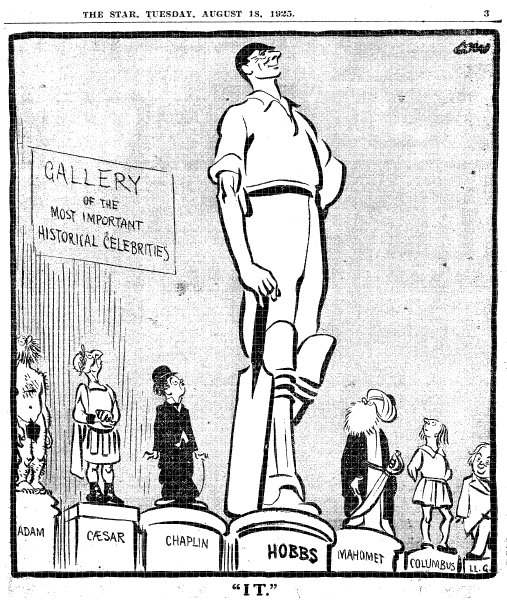
… A ferment of a different sort arose in Britain’s Indian Empire in the wake of Hobbs’s triumph. On the day that Hobbs beat Grace’s record, the Star published a cartoon by the brilliant New Zealand-born illustrator David Low, later to be renowned for his savage depictions of the European dictators of the 1930s. This 1925 cartoon, which perfectly captured the Hobbs mania that had gripped Britain, showed the Surrey player, bat in hand, towering over a series of other historical figures, including Columbus, Lloyd George, Caesar and Charlie Chaplin. Fatefully, Low also inserted in the line-up the Prophet Muhammad, standing on a pedestal and gazing up at Hobbs. When the image appeared in the Indian papers, it caused fury in the Muslim population, not just because Islam regards any portrayal of the Prophet as sacrilegious, but also because Muhammad was placed in a position of inferiority to a mere cricketer. According to the Calcutta correspondent of the Morning Post, the Hobbs cartoon ‘convulsed many Muslims in speechless rage. Meetings were held and resolutions were passed.’ So serious was the problem that the Indian Viceroy, the Marquess of Reading, wrote to the Cabinet in London to convey the feelings of Muslim outrage.
I note with approval that the internet allows us to see what all this fury was about:
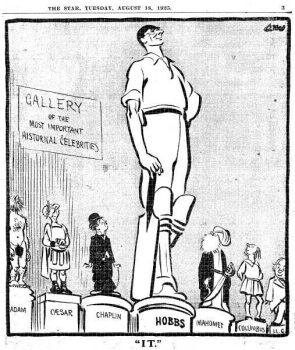
Google quickly showed me this cartoon reproduction, which is apparently to be found at the Mohammed Image Archive. There are many other depictions of Mohammed (that being the third version in this posting alone of how this personage is spelt) on view at the other end of that link, but I could not find the above cartoon, although presumably it is there somewhere.
Nor have I been able to determine whether Indian Muslims issued any death threats, against David Low or against anyone connected to or working for The Star. From the reference to “meetings and resolutions” I get the impression: not, or the death threats would have got a mention also. But I would love to know.
Because they’re thinking about it the wrong way, says Anand Menon in the Guardian.
There are moments in life when your heart sinks. I had one last night, right at the start of my terrifying debut on Question Time. Isabel Oakeshott had just said we should leave the EU with no deal. And the audience cheered. Not a subdued, start-of-the-evening, not-quite-warmed-up cheer. But a roar. A loud one.
Professor Menon goes on to give his reasons. They are quite well expressed, and it is good to be aware of opinions contrary to ones own, so I do urge the generally Leave-supporting readers here to take a look.
Now, having said that, will I get away with pretending that my main reason for posting this was something other than the fact that the moment he’s talking about during last night’s Question Time put an enormous silly grin all over my face?
(Hat tip to Guido for the video clip.)
Edit: Take a look at the comments to that Guardian piece in order of numbers of recommends. As I said, Professor Menon himself seems well meaning, but many of the most popular comments talk of their fellow citizens as a Victorian “Nordicist” would speak of the Andaman Islanders:
The Brexit mindset is anti-intellectual – the Brexiteer is proud of their ignorance.
Reasoning with them is useless.
A case in point, Brexiteers (and yes, I am generalising here) claim to be anti-elitist yet put their trust in Boris, Farage and Rees Mogg – the epitome of privilege and elitism.
Think I’m being rude? Good.
That was from someone calling themselves “stinky”. As I write this that comment had received 126 upvotes. There are times when I think I should give in to the Guardian‘s constant begging and give them some money, just to ensure that as many people as possible read these comment threads. As the next comment says, “When people ask me why they should support Leave, I tell them to read the comments on a Brexit CiF article.” Lord knows the British electorate has some wrongheaded views, but it has shown before now that it instinctively knows one of the great truths of politics: that it is unwise to place yourself in the power of those who despise you.
The Telegraph has a scoop. This might not go down too well in the working class areas:
Exclusive: Philip Hammond tells business chiefs MPs will stop no-deal Brexit
Philip Hammond told business leaders that the “threat” of a no-deal Brexit could be taken “off the table” within days and potentially lead to Article 50 “rescinded”, a leaked recording of a conference call reveals.
The Chancellor set out how a backbench Bill could effectively be used to stop any prospect of no deal. He suggested that ministers may even back the plan when asked for an “assurance” by the head of Tesco that the Government would not oppose the motion.
He claimed next week’s Bill, which could force the Government to extend Article 50, was likely to win support and act as the “ultimate backstop” against a no-deal Brexit, as a “large majority in the Commons is opposed to no deal under any circumstances”.
A recording of the call, passed to The Daily Telegraph, recounts how the Chancellor, Greg Clark, the Business Secretary, and Stephen Barclay, the Brexit Secretary, spent nearly an hour talking to the leaders of 330 leading firms.
They included the heads of Siemens, Amazon, Scottish Power, Tesco and BP, all of whom warned against no deal.
The disclosure reveals the close nature of the relationship between the Treasury and some of Britain’s biggest businesses, and how they appear to be working in tandem to block a hard Brexit. It will also add to suspicions that Mr Hammond has been orchestrating attempts to soften Brexit.
Mr Hammond assured the business leaders that the Government would stop spending money on no-deal preparations “as soon as we know we are not going there” and give businesses “a resumption of normal service”.
So the Chancellor of the Exchequer sees himself as serving the heads of Siemens, Amazon, Scottish Power, BP and Tesco, among others. Perhaps I am reading too much into one ill-chosen word, but that is not a good look. If he had not used that word it would still not be a good look. The whole conversation, the whole meeting, reeks of the sort of black-tie cronyism that gives capitalism a bad name.
I think that this is a very revealing Tweet about last night’s House of Commons EU vote, from Lord Deben, formerly John Selwyn Gummer, and not in a good way:
So we leave all decisions to others and remove our major opportunity to influence and to work for a better world. We decide we are indeed just a nation of shopkeepers whose customers and suppliers decide and we obey. That instead of being the driver of the EU. What a come-down!
Lord Deben thinks that “we” were “the driver of the EU”, to which I would say that this “we” was only … a very few of us, and that also other EUropeans did quite a bit of driving. And, Lord Deben thinks that the best way to “influence and work for a better world” is to do politics, and EU politics at that.
Does Lord Deben think that Britain leaving the EU is not going to have any “influence” upon the world? I put it to him, as my trial lawyer ancestors would say, that this will have a big influence, provided only that it does happen. Just not the sort of influence that Lord Deben will like. It’s a lot to hope for, but I really do hope that Lord Deben is, approximately speaking, right about the sort of nation that Britain will become. Although, I can’t remember ever having “obeyed” a shopkeeper, unless they were the kind that collaborate with people like Lord Deben to restrict me in what I can buy.
When I think of the good that has been done for the world by inventors and entrepreneurs, and yes, shopkeepers, I think that Lord Deben’s is a very restricted view of the world and its possibilities.
As described by Paul Canning in “Venezuela: the Left’s giant forgetting”, Jeremy Corbyn prudently deleted a slew of pro-Chavez and Maduro content from his website in 2016. The same pattern was followed by others on the Shadow Front Bench who had once described themselves passionate defenders of the Venezuelan Revolution but who have now rediscovered the advice their mothers gave them about how if you can’t say anything nice, say nothing.
However one of Mr Corbyn’s most devoted allies, Chris Williamson MP, still has nice things to say about the Maduro regime. I must praise him for his rare honesty – the “Deleted by the PC media” tag this post bears applies to his leader, but not to him.
The Spectator‘s “Steerpike” writes,
Chris Williamson on the joys of Venezuela
Venezuela is a country in crisis: inflation hit one million per cent last year and GDP has plummeted by half since 2013. Those who dare stand up to president Nicolás Maduro risk finding themselves locked up – or worse. Many have opted to leave: three million migrants and refugees have fled the country in the last few years. But ever the optimist about the joys of socialism, Labour MP Chris Williamson has managed to find some good news about Venezuela – the country’s social housing programme is ‘on track
Here’s the tweet itself.
As lose it she will, the only question is by how much. The Guardian reports,
May faces crushing Brexit defeat despite last-minute plea to MPs
Theresa May appears to be on course for a crushing defeat in the House of Commons as Britain’s bitterly divided MPs prepare to give their verdict on her Brexit deal in the “meaningful vote” on Tuesday.
With Downing Street all but resigned to losing by a significant margin, Guardian analysis pointed to a majority of more than 200 MPs against the prime minister.
Labour sources said that unless May made major unexpected concessions, any substantial margin against her would lead Jeremy Corbyn to call for a vote of no confidence in the government – perhaps as soon as Tuesday night. But since Conservative MPs are unlikely to offer Corbyn the backing he would need to win a no-confidence vote, he would then come under intense pressure to swing Labour’s weight behind a second referendum.
As usual in these prediction threads, I am not asking what you think should happen, I am asking what you think will happen.
Edit 15/01/19: May lost by even more than expected, 202-432. Jeremy Corbyn has tabled a motion of no confidence in the government, to be voted on tomorrow. May will survive it. Vince Cable says the defeat is beyond what anyone imagined and it is the beginning of the end of Brexit. Boris Johnson says the result gives Theresa May a “massive mandate” to go back to Brussels. In other words everyone says that what happened today proves whatever they were saying yesterday.
I have finally got around to reading this notable blog posting by Dominic Cummings. I recently watched the Channel 4 DocuDrama about Brexit. This was fun to watch, but if you are a Brexiter like me, you might also want to read this denunciation of it. Upshot: I wanted to know what Cummings himself had to say.
And one of the things Cummings says, right near the beginning (this being as far as I’ve got so far) might well serve as the rationale for political blogging generally, and for Samizdata in particular:
I’ve learned over the years that ‘rational discussion’ accomplishes almost nothing in politics, particularly with people better educated than average. Most educated people are not set up to listen or change their minds about politics, however sensible they are in other fields. But I have also learned that when you say or write something, although it has roughly zero effect on powerful/prestigious people or the immediate course of any ‘debate’, you are throwing seeds into a wind and are often happily surprised.
It’s actually not complicated. People read things like Samizdata when they are making up their minds, or because they have made up their minds that Samizdata is right and like reading about how right they are. They make up their minds as intelligently as they can, but when they have made up their minds, their intelligence is then almost entirely applied to acting in accordance with whatever political principles they have made up their minds to follow, rather than in listening seriously to anyone who wants to explain why these principles are mistaken. Critics are only attended to in order themselves to be criticised.
The logic of socialism is to look at someone in a wheelchair and punish the able-bodied by breaking their legs.
– The Academic Agent, talking about The Problem with the BBC. The whole thing lasts just under ten minutes, and that little nugget comes about a minute before the end.
Thank you Instapundit.
|
Who Are We? The Samizdata people are a bunch of sinister and heavily armed globalist illuminati who seek to infect the entire world with the values of personal liberty and several property. Amongst our many crimes is a sense of humour and the intermittent use of British spelling.
We are also a varied group made up of social individualists, classical liberals, whigs, libertarians, extropians, futurists, ‘Porcupines’, Karl Popper fetishists, recovering neo-conservatives, crazed Ayn Rand worshipers, over-caffeinated Virginia Postrel devotees, witty Frédéric Bastiat wannabes, cypherpunks, minarchists, kritarchists and wild-eyed anarcho-capitalists from Britain, North America, Australia and Europe.
|





Recent Comments