We are developing the social individualist meta-context for the future. From the very serious to the extremely frivolous... lets see what is on the mind of the Samizdata people.
Samizdata, derived from Samizdat /n. - a system of clandestine publication of banned literature in the USSR [Russ.,= self-publishing house]
|
I picked up this story from James Taranto’s daily email newsletter:
A roadside bomb containing sarin nerve agent exploded near a U.S. military convoy, the U.S. military said Monday. Two people were treated for “minor exposure,” but no serious injuries were reported.
“The Iraqi Survey Group confirmed today that a 155-millimeter artillery round containing sarin nerve agent had been found,” said Brig. Gen. Mark Kimmitt, the chief military spokesman in Iraq. “The round had been rigged as an IED (improvised explosive device) which was discovered by a U.S. force convoy.
“A detonation occurred before the IED could be rendered inoperable. This produced a very small dispersal of agent,” he said.
Interesting. Our enemies are attacking us with those nasty nonexistant weapons.
I will be watching the network News tonight to see if something as inconsequential as the use of nerve gas against American troops gets mentioned. There are, after all, really important stories running: like the life story of a young American dominatrix and how she found fame in an Iraqi prison…
Members of the Iranian student dissident organization, SMCCDI, protested at a May 15th UCLA talk by Shirin Ebadi. According to their press release (no URL supplied):
Tens of Iranian activists protested, yesterday, against Shirin Ebadi’s presence at the UCLA and her controversial stands in line with the Islamic regime’s so-called “reformist” faction and foreign policy.
Protesters distributed templates and tracts while shouting slogans against Ebadi and in condemnation of the Islamic regime’s persistent rights abuses outside the conference room. In addition, several of them were able to introduced themselves in the closed door meeting and to shout slogans and questions to which an embarrassed and interrupted Ebadi did not respond. These questions were mainly focused on the evil nature of the Islamic regime and it’s repressive policies or asking from Ebadi to respond clearly if she’s rejecting the rights abuse in Iran.
Each time the security forces rushed to oust out the protesters and also those who deployed tissue banners denouncing the Islamic republic’s crimes. Several opponents were brutalized by young naive Iranians supporting Ebadi and who are blinded by her Iranian adjective. An Iranian woman activist was reported as agressed by Kazem Alamdari, one of the speech organizers who does frequent travel to Iran and who has obtained the authorization from the repressive Islamic regime to publish his books in Iran. The latter and his wife Nayere Tohidi, both UCLA professors, were in their younger age part of a Marxist guerilla group involved in several murders and which contributed to the victory of the Islamic revolution.
If a member of SMCCDI could supply me with a URL for the full press release, I would be happy to link to it.
Jeannie Fiona Macauley reports the information can be found here.
Guy Herbert wrote in with this strangeness a while ago, but for some reason it was trapped by the overzealous Samizdata.net spam filters, only to be discovered today. Better late than never!
This is a very strange story, given the British authorities’ current obsession with illegal immigration. Three Albanian men have been arrested for trying to leave Britain and others charged with trying to help them. What’s really strange is that it is heavily implied by police that the men were illegally present in the country, but there’s no suggestion yet that they are fugitives from the law for any other reason. So what on earth is the point of trying to keep them here? Is it that self-deportation shows up the Immigration Service’s incompetence in that department?
Britons are now inured to (the entirely extra-legal) requirement to show a passport before being permitted to travel abroad on planes, trains, and ferries. That causes no outrage, and I confidently predict this arrest will not either. But it should.
If one may not leave nor enter the country without government permission – which is what these arrests imply – then we are already living in a (rather large) open prison, even before everyone is numbered and tagged.
Guy Herbert
Sean Gabb, who has been involved in libertarian circles for many years, will be well known to many readers of this blog. His personal website and his Free Life Commentary are always a cracking good read, even if one disagrees with some of what he says. Sean has never allowed his fierce passions thus far to break elementary good manners, as far as I can tell, until now.
Mr Gabb opposes the Coalition powers’ overthrow of Saddam and his regime, which he deemed as essentially harmless to Britain and the West, and considers the venture of seeking to transform that injured nation into some form of pluralist, liberal haven to be an act of folly. The plight of the people living in Iraq under Saddam, while obviously awful, was not deemed by Sean to be reason for overthrowing Saddam’s vile rule. Fair enough. A lot of people whom I hold in esteem share that view – mistaken though I think such ‘realists’ to be. But by now the arguments on both sides are well known and I will not go into them again.
What I really dislike about so much anti-war commentary to date has been in many cases its pompous anti-Americanism, a sort of drawn-out sneer. The likes of Times journalist Matthew Parris and Sir Max Hastings are particularly egregious sinners in this respect. Well, in his latest commentary, Mr Gabb comes out with a paragraph of breathtaking rudeness at the expense of Americans and their country, of the sort that might possibly give even those gentlemen a moments pause:
It is, I admit, inappropriate to ascribe one state of mind to a nation of more than 250 million people. But Americans remind me increasingly of someone from the lower classes who has come into money, and now is sat in the Ritz Hotel, terrified the other diners are laughing at him every time he looks down at his knives and forks. I suppose it is because so many of them are drawn from second and even third rate nationalities. The Americans of English and Scotch extraction took their values and their laws across the Atlantic and spread out over half an immense continent, creating a great nation as they went. They were then joined by millions of paupers from elsewhere who learnt a version of the English language and a few facts about their new country, but who never withheld from their offspring any sense of their own inferiority. The result is a combination of overwhelming power and the moral insight of a tree frog.
The reference to ‘paupers’ who ‘never withheld from their offspring any sense of their own inferiority’ is particularly vile. Some of the people who have made their home in the relative freedom and prosperity of America did so by successfully fleeing despotisms similar to Iraq.
I have known Sean for such a long time and enjoyed talking to him down the years that it would seem churlish to get too outraged at something like this. But it would be dishonest of me not to record my disgust at what was a particularly oafish piece of writing, all the less forgiveable for coming from one of the finest writers I know.
Free market people should not be depressed by the result of the Indian general election. The BJP government borrowed money hand over fist (India has a large government deficit) and spent the money on government road building projects and other such.
Of course the new Congress Party government (plus its socialist allies) is not going to be any better – but that is democracy.
If anyone knows of any government (democratic or undemocratic) that is cutting government spending I would be pleased to hear of it.
After taking in a movie in Times Square a few days ago, I was suddenly struck by a desire for that most classic of New York City cuisine: the hot dog. I had visions of a fat, juicy frank, smothered in cheese and dripping chilli. I was near drooling at the thought. New York, Coney Island, Baseball, Times Square, Hot Dogs. They are stream of consciousness free associations central to Gotham; icons of the Apple, core Americana.
One can argue whether this was caused by subliminal advertisements placed in ‘Troy’ by evil global fast food capitalists. Or perhaps it was the recent cable TV ad for ‘Girthy’ hotdogs starring a beer bellied, back yard barbecuing, flag saluting All American character named Frank. Regardless of the source of this sudden desire there was but one problem.
I could not find any. → Continue reading: Where have all the hotdogs gone?
British troops have been closing to bayonet range in fights against company sized units of Islamist militiamen in Iraq:
Scottish troops fixed bayonets and fought hand to hand with a Shi’ite militia in southern Iraq in one of their fiercest clashes since the war was declared more than a year ago, it was reported last night. Soldiers from the Argyll and Sutherland Highlanders mounted what were described as “classic infantry assaults” on firing and mortar positions held by more than 100 fighters loyal to the outlawed cleric Moqtada al-Sadr, according to military sources.
And in support of Britian’s soldiers, some Members of Parliament have called not for rapid reinforcement to be sent but rather for a vote to decide if the Blair government should send any additional troops at all.
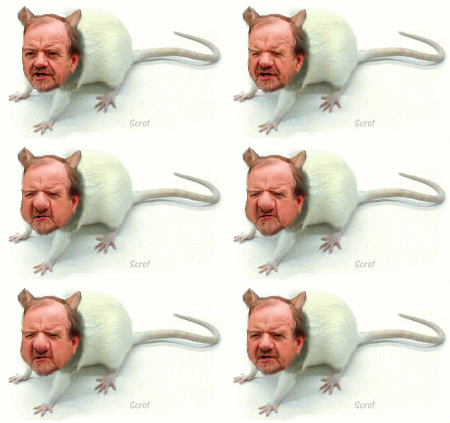
It is one thing to oppose British involvement in Iraq in its entirety, it is quite another for politicos to take positions which places UK forces in danger by denying them support without having the courage to just come out and say that Britain forces should just be ordered back to the UK in order to allow Tony Blair to be deposed by more suitably leftward statists. It is unedifying to see the likes of Robin Cook playing political games in Westminster when people are fixing bayonets in Basra and calling for support.
Either support and reinforce the army or (bizarrely) declare defeat and withdraw them.
Never get between a dog and his favourite lamp post
– Unknown
Once upon a time, I read an article in the Financial Times, which used the slightly peculiar phrase “resigned voluntarily” about six times in the article. Essentially, some CEO had in fact actually decided to leave his job in order to spend more time with his family genuinely of his own accord, and this was such a remarkable thing that the FT felt the need to explain over and over that he had not “resigned” in the usual way (ie been sacked).
A case in point today. Piers Morgan, the editor of the Daily Mirror, ceased to be the editor of the Daily Mirror. The Sun reports that he “resigned” upon the photographs that the Mirror had published purporting to show abusive treatment of Iraqi prisoners by British soldiers being proved to be forged. The Mirror itself reports that Morgan “resigned”. The media section of the Guardian reports the truth: that Morgan refused to apologise in any way to anybody, and upon making this refusal clear to Trinity Mirror’s chief executive, Sly Bailey, he was escorted out of the building by security. Given the dreadful way in which the Queen’s Lancashire Regiment and the British army in general have been libeled in these circumstances, it would have been nice to have been there to cheer the security guards on yesterday. In any event, some of the Samizdatistas did get a certain amount of pleasure out of it later.
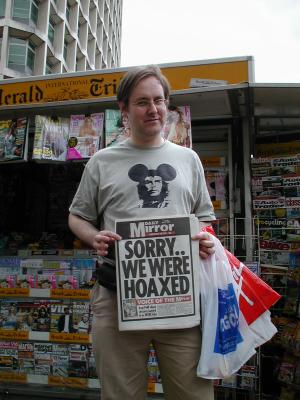
I particularly like the way the Mirror has the words “Newspaper of the Year” above the banner headline.
And as another observation, the Chairman and Director-General of the BBC and the editor of the Mirror have now all lost their jobs due to their organisations essentially lying in order to make their case of opposition to the Iraq war. It really is not impressive on their part.
A shame we can’t get the editor of the Guardian as well though.
With all the coverage and uproar about the images of American troops, there is probably not much attention spared for the pictures of British troops also accused of abusing Iraqi prisoners/captured. The difference is that the British ones were faked and the saga that started with their appearance in the Daily Mirror with headline ‘Vile’ has come to a climax with the sacking of the editor of the strongly ‘anti-war’ newspaper, Piers Morgan.
The Army has made a forceful rebuttal of the accusations and demonstrated why it was convinced that the Daily Mirror photographs were fakes. The arguments focused on four items – the weapons the soldiers were carrying while ‘abusing’ the Iraqi prisoner, the vehicle in which the alleged assault was supposed to happen, the soldiers’ appearance in the photos i.e. wrong hat, no watch and no tan and the t-shirt worn by the captured.
Our own source listed the ‘things wrong with the photos’ before the published Army rebuttal. It pretty much covers the same points plus a few incidental details I thought you might find interesting.
- The most importanty reasons – it’s too clean. Everything in Iraq was covered in dust and shit. Everything in these pictures is clean- the soldiers, the ‘prisoner’, the truck itself. The uniforms look freshly pressed, let alone washed (after being on patrol..?) Same for the ‘prisoners’. Squaddies have been patrolling the streets, climbed in the back of this truck, and there’s not a mark of dust or mud anywhere? Or was the truck specially cleaned so they would have clean enviroment to beat someone up in? Impossible.
- No one’s sweating. It’s 40+ degrees, the soldiers are beating a guy up, he’s being beaten up, and no one is sweating. Impossible.
- This guy is being beaten almost to death. There’s not a single mark on him. Impossible.
- The truck is a Bedford. We had very few DAF’s in Iraq and all were used by the stores department. Troops on patrol used Saxon APC’s or Landrovers. Try to drive a 8 ft wide truck down the back alleys of Basra catching looters. No way.
- Those photos are way too good. There are enough photo nuts at Samizdata they should know that. [ed. no need to abuse our contributors…] Squaddies in the back of a truck taking crystal clear pictures, with no bad shadaw or anything else? Compare to the US photos that are grainy and blurred in places.
- There’s not a single identifying mark on teh soldiers. No tattoos, no watches, no rings, nothing. And nothing to identify their Regiment or unit either. What’s the point of a ‘trophy photo’ if you can’t prove your in it? You might hide your face, but you would wear something you can point at to prove to your mates that it is you. They won’t believe you otherwise.
- There’s no movemnet. There’s no blurring, so unless they are using expensive, super high speedcameras (on patrol? In Basra?) there is no movement. And if the guy in the floor is being hit, or has been hit, I’m Dutch [ed. no he isn’t Dutch, we can vouch for that.]. I have been hit – you automatically curl up and away and try to protect your head, you just do no lie there stretched out.
- Since when do sqauddies take happy snaps in black and white?
- The rifles. No slings on them (no way do yoiu take your sling off in Basra- someone might grab your rifle) and where did they put them? They look like A1s, though hard to tell. The Mirror’s source claims they were A3s, which will come as news to the manufacturer, let alone to everyone else.
- The kit. They aren’t in proper patrol order, the pouches are not only undone they look mostly empty, and there is no sign of body armour, helmets, or the “platypus” water bags everyone carried. Nor is anyone wearing sweat rags, shamaghs, or anything else. Never saw a squaddy look like that on patrol.
- The hats. Guys did have soft hats like that, were not supposed to wear them on patrol, it was berets or helmets according to the threat. But even suppose they were wearing the hats – they are wearing the hats whilst beating a guy up?! Put on a soft hat, then start moving furniture around your house. See how long you leave the hat on. But very convenient, if you need to wear non-unit specific but obvious “desert” clothes for a nice picture for the Mirror…
- The T-shirt. There were guys wearing T-shirts like that, but not many – it would have been a bit sensitive. It could have been worn by a looter – but mostly bloody convenient, only if you want to show a picture of an ‘Iraqi being beaten up’.
Red Herrings:
- The way the boots are laced. It is wrong, but maybe that guy just laced his different, no one cared that much as we had bigger fish to fry.
- Iraqi looks pale. Many do under their clothes.
- Hessian hoods. Those hoods were used to blindfold prisoners on capture, and to prevent them escaping – though not normally for looters but for higher importance/risk deliberate captures.
The really big point here is what the hell happened to Innocent until Proven Guilty? The Mirror is arguing it is up to us to prove the pictures are false.
Quite. Fortunately, the Army did conclusively prove the pictures were faked, the Mirror admitted they were a hoax, fired the editor and apologised (not unreservedly though). However, the damage done to the morale and reputation of the soldiers and the regiment subjected to such horrendous accusations cannot be easily undone…
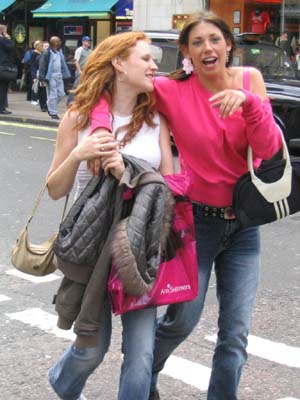
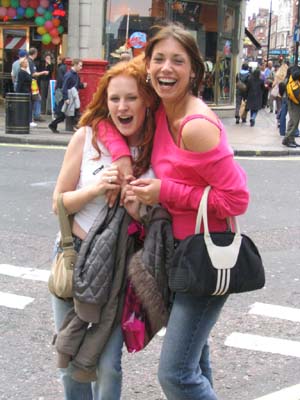
Some people do not like having their photos taken by strange strangers… but some love it! These two for example, having a day out in London by the look of it, thoroughly enjoying it, enjoying London and enjoying themselves, and in a state of… mutual support. I took photo number one.
And they said: Oooh! Are you doing us?! Do another one!! So I did.
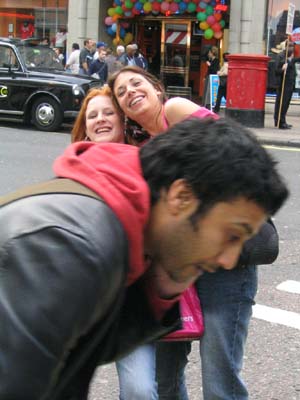
… and captured another of those characteristic Photography Moments. In the background: the objects of my attention, while in the foreground another Londoner hurries past. Like most people in London he has a purpose. He is going somewhere. He is in too much of a hurry to actually stop, but he is as polite as he can be without seriously interrupting his business and he does not want to get in the way of my business if he can avoid this, so he ducks as he passes. And for once, I get it all: him hurrying and out of focus, and the ladies in focus behind him.
But, one more, eh ladies? And that one comes out okay too. Sometimes everything clicks. Three out of three. This is not my usual hit rate, I can tell you.
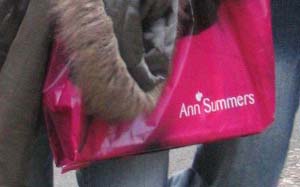
These photos are even more entertaining if you look more closely at the label on the red bag:
All hail to the marginal cost (zero – near enough) of digital photography.
On May 13th, Mike Melville piloted Scaled Composites SpaceShipOne to an altitude of 40 miles. At 50 miles a USAF pilot would be granted their Astronaut Wings. The Federation Aeronautique International (FAI) defines the boundary of space as 100 kilometers, just over 62 miles.
Here is the Scaled Composites flight report:
Objectives: The third powered flight of SpaceShipOne. 55 seconds motor burn time. Handling qualities during boost and performance verification. Reaction control system use for reorientation to entry attitude. Supersonic feather stability and control.
Results: Launch conditions were 46,000 feet and 120 knots. Motor light off occurred 10 seconds after release and the vehicle boosted smoothly to 150,000 feet and Mach 2.5. Subsequent coast to apogee of 211,400 feet. During a portion of the boost, the flight director display was inoperative, however the pilot continued the planned trajectory referencing the external horizon. Reaction control authority was as predicted and the vehicle recovered in feather experiencing 1.9M and 3.5G’s. Feather oscillations were actively damped by the pilot and the wing was de-feathered starting at 55,000 feet. The onboard avionics was re-booted and a smooth and uneventful landing made to Mojave.
The previous test flight on April 8 reached just under 20 miles. It seems certain they will cross the 50 miles ‘astronaut’ threshold sometime in June unless detailed examination of test data or post-flight inspection of the vehicle turn up a serious problem.
Given the progress of the current test campaign, I expect the the FAI altitude will be reached no later than July: sooner if test results and vehicle condition allow it. In the best case they will cross both altitude thresholds in June and will make the Ansari Prize (X-Prize) winning flights in July or August:
The ANSARI X PRIZE is a $10,000,000 prize to jumpstart the space tourism industry through competition between the most talented entrepreneurs and rocket experts in the world. The $10 Million cash prize will be awarded to the first team that:
- Privately finances, builds & launches a spaceship, able to carry three people to 100 kilometers (62.5 miles)
- Returns safely to Earth
- Repeats the launch with the same ship within 2 weeks
I believe they will make at least one flight over 62 miles on July 20th, the 35th anniversary of the Apollo 11 landing on the moon.
|
Who Are We? The Samizdata people are a bunch of sinister and heavily armed globalist illuminati who seek to infect the entire world with the values of personal liberty and several property. Amongst our many crimes is a sense of humour and the intermittent use of British spelling.
We are also a varied group made up of social individualists, classical liberals, whigs, libertarians, extropians, futurists, ‘Porcupines’, Karl Popper fetishists, recovering neo-conservatives, crazed Ayn Rand worshipers, over-caffeinated Virginia Postrel devotees, witty Frédéric Bastiat wannabes, cypherpunks, minarchists, kritarchists and wild-eyed anarcho-capitalists from Britain, North America, Australia and Europe.
|





Recent Comments