We are developing the social individualist meta-context for the future. From the very serious to the extremely frivolous... lets see what is on the mind of the Samizdata people.
Samizdata, derived from Samizdat /n. - a system of clandestine publication of banned literature in the USSR [Russ.,= self-publishing house]
|
Greg Allison claims this title because instead of finding junked cars hidden in the back yard grass when he mows, he finds rockets. If you ever wondered what happened to the wreckage of the DCX rocket, now you know. Its remnants have been serving as a parts source for Alabama space entrepreneurs.
Here is what the stripped spaceframe looked like as of a few days ago.
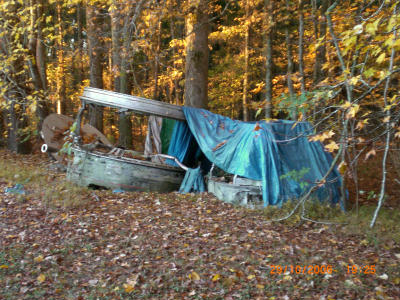
The DCX rests in pieces. Photo: Courtesy Greg AllisonIt kinda reminds me of ‘The Rolling Stones’. No, not the band… the Heinlein novel!
[I]f they have got drug dealers living in the street, you know, love is not the answer to that I am afraid, evicting them from their houses and locking them up is the answer.
– The Right Honourable Tony Blair MP, at his monthly press conference yesterday (At least the cleaned-up transcript from No.10.).
Lobby correspondents are united in thinking the Prime Minister was belligerent and bad tempered about everything. Has he finally gone completely round the bend? The people he wants to evict and lock-up are implicitly those suspected of being Bad People. The rest of the conference made clear he is not interested in due process, civil liberties, all that old-fashioned nonsense.
Take my advice, never trust a politician. When a politician tells you they are going to look after your child’s education, it’s perhaps time to go private – or even to home educate. When a politician tells you they are going to ban guns – expect vast increases in gun crime. When a politician tells you they are going to ban dangerous drugs – watch out for your community being awash with these substances. My heart sinks when politicians get involved in anything. Invariably, they promise the earth, coercively tax you out of your hard earned money, and then they deliver bugger all when you really need the service.
– Helen Evans in the Nurses for Reform blog today (I thought it might liven up)
Today I received, from the Globalisation Institute, a press release, which began as follows:
Monday 6 November – A new report released today by the Globalisation Institute says that microfinance is not being taken seriously by the Department for International Development.
In October, it was announced that the Nobel Peace Prize would go to the founding father of microfinance, Dr Muhammad Yunus, who created the Grameen Bank in Bangladesh. However, microfinance remains tiny in Africa and receives scant support or encouragement from DFID.
Okay, cards on the table. I am a big fan of the Globalisation Institute and of its bosses Alex Singleton and Tom Clougherty. I write quite frequently for the Globalisation Institute blog, my latest posting there, about mobile phones (which makes much of a comment at my blog by Michael Jennings on the subject), having gone up there only last Friday. Tonight, I am attending a Globalisation Institute do, to which I have been invited so that I can take photos. David Cameron will be present, and they want to be sure that his presence there is immortalised pictorially, so that they can blog about it and impress their many donors with their political plugged-in-ness. Very sensible.
But… and you could hear that word coming a mile off couldn’t you?… I have severe doubts about these latest pronouncements of theirs. → Continue reading: Memo to DFID – please do not take microfinance seriously
If there is one thing that statists of all parties hate, it is being ignored. They cannot abide the idea that there could be a solution to any problem anywhere that does not involve the state and its force backed regulations.
And so the Charities Commission is to have its powers vastly increased so that the state, and only the state, gets to say what is a Charity and what constitutes a ‘public benefit’. Not only can the state decide who gets preferential tax treatment, soon it’s bureaucrats will be able to test for ‘public interest’ according to their own judgement and if they are not satisfied…
…the Commission will declare the organisation no longer a charity. And then, under the new Bill, its endowments can be seized and given to a charity of whose aims the bureaucrats do approve.
The fascist approach has clearly won out over the old socialist approach of simple ‘nationalisation’. In the fascist way of doing thing, individuals and companies and indeed ‘private’ charities could remain in ‘ownership’ of the means of production, but only if they actually used them in accordance with the government’s national objectives. Clearly this is Britain’s future. You can set up a charity and get endowments from willing people, but if the state decides it disapproves, it will simple take the money are give it to someone more politically correct. Can you imagine a charity in the future saying anything that might displease or embarrass a future British government?
So Saddam Hussain will be hanged… what is there left to say except ‘sic semper tyrannis’?
Ordinary Britons struggling to get on with their lives are being menaced by a small number of bullies who do not care about the rights of their victims. These ‘Tsars’, as they are sometimes known, impose themselves and their lifestyle choices on others with an almost psychopathic disregard for other people’s viewpoints, and regardless of all attempts by police and others to maintain traditional values.
When the Government’s antisocial behaviour tsar was out on patrol with the police on a housing estate last week, she was amazed to find that the officer was handing out sweets rather than enforcing Asbos.
– according to The Independent on Sunday
“Family intervention projects – I really believe this is the approach that will work,” she said. “It ain’t cheap and it also isn’t easy. Basically it’s the end of the road.”
“The priority was to do families, because they have children, first. But we are working on doing something for chaotic adults where the same approach will be taken.”
Ms Casey added she was working with Whitehall to adapt the centres to cater for single people.
She said other measures to tackle anti-social behaviour included plans to extend parenting courses across the country, and powers for imposing compulsory parenting orders.
“If you are not going to take parenting help then we are going to make you take parenting help,” she said.
As the same interview is (puzzlingly) slightly differently reported by the BBC. Anyone would think that the Indy report did not sound tough enough, and was re-spun for presentation to the Beeb.
Alan K. Henderson has some seasonal musing to share on this day, the fifth of November. Warning… contains critique and therefore spoilers for ‘V for Vendetta’
This graphic novel V for Vendetta was first published as a comic book series which began in 1982. Many readers will laugh at author Alan Moore’s second-guessing of future history. In the story, the Thatcher government’s loss in the 1993 elections sets up a Labour government whose unilateral disarmament measures somehow keep Britain on the sidelines during a US-USSR nuclear confrontation. The war is triggered by an un-detailed situation analogous to the Cuban Missile Crisis – and there’s even a Kennedy in the White House (which Kennedy we are not told). Why a non-nuclear Africa gets wasted and a non-nuclear Britain survives is not explained.
The likelihood of the next major event – the rise of the Norsefire party into power – is debatable. Post-holocaust Britain would still have a strong domestic military presence. It would have to be weakened significantly for an insurrection to succeed. The story mentions that there were several insurgent factions; perhaps Norsefire sat back while these multiple rebellions sapped the military of its strength. It is also possible that some of these insurgents drew their membership in part from the military.
The story does accurately portray the function of a Fascist state. The church is nationalized but powerless, serving a mere ceremonial function. Surveillance cameras are everywhere (hey wait a minute, some social democracies are like that…) The government also conducts audio in addition to video espionage against its citizens. Separation of powers between executive, legislators, and judiciary is vastly diminished or non-existent. The economy is planned. Propaganda is pervasive. Citizens are forcibly resettled, and some like Evey are forcibly sent to work in certain industries. Undesirables are deported or incarcerated (and sometimes experimented upon). Policemen are granted latitude to allow certain criminals to ‘disappear’, as in Evey’s case. To formally prosecute her for prostitution makes it a matter of public record that the State is not meeting her economic needs as government propaganda promises.
Enter V… His identity unknown, he is one of the last four survivors of the Larkhill Resettlement Camp, where he was subjected to medical experiments involving hormone injections. having escaped, he now dons a Guy Fawkes costume and is orchestrating a vendetta against the Fascist government.
While Alan Moore himself allows the reader to determine whether or not V’s actions are warranted, many have described V as a morally ambiguous character. Such people are wrong; the direction of his moral compass is crystal clear. → Continue reading: Vendetta vs. Just War
Following on the pubs being leant on to fingerprint their customers and take names and addresses, another egregious example of police and licensing authorities clubbing together to force a business to stop its paying customers behaving in ways officialdom does not approve of.
West Ham are under pressure from Newham Council and the Football Licensing Authority to limit persistent standing inside Upton Park, and several supporters have been banned from attending the next two home games at Upton Park for persistent standing.
Those who have been sent letters informing them of the action, will miss West Ham’s Premiership games against Blackburn and Arsenal on the next two Sundays.
– from VitalFootball.co.uk
“Persistent standing”? I am no soccer fan as I abhor the tribalism of team sports, and it is really, really, dull to watch – almost as dull as horse- or motor-racing. I would not know about this at all but for Duleep Allilrajah’s column on Sp!ked. But is not leaping up and down, along with shouting and singing as part of a crowd, a significant part of football supporting? And unlike cheering and community singing, standing or sitting has no effect on the world outside the stadium. What has it got to do with anyone but the club and its supporters?
Perhaps if I had taken more notice of soccer before now, I would have known of the existence ot the Football Licensing Authority, too. It is a public body created under Thatcher, for those tempted to idealise Britain before Blair. But we should all take notice of it now, because its imperial ambition is charted out on its website, a clear mission to tell everyone involved in doing or watching sport what to do:
In December 1998, following a major review, the Government announced that we would in due course become the Sports Ground Safety Authority. It presented legislation to this effect to Parliament but the 2001 General Election intervened. Ministers are committed to reintroducing it when they can find a place in the Parliamentary timetable.
One small mystery. Why should the Borough of Newham connive at undermining one of the poor borough’s richest sources of trade and employment? Could it be that the bureaucrats who seek such petty restrictions will get paid and pensioned from taxes raised in other places regardless of how blasted into feebleness the people in their care remain? Or are they just getting into practice to discipline the Olympics?
It is often said that Guy Fawkes was the only man to ever enter Parliament with honest intentions…
South Korea finally surrenders to one of the finer features of modernity and legalises the miniskirt!

Legal!
The advances in robotic vehicles due to the DARPA challenge prizes over the last few years has been nothing short of astounding. I am therefor slack-jawed at the congressional stupidity which has brought about this addition to the DARPA Urban Challenge press release:
UPDATED, October 2, 2006: Congress has changed the Secretary of Defense’s authorities and
DARPA no longer has authority to carry out programs to award cash prizes. Therefore, DARPA
has announced that the top three teams to finish the 60-mile Urban Challenge course in less than
six hours will receive trophies rather than cash prizes. Track B participants will not receive
cash prizes for completing qualifying events, but will be eligible to compete for the trophies to be
awarded in the final event. Track A participants will continue to receive up to $1 million in
technology development funds for achieving key technical milestones.
I presume the problem with prizes is anyone from anywhere can enter and win it. This limits the usual opportunities for congressional corruption, or as I like to think of it, “Stevensing” (as in Ted Stevens, the Alaskan Ubercrook).
I do hope some sanity breaks out in the Washington asylum. There are other Grand Challenges going on which have been generating simply amazing results.
|
Who Are We? The Samizdata people are a bunch of sinister and heavily armed globalist illuminati who seek to infect the entire world with the values of personal liberty and several property. Amongst our many crimes is a sense of humour and the intermittent use of British spelling.
We are also a varied group made up of social individualists, classical liberals, whigs, libertarians, extropians, futurists, ‘Porcupines’, Karl Popper fetishists, recovering neo-conservatives, crazed Ayn Rand worshipers, over-caffeinated Virginia Postrel devotees, witty Frédéric Bastiat wannabes, cypherpunks, minarchists, kritarchists and wild-eyed anarcho-capitalists from Britain, North America, Australia and Europe.
|





Recent Comments