We are developing the social individualist meta-context for the future. From the very serious to the extremely frivolous... lets see what is on the mind of the Samizdata people.
Samizdata, derived from Samizdat /n. - a system of clandestine publication of banned literature in the USSR [Russ.,= self-publishing house]
|
Here is an excellent piece of political and cultural commentary, about the excellent TV show South Park and its excellent political and cultural commentary, from Michael Cust.
A brief survey of some of the more salient libertarian episodes bears this out:
Episode 713 takes aim at Hollywood director Rob Reiner and the anti-smoking movement. The movement – and especially Reiner – is portrayed as, and called, fascist, controlling, and deceitful, while big tobacco is portrayed as honest, hardworking, and well-rooted in American history.
In Episode 616 drug war propagandists are labelled “ultra-liberals” who operate on the principle that “the end justifies the means.”
In Episode 614, political correctness is condemned. When the boys (the main characters) refuse to tolerate their intolerable homosexual teacher, their parents take them to the Museum of Tolerance, where tolerance of everyone (except tobacco smokers) is taught. When this fails, the boys are sent to a gulag called “Death Camp of Tolerance,” where they are forced at gunpoint to produce arts and crafts that don’t discriminate along the lines of race and sexual orientation.
In Episode 301, the boys travel to the Costa Rican rainforest as members of an environmentalist choir. While there, they learn how dangerous and deadly the natural world can be – as a snake kills their tour guide and aboriginals kidnap them. Upon their return to civilization, the boys put on a musical performance that admonishes smug first-world environmental activists. (In this episode, Friends star Jennifer Aniston guest stars.)
But this is just scratching the surface of a fruitful and deep social commentary that comes out libertarian on pressing current events. Just about any issue that libertarians hold up as an instance of state excess or market success is portrayed in the show …
All of which is very noble and very true. But what I like about South Park is that it is so damn funny.
What I believe this shows is that “Hollywood” is not nearly as biased against our kinds of opinions as people with our kinds of opinions, who happen to be talentless bores, often claim. It is just that Hollywood is biased against them and against all other talentless bores, for being talentless bores. What Hollywood is biased in favour of, as is often pointed out here – especially by this Samizdatista in these two much admired postings – is making money. If people with our kinds of opinions can help Hollywood to do that, Hollywood will welcome them with open arms.
Hollywood, like Cartman’s mother, is a dirty slut.
Cust also has some interesting and provokingly positive things to say about Michael Moore, and about the fact that South Park‘s Matt Stone contributed (in a good rather than anti-gun way) to Bowling for Columbine.
I do not understand how this works, but it sounds like fun, or at any rate like a ripple of the future:
A band from Germany has adopted a novel approach to getting their music heard by millions.
Super Smart have turned their backs on vinyl and CDs and instead have decided to just release their album as ringtones.
The album, Panda Babies, is published by a German company that focuses on digital music for mobile phones.
So if there’s there is no CD, what does the word “album” mean in this connection? And, if Super Smart are a “band”, what is a Super Smart live gig like? A bunch of Germans waving their portable phones at the audience?
The identity of the four-piece from Munich is shrouded in mystery and in photos they appear with giant panda heads.
“Shrouded in mystery” presumably means that Super Smart is actually one person, and anybody can be a Panda for the photo shoots. The individual, by wearing a uniform, is subordinated to the Greater Whole, dominated by one “Super Smart” individual. Germans eh? – they never change. But I suppose much the same could be said of the Wombles.
I have yet to acquire a mobile phone, so none of this will make any difference to me. But I do have some questions. For example: Can mobile phone music play more than one note at a time, or is it like solo violin music without any double stopping? How long can it go on for? Is any of it any good?
And can I buy a compilation CD of mobile phone Greatest Hits?
Feeling cheerful? Have a read of this:
In a new book, Bare Branches: Security Implications of Asia’s Surplus Male Population (MIT Press), Valerie M. Hudson and Andrea M. den Boer warn that the spread of sex selection is giving rise to a generation of restless young men who will not find mates. History, biology, and sociology all suggest that these “surplus males” will generate high levels of crime and social disorder, the authors say. Even worse, they continue, is the possibility that the governments of India and China will build up huge armies in order to provide a safety valve for the young men’s aggressive energies.
“In 2020 it may seem to China that it would be worth it to have a very bloody battle in which a lot of their young men could die in some glorious cause,” says Ms. Hudson, a professor of political science at Brigham Young University.
With luck, if the two armies do go to war, it will be against each other.
Apart from that, what is the answer? Homosexuality via genetic modification, administered with magic gamma rays beamed in by satellites? Male death, ditto? An immediate plan by someone to test-tube a lot of girls, now? Polyandry? When confronting such a problem we generally find that the answers have a way of mutating into grisly restatements of the problem. How can we avoid …?
In the words of Noel Coward, there are, as always, bad times just around the corner, although that song (recently covered with what appear to be somewhat rehashed words by Robbie Williams) was originally only about places like Kettering (where I believe this Samizdatista lives), Hull and the isle of (because it rhymes with Hull) Mull.
I have not seen The Passion of The Christ, and don’t plan to. A friend of mine told me that after a while The Passion just became boring, and I think that is probably how it would be for me. It is not so much that I am opposed to Christianity (although I am), more that I do not like horror movies, although of course part of the reason I am opposed to Christianity is that the crucifixion parts of it are to me a lot like a horror movie already.
But as a movie phenomenon, The Passion is fascinating. Mel Gibson has made a fortune with this movie not because he was trying to make a fortune, but because he was trying not to. He wanted other people to invest in it. But everyone else thought it would be money down the drain, so they refused. So Gibson invested great gobs of his own money, and now he gets this Niagara of profit. From a film about Jesus Christ. The ironies just pile up.
Hollywood also disapproved of the The Passion on ideological grounds, because an accurate presentation of the Gospels version of the crucifixion sets the Jews up, yet again, as the villains of Western Civilisation. The Gospels, as far as Hollywood is concerned, are anti-Semitic. I agree with Hollywood about this. This is yet another reason why I am not a Christian. But none of that stopped Mel Gibson from doing The Passion. The great thing about the free market is that anyone can join in.
Changing the subject only somewhat, I note that James Lileks today ruminates about why there has not been much in the way of movie making about or around the subject of the 9/11 attacks. Basically, he says, the reason is that Hollywood disapproves of what such movies would have to say. Arabs bad. America good. George W. Bush good. Israel not part of the story. And Hollywood does not believe any of that. So, no 9/11. → Continue reading: Could someone do with 9/11 what Mel Gibson did with the crucifixion?
Arts & Letters Daily links to two articles, both protesting against the absurdities and cruelties of political correctness.
David Mamet writes in the Guardian in connection with the forthcoming London production of his play Oleanna, the central character of which is a young woman who falsely accuses a man of raping her:
The play’s first audience was a group of undergraduates from Brown University. They came to a dress rehearsal. The play ended and I asked the folks what they thought. “Don’t you think it’s politically questionable,” one said, “to have the girl make a false accusation of rape?”
I, in my ignorance, was stunned. I didn’t realise it was my job to be politically acceptable. I’d always thought society employed me to be dramatic; further, I wondered what force had so perverted the young that they would think that increasing political enfranchisement of a group rendered a member of that group incapable of error – in effect, rendered her other-than-human. For if the subject of art is not our maculate, fragile and often pathetic humanity, what is the point of the exercise? And if the writer is capable, why enquire, let alone obsess about his sex? No one ever said of a comedy, “I laughed myself sick until I discovered the sex of the writer.”
But as Theodore Dalrymple makes clear, there are limits to the notion that a woman can do no wrong. If the wrong is done to her by her own ethnic minority, and even in particular by a male member of it (her father), then it is all her fault. → Continue reading: She can do no wrong – but it is all her fault
Living in a seriously totalitarian country is an experience that someone who has never lived in a seriously totalitarian country inevitably finds it extremely hard to imagine accurately. As with today’s religious topic du jour, crucifixion, I can only guess at a tiny fraction of what it must have been like.
As I understand it, each person lives in his little personal, private pod (assuming he gets to live at all, that is). Totalitarianism creates a degree of individualism, if that is the right word, that people in a free country can never experience. This is because you simply cannot afford to allow strangers any glimpse of what is going on in your mind, let alone speak your mind to them. (As for telling the truth to visiting foreigners whom you do not know extremely well – that is absurd.) You can trust nobody out there. Intimate friends whom you do trust, and family of course, are everything in such a world.
Do the true feelings of the people ever express themselves? Well, when the lid is well and truly screwed down, no. But if things do loosen up a little, then there is one kind of event where truth can begin to make itself felt, namely at an artistic event of some kind. → Continue reading: Appassionata
The other night I finally got around to watching the DVD of Love Actually. And I believe that netiquette demands that I now flag up a “spoilers” warning, for all those millions of Samizdata readers who have not see this movie yet but fully intend to, so that these people read no further and have some of the various plots spoiled for them.
I liked it, on the whole, although I preferred Four Weddings, Notting Hill and Bridget Jones’ Diary, all of which I thought were quite special. I will probably have another look at Love Actually some time soon, but my first impression of it is that it was just forgettable fun by comparison. In regular romantic comedies, you have a gorgeous hero and gorgeous heroine, but reality is nodded to in the form of a cast of not so gorgeous other people. Not so in Love Actually. Here almost everyone was gorgeous, and almost everyone was indulging in a happy-ending romance. Which meant that reality could not ever be suspended and you could never, even as a pretend Friday night self deception, forget that this was just made up fantasy entertainment nonsense. And that is not so entertaining.
A further source of non-entertainment, for me, was that, wearing my political glasses, I could not help noticing that Love Actually contained a characteristic type of movie political propaganda. Not for the first time in the movies (and that is putting it very mildly) we were presented with a fantasy version of the President of the United States, and what is more a fantasy version which reflects little credit on either its creators or on the audience at whom it was aimed. → Continue reading: Not the American President actually
Stephen Pollard publishes an honest obituary to British actor Peter Ustinov:
I have tried to fathom how else a man with Ustinov’s record of excusing tyrants and defending tyranny could have been so eulogised. The butchers of Tiananmen Square, Stalin, Milosevic, bin Laden, Saddam: he defended or gave succour to the lot.
There were some people he did want to convict, though: businessmen. “The formation of the committee for the World Criminal Court is very important because there are corporations more powerful than many governments.” Stalin: OK; business: criminal; al-Qaeda and the US: moral equals. Murdering Chinese dissidents: good; removing tyrants: bad. That was the world view of Sir Peter Ustinov, “humanitarian”.
And now for sanitised BBC version:
He worked as an ambassador for charity Unicef, whose executive director Carol Bellamy said: “The children of the world had no greater champion.”
And neither did its despots and thugs.
My friend Bernie emailed me with the link to this short Radio Times film review of The Godfather, shown last night on Channel 5. Spot the anti-capitalist bit.
This crime drama and its 1974 sequel are among American cinema’s finest achievements since the Second World War.
The production problems are well documented — how Paramount wanted a quickie, how Francis Ford Coppola came cheap and how he turned the picture into an epic success, a box-office hit that was also an artistic triumph.
His first masterstroke was casting Marlon Brando, Al Pacino, James Caan, Robert Duvall and Diane Keaton, four relative unknowns and one known risk; his next masterstroke was to keep cool under fire, like Michael Corleone himself, turning Mario Puzo’s pulp novel into art and showing how capitalism and crime go hand in hand.
It’s thrilling, romantic, tense and scary – a five-course meal that leaves you hungry for more.
“… capitalism and crime go hand in hand.” Another of those implied solutions that dare not spell itself out clearly. Wanna get rid of crime? Rub out capitalism. But if thus challenged, the anti-capitalist replies: “but I never said that”. If unchallenged (which is how most readers will get the message), he did say it.
This is why we need our own publications, to edit out sneaky little innuendoes like that, and to insert our own.
It would be truer to say that the legal creation of victimless crimes goes hand in hand with crime, and that the state (a) claiming a universal monopoly in the supply of law and order but then (b) not supplying it anything like universallly goes hand in hand with crime.
Will this get a link from Biased BBC?
One of the great pleasures and advantages of living in Pimlico, in central London, is its proximity to one of the world’s great art galleries, The Tate, a fine classical building looking over the Thames. Recently my girlfriend and I went around two separate exhibitions and had two contrasting experiences not far different in extremes from the North Pole and the Sahara Desert.
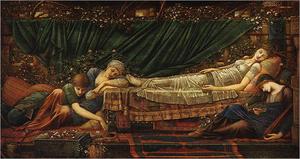
The first exhibition was a display of Pre-Raphaelite art, from that group of talented, romantic and at times eccentric group of artists in the middle of 19th Century England. They took their inspiration, as the word pre-Raphaelite suggests, from the Renaissance artist Raphael. Some of them were intensely religious, while others took a passionate interest in the natural world.
I must say I have mixed reactions to their art. Some of the paintings, particularly the coastal seascapes and the depictions of the Swiss Alps, were stunning. Others, while rendered with incredible attention to detail, left me rather cold. There is something almost rather mannered about this art, as if it was produced by someone trying too hard to impress. On the whole, however, I could not fail to be struck by the descriptive lust of these artists, their desire to convey the world as they saw it and as it could be.
And then, after a slurp of wine – we were at a private viewing – we set off to another part of the Tate for an altogether different experience, namely, a selection of ‘art’ (I will explain the inverted commas a bit later) by some of the world’s newest artists, including the so-called enfant terrible of the Brtitish art establishment, Damien Hirst., and Sarah Lucas, about whom I had not heard before.
Some of the exhibits featured dead animals inside tanks containing fluids, bits of sausages, live fish, a brain, bottles of wine, a bucket, and other bits and pieces I could not readily identify. Two exhibits were models of people undergoing surgery, with nothing showing apart from their genitals. Several large oval-shaped boards were covered with hundreds of dead butterflies. An empty full-size truck cab, plastered in its interior with tabloid newspapers, had a man’s arm pumping up and down in a familiar sexual act. In fact, several exhibits seemed to portray human bodily functions, as if the exhibits had been assembled by a sniggering, slightly conceited 12-year schoolboy trying to shock his elders.
I will not deny Hirst and others like him are folk with a certain talent. They are talented in much the same way that pickpockets can be said to be talented. But to what effect? So much of his art seems to shout, “I am taking the mickey out of you stupid, repressed middle class wankers”……No doubt Hirst thinks he is being ever so clever and subversive, and judging by the large audiences for his work, he probably is. What perhaps is forgotten is that the image of the artist as the mocker of bourgeois sensibilities, far from being daring and new, is in fact very dated, and bang in line with the ethos of the Modern Art establishment. They are the bores of our age.
There you have it. About 150 years from the Pre-Raphaelites, we have gone from the ability to portray nature with passionate concern for accuracy, and an essentially warm embrace of human life, to lumps of meat in tanks, and to images of human beings sitting on the toilet, smoking a cigarette. Perhaps these folk really have caught the meaning of Blair’s Britain, after all.
Addendum: if you are as disgusted as I am by the bogus nature of much modern art, but cannot always put that disgust into words, then I strongly recommend the book, What Art Is, written by Louis Torres and Michelle Marder Kamhi. It unashamedly defends representational art, questions whether certain forms, such as abstract painting, really can pass muster as art, and perhaps controversially, argues that photography does not pass the test. I do not agree with everything in the book but it is well worth the attention.
Jack Vettriano may sound like a Sicilian mobster but, in fact, he is this country’s most popular and successful artist.
Born in Scotland, he started out his working life as a mining engineer before a girlfriend bought him a set of watercolour paints for twenty-first birthday. He taught himself to paint and embarked upon a career as an artist. Today, reproductions and prints of his work massively outsell those of Monet and Van Goch and originals hang in the collections of the wealthy and famous (making Vettriano pretty wealthy and famous himself).

Only the Deepest Red Vettriano’s deeply evokative work is rich in art deco erotica noir: elegant, sexy and (in this day and age) subversive. While many artists use a canvas to tell a story, Vettriano uses his to write a seductive novel full of unambigiously masculine and feminine characters. → Continue reading: He’s alright, Jack
Yesterday evening I was channel hopping by way of relaxation and chanced upon a UKTV History programme about the Cold War, and in particular about the doings and sayings of the rocket scientists. (Here is the UKTV History home page, but I can find no internet reference to this particular programme.)
The programme seemed fairly good, on the whole, but towards the end of it there was one glaring – not to say outrageous – non sequitur. → Continue reading: The UKTV History channel – underestimating Ronald Reagan and his rocket men
|
Who Are We? The Samizdata people are a bunch of sinister and heavily armed globalist illuminati who seek to infect the entire world with the values of personal liberty and several property. Amongst our many crimes is a sense of humour and the intermittent use of British spelling.
We are also a varied group made up of social individualists, classical liberals, whigs, libertarians, extropians, futurists, ‘Porcupines’, Karl Popper fetishists, recovering neo-conservatives, crazed Ayn Rand worshipers, over-caffeinated Virginia Postrel devotees, witty Frédéric Bastiat wannabes, cypherpunks, minarchists, kritarchists and wild-eyed anarcho-capitalists from Britain, North America, Australia and Europe.
|





Recent Comments