There’s more to the world than politics. Politics is a way to have paved streets and cops and firefighters show up when we call 911. It’s nothing more than that.
– Commenter ‘Sunfish’
|
|||||
|
There’s more to the world than politics. Politics is a way to have paved streets and cops and firefighters show up when we call 911. It’s nothing more than that. – Commenter ‘Sunfish’ February 16th, 2007 | 13 comments - (Comments are closed)
 He might well say, man, this is some repugnant shit:
If only Mr. Jackson were here to pop a few caps in a few asses. February 15th, 2007 | 43 comments - (Comments are closed)

As advertised, the seafood is excellent.  The colonial archiecture (and for that matter the relaxed friendliness of the people) is Portuguese. A beer costs about 25p, 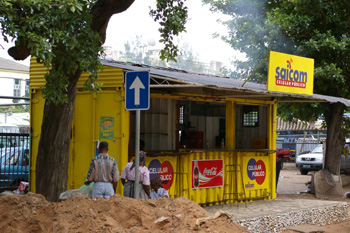
and Brian is right. (Actually, there is a book to be written on why mobile phones and their applications in Africa have evolved differently than mobile phones in the rest of the world, and the biggest things (besides their being so useful) is the lack of legacy. That means legacy in terms of business methods as much as legacy in terms of technology. In Europe and (paritcularly) America, mobile phones networks are run by the same old telecommunications businesses as were traditional phones, and these companies are both terribly bad at retail and figruring out what customers want rather than just telling them what they should want. Plus they are far too busy trying to protect their existing business (including their existing mobille phone businesses) to want to innovate, and sometimes they will actively oppose innovation. Africa is much more a matter of “Try and see what works”, and that really works. But I digress). I was in Johannesburg for a few days before coming here, and while the northern suburbs of that city have all modern amenities and in many ways feel like modern American suburbia around a couple of Edge Cities, every building and business in that city is fortified in a way that is not normal elsehwere. It is a dangerous city, and that influences the way that people go about every moment of their lives. Maputo is not like that. Walking down the street there is no air of threat whatsoever. I feel perfectly safe walking down the street with my digital SLR around my neck and using my iPod, which I certainly would not in Johannesburg. Occasionally people try to sell you things fairly aggressively, but they are simply trying to sell you things.There is no implied threat whatsoever. By the standards of the thirld world this is a very relaxed place. So far I am enjoying it very much. February 15th, 2007 | 10 comments - (Comments are closed)
There has been a lot of talk about ex President Carter getting a ‘grammy’ for the audio verison of his latest it-is-all-the-fault-of-the-Jews book. And certainly he was honoured in the company one might expect. The ‘Dixie Chicks’ were honoured with three awards in spite of their commercial decline (Bush bashing trumps anything else), as was a gentleman whose songs are largely about ‘niggerz’ and his practice of beating up his ‘Ho’. The award ceremony was, as it happens, held on the 28th anniversary of the Iranian Revolution – an event that occurred after then President James Earl Carter sold out the Shah. I wonder how many in the audience noted the irony. However, ex-President Carter is not alone. There seems to be a broader movement in the South (for some time considered generally the most conservative part of the United States) towards something that reminds me of the late 19th and early 20 century Populism. The Populists sometimes operated as a party in their own right, and sometimes as a faction of the Democratic party in the South (after the end of Reconstruction the Republican party virtually ceased to exist in the Southern States – so a lot of politics was between factions of the Democratic party) against conservative ‘Bourbon’ Democrats. The stock in trade of the Populists was hatred of big business, the rich, Roman Catholics and Jews. Ex Senator John Edwards recently got into trouble for having two bloggers on his pay roll who specialized in obscene attacks on (for example) the Virgin Mary. Many were surprised that Mr Edwards did not fire these staffers – but he is no fool, and it not just a matter of fear of revenge from the left of the blogosphere if he did fire them. As long as the attacks can be kept as anti-Catholic as opposed to anti-Christian he may be fine – indeed these attacks may even help him. Although he may be making a mistake, as the principle reason that his staffers hate Roman Catholics is the Catholic position on abortion – a position that many Protestants (and Orthodox Jews and some atheists and others) share. → Continue reading: President Carter and the return of the Southern Populists? February 15th, 2007 | 31 comments - (Comments are closed)
And about time too:
Quite right, I say. This insenstive cultural anachronism is completely outmoded and needs to be consigned to the dustbin of history. In fact, I have taken the liberty of writing a short synopsis of a new, modernised version of the Puccini opera which will more accurately reflect the values of a modern-day audience. → Continue reading: Lepidoptera Grrrl February 14th, 2007 | 18 comments - (Comments are closed)
I have been keeping an eye on the French Presidential race, if only because it is high time perhaps that that great, sometimes infuriating country had the sort of leader who might unleash the entrepreneurial energies that do exist. (Entrepreneur being of course a French word). We like the witty French economics writer Bastiat at this blog and it would be lovely to think that some of his classical liberal spirit might return to that country. Alas, Nicolas Sarkozy, the Gaullist candidate, has already signalled that he is as hostile to capitalism as any Sartre-reading socialist:
Hedge funds, which are investment pools usually registered in sunny Caribbean islands, have become a bugbear for protectionist-minded politicians, who fear the ability of these folk to quickly move in and out of a company’s stock, a currency or bond to make a profit. Hedge funds typically amplify the size of the market positions they take by what is called leverage – borrowing to you and me – and from time to time their bets go badly wrong, as happened during the Russian debt default crisis 9 years ago. On the whole, though, hedge funds make markets more liquid and efficient by increasing the number of buyers and sellers in a market and their arbitrage skills remove inefficiencies in how assets get priced. They also, on a more venal level, generate enormous revenues for financial centres like London and Wall Street. They often put pressure on underperforming company boards to raise their act, which is hardly a bad thing. Like private equity buyout funds, however, hedge funds sound mysterious and a bit dodgy; they prefer to operate in secret and their PR is often awful. For most people, a hedge fund manager is a guy with a slicked haircut shouting into a telephone. The French business culture, despite a few improvements, is overwhelmingly dirigiste, and can ill afford to give the finger to some of the sharpest financial talents around. If Sarkozy wants to market himself as a sort of French proto-Thatcherite, this seems hardly the way to go about it. Bashing speculators is the oldest and one of the grubbiest tricks in the political book. It plays on public ignorance about economics, it plays on envy at great wealth, and panders to the out-dated idea that wealth is only real if you can hit it with a hammer or or dig it out of the ground. Sarkozy should do his underperforming republic a favour and read some Bastiat instead. February 14th, 2007 | 9 comments - (Comments are closed)
One thing that is really bugs me about the guy or at least the Obama phenomenon is that he and his supporters (definitely his supporters) like to make a big deal about every possible racist interpretation that can be put into what his opponents say about him. Yet it is obvious to Blind Freddy that he would not be in the limelight in the first place were it not for the whole race issue. If Obama were white would anyone really give a damned what he said? He’s milking this mixed heritage business for all it’s worth. How much of his book is about his philosophy and how much of it is about converting his personal life story into a heap of ‘we are the world’ cliches?The hype that has been placed on the guy speaks volumes for the ridiculousness of the media’s patronising attitudes on race. Is there any evidence that he is any much smarter than the average politician? Any wiser or more intellectual? Does anyone know what he stands for besides banal platitudes and a trendy populism? – Jason Soon of Catallaxy enunciates what I suspect a number of Samizdata readers and contributors are thinking about Barack Obama. February 14th, 2007 | 18 comments - (Comments are closed)
If you think that lower class yobbery is a problem in this country, as most seem to think it is, then is electing an upper class yob to be the Prime Minister the best next step in the right direction? Perhaps it is. Perhaps a man who can look louts in the eye and say: “I know exactly what you are because I used to be exactly like you, the only difference being that I at least paid some of the bills for the havoc and misery I caused, and, being rich and lucky, I had the chance to learn a few manners, turn over a new leaf, get a job and make something of myself. You are not so lucky. Shape up now or face a future of utter misery, which I and my rich and well-connected friends will now do our considerable best to make worse for you.” It takes one to catch one, in other words. And perhaps something similar applies to dealing with foreign despots and thugs. As with everything involving what sort of Prime Minister Mr Cameron may choose to be, we shall just have to wait and see. Meanwhile, the fact that he is now thought by millions to be the best we can now do as our nation’s senior politician is hideous proof of the failure of mass state education. Could not the great middle/working class come up with anybody? Well, John Major I suppose, and now Gordon Brown. As a long lost friend from my better-spent youth used to say: Dear oh lor! My thanks to Clive Davis, who writes about Cameron’s Bullingdon Club past, and who links to this description of Bullingdon Club yobbery by Libby Purves, and to this diary item (scroll down a bit) by Christina Odone, who says:
Well, a pretty good one, of course. (And I wonder just who that “dashing” Iranian was?) “We’ve all done things we regret,” Mr Cameron now says. But actually, not all of us, in fact hardly any of us, were this appalling. The fear now is that if and when Mr Cameron enters Number Ten, this open thuggery will be replaced not by anything resembling true decency or genuine political wisdom, but by thuggery on a far grander scale, legally sanctioned, and covered in and disguised by an expert layer of smarm. February 14th, 2007 | 25 comments - (Comments are closed)
At 2p.m. British time on Monday the 12th of February, I turned on Sky News. I was greeted by the sight and sound of various people (including a bearded person in Washington DC – who I think I remember watching on the BBC some years ago) going on about how the “legislators and media” in America doubted the “claims” that Iran has been arming and training the terrorists in Iraq (O.K. “the resistance” to you ‘progressive’ people out there). Supposedly the evil Bush and his henchmen are cooking up stories to justify plans to attack the peace loving Islamic Republic of Iran. Of course the Iranians (and their friends ‘The Party of God’ in Lebanon) have been arming and training people in Iraq for years. Many Americans and British soldiers and Iraqi soldiers, police and civilians have been killed by these Iranian actions. Indeed the Iranian regime has even armed Sunni groups in Iraq – even though it knows that some of these groups kill large numbers of Shia. Causing blood soaked chaos (in order to undermine the Western will to fight) is the main aim – even if very large numbers of Shia are killed. The Iranian regime has been in a de facto state of war with the United States (really with the West generally) for 28 years – even since the Iranian Revolution which occurred after President Carter betrayed the Shah. To give a example, the Iranian regime was behind the suicide bombings against the Americans and French in Lebanon in 1983. Bombings that killed hundreds and mutilated many others. The President of Iran is one of the people who invaded the American embassy in Iran and held the Americans there hostage (in various places) for a year, he holds that Israel should and will be wiped off the map and that the ‘hidden Iman’ will soon lead the Faithful to world conquest. The ‘Supreme Leader’ of Iran and the ‘Council of Guardians’ agree with this theology and they wish us all dead (or enslaved). → Continue reading: What is the point of Sky News February 13th, 2007 | 33 comments - (Comments are closed)
Up until today, I knew very little about Barack Obama except that he is Democrat Senator who has very recently announced that he is going to run for President in 2008. Today, I still know very little about Mr. Obama but I now know a little more than I did yesterday. Specifically, I now know that, although he is now a Christian, he was raised as a Muslim. If that is the case then does that not mean that he has (at some point in his past) left Islam and converted to Christianity? And does that not mean that he is, according to the Islamic faith, an apostate? And is not the penalty for apostacy (again, according to Islam) death? And, if all that is correct, is it not reasonable to speculate that there are, at least, some rather excitable Islamists who regard themselves as being under a religious obligation to separate Mr. Obama’s head from his shoulders? I have no idea as to what his chances are but in the event that Mr. Obama achieves his goal, then I humbly recommend that his very first executive action should be to order a generous salary increase for the staff of the secret service because, oh boy, are they going to be earning it. February 13th, 2007 | 40 comments - (Comments are closed)
Most people have no idea how much damn maintenance and tender loving care a ballistic missile needs to remain operational. The frigging things are like a temperamental girlfriend (more likely to go off in your face than take you to the heavens). If I was forced to chose between standing 500 yards from the launch site of a Russian ICBM or within 500 yards of the intended target, I’d chose the target. – A pseudonymous commenter February 13th, 2007 | 12 comments - (Comments are closed)
I must have missed this but according to the Heavens there has been a blogwar. Or perhaps some minor arguments amongst the British blogosphere. First alerted by Iain Dale’s misapprehensions, I checked Google News to see how far the disagreements and conflicts had rocked the mainstream media. They had not. Staying below the parapet of the media or using the wrong search word certainly demonstrated to me that if there was any retelling of these events, they were not listed as a blog war and I cannot stomach Media Guardian tonight. It was time to try Technorati, the rather slow and ponderous Technorati. You can tell I am writing this as I wait. Well, I have gone back three days and, as yet, no blog war has appeared concerning British bloggers on Technorati. Call me an old fogey but I remember the days when blog wars were real blog wars. I think that a blog war only exists if it meets the nominalist requirements and is called a blog war as it happens across many blogs. The Heavens have had a minor spat. It hardly counts as the fall of Lucifer. If you want a real British blog war, agree the terms of declaring the conflict by throwing down a stylised gauntlet and go to war. Ritualised textual combat, avoiding libel and error of fact, may be just the path to spice up our ideological differences. February 12th, 2007 | 2 comments - (Comments are closed)
|
   |
||||

All content on this website (including text, photographs, audio files, and any other original works), unless otherwise noted, is licensed under a Creative Commons License. |
|||||
Recent Comments