You can almost hear the crunch of gritted teeth as the Guardian reports on how kibbutzers have “allow[ed] the market to take the place of the idealism”.
|
|||||
|
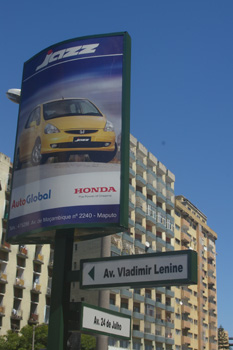
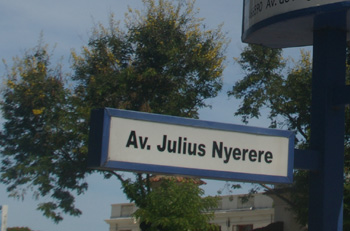
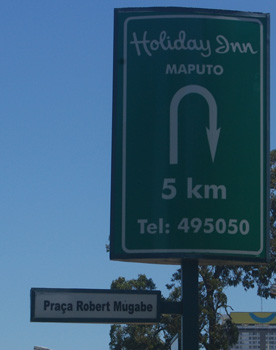
One of the sad things that happened in the cold war was that the two sides each found allies in the third world, and what was best for poor countries got lost in the global realpolitik. This was saddest in Africa, where in many cases the anti-colonial rhetoric of communism and the money and weapons provided by the Soviet Union (combined with the fact that many of the African colonial powers were American allies of one form or another) led to many countries embracing socialism. This was of course a catastrophe, in that pretty much without fail the countries that took the socialist road were impoverished by it, not to mention being involved in wars that could and should have probably been avoided. The socialist rhetoric is now largely gone, and most African countries are now more over-bureacratic and corrupt than particularly ideological. That said, the ideas live on in the minds of many of the people who were involved in African struggles. Listening to South African government officials talking about appropriating private propery is rather depression. One would hope that they could look north at Zimbabwe and see what is not the solution. And it lives on in other ways. One way is in the names of streets in places like Maputo. I think it would be a good thing at this point to formally disavow certain aspects of the past. But there seems to be a certain lack of that kind of bravery.  Tosser Tosser
There is perhaps one redeeming feature, however. Near the botanic gardens is to be found a statue of Samora Machel, the first post-independence president of Mozambique. As it happens, this statue was given to Mozambique by the North Koreans and Kim Il Sung, which perhaps explains the slightly wacky style. 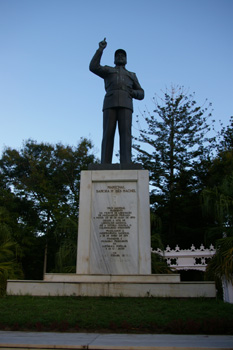 However, the statue hasn’t received much maintenance, and many of the words on the plaque below it have crumbled away. In particular, the whole section explaining when and how the statue was erected is gone, and there appears to have been no attempt to repair the sign and return Mr Kim’s credit. That is something to be thankful of, I suppose.  February 19th, 2007 | 16 comments - (Comments are closed)
 Here on Samizdata, we do not have a single ‘editorial line’ and therefore we sometimes disagree with each other. And this is a case in point. Midwesterner has stated that:
Actually there are loads of them. If a foreign state wants to subsidize (say, mp3 players) that I buy at the expense of their hapless taxpayers,well, more fool them. In the long run it is unsustainable and if at some point their wicked government stopped the export of said products, then the glory of capitalism is that domestic producers will simply re-appear or an intermediary market for importing them via a third party will pop up, but in any case it is hardly a tragedy for the overseas people purchasing said products. Is it ‘fair’ to the mp3 player manufacturers elsewhere else? Wrong question because trade is not about fairness in that sense. If it is ‘unfair’ that a country (say, Taiwan for example) subsidies a product to make the price lower, why is it not ‘unfair’ that a western state makes me pay more for my mp3 player because they have forced domestic mp3 player manufacturing companies to expend vast sums on welfare payments and other labour cost increasing regulations and hence making them uncompetitive? As the USA is generally less regulated than most other countries, by the logic of ‘fair trade’, no one else should allow the US to import ‘their’ unfairly under-regulated products into their over-regulated markets. If you follow the logic of ‘fair trade’ rather than ‘free trade’, a nation-state should not allow its subject people to trade with anyone not subject to that nation-state’s laws (i.e. there should be no international trade at all), otherwise it is bound to be ‘unfair’ in some way. Labour costs, raw material costs, ease of market entry, etc. etc. are always going to vary. Moreover, it is a mistake under most circumstances to accept that buying a product from a foreign company is trade between (say) the UK and US. Unless a state of war exists or I am trading with a state owned company, trade occurs between me and a company, not ‘my’ nation and some other nation. Unless the company I trade with is largely an adjunct of a foreign government, it is just trade between private people. To think otherwise suggest accepting that the state has a controlling interest in every economic action you make, even if the other party is not subject to its sovereignty. From both moral and utilitarian perspectives that is a serious mistake. February 19th, 2007 | 59 comments - (Comments are closed)
Five consecutive years of record trade deficits. There are very few rationalizations for supporting unilateral global free trade, but in the spirit of David Letterman, here’s my top ten. Starting with: And, the number one rationalization of unilateral free trade, drum roll please: Seriously, → Continue reading: Global free traders have some explaining to do February 19th, 2007 | 42 comments - (Comments are closed)
The continuing story of Samizdata people meeting in the USA in order to conspire, drink, shoot and eat… 
The poison of the evening was both delicious and lethal in equal measure, which eventually necessitated…
…the development of some innovative instant sober-up techniques…
… which proved surprisingly popular The following day, we took out our hangovers on the surrounding environment…
…and scared local wildlife by creeping around and pointing basters at them… …large quantities of .40 were expended at metal objects…
…although we did not end up eating a local turkey, we had a sublime lamb dinner I am not a believer but if there is indeed a ‘happy hunting ground’ in the hereafter, I think it will look something going shooting with your close friends followed by a meal of epic quality. February 18th, 2007 | 25 comments - (Comments are closed)
Bryan Appleyard has a terrific piece in defence of 4×4 vehicles, often dubbed as “Chelsea Tractors” on account of their often being driven by well-heeled west Londoners in the narrow streets of said neighbourhood rather than being driven in muddy village lanes. He says what I suspect has been the obvious point, which is that class hatred and the current puritanical culture explains what fires the dislike of these vehicles. The amount of petrol consumed per mile has, I expect, not got a lot to do with it.
I can sympathise, however, with some, not all, of the annoyance that these vehicles provoke. Their drivers are often terrible, imagining that their being surrounded by massive lumps of metal means they are somehow absolved from the rules of the road. They gobble up a lot of parking space, which is at a premium in highly-taxed London. They have a higher centre of gravity than most cars and yet some drivers do not adjust their driving to take account of this. And I occasionally do wonder quite why a person needs such a large vehicle to take little Johnny to school or do the shopping. But whether I think people should or should not “need” to have such a vehicle is beside the point. I have an opinion, but the Greenies want to use the coercive power of the state to limit our motoriing ambitions, and I very much doubt that concern for the welfare of the planet has much to do with it. Talking of politics of envy and massive City salaries, this article is worth a look. February 18th, 2007 | 49 comments - (Comments are closed)
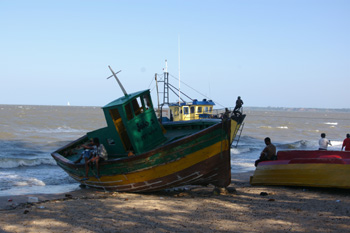
I am still in Mozambique, although I shall be getting on a plane to Johannesburg in a few hours, and then another to London right after that. My trip has been a very brief one. I came to Johannesburg for a friend’s wedding, and (partly drivern my great love of things Portuguese) then spent a few days in Mozabique after that. It has been well worth it. (However, upon meeting some members of the South African branch of the Jennings family, I did have to turn down an invitation to visit them at their private game lodge as I had already booked the trip to Mozambique. That was a shame). I have had a fascinating and enjoyable time, although I have only been able to look at a small area in the south of the country: Maputo, the Ilha da Inhaca, and Catembe. I now know that some day I really must see the Ilha da Mozambique. Of course, what I would really like to do now is take another couple of weeks, and work my way up the entire length of Mozambique to Malawi and Tanzania. But of course, I do not have time, and in fact in theory I am going to work in London tomorrow. (Who am I kidding? What I would really like to do is take three months, and work my way all the way to Cairo). So I don’t think it will be long before I visit Africa again. I have lots more to write, but that can wait until I am back in London. February 18th, 2007 | 8 comments - (Comments are closed)
The damage from an asteroid impact is referred to as an existential threat. The likelihood of this type of event is ranked alongside supervolcanoes, catastrophic climate change and pandemics as a risk that could undermine civilisation’s infrastructure. The threat from Apophis, aptly named for Stargate SG-1 fans, has crossed our radar screens with the possibility of an impact event in 2036. Astronomers mapping asteroids that pose a threat have singled out Apophis as a unique danger. Their campaign for awareness and funds to establish defences against such threats is beginning to bear fruit. Disagreement on how to institutionalise such space defences acquires momentum when one reads about the role assigned to the United Nations. Russell Schweickart, of the Association of Space Explorers, has announced, during the meeting of the American Association for the Advancement of Science, that they hope to submit a “draft document” on asteroid impact to the United Nations Committee for the Peaceful Uses of Outer Space in 2009. The United Nations would acquire the responsibility for identifying dangerous objects in Near Earth Orbit and requesting national space agencies take appropriate action. This is usually know as the system ‘UN say, US pay’. The goal is laudable, the method is lousy. It is not clear if the United Nations has the mechanism available to foster co-operation in this field, since many countries may not consider this type of event a risk that requires further expenditure. Moreover, there is a possibility that a rapid reaction is required, whilst the UN’s institutions are not noted for their nimble response to crisis, as the tsunami in South East Asia demonstrated. The private sector institutions that campaign to counter such existential risks need to develop pragmatic plans involving national co-operation, principally through NASA, with ancillary aid from Russia and Europe, if possible. A private sector solution would be even better. The involvement of the United Nations is an additional layer of bureaucracy. Schweickart’s proposal requires a more pragmatic competitor. February 17th, 2007 | 18 comments - (Comments are closed)
It was only a couple of weeks ago that we appeared to be in the throes of what could reasonably be described as a low-level campaign of insurrection, aimed principally (it seemed) at the various assets and agents of the surveillance state. Now, nothing. Not a word. What happened to it? One minute there were letter-bombs popping off in offices all over the country and next minute, well, as I said, nothing. Is it the case that the perpetrator(s), perhaps feeling that their point has well and truly been made, just decide to call it quits? Or is that case that brown packages are still erupting away in postrooms only we are no longer being told about it for fear of inspiring copycat attacks or general panic? Nor have been any reports anywhere about any arrests, despite the fact that we have the most comprehensive and highly-equipped security apparatus of any country in the world and a truly frightening array of “anti-terrorist” powers, agents and mechanisms. It’s almosty as if the whole episode never occured. But it did occur. We know it did. But what exactly did happen and why and who? And why has the whole story dropped off the radar like a suddenly evaporating UFO? February 17th, 2007 | 21 comments - (Comments are closed)
I am sometimes asked why I seldom write about matters in my local part of the world. Partly this is because local events are too depressing, but it is also that there is a ‘culture clash’ between myself and the local environment, something that becomes even more apparent if you compare the political fate of ‘conservatives’ in Kettering Northamptonshire and Kettering Ohio. Recently a political leaflet from the ‘Conservative’ party landed on my doormat. The leaflet boasted of the ten thousand Pounds that ‘Conservative’ Country Councillors were each spending on local projects. For a few seconds I was impressed. True some of the councillors are wealthy people, but none is the league of Bill Gates – ten thousand Pounds is a lot of money for them. But then I understood that it was not their money. It was local taxpayers money that the County Council, which is ‘Conservative’ party controlled, had given to the councillors to be spent on various projects. Now in some parts of the world this would be called a ‘slush fund’ or ‘pork’ to buy votes. But in the United Kingdom it is called ‘pavement politics’ and is considered entirely ethical rather than corrupt ‘political machine politics’. How different things are across the Atlantic when you consider how the Republicans lost Congress partly for following a similar line of policy with many of the ‘pork barrel’ projects getting so much negative publicity with suggestions of impropriety. The Republicans in Ohio (Kettering Northamptonshire is the ‘sister city’ of Kettering Ohio and there are links between the Ohio Republicans and the Northamptonshire ‘Conservatives’) turned the State into the third highest taxed in the nation – and thus lost control. The problem is that the situation is different. The Northamptonshire ‘Conservatives’ really are not being corrupt by the prevailing local standards in Britain. It is just that their minds are so different to mine that no real mental link exists – it is of limited use to write about people one does not understand. February 17th, 2007 | 10 comments - (Comments are closed)
Having spent £13,000 on installing a wind turbine at his home, John Large is disappointed at the return on his investment, which amounts to 9p a week. At this rate, it is calculated, it will take 2,768 years for the electricity generated by the turbine to pay for itself, by which time he will be past caring about global warming. The wind turbine was installed at the engineer’s home in Woolwich, southeast London, four weeks ago and has so far generated four kilowatts of electricity. An average household needs 23kw every day to power its lights and appliances. Mr Large said that his difficulties highlighted the problems faced by consumers who wanted to buy wind turbines to save money and to reduce greenhouse gas emissions. – from the Times today (hat tip Bishop Hill) February 17th, 2007 | 63 comments - (Comments are closed)
As Michael has posted some interesting pictures from sunny Mozambique, I thought I would contrast that with a picture out of my window of the freezing USA…  … I am here to do some shooting and maybe some skiing in the Land of the Free(ish). More later. February 16th, 2007 | 16 comments - (Comments are closed)
|
   |
||||

All content on this website (including text, photographs, audio files, and any other original works), unless otherwise noted, is licensed under a Creative Commons License. |
|||||









Recent Comments