We are developing the social individualist meta-context for the future. From the very serious to the extremely frivolous... lets see what is on the mind of the Samizdata people.
Samizdata, derived from Samizdat /n. - a system of clandestine publication of banned literature in the USSR [Russ.,= self-publishing house]
|
Like many people, I thoroughly enjoyed the new Star Trek film, which seeks to “re-boot” the series by going back to the early days of Messrs Kirk, Spock, Scotty and the rest in much the way that the makers of Casino Royale tried with some success to do with 007. I liked the paciness, humour and action of the ST film a lot; some of the cast were great. I thought the fellow who played Spock stole the movie with such brio that he should be probably up before a court for grand larceny. But I have a reservation: I thought that the guy playing Kirk was often a total jerk, albeit with some redeeming qualities, and it was wildly improbable that a starship would have employed him as a commander at that point. Yes, I know that the very premise of the movie is fanciful, but there has to be enough credibility and character development to make it work at even the level of fantasy (that is why Lord of the Rings triumphed as a movie series, for instance).
And this guy thinks the same way. But even so, Stark Trek is well worth the money and far more enjoyable than a lot of SF films I have seen in recent years.
William Hill, the betting firm, is offering 5/2 odds that Gordon Brown leaves the office of Prime Minister this year. I guess if you want to finesse it, it would be worth knowing what are the odds that he has gone by the end of the party conference season in the autumn (ie, by the end of September in Labour’s case).
Dozens of MPs, such as from Labour and Conservative, could be de-selected by their own local party members over expense abuses that have come to light; it is likely that the issue will be one of the very top questions that a voter will have of a candidate who is up for re-election, whenever the polls are held. As far as I know, my local Pimlico MP, Mark Field, is a good guy in this expenses issue, but I’ll have to check. Here’s some data on him at the “They Work for You” website, an invaluable resource. Mr Field, is, by the way, sound as they come in opposing ID cards.
As a side-issue, I hope, as Guido says, that Douglas Carswell gets re-elected for his East Anglian seat with a good majority. He’s been one of the undoubted good guys of this whole sorry process, not something you will usually read at Samizdata. Here is Mr Carswell’s blog.
And thanks Samizdata readers! It turns out that there has been a fair amount of foreign coverage of this saga. The reports generally do not address what is the 800 lb gorilla in the drawing room: the fact that Parliament is as ineffectual as it is in large part due to the transfer of great powers to the EU. And the expenses of European MPs in Strasbourg will no doubt make for fascinating reading.
Very smart article by Niall Ferguson on the lessons to be drawn from the financial crisis. As one would expect, many of the wrong lessons have been learned by policymakers. As he says, the 1970s was a period of relatively heavy financial regulation and state controls over part of the banking system, and yet it was a grim period economically (unless you happened to be an OPEC oil producer). He also picks up on the point that Canada, which operates a broadly free market banking system, has not suffered anything like so badly as its neighbour, or indeed the UK. That’s mightily inconvenient for our own Gordon Brown in claiming that the crisis was like swine flu or a meteorite impact from outer space, rather than something that was caused in many cases right on his doorstep.
It is often a useful question to ask: who benefits from this? Senior Libertarian Alliance honcho Sean Gabb, who not surprisingly is grimly satisfied at seeing the discomfiture of this partly corrupt, oppressive and pointless bunch of political boobies, asks whether his one-time adversary, a certain Boris Johnson, might be a prime long-term beneficiary from the current expenses crisis. Mr Johnson, a former editor of the Spectator, a Daily Telegraph journalist and former member for the safe Tory seat of Henley-on-Thames, is now Mayor of London. Being outside the House of Commons, Mr Gabb argues, confers upon the colourful Mr Johnson the chance to pose as a man untainted. Quite possibly so.
But maybe Mr Gabb is in danger of being caught up in his own cynicism, understandable thought that may be (full disclosure: I am an old friend of Sean Gabb whom I have known for more than 20 years). Mr Johnson, does, of course, have other potential skeletons rattling in his cupboard, as do many of us mere mortals who do not happen to be moral saints. But right now, all that I want is a politician with the sense to roll back the state to the extent that Sean Gabb and I share. In other words, roll it back a long, long way. That surely has to remain the prime focus of our energies, long after stories about expense fiddling have faded from view.
The Speaker of the House of Commons, Michael Martin, is due to speak about his position at 3:30 pm today (about an hour from when I am now writing this). There is a high chance he will resign in disgrace, rather than risk the even greater ignomy of being forced out by a vote of no-confidence from MPs. It appears that even fellow Scot Gordon Brown will not explicitly back him. The scandals over the outrageous arrest of Tory MP Damian Green, and now the relentless series of stories of MPs abusing expenses for things like mortgages on second homes, has damaged confidence in Parliament so badly that fringe parties such as UKIP and the British National Party – a party of hard-left economic views, let it be noted – may do relatively well in the upcoming June European Union elections.
This whole saga demonstrates the truth of the thesis that politicians increasingly have come to regard their own interests as set apart from the country as a whole. It adds to the notion, put forward by Sean Gabb, of an “Enemy Class” that is quite consciously at odds with the more conservative (small – c) values of the country. Of course, there has always been an element of this – it is naive to imagine that Parliament ever quite met some Greek ideal – but it is now in a particularly bad way.
Let’s hope Mr Martin sees sense and takes the proverbial bottle of whisky and the loaded revolver into his study. He will be the first Speaker to be ejected from his role in more than 300 years. Not a record to be proud of.
As an aside, it surprises me still how little this whole saga is registering in the foreign media. Anyone got any examples of US, French, German etc coverage of this? It might be nice if even Instapundit mentioned it.
Perhaps the fact that we have seen millions voting themselves into complete dependence on a tyrant has made our generation understand that to choose one’s government is not necessarily to secure freedom
– Friedrich Hayek
…or perhaps not
First there was the financial crisis; then, our entire political numpties were found out to be embezzlers. But now, we have a real black swan.
Nul point Norway wins Eurovision with the highest number of points ever achieved in the competition.
Io9 lists their ten best sci-fi libertarian stories: and the mix is an interesting combination of the obvious and the outliers. The anarcho-socialist tradition, mostly British, is referenced, revealing some surprises on the influences that could be fictionalised as libertarian utopias. My own favourites are that hoary old goat, the fabian Wells, providing a counterpoint to his scientific socialism, and Eric Frank Russell with his homage to Gandhi.
Some would criticise the absence of L. Neil Smith, Ken McLeod and others, but lists are always a springboard for discussion, an opportunity to find works that did not blip the reading radar.
Outside the Westminster Bubble of bent MPs and Brownite thugs, other political developments take place. And few of them are likely to be more important for the state of the world than the Indian polls, now concluded. This report says the Congress party, the party of Nehru and Gandhi, has won. Congress, if my memory is accurate, was associated for a long time with a centre-leftist sort of nationalism. However, it may have moved on a bit from that – India certainly has. Despite the 2008 stock market crash, the ascent of the Indian economy, due in large part to some of the deregulation that has taken place, has been one of the bright spots of the world economy over the past decade or more. It is arguably more sustainable over the long term than in the case of China. Britain, with its post-Empire connections to India, should certainly pay close attention. And given India’s proximity to Pakistan, a nuclear power now in a deadly confrontation with the Taliban, it cannot be emphasised often enough how this “Anglosphere” power matters. India should, for example, be taking a lead role in helping to suppress piracy in the Indian Ocean, a subject about which I have written from time to time.
So these elections matter. It is not all about the Chicago Community Organiser or the One-Eyed Nutter With the Stutter, otherwise known as the UK prime minister. Let’s remember that.
Update: Guido seems very enthused by the result. The Indian stock market has rallied strongly today.
One of the lovely things about the interweb is the complete freedom to post obscure, intractable, thoroughly off-putting essays, revelling in the fact that even if 99.9999 per cent of humanity really doesn’t want to read e.g. a rambling 12,000 word reflection on some little-known artist by a totally unknown commentator – a perfectly legitimate point of view, obviously – well, there’s still the outside chance that someone out there, somewhere, actually will want to read it. And sometimes just the prospect of connecting, probably anonymously and certainly at a great distance, with that one other person is what makes the whole project worthwhile.
– Bunny Smedley comments on a short posting at my place
I have been somewhat quiet of late as I am on the road again, going from job to job to keep cash flowing sufficiently to keep me alive until my aerospace startup can keep me busy and paid full time. In the last 30 days I have worked jobs in Manhattan and north of DC; at the moment I have one day of business in Pittsburgh and am staying with the other half of “Browning and Amon” (or vice-versa), a duet from my younger days as a fixture in the Pittsburgh music scene.
Mark Browning, besides being a fellow singer-songwriter and guitarist who shared many years and several bands with me, is also a Pittsburgh zoo-keeper and has used his knowledge of birds and his fertile imagination to invent a product for a market most of us would never have imagined existed: housing for Barn Owls.
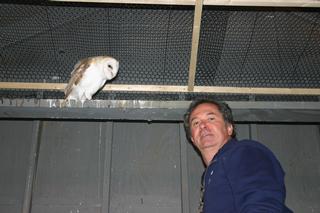
An Owl ponders the possibilities of Mark and dinner.
Photo: Courtesy of Mark Browning
Sound strange? You might think so and you would be wrong. Barn Owls, beside being large, gorgeous and fascinating predators also happen to be exceedingly effective controllers of small mammals. Since I long ago shared a flat with Mark and assorted birds and vipers, I realized immediately how useful it might be having some living about your farm field. What I did not realize was just how big the potential market is. To be truthful I still do not know how gargantuan it may be, but it is simply huge. There is hardly a farm in the Anglosphere world (and perhaps later elsewhere) that would not profit from the free service provided by these birds.
His boxes are selling like hotcakes in the California wine country. Sales are accelerating rapidly. Barn Owls love his nesting boxes and growers are packing them into their fields as closely as the Barn Owls will go along with. I would say there is every chance Mark will make his million from warm blooded flying predators long before I make mine off rapidly flying objects of the manmade kind.

Mark with his box and the Pittsburgh skyline behind him.
Photo: Courtesy of Mark Browning
You may wonder what is so special about these things. I cannot give out details I have been told over a few beers (well, not just a few. A lot actually) until his patent is through, but it comes down to a design which lasts and is naturally cooling. It gives barn owls a cool nesting place even if there is direct sunlight. If one happens to be flying around in the neighborhood it will make a beeline for one of these boxes because large enough hollow trees are rare and their old wooden barn homes are rapidly disappearing.
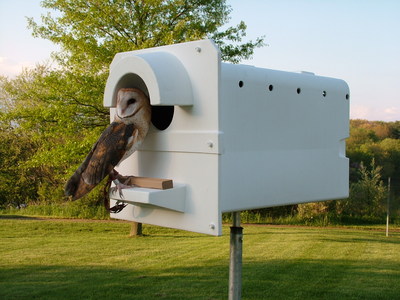
A proud homeowner surveys his cool new pad.
Photo: Courtesy of Mark Bornwing
I would not be at all surprised to turn on Autumn Watch in a year or two and see Bill and Kate talking with Mark about the increase in owl population these boxes have brought about.
I am sure our own Editor Perry deHavilland will also appreciate this advance in Barn Owl housing…
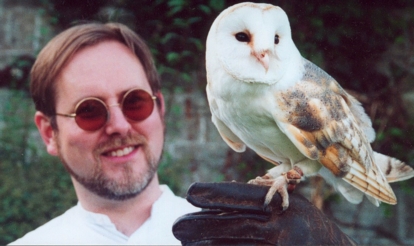
Perry with his familiar, Cadaemus, during his Hogwarts days.
If you are interested you can find out more from The Barn Owl Box Company web site.
Thomas E Woods – whom I mentioned the other day – hits back most satisfyingly at Matthew Yglesias. The latter had some sniffy thoughts about Mr Woods’ recent book on the financial crisis. For the sin of looking at the crisis through the perspective of Austrian economics, with its specific way of looking at the economic cycle and the role of banking, Mr Woods incurs a certain amount of sneering from Mr Yglesias.
Mr Woods gets the distinct impression that Yglesias has not read his book. I have no idea whether he has or not; but there does seem to be a recent pattern of leftists trashing the likes of FA Hayek, or whomever, in a way that suggests that they haven’t the faintest idea of what or who they are talking about. You can just picture the thought process that goes through Mr Yglesias’s mind: “Ah, these central Europeans with their funny names and their think tanks – who are they to question the great Keynes and his sensible ideas on demand management”.
But I detect a sign that perhaps, just perhaps, the Yglesiases of this world are losing some of their Olympian self-confidence. At a City event the other night, listening to people talking about the economy, I did not get the impression from all the associated financial types that the idea of using the printing press to cure problems caused by underpriced credit was regarded as very brilliant. In fact quite a few folk are mentioning inflation as the issue that could hit Real Soon Now.
Thomas E. Woods is great value. Check out his website.
|
Who Are We? The Samizdata people are a bunch of sinister and heavily armed globalist illuminati who seek to infect the entire world with the values of personal liberty and several property. Amongst our many crimes is a sense of humour and the intermittent use of British spelling.
We are also a varied group made up of social individualists, classical liberals, whigs, libertarians, extropians, futurists, ‘Porcupines’, Karl Popper fetishists, recovering neo-conservatives, crazed Ayn Rand worshipers, over-caffeinated Virginia Postrel devotees, witty Frédéric Bastiat wannabes, cypherpunks, minarchists, kritarchists and wild-eyed anarcho-capitalists from Britain, North America, Australia and Europe.
|





Recent Comments