We are developing the social individualist meta-context for the future. From the very serious to the extremely frivolous... lets see what is on the mind of the Samizdata people.
Samizdata, derived from Samizdat /n. - a system of clandestine publication of banned literature in the USSR [Russ.,= self-publishing house]
|
Liberty is not a pick and mix free-for-all in which you think government should ban the things you don’t like and encourage you things you do like: that’s how Libtards think. Libertarianism – and the Tea Party is nothing if its principles are not, at root, libertarian ones – is about recognising that having to put up with behaviour you don’t necessarily (approve) of is a far lesser evil than having the government messily and expensively intervene to regulate it.
– James Delingpole, with his obvious typo corrected.
Some have asked how the Tea Party movement hopes to pressure Republican leaders or influence the party. That’s the wrong way to look at it. The goal is not to pressure Republican leaders but to become the Republican leaders. The goal is not to influence the party but to become the party.
– Richard Viguerie
For the benefit of anyone who would like a Brit libertarian angle on the US Midterms, Antoine Clarke has blogged about them already (with more promised) at his recently launched Norlonto Review. And Rob at Rob’s Blog is also up and liveblogging. Both are at Mr and Mrs Rob’s home for the evening.
I too was going to be there, if only to see how the new offspring is doing, but a seriously sore throat demands that I remain at home, and probably also that I stay away from babies outside of London. Have a good evening everyone, and sorry not to be there to share with you face-to-face whatever fun may materialise. Your blogging will be the next best thing.
LATER – best bit yet, from Rob at 20:48:
So Al Jazeera had a polite discussion with a sensible Tea Partier who was allowed to make all kinds of sensible points about healthcare reforms and stimulus packages. Al Jazeera is much better than the BBC.
Building an audience by reporting things intelligently. Whatever next?
LATER: Michael J just got a mention from Rob, so maybe there’ll be something from him here. Or here.
“But his [Peel’s] chosen remedy for widespread poverty was already apparent. It did not lie in changing the Poor Law, or reducing factory hours through a Ten Hour Bill, or in accepting the irrelevant political demands of the Chartists. Still less did it consist in commissioning that engine of public welfare and State guidance of the economy to which we became accustomed in the twentieth century. Peel and most of his contemporaries would have regarded our giant complex of State machinery as a destructive restraint on individual freedom.”
Robert Peel, page 243, by Douglas Hurd.
Indeed they would have so regarded the modern state of the late 20th and 21st centuries. And with good reason. Somehow, I doubt that even the founder of the Metropolitan Police would have liked the idea of the modern Surveillance State. I am not too sure that he’d have been all that keen on top tax rates of 50 per cent and more, compulsory schooling to the age of 18, or the hideously regulated labour market of today.
And this historical shift, I think, can explain to a certain extent why, to a British audience dulled by decades of socialism, the sight of Americans protesting against Big Government and the like is so odd. Last night, on the BBC, the broadcaster and one-time Sunday Times (of London) editor, Andrew Neil, was looking at the Tea Party movement. It was not all bad as a documentary – he had a great short interview with the son of Barry Goldwater – but in the main, the general idea that the viewer was meant to draw was that the Tea Party movement was comprised mainly of cranks, bigots and fools. The problem, I think, is that Britain has not really had a genuine, tax-cutting protest movement since the anti-Corn Law League of the 1830s and early 1840s, which is why I was so struck by that passage about the Peel administration. We have to go back to the early years of the Industrial Revolution to find anything remotely like such a protest for government retrenchment and tax cuts. No doubt Mr Neil would regard Cobden, Bright, or indeed Peel himself, as a bunch of nutters.
And that, of course, is why the accurate teaching of history, such as around such episodes as the Industrial Revolution, is so important.
I know we keep banging on here about Steve Baker MP, but he really is excellent.
The thing about Baker is that he doesn’t just say the uncompromisingly libertarian things that he does say about economics and economic policy, and about, to quote the title of his talk, honest money and the future of banking. He is willing to be immortalised on video saying them, and therefore potentially to be heard saying them everywhere on earth. Amazing. Truly amazing.
This performance lasts just over forty minutes. I urge you to make the time to look at it and listen to it. If, like me, you have any sort of drum handy, I also urge you to do some banging on about it yourself.
“Not for to hide in a hedge,
Not for a train attendant,
But for the glorious privilege
Of being independent.”
Robert Burns.
As quoted in The Constitution of Liberty, FA Hayek, page 118.
Recently, I was wandering along a back street in the former Vietnamese Imperial capital of Huế, perhaps best known outside Vietnam as the site of one of the bloodier battles of the Vietnam War. This was a street full of the sort of shops that would once been have referred to as a “General Stores” in English: shops full of many goods that are likely to be useful to many people, but that sometimes seem to have a tenuous relation to one another.
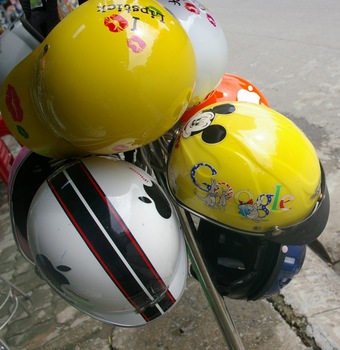
In such a store, I stopped and started photographing a colourful display of western trademark violating motorcycle helmets. After I had been doing this for a short while, the shopkeeper came up to me, basically just to say hello. He didn’t mind me photographing his merchandise and was not putting any pressure on me to buy anything, but he clearly didn’t get Westerners wandering into his shop to take photographs every day. Huế is a tourist destination, but despite its easy accessibility (the Americans having built an airport) it is not nearly as big an attraction as places such as the nearby ancient town of Hoi An. One does not have to walk far from the centre of town for the presence of foreigners to be rare.
What happened next was more interesting. He gestured for his son to come over and pose for a photograph. The lad must have been only about two years old, but there was a serious amount of proud father syndrome on display. This gentleman wanted the whole world to see how proud a father he was. So they posed and I took a photo. Alas, the white balance isn’t perfect.
As an added bonus, the father decided that he would pose for the photograph with a cigarette in his mouth.
Of course, this gentleman had no idea how many western taboos he was breaking. If he had, I am sure he would have thought we were all idiots. Quite accurately.
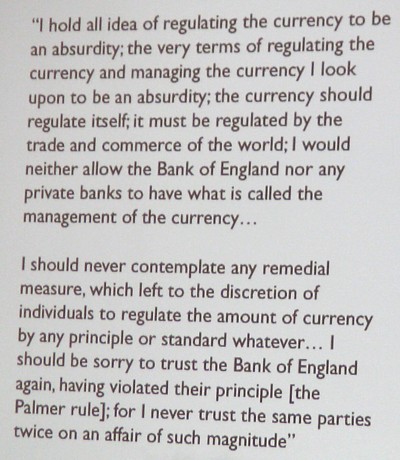
– Richard Cobden (1804-1865), quoted at the Cobden Centre website. Quoted again by Steven Baker MP at the end of his presentation this morning to the Libertarian Alliance, and featured in his final slide, of which the above is my somewhat wonky photo.
Great essay by Sean Gabb on the UK government and supposed plans to reduce public spending. The article contains a lovely line in relation to Peter Mandelson, the disgraced former Cabinet minister.
Along with Sean and others, I will be at the two-day Libertarian Alliance annual conference tomorrow, held at that ancestral seat of 19th Century liberal politics, the National Liberal Club.
[with apologies to the Four Yorkshiremen]
A fantasy writer produced this:
But there’s a dark side as well. We know about the real world of the era steampunk is riffing off. And the picture is not good. If the past is another country, you really wouldn’t want to emigrate there. Life was mostly unpleasant, brutish, and short; the legal status of women in the UK or US was lower than it is in Iran today: politics was by any modern standard horribly corrupt and dominated by authoritarian psychopaths and inbred hereditary aristocrats: it was a priest-ridden era that had barely climbed out of the age of witch-burning, and bigotry and discrimination were ever popular sports: for most of the population starvation was an ever-present threat. I could continue at length. It’s the world that bequeathed us the adjective “Dickensian”, that gave us a fully worked example of the evils of a libertarian minarchist state, and that provoked Marx to write his great consolatory fantasy epic, The Communist Manifesto. It’s the world that gave birth to the horrors of the Modern, and to the mass movements that built pyramids of skulls to mark the triumph of the will. It was a vile, oppressive, poverty-stricken and debased world and we should shed no tears for its passing (or the passing of that which came next).
Oh really? Try this from the Old Bailey’s website:
1760-1815
From approximately three-quarters of a million people in 1760, London continued a strong pattern of growth through the last four decades of the eighteenth century. In 1801, when the first reliable modern census was taken, greater London recorded 1,096,784 souls; rising to a little over 1.4 million inhabitants by 1815. No single decade in this period witnessed less than robust population growth.
In part this urban bloat resulted from a marked decline in infant mortality brought about by better hygiene and childrearing practices, and a changing disease pattern. By the 1840s children born in the capital were three times less likely to die in childhood than those born in the 1730s.

Bangkok, Thailand. October 2010
|
Who Are We? The Samizdata people are a bunch of sinister and heavily armed globalist illuminati who seek to infect the entire world with the values of personal liberty and several property. Amongst our many crimes is a sense of humour and the intermittent use of British spelling.
We are also a varied group made up of social individualists, classical liberals, whigs, libertarians, extropians, futurists, ‘Porcupines’, Karl Popper fetishists, recovering neo-conservatives, crazed Ayn Rand worshipers, over-caffeinated Virginia Postrel devotees, witty Frédéric Bastiat wannabes, cypherpunks, minarchists, kritarchists and wild-eyed anarcho-capitalists from Britain, North America, Australia and Europe.
|






Recent Comments