We are developing the social individualist meta-context for the future. From the very serious to the extremely frivolous... lets see what is on the mind of the Samizdata people.
Samizdata, derived from Samizdat /n. - a system of clandestine publication of banned literature in the USSR [Russ.,= self-publishing house]
|
I am very sad to hear the news that a libertarian acquaintance of mine, Richard Garner, has died at a young age. I don’t know any more details. Richard used to write a fair number of excellent comments over at this blog’s comment threads. I used to like chatting to him at conferences and other gatherings; I remember getting a cheery invite from him to join him and others at the recent “rally against debt” in central London.
My condolences to his family and many friends. He will be missed.
Too many of our internet dreams depend on the internet being far less vulnerable to governments than it actually is.
– August, commenting on a posting at my place about Bitcoin.
I suggest comments about what August says about the internet: here. Bitcoin comments: there.
Our own Michael Jennings does his bit to stave off a new Ice Age by his almost obsessive amounts of globe-trotting, and I cannot compete with that, but I did my little bit at the weekend, as did a lot of other crazy people, by attending this event in France.
Ever since I watched the Steve McQueen film about the extraordinary 24-hour race in this part of France, I have wanted to go to Le Mans. I was not disappointed. The sight and sound of the cars setting off for the race, and then thundering down the Mulsanne Straight, or twisting around the S-bends after shooting down the track under the Dunlop Bridge, was unforgettable.
There is, I suppose, something very elemental about getting excited about the sight of such things, and of course, there is the satisfaction in how Man, by mastering technology, can produce cars able to go flat out for 24 hours and drive at such speeds, competitively, and live to tell the tale.
I shall definitely be going back.
The dependably dismal Archbishop of Canterbury, a man who thinks his god favours a massive force backed regulatory state which takes one person’s wealth implicitly at gunpoint and gives it to someone else, get a well phrased hammering by Graeme Archer:
It is obscene, Dr Williams, that some people choose not to work, and are better off as a consequence than those who do not make such a choice. Such people are less deserving than others. If there are no jobs available, what are all these Polish men doing on this bus, at 6.30am? They deserve more than to be viewed as taxable cart-horses.
And you? On an average salary? Trying to raise a child and thinking about having another? Coming to the conclusion that you might be able to balance commuting against mortgage costs, if you moved to an unpopular area farther out than you’d like? It must be hard for multiple houseowners such as Mr Cruddas, or the Archbishop in his palace, to understand: this is life, for most of us. And we’re not fascists because we make a distinction between the deserving and the undeserving when we see where our tax is spent.
Read the whole thing. My only regret is Archer does not follow the moral argument to its logical conclusion.
I see that my fourth (approximately, I think) cousin John Micklethwait, Editor of the Economist, whom our own Paul Marks disapproves of so severely, is this weekend attending a meeting of the Bilderberg Group.
I learned about this list of potentates thanks to a link to it from Guido Fawkes, and I consider it rather significant that such an august media personage as Guido should be positively drawing our attention to this gathering.
When the internet got seriously into its stride, and particularly blogging, at or around the year 2000, you would have thought that observation and analysis of the global elite would have exploded. After all, detailed analysis of these persons and their thinkings and their doings was the quintessential Story They Don’t Want Us To Know, in other words, a story that was ready-made for the internet.
Yet, actually, very little was said about these persons and their meetings and their secret thinkings aloud, by regular people as opposed to the people who were already fascinated by such things. Oh, I’m sure that the people who had been banging on about the evil Bilderbergers for the previous quarter of a century immediately started publishing vast screeds about these persons on the internet. But, or so it seems to me, very few other people paid such talk very much attention. And so, pretty much, it has continued.
Why? Was it because bloggers who dipped their toes into these hitherto forbidden waters were visited by sinister people in sinister raincoats at sinister times of the night? Did those who mentioned the Bilderberg Group on the internet suffer mysteriously fatal road accidents?
I can’t speak for others, but the thing that kept me away from talking about Bilderberg meetings and similar things was not the fear of Them, but the desire not to be thought completely mad, by people generally. → Continue reading: Is the globe now ready to start thinking seriously about its elite?
I have pretty much ignored the Weiner Dong flap as I am not much fussed about how the man gets laid. Whether he is true to his wife, a kinky netizen or as much a womanizer as some of my musician friends of old does not much matter to me. His political stands would be equally obnoxious to me whether he be Saint Weiner or an alley cat guitarist. However, I could not pass up this brilliant little bit of poetic license from the always humorous Iowahawk which Taylor Dinerman pointed out to me.
`My name is Weinermandius, Dong of Dongs:
Look on my junk, ye mighty, and despair!’
As oft saith Glenn Reynolds, “Read the whole thing.”
I tend to have a “half empty” view of the world – but even I do not believe that the British population contains no pro freedom people. Indeed I believe that there are millions of pro freedom people in Britain – and basically the British book trade was telling us all to bugger off, that we were not welcome in the book shops.
Well we got the message – it is not all “the internet” that is the reason for the decline of the British book trade, basically they were telling non-socialists that our custom was not wanted.
– Paul Marks
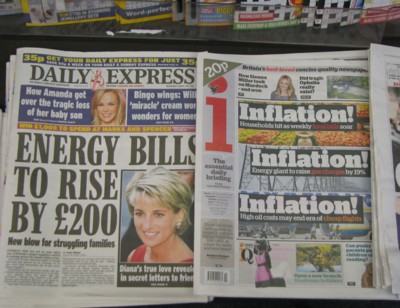
Newspaper headlines photoed by me today, in London:
For a more considered view of the economic picture, try Detlev Schlichter, who now seems to be the unofficial Samizdata economics correspondent, who has another posting up today, about, ah yes, inflation.
But the good news is that not all prices are rising.
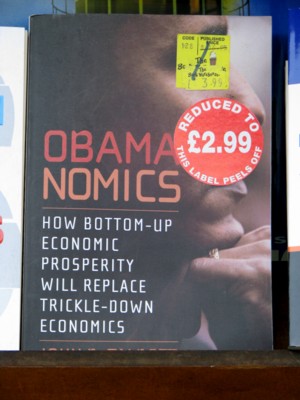
Photoed by me yesterday, in London:
The original price of this book was £10.99. I guess people now realise that it didn’t have a happy ending.
Perhaps the answer is going to be to keep warm by burning books.
Violence must be replied to with violence. The only time I would suggest turning the other cheek is when firing off the left shoulder with a rifle after taking cover in a doorway.
– Perry de Havilland commenting here
“Auction houses and auction websites make markets out of common objects that would be trash except for a celebrity having owned or used or once touched it. A set of golf clubs or a box of golf balls is worth far more in a pro shop if the brand name “Tiger Woods” is on the label, because by affixing the name of the golf legend the buyer is being told that Tiger Woods had personal input into the quality of the products. Anyone who copies that box of golf balls with the Tiger Woods label on it — without proper authorization — is committing an act of forgery.”
J. Neil Schulman.
He certainly has an unusual way of looking at IP. This issue is messing with my head. A few weeks ago, I read Tim Sandefur’s lucid take on the matter, and took the view that whatever else can be said about it, it is hard to see how I could make a “natural rights” claim for IP in the same way as some classical liberals can do with physical property. But a few days later, talking to an old friend who is a professional arbitrator, my view swung more favourably to this sort of argument, as presented in favour by the late, great Lysander Spooner.
I fear that with IP, this is going to be one of those “I haven’t really made up my mind yet” positions. I suspect I am not alone.
Surely it’s time for climate-change deniers to have their opinions forcibly tattooed on their bodies.
Not necessarily on the forehead; I’m a reasonable man. Just something along their arm or across their chest so their grandchildren could say, ”Really? You were one of the ones who tried to stop the world doing something? And why exactly was that, granddad?”
Dear Mr Glover,
I once lived next door to a lady who was tattooed at Auschwitz. I was outraged, as I suppose you intended, by your glib call for people who think differently than you do to be tattooed. But the outrage came from the smug assumptions you made. I bet you feel very “radical chic” after writing your article, a bit like the gay people who wear Che Guevara T-shirts, not realising that he used to enjoy killing people for being gay.
You want to tattoo me for doubting the claims of such people as Michael Mann, the fabricator of the “hockey stick” graph, which among other lies, denied the existence of the European medieval warm period and the mini ice age of the 16th and 17th centuries. I note that the hockey stick has quietly been abandoned as a model by the UN Climate Change campaign’s official documents. Does that mean the tattoo could be lasered off when what you think is true today, turns out to be inaccurate or plain wrong? I hope that at the very least you might say sorry and offer to pay for the tattoo’s removal. But as they say, Socialism means never having to say ‘Sorry.’
David Evans worked for what is now the Australian Department of Climate Change from 1999 to 2005, and part-time 2008 to 2010. Should he be persecuted for writing this?
I have changed my mind more than once about what to do about global threats to the environment. I have never taken a payment from an energy company and would welcome viable clean energy, but the carbon dioxide scare is as bogus as propaganda movies that depicted people like my former neighbour as rats spreading the plague across Europe. For one thing, I find it extremely unlikely that fluctuations in the Sun’s radiation has less influence on the Earth’s climate than humans do. I’m open to persuasion that I’m wrong about sun spots, but not by threats of torture or death.
If your ideology requires the extermination – or at least for now – the branding of all who opposes you, one might wonder just what principles you stand for. It is shameful that a reporter would advocate the terrorising of people based on their opinions. That does not seem compatible with freedom of thought, or of expression.
Once you get your police state, what are the odds that an opinion YOU hold will be deemed thoughtcrime and you get branded for holding “unhelpful” opinions on homosexuality, torturing prisoners, freedom of religion, or abortion rights? And what sort of person thinks that tyranny is fine provided that the “right” people are being tortured and killed? I usually take the view that any call to expand government power should be met with caution, even for causes I might privately support.
My concern is not the profits of oil firms but that environmentalism, as a political ideology, threatens the principle of science as an arena for competing ideas to be tested without prejudice, when its advocates demand the silencing of critics.
One final thought. If anyone attempts to tattoo or brand me or anyone else for their non-conformist opinions, anywhere in the world, I shall hold you personally responsible and to be an accomplice of evil men. If you call for people to be harmed, even in jest, you cannot hide from responsibility when your call gets acted on.
Kind regards,
Antoine Clarke
Neuilly-sur-Seine,
France
As a BBC news announcer gave out the round of story headlines this morning on the television, I heard this particular classic of its type connected to this story about extremism and universities:
“Government money is no longer going to be given to Islamic extremists”.
First of all, there is, as readers of this blog know, no such thing as “government money”. All money spent by government is, despite what some might believe, owned by you, the taxpayer, or lent to it, by other people. Second, it is not just appalling that money levied on pain of imprisonment (taxes) is then transferred to people who want to impose a particular worldview on their fellows; it would be just as bad if the money were to be given to the forces of sweetness and light. No such groups, whether it be Islamic Jihad, The Women’s Institute or the Worshipful Company of Bald People, should receive a penny from the taxpayer. End of subject.
|
Who Are We? The Samizdata people are a bunch of sinister and heavily armed globalist illuminati who seek to infect the entire world with the values of personal liberty and several property. Amongst our many crimes is a sense of humour and the intermittent use of British spelling.
We are also a varied group made up of social individualists, classical liberals, whigs, libertarians, extropians, futurists, ‘Porcupines’, Karl Popper fetishists, recovering neo-conservatives, crazed Ayn Rand worshipers, over-caffeinated Virginia Postrel devotees, witty Frédéric Bastiat wannabes, cypherpunks, minarchists, kritarchists and wild-eyed anarcho-capitalists from Britain, North America, Australia and Europe.
|





Recent Comments