Britain’s energy reforms are billed as a key part of the Cameron government’s growth strategy. To understand why the U.K. economy is flat-lining, look to a government that believes a policy to raise energy prices and squeeze living standards is good for growth. Unless Mr. Cameron wants to share Jimmy Carter’s electoral fate, he’d better push the reset button on his energy policy – fast
|
|||||
|
“Eurosceptics aren’t supposed to like Ken Clarke. But I can’t help it. Apart from being completely wrong about one of the biggest questions of our age, the disastrous EU project, “Ken” is the absolute business. The unfazed Justice Secretary stands (or often sits) as a wonderful reprimand to the prissy, on-message posturing of the dominant political class. He likes jazz, smokes cigars and after more than 40 years in Parliament is one of the government’s few true big beasts.” I think if Ken Clarke did not have a track record of being so spectacularly wrong on the EU, he’d easily be the best man for the top job as Tory leader. Out with the windmills and the AGW nonsense, in with the Louis Armstrong and the Cuban cigars. I have met him several times and always been impressed by his blunt honesty and friendliness. The suede-shoes-and-pint-of-bitter thing is not a sort of act, either. That’s him. But the EU-wrongness is a problem. May 30th, 2012 | 9 comments - (Comments are closed)
 A lot of people like the way Obama has governed less than they liked the idea of Obama governing. If Obama loses – if – I think that will sum it all up very well. And if Obama does lose, we must all hope that Romney governing turns out better than the idea of Romney governing looks now. May 30th, 2012 | 23 comments - (Comments are closed)
Being on the Cobden Centre email list is a constant source of interesting news items and opinions, in addition to all the stuff that is none of your business and not really any of mine. Today, for instance, someone provided a link to this blog posting, which is entitled “CRASH 2: Why has the Treasury revoked debt-trading sections of a 1939 Act – without telling Parliament?” and is subtitled “How a hidden order could be used to bankrupt the UK”. Quote:
The gist of this particular quiet little alteration being that it just got easier for Britain to bale out the banks of various other countries which are now part of the EU. It’s all to do with “negotiable instruments”. In response, someone else on the Cobden Centre list sent the text of a Reuters story, which I found in a linkable form here. Quote:
And not only Germany, it would seem. As to whether the story behind link number one really is link number two, I don’t know. But I have long believed that the European Union, when it finally collapses, will do so all at once. All the power and all the money that these fanatics have under their control will all be used up, all of it, to sustain the illusion that they are all now so determined to sustain. And then all the power and all the money will be gone, and everything will very suddenly disintegrate. At which point it will emerge that everyone was only obeying orders. May 29th, 2012 | 9 comments - (Comments are closed)
I have been following the Brett Kimberlin case, much linked to of late by Instapundit, with interest, but with some confusion. It is not that I consider exercises like Everybody Blog About Brett Kimberlin Day to be pointless. It is that I remain genuinely confused about what that point might be. Who, exactly, are we all trying to convince, and of what, exactly? I get the impression that all those blogging about this do know their answers to this question, but to them, it’s obvious, and if they ever did spell it out, that was many days ago. So, what are those answers? Kimberlin is a bad, bad man, who has a history of villainy generally, and in particular of trying to intimidate bloggers who point this fact out. So yes, the cost in potential intimidation from Brett Kimberlin of lots of us blogging about Brett Kimberlin is small, and all the smaller for lots and lots of us doing this, especially from a nice safe distance like from London. But what exactly does me mentioning the name of Brett Kimberlin, on the blog that I write for, accomplish? Does it intimidate Brett Kimberlin himself, and thereby stop him intimidating any more bloggers and from intimidating any more the bloggers he is intimidating now? How? Isn’t Kimberlin rather pleased to have got up the noses of so many bloggers whom he already detests and despises, and turned into a minor internet celebrity like this? Does it persuade the forces of law and order to stomp all over Kimberlin, more than they have been doing lately? Again, how? Is the idea to show to mainstream Americans that the mainstream media are rubbish, for not mentioning this story? If so, what exactly is the plan for reaching mainstream America with this proposition? Leading directly on from the previous question, is the idea to embarrass the mainstream media into mentioning the story? Their current opinion of all this is, presumably, that a lot of stupid right wing blogs are making a gigantic fuss about a small-time crook, who has gone some way towards rejoining polite society by making himself useful to the left-wing cause, which just goes to show that Kimberlin is doing something good, having annoyed all the right right wing nutters. And given that not even that opinion will find its way into the mainstream media any time soon, nothing much would seem to be being accomplished on that front either. The pieces I have been reading during the last week or so have entirely convinced me that Brett Kimberlin is a bad man, and that those who support him with money, or who did once upon a time, are at best very stupid, and probably not at all stupid but very, very bad also, arguably even worse than Kimberlin himself, in particular Barbra Streisand and Brett Kimberlin’s evil and/or stupid aunt. My opinion of George Soros, to mention another Kimberliner, has gone done (even further). I had not realised until now quite what a brazen villain he is. But convincing someone like me of things as simple as these hardly amounts to much by way of an objective. I have no objection in principle to preaching to the choir. This can often be a very valuable exercise. I am positively asking for exactly such preaching now. But what valuable lesson might this particular chorister be learning from the Kimberlin affair, that I might otherwise have neglected? Or is it that all this just makes me … think about things? Is it a case of all of the above? The matter is easily blogged about, fun to blog about, and will achieve a wide variety of relatively small but desirable things. My questions are genuine, rather than sneeringly rhetorical. If I truly thought that Everybody Blog About Brett Kimberlin Day was pointless, I would not have mentioned it here at all. But, please somebody tell me why it is not pointless, and not perhaps even counter-productive on account of being so over-the-top for what it is actually accomplishing. I am sure that our commentariat will have useful answers to offer me, and I look forward to reading them. May 29th, 2012 | 20 comments - (Comments are closed)
An article about how Washington DC and the surrounding area is booming on the back of government spending is creating a bit of a buzz. Grizzled veterans of lobby groups and the dynamics of how spending decisions are made will not be remotely surprised, of course. Even so, this is the sort of article that sums up so much that is bent out of shape of Western societies and their bloated public sectors. And it also highlights how, in such an economy, so many of those who call themselves “contractors” and “consultants” are in fact dependent to a significant degree on the taxpayer for funds, not on anything resembling laissez faire capitalism. (There are similarities with London and Brussels, of course, though in the case of London, it is not just the centre of political power, but of financial and other sorts of power too, such as in the arts and entertainment business). And this quote is chilling, if it highlights where young people think the action is:
Marvellous, as Clint Eastwood says in his movies. May 29th, 2012 | 9 comments - (Comments are closed)
“Capitalism is based on capital, and capital is generated through saving and not money-printing, contrary to what many economists and central bankers want us to believe. Prosperous societies have always been built on hard money, which encourages saving and the expansion of the capital stock, and in turn increases the productivity of human labour. Greek savers are no different from American savers or German savers, and the role of money, saving and capital is no different in Greece from that in any other country. The laws of economics change as little from one place to another as the laws of physics. And sacrificing the interests of your savers for some short-term boost to growth will have the same adverse long-run effects in Greece as it has anywhere else.” May 28th, 2012 | 36 comments - (Comments are closed)
Not being wise in the ways of Twitter, I am not sure where Mr Eugenides got this piece of simple but effective graphics, only that he either acquired it or created it, one way or another, and that I found out about it because it was one of David Thompson’s clutch of ephemera last Friday: 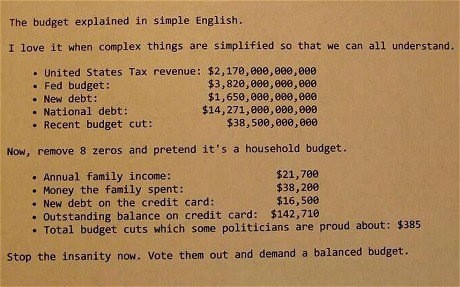 I recall reading in one of Professor Parkinson’s books, I think in his classic Parkinson’s Law, that people only find it easy to have strong opinions about sums of money, or circumstances generally, that are within their particular and usually rather limited range of experience. So it is that a local planning committee will spend an hour arguing about a cheap loft extension, while nodding through an entire hundred million quid power station without discussion. Something along those lines. True, I suspect. Certainly true of many people. So, the thing to do, with these otherwise unimaginably huge sums of money that politicians are slinging around nowadays, to keep all their various financial plates on sticks spinning fast enough, is what is done here, in the above graphic. Divide them all by the same (very large) number, until the original numbers become regular numbers of the sort regular people can relate to, while the numbers all nevertheless retain their relative sizes, to each other. The essential nature of what is going on is thus laid bare, for people who might otherwise be blinded by all the zeros, and all those bewildering words ending in “-illion”. I agree with Mr Eugenides. This is clever. And no, he didn’t invent it. It’s been around for a while. May 27th, 2012 | 20 comments - (Comments are closed)
…Was invented by me today while we ate our supper with the patio doors wide open to admit the glorious sunshine. Unfortunately we also admitted an insanely persistent fly. Somebody really needs to miniaturise yet further a quadrotor, equip it with a little vacuum cleaner sucky mouth and an incinerator inside, fix it up to a remote control system with a joystick and send it out like a tiny hawk to swoop upon the critters and suck them to their fiery doom, preferably with a satisfying actinic flash and a buzz like the noise a lightsabre makes in Star Wars. As a by- product, the chemicals harvested from the flies’ little frazzled bodies could power the “predator drone”, as I think I might call it, unless that name is taken. This would not be an efficient means of killing flies, nor even of using quadrotors to kill flies. To do that you would have to give the quadrotors echolocation and probably rejig them as Von Neumann machines. Inevitably they would start to evolve independently and develop a taste for human flesh, so perhaps we should stick with having a human at the controls. In future years, when the cry of tally-ho is a familiar refrain at every barbecue and picnic, raise a glass to me and send me some money. Only it would not actually be a blood sport. Insects do not have blood, they have something called hemolymph sloshing about inside them instead. Not ichor, that was Greek gods and other sundry immortals. Hunting Greek gods with quadrotors doesn’t work, ‘cos they’re immortal. May 27th, 2012 | 13 comments - (Comments are closed)
I understand there’s a new sheriff in town. Who wants to kill him? – said by the boss cowboy with the mustache (Slim Pickens?) in Blazing Saddles, to an enthusiastic response. Blazing Saddles, what with Sheriff Obama and all, is now downright prophetic, in the sense that there must be Democrats who think they are living in this movie right now. It’s showing on Brit TV right now. Earlier I set my TV hard disc to record this, and I just switched on my telly to catch that line. May 26th, 2012 | 22 comments - (Comments are closed)
I found Michael Barone’s piece here (thank you Instapundit) about ideological self-sorting very thought provoking. Barone mentions a book called The Big Sort, which says that such self-sorting within the USA is bad, because it is “tearing us apart”. The book, says Barone:
Barone only concerns himself with how such self-sorting might be affecting the upcoming Presidential election, speculating that it causes liberals to live in an ideological cocoon and be bad at dealing with criticisms of their opinions. He instances the claim that Obamacare is unconstitutional, which liberals only took seriously when the Supreme Court suddenly did. Liberals had had months to prepare counter-arguments to that argument, or to rejig Obamacare so that it didn’t clash with the Constitution, but they saw no need to do either. But there is plenty more to be said about ideological self-sorting. Might ideological self-sorting in due course become a major global tendency, with people choosing not just localities within countries, but actual countries, on ideological grounds? Is that already happening to any significant degree? If not, how likely is it that it might? And if it did start or has started, what might be its consequences? The self-sorting Barone refers to is happening because moving within the USA is now quite easy. But time was when moving anywhere else was far harder, yet some people still did it, to particularly enticing destinations, from particularly abominable starting points. That people tried to hard to get out of the old USSR was one of the most damning and least answerable criticisms made against that horrible place. The USA itself, all of it, is an exercise in ideological self-sorting, in the sense that most Americans are descended from people who bet the farm, metaphorically and often literally, on life in America being a better bet, even if they started out in America only with what they could carry. Americans are mostly descended from people who took a huge chance to make hugely better things happen for them. The great American exception to this is Americans descended from slaves, or from American natives. African slaves shipped to America placed no bets. They were chips in bets placed by others. Does that fact illuminate the seemingly still rather fraught relationship between black America and the rest of America? I think: yes. But I am digressing into American history. What of the future of the world? As a libertarian, I like the idea of ideological self-sorting, partly because it seems to me that there is a huge imbalance, in favour of minimal statism and against maximal statism, when it comes to how well each works out when practised only locally. Remember all those mental agonies suffered by Soviet communists when they started to realise that they were going to have to make do with “socialism in one country”, rather than everywhere? And remember how easy it then became to see which was better, Communism or not-Communism? Most of the world’s collectivists, although there are surely exceptions to this generalisation, are now collectivisms whose entire purpose is to deny “free riders” their free ride, anywhere on earth, thereby denying not only choice but exit. For collectivists, a world in which anti-collectivism flourishes, albeit only in some places, is anathema. They have to have it all, or their ideas won’t work, even in the limited sense of being inevitable and inescapable, and alternatives being hard to imagine because all suppressed. For most collectivists, it’s world government or nothing. But for libertarians, we only have to get a libertarian nation of some sort going, and to protect it from being completely shut down, and we’re in business. We libertarians also have a big advantage in believing in being self-armed. Any libertarian national enclaves that emerge from the process of self-sorting that I envisage will, I believe, punch above their numerical weight, militarily speaking. It is tempting to suppose that once ideological self-sorting gets seriously under way, if it does, it will then self-reinforce. As more people of one mind concentrate in particular places, those of other minds will have ever more reason to go elsewhere. This is the process that the author of The Big Sort dislikes, but which I favour for the world as a whole. And then, when we all get to see which places work well and which work badly, you would at least hope that lessons would be learned. Sometimes that happens, as when many Eastern Europeans fled from Communism to America and then provided the political fuel for what America’s Communists and their useful idiots still describe as anti-Communist “hysteria”, in other words opposition to Communism and the belief that Communists ought not to infest the American government. However, a big problem with ideological self-selection is that sometimes, having helped to wreck their original home, ideologically stupid people then move to other more successful places, but bringing their own stupid ideological opinions with them. Think of all the Muslims who now run away from overwhelmingly Islamic countries because of Islam’s despotic habits of government, only to bring those despotic tendencies with them to their new homes. I’ve never been to the USA, but I occasionally read reports (and I seem to recall comments at this blog along these lines) that something similar happens there quite a lot, and is happening now, as “Blue” Staters run away from Blue States, but then vote for more Blue State stupidity in their new and formerly Red State homes. I trust I have the colour coding the right way round there. Personally I think this coding is wrong. How did the damn pinko taxers-and-spenders manage to get themselves coloured blue, and to colour their more enlightened and less parasitical enemies red? So, to sum up, and hence to enable me to bring this rather unwieldy posting to a close, I think that, although it might not work out as well as I hope, I’m in favour of ideological self-sorting, and especially when it comes to self-sorting between different countries. But I’m sure I’ve missed out a lot of important things that could be said further on this topic, and I look forward to any such things that our commentariat might want to add to this. May 26th, 2012 | 31 comments - (Comments are closed)
Instead of the Government directing energy policy from the centre, let the people choose. This would involve the scrapping of ALL subsidies for power generation, direct or indirect. So all ROCs, FiTs, payments for nuclear decommissioning, tax breaks for gas extraction, and so on, would go. The real whole-life cost of each technology would be apparent. Each consumer could then choose the source, or mix of sources, for their electricity, in much the same was as at present one can choose energy supplier, or even a ‘green’ tariff, and pay accordingly. – Murdo Fraser, deputy leader of the Conservative Party in Scotland, “breaks ranks”, as Bishop Hill puts it. Fat chance, but good to hear such a highly ranked Conservative saying such a thing. May 25th, 2012 | 7 comments - (Comments are closed)
|
   |
||||

All content on this website (including text, photographs, audio files, and any other original works), unless otherwise noted, is licensed under a Creative Commons License. |
|||||
Recent Comments