We are developing the social individualist meta-context for the future. From the very serious to the extremely frivolous... lets see what is on the mind of the Samizdata people.
Samizdata, derived from Samizdat /n. - a system of clandestine publication of banned literature in the USSR [Russ.,= self-publishing house]
|
By all that I know so far, berthing should occur within the next couple hours; keep an eye out here if you want to see live coverage.
I am getting ready for the morning sessions; we should have this on the screens here this morning, just before General Bolden does the opening session of our ISDC.
Apart from history buffs, the conflict between the young United States and Britain in 1812 is a war – which ended in 1815 – that few people today know or care much about. The US Navy, justifiably proud of its performance in that campaign, is commemorating it, unsurprisingly as we are now in the 200th anniversary spot. The war was famous, among other things, for this doughty US Man O’War, the mighty USS Constitution, a ship that became known as “old Ironsides” on account of how British ships’ broadsides appeared to make little dent in its sides.
Among other things, the War of 1812 is a reminder of how “trade wars” can turn into military ones. This Wikipedia entry about the conflict seems pretty comprehensive in explaining some of the main causes and battles.
“Don’t vote Green until they drop the anti-science zealotry”, says Tom Chivers of the Telegraph.
Well, obviously. The first three words would have sufficed. It is not that I disagree in the slightest with the thrust of Mr Chivers’ article – he rightly condemns a Green Party plan, now apparently dropped, to have some sort of mass vandalism party directed against an experimental crop of GM wheat. Ironically, but not surprisingly, the point of the experiment was to try and produce a type of wheat less reliant on pesticides. That the Greens are Luddites should surprise no one. It did surprise me that it surprised Mr Chivers. How does one get to be assistant comment editor of the Telegraph? I would have thought that the knowledge of political affairs required to qualify for that post would disqualify one from being able to write, other than as a joke, the following:
I actually like the Green Party. My dad used to be, and may still be, a member. They’re well-meaning and many of them share my taste for unkempt beards. I think I put Jenny Jones as my first choice in the London mayoral elections.
But the trouble is that they’re scientifically illiterate and have what seems to be a fear of technological process.
In other news, Queen Anne’s dead.
Mr Chivers shared his Platonic cave with Mr George Monbiot of the Guardian. He has recently noticed that Noam Chomsky and John Pilger are quite happy to flirt with genocide denial so long as the deniers oppose the United States.
Dragon has been flying near the space station and has performed all tasks perfectly so far. One of the astronauts on ISS took this video of the SpaceX Dragon flying a couple kilometres away.
The berthing is due tomorrow. Apparently there are sensitivities about using the word’s docking versus berthing to the ISS docking collar. Berthing means they use the robot arm to pull it in the last few feet; docking is intended to mean the approaching craft flies into contact itself.
“All the available Keynesian levers for achieving economic growth have been pulled, yet the recovery is one of the weakest since World War II. The problem lies with the way the “stimulus” was carried out, the uncertainty of looming higher taxes, and the antibusiness rhetoric and regulatory strong-arming of this administration.”
– Harvey Golub, Wall Street Journal.
One of the things I most admire about capitalism is its willingness to pay attention to what for many are utterly extraneous details, details that many would consider far too insignificant to be concentrating on – even morally rather degraded, but which many others have been begging for someone to sort out. In among solving world peace, imperialism, poverty, AIDS, blah blah blah.
One of the many disagreeable features of tyranny, on the other hand, is that everyone has to obsess about whatever happens to be the dominant obsession, such as world peace, imperialism, poverty, AIDS, blah blah blah. People aren’t allowed to concentrate entirely on their own thing and ignore whatever public mood has been officially decided upon. With the result that very little actually gets accomplished. Progress, which usually takes the form of a large succession of small steps, just does not happen. While everyone is shouting about world peace, imperialism, poverty, AIDS, blah blah blah, nobody is taking care of it, by doing little bits of it.
So, all hail to the team of super-geeks who may (probably a bit early to say for sure yet) have cracked (which is the opposite of the right word) the problem of tomato ketchup getting stuck in the tomato ketchup bottle.
David Thompson has details:
Because the world has been waiting for a low-friction ketchup bottle.
Indeed it has. Not all of it, mind. But, a lot of it.
…the state is not your friend.
Ira Stoll over on Reason.com has an excellent article drawing the obvious parallel between the Nazi era Reichsfluchsteuer tax imposed on fleeing Jews and the ‘exit taxes’ being imposed on US subjects seeking to leave the USA.
Read the whole thing.
One of the little pleasures of my life is looking back through old photo-archives and finding pictures that particularly amuse, in ways that I did register when taking them (otherwise I would not have taken them), but then forgot about.
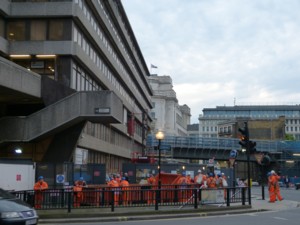
So this morning, for instance, while looking through some pictures I took earlier in the month of the remarkable (because so remarkably ugly) Baynard House, I came across this picture:
Yes, it is ugly, isn’t it? But what interested me when I took that photo was also all those Men in Orange. What were they up to? What struck me at the time, and I distinctly remember this feeling now, was what an alarmingly large number of Men In Orange there were. It was like they were making an action movie and about to be slaughtered by James Bond or by a James Bond imitator, or perhaps even plotting an urban atrocity of some sort themselves, for real. None of the photos I took of these many, many Men In Orange quite captures the scary oddity of them, congregated in such an alarmingly large number. The above snap was only the least unsuccessful from this point of view.
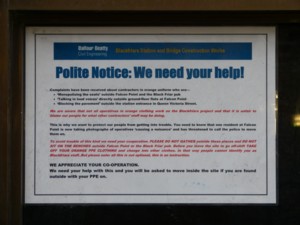
So it was that, when I encountered this sign on the side of Baynard House a few moments later, I was amused, and not wholly surprised:
Click to make that more legible.
What the Men In Orange are doing is some major rearranging of Blackfriars tube station. Blackfriars Station as a whole, including an overground railway station that straddles the Thames on Blackfriars Bridge, is being entirely reconstructed, and the underground bit with it. (I show a couple more shots of the overground aspect of all this activity here.) Merely the London Underground (LU) aspect of this is a big job, which requires the attentions of Men In Orange in large numbers.
The above snaps were taken when I was on my way to One New Change. The process of writing about One New Change caused me to forget my strange encounter with the Men In Orange, until prompted to remember the experience this morning, thanks to the magic of digital photography and the infinitely capacious hard drives that computers have in them nowadays.
SpaceX will try again for the one second launch window this monring at 03:44 am EDT; coverage will start at 03:00 am. The link is not yet up, I will add it here when I see it.
The link is here and will go live in about 1.5 hours from now.
Broadcast is live both at SpaceX and at NASA’s web site.
Falcon 9 launch flawless, Dragon capsule is in orbit, solar arrays deployed. Dragon is on its way to ISS! It is a new ballgame in space.
In all the discussion about the Greek exit from the Euro I see a lot about wealth and poverty; about whether more damage would be done to the economies of Greece, Europe and the world by “austerity” within the Euro versus a default and a return to the drachma.
These are the questions of cost and benefit that it is respectable for world leaders to discuss. Discussion gets heated, I hear – voices are raised and cheeks flushed with anger. But the thing that really sends the blood rushing to a Prime Minister or a Chancellor’s cheek is pride, not money. Pride matters. Pride, shame and “face” in the oriental sense set billions of Euros coursing this way and that in a way that mere economics could never manage. Greek pride finds German diktats hard to bear – but not so unbearable as facing the fact that Greece did not join the Euro but rather was let in by condescending officials who turned a blind eye to obvious lies, like a university turning a blind eye to plagiarism in order to keep up the diversity quota. The Germans were proud of their Deutschmark, prouder still of their own nobility in giving it up for the greater good (with a little frisson of shame at the sinful pleasures of that export boom), and this is the thanks they get?
Bitterest of all is the wounded pride of the Eurocrats. Their sure touch was meant to gently shape history as the potter’s touch shapes the clay. Only the clay slid off-balance on the wheel and it has begun the trajectory that will end when it hits the wall with an almighty SPLAT.
Shapers of history really hate almighty splats. Hurts their pride, you see.
I really hate shapers of history.
I have a sense that, if what writers such as Roger Kimball of Pajamas Media say is correct, that it will become more politically palatable for parts of the mainstream media to address the sensitive issue as to whether Mr Obama actually is, by the usual tests required of a POTUS, American.
“So now Chris Matthews isn’t the only one experiencing a little thrill when he thinks about Barack (omit middle name) Obama. The recent revelation that from the early 1990s until the day before yesterday—or, to be more accurate, until Obama made his decision to run for president—a biographical pamphlet circulated by his literary agents described him as having been “born in Kenya” has been setting the world of Twitter atwitter. What should we think about that? An agency spokesman who claims to have been responsible for the “born in Kenya” wheeze has publicly said that it was a mistake, a typographical error, a slip of the pen that just went “unchecked” for, um, sixteen-seventeen years. I can understand that. She meant to write “Hawaii” and wrote “Kenya” instead. Could happen to anyone. They look and sound enough alike, don’t they, that no one noticed. You meant to write “there” and you wrote “their” instead. You meant to write “cup” and you wrote “floccinaucinihilipilification” instead. No one—no one at the literary agency, not the author himself—could be expected to notice. You understand that, right?”
The article then goes on to address to the extent to which various records about Obama (medical and college stuff,) have been sealed. And one commenter on the PJM site had this observation:
“The curious thing isn’t so much that these things are all sealed, but that the sealing is so effective. If this had been any Republican, or any ordinary Democrat, these things would all have been on Wikileaks years ago. The CIA can’t keep secrets this well. Not even the Mossad.”
But in the end, how much of this stuff about “Who is Barack Obama?” matters. He’s been in the job for four years. Although his period of office coincided with the very welcome disposal of Bin Laden, I cannot really think if a single serious positive accomplishment by Obama during his time in office, although I suppose his greatest might be his unintended one: the birth of the Tea Party movement, and an associated invigoration of the small government, libertarian strain within the Republican Party (well, even that might be debatable). Whatever doubts I might have about Mitt Romney, I just cannot go along with the idea of “to save the village we must destroy it” point of view, nor do I think we can finesse the situation if Obama wins, as argued by Tim Sandefur recently. (I don’t share Tim’s fear that we will see a dramatic loss of freedoms to the religious right, although I suppose anything is possible).
|
Who Are We? The Samizdata people are a bunch of sinister and heavily armed globalist illuminati who seek to infect the entire world with the values of personal liberty and several property. Amongst our many crimes is a sense of humour and the intermittent use of British spelling.
We are also a varied group made up of social individualists, classical liberals, whigs, libertarians, extropians, futurists, ‘Porcupines’, Karl Popper fetishists, recovering neo-conservatives, crazed Ayn Rand worshipers, over-caffeinated Virginia Postrel devotees, witty Frédéric Bastiat wannabes, cypherpunks, minarchists, kritarchists and wild-eyed anarcho-capitalists from Britain, North America, Australia and Europe.
|






Recent Comments