We are developing the social individualist meta-context for the future. From the very serious to the extremely frivolous... lets see what is on the mind of the Samizdata people.
Samizdata, derived from Samizdat /n. - a system of clandestine publication of banned literature in the USSR [Russ.,= self-publishing house]
|
The state funded Great Britain team has (by perception) done extremely well at the London 2012 Olympics. As a consequence (?) there are calls amongst politicians and sports bureaucrats to make competitive sport compulsory for children.
The state funded Australia team has (by perception) done extremely badly at the London 2012 Olympics. As a consequence (?) there are calls amongst politicians and sports bureaucrats to make competitive sport compulsory for children.
I have a standing personal rule that whenever someone proposes compulsory activities for children that are implied to be wholesome – particularly if they involve going outdoors and running around in some way – I should immediately compare them to the Hitler Youth, on the basis that the comparison is always fair. So consider it compared.
The world’s energy problem seems to have been solved, but governments do not seem to have noticed.
– Madsen Pirie
Peter Schiff is an economics guru held in high esteem by several of my libertarian acquaintances, and he is is starting a gold-based bank.
The good news:
You can open accounts in dollars or gold bullion at the new Euro Pacific Bank Ltd, launched by Peter Schiff. this is an awesome idea
You can even get a “gold debit card” that you can use anywhere in the world. It’s backed by actual gold, which converts to whatever currency you’re needing at the time you visit an ATM.
The bad news:
There’s one catch if you are an American: you can’t open an account at this bank if you’re a U.S. citizen.
U.S. security laws have become so intrusive, burdensome, and expensive to comply with, that it made it difficult for Schiff to offer the services in the U.S. So, Schiff opened his bank offshore, in St. Vincents and the Grenadines. It operates outside the jurisdiction of U.S. security regulations, and does not accept accounts from American citizens or residents.
In the comments on my previous posting here, about what went wrong and when, much was made of the idea that in addition to knowing what went wrong it would help a lot if we can also say how to put it right.
Personally, I believe that “politics” is never going to sort this mess out, certainly not politics alone. What might is people just recreating the gold standard on a freelance basis, by such means as joining in with enterprises of the sort described above.
Yes, governments can shut such things down, as the above report makes abundantly clear. But if large numbers of people start placing side bets in enterprises of this sort, then it starts to become politically hazardous to just forbid such arrangements.
One of my favourite slogans just now is: “This isn’t gold going up; it’s the dollar (the pound, the euro, the yen, the whatever) going down.” That is because I consider this to be the basic idea behind a non-state imposed (which is the good kind of) gold standard. When large numbers of people measure state fiat currencies by how badly they do against gold, rather than gold by how “well” it is doing against this or that collapsing currency, then that is surely the beginning of the end for these currencies.
One of my understandings of the current financial mess that the world is in concerns when the various contending diagnosticians think that the rot set in. The earlier the more Austrianist, seems to be the rule.
Instapundit recently linked to a piece by James Pethokoukis concerning the diagnosis offered by Robert Hetzel.
Hetzel thinks the problems only got seriously serious around 2008. Until then, it had been a bit up and down, but nothing that bad. But then, in 2008, the Fed, and central banks the world over, adopted money supply policies that were too restrictive. By not creating enough more money at that moment, the Fed turned a little temporary difficulty into a far bigger difficulty.
I’m not an expert on this stuff, but this is similar to what Milton Friedman et al said about what triggered the Great Depression, is it not? Hetzel is, I presume, some kind of Friedmanite Monetarist. He reckons he knows exactly how to skipper the nationalised industrial ship that is money. I reckon he doesn’t.
For if Detlev Schlichter and the other Austrianists are right (I think they are), the rot set in a long, long time before 2008. The idea that, if things had been handled just that little bit more deftly in 2008 all could have been well – bar a slight bump or two – is just wrong. The world by then was full of bad investments, and these investments were – are – going to have to be liquidated if the world economy is ever going to start motoring again. Encouraging even more bad investment, which is what Hetzel is saying should have been done, would only have made the grief still to come that much more grievous.
Whether James Pethokoukis agrees with Hetzel with anything resembling the vehemence with which I disagree with Hetzel, I do not know. Perhaps he just wants an excuse to blame everything on President Obama.
But if the Austrianists are right (they are – reprise), it goes way back, to Nixon and before, to the very creation of central banks as a means of sucking wealth out of economies (traditionally to wage war) without people getting the chance to complain too loudly in some sort of parliament. The idea that Obama, or for that matter George W. Bush, could have entirely solved the world’s present financial problems, i.e. solved them without any political grief, is absurdly mistaken. They could make it worse and they both did, with only a bit less Hetzelism than Hetzel now thinks they should have perpetrated. The idea that, with one Hetzelian bound, they could have freed us all from any grief is crazy.
As is the idea that dumping Obama and replacing him with someone less malevolent, anti-American, socialistic, Christian, atheist, Muslim, environmentalist, Chicagoan, incoherent, lazy, golf-loving, devoted to black magic (take your pick), will fix everything.
In my opinion dumping Obama would be better than not dumping him. But doing this could merely be the difference between jumping off the cliff instead of sliding down it.
This is 1912 I am referring to (of course), when Britain had ended up behind the United States and Sweden, and not more recent times. A certain Sir Arthur Conan Doyle (who you may have heard of) is particuarly upset:
All who have our reputation as athletes at heart owe a debt of gratitude to you Correspondent at the Stockholm Games for his very clear and outspoken comments on the situation. We can now see the causes of past failure.
But he has a solution:
1. The first is the formation of a British Empire Team…
Like the Australians know anything about winning at the Olympics. Ha!
Actually, Sir Arthur is kinda sorta touching on, what is, in 1912, for Britain, a worrisome issue. Britain’s lead is slipping. France, Germany and the US are all catching up. Meanwhile, the colonies, especially Canada and Australia, are becoming less dependent on the Mother Country. Britain wants to retain some influence without getting into the same mess it got into with the Americans. Hence ideas are being floated for a combined tariff wall, a combined defence staff and (in this case) a combined Olympics team. They won’t work, of course, but Britain does, at least, manage to avoid a war of colonial repression. And the colonies manage to show up on time for the world wars.
The Times, Tuesday, Jul 30, 1912; pg. 6
Almost a SQOTD, but Guy beat me to it:
The technical and economic advantages of coattailing on the economies of scale of the trillion-dollar mobile-phone industry are astounding. If you want to understand why the personal-drone revolution is happening now, look no farther than your pocket.
That is Chris Anderson in Wired writing about how automated flying aircraft happen to need just the same sensors and processors that are found in smartphones, and hobbyists and increasingly serious people like farmers surveying their crops are taking advantage of this.
I suspect his first sentence applies more generally.
If you think £2m for a project without any policy implications is expensive, just imagine how expensive it would have been with policy implications.
– The IEA’s Kristian Niemitz on the Office for National Statistic’s venture in ‘happiness research’.
Earlier this year, I bought myself an FZ150. But now there’s an FZ200.
And the torture begins:
While in 2002 the 12x FZ10 had a maximum aperture of F2.8 across its entire zoom range, the 24x FZ150 in 2011 only offers this setting at its wider zoom positions. At the long end of the lens the maximum aperture is reduced to F5.2 which, in combination with the limited high-ISO capabilities of the small sensors typically used in superzooms, makes shooting at long focal lengths a difficult task in anything less than perfect light.
Now they tell me.
However, with Lumix DMC-FZ200, Panasonic has executed a veritable engineering coup by creating the first Lumix superzoom since 2004’s FZ20 to come with a F2.8 maximum aperture across the entire zoom range. And, unlike the 12x, 36-432mmm equivalent range of the FZ20, the FZ200 maintains F2.8 on a 24x, 25-600mm equivalent lens.
In combination with the newly-developed 12MP MOS sensor, this makes the FZ200, at least on paper, by far the best choice in the superzoom segment for low light shooting. That large aperture allows it to offer faster shutter speeds at the same ISO settings as its peers, or use lower sensitivities at the same shutter speeds as the competition.
Is this why some people hate progress?
The thing is, my FZ150 is the best camera I’ve ever owned.
And now there is a better one.
Incoming:
Dear Samizdata,
Defense Distributed, a libertarian student partnership, is announcing a project they’re calling the Wiki Weapon. This project’s goal is to test and prove a design for a completely printable, one-use ABS plastic .22 handgun, and to take that design from CAD and port it to a .STL file that will then be freely shared across all major file-sharing platforms to the world. DefDist is anticipating a world where 3D printing becomes much more economical and ubiquitous, and the Wiki Weapon will be one step in providing political and personal leverage to the peoples of that world. The value of such a file’s existence in the future cannot be overstated.
We ask that you please share the project or its video, located at http://PrintableGun.com and http://Indiegogo.com/wikiwep, with your readers and help spread the word that there are intellectual entrepreneurs dedicated to preserving Liberty in a time of almost unopposed statist planning.
Please find the attached press release for your convenience.
Thank you for your time.
You’re welcome.
Nepal to ban independent trekking. Public safety, job creation and ‘stimulus’ all in one; how long before other nations follow Nepal’s lead?
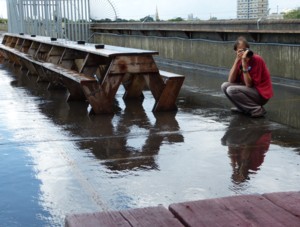
Yesterday some Samizdatistas met up on the roof of a multi-story car park in Peckham, where there just happens to be a semi open air restaurant (i.e. open air but under a canvass roof), which operates over the weekends of the summer. I first blogged about it here, but never since, I now realise, even though this is not the first time we’ve all met there. It is a splendid place, which looks like this:
That shot was taken during a favourite photography time: during sunshine, after rain. The rain cleans the air, and the sun then shines through it, to delightful effect.
Believe it or not, that cement muddle thing in the foreground is Art. But it was Art that was really suffering from the rain. Art in the outdoors shouldn’t do that, should it? Well, maybe it would be better if quite a lot of outdoor Art did just get rained out of existence, like a sandcastle being washed away by the tide (and many a sandcastle has deserved better than that).
And boy did the rain rain. Rain is not easy to photo, in my experience, but this rain was so violent that, what with the marginal cost of digital photography being zero, I just snapped and snapped, hoping I’d get lucky.
And I did:
I wasn’t the only one of us taking photos:
That’s Rob Fisher, whose wife and young son were also present, which made it all a lot more fun. → Continue reading: Sunny intervals and scattered showers – as seen on a roof in Peckham
What have you failed to find on the internet that you expected to be there?
|
Who Are We? The Samizdata people are a bunch of sinister and heavily armed globalist illuminati who seek to infect the entire world with the values of personal liberty and several property. Amongst our many crimes is a sense of humour and the intermittent use of British spelling.
We are also a varied group made up of social individualists, classical liberals, whigs, libertarians, extropians, futurists, ‘Porcupines’, Karl Popper fetishists, recovering neo-conservatives, crazed Ayn Rand worshipers, over-caffeinated Virginia Postrel devotees, witty Frédéric Bastiat wannabes, cypherpunks, minarchists, kritarchists and wild-eyed anarcho-capitalists from Britain, North America, Australia and Europe.
|








Recent Comments