We are developing the social individualist meta-context for the future. From the very serious to the extremely frivolous... lets see what is on the mind of the Samizdata people.
Samizdata, derived from Samizdat /n. - a system of clandestine publication of banned literature in the USSR [Russ.,= self-publishing house]
|
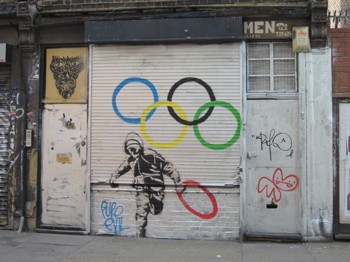
I’m at least a week late with this picture (illness blah blah), but it remains one of my favourite Olympics images, snapped by one of my favourite bloggers, Mick Hartley:
Suddenly I heard myself asking: Yes, why couldn’t those damn rioters have waited until the Olympics? Not really, but I did think it. (What I really think is that rioters shouldn’t. And before anyone says, it’s different if all you do is call yourselves a Riot and play noisy tunes.)
But to take my question seriously, I suppose rioters can tell when they’ll be allowed to run riot for a little while, and when they absolutely will not. Had they tried anything seriously wicked during the Olympics, they would have been crushed without mercy, the crushing egged on by the very people who, during and after the actual riots, were most sympathetic towards the rioters.
Interestingly, a little two-part BBC2 TV show about the riots was billed in the Radio Times to be shown just before the Olympics. But then it was postponed.
“People who do otherwise commendable work are capable of rape and other crimes. If presented with rape allegations, they must face them like anybody else, however otherwise worthy their past contributions. Now, these statements should be so self-evidently obvious, it is ludicrous that they need to be said. But the furore over WikiLeaks founder Julian Assange sadly makes it necessary. Although now granted political asylum by Ecuador, Assange is a rape suspect who skipped bail. Yet some of his supporters have ended up making arguments that they would never dream of making about anybody else.”
– Owen Jones, writing in the Independent. He is, by the way, a big fan of Wikileaks. I am not so keen, as I have explained here before at Samizdata, such as when Wikileaks affected private bank details.
Here is also a good article on the impact of Wikileaks’ activity on investigative journalism, by Nick Cohen.
Update: George Galloway has, er, tried to defend Assange. With friends like Galloway, Assange doesn’t need enemies.
Photoed by me in Vauxhall Bridge Road, earlier this week:
I liked this enough when I first set eyes on it to snap it up, and that was two days before I even noticed the “we’ve got one ‘ere” bit. Like I always say, my camera regularly sees more than I do.
Website here.
I was surprised to discover today (unless I have been more than usually let down by my internet searching “skills”) that this, by Douglas Adams, has never been mentioned here at Samizdata before:
“On its world, the people are people. The leaders are lizards. The people hate the lizards and the lizards rule the people.”
“Odd,” said Arthur, “I thought you said it was a democracy.”
“I did,” said Ford. “It is.”
“So,” said Arthur, hoping he wasn’t sounding ridiculously obtuse, “why don’t the people get rid of the lizards?”
“It honestly doesn’t occur to them,” said Ford. “They’ve all got the vote, so they all pretty much assume that the government they’ve voted in more or less approximates to the government they want.”
“You mean they actually vote for the lizards?”
“Oh yes,” said Ford with a shrug, “of course.”
“But,” said Arthur, going for the big one again, “why?”
“Because if they didn’t vote for a lizard,” said Ford, “the wrong lizard might get in.”
That’s from So Long And Thanks For All The Fish. In the place I found it on the www (see the link above), it does not say on what page.
I was reminded about this snatch of dialogue by a recent episode of the BBC Radio 4 show Quote Unquote. A lady participant said she thought Douglas Adams very wise and very funny, this quote in particular. I post it here as a corrective to today’s SQotD, below, in which Paul Ryan says something good, thereby proving himself to be a more likeable lizard than nasty lizard Obama and his lizard gang.
But, alert readers will note that this is a classic example of a piece of writing that will have everyone nodding, but each thinking his own thing. It’s like if you say you favour “common sense”, “principled government”, or “democracy“. Each person listening to you agrees. Each has his own distinct idea about what each phrase means, in ways that often wildly contradict the ideas in the heads of his nodding neighbours. All agree, that these are fine things. Far fewer actually do agree about anything of substance.
For some, reading the Adams quote above, the lizards in charge of us are too capitalist inclined, for others they are insufficiently capitalist inclined. Some want the lizards to be keener on policy X, others curse the lizards for being insufficiently opposed to policy X. All agree only in being unsatisfied with the rule of the lizards, and that the lizards are indeed lizards.
Which is one reason why the lizards usually survive and thrive. We, their victims, can so very rarely agree amongst ourselves about what species, or indeed if any species, ought to replace them.
Life, liberty and the pursuit of happiness, and the government doesn’t define what happiness is. You do.
– Paul Ryan, quoted in this report.
What do our American commenters make of this guy?
He seems to make a lot of good noises, which I think is a hell of a lot better than no good noises. Put it this way, if America did not now vote for these good noises, that would really be a disaster, I think.
I am now recovering from an illness. While ill, the only thing I could manage to pay much attention to, other than the various pains in my head, was the Kevin Pietersen Affair, the contemplation of which, to an England cricket fan like me, is a not dissimilar experience to that of being ill.
Today at Lord’s, the sacred home of cricket, England are embarking on the third and final game in their five day test cricket series against South Africa, but without Kevin Pietersen. Pietersen scored a brilliant century in the previous game. But no, he is not injured. He has been dropped.
Pietersen sent out disloyal tweets about the England captain and coach, for which transgression he did apologise, but too late. You can read the details, in the unlikely event that you want to, in media reports like this one, where phrases like “underlying issues on trust and respect” appear.
Where my interest in all this (I could write about it for ever) and the interest of Samizdata readers (who would presumably prefer me to keep a lid on it) may overlap, or so I hope, is in the big picture background to all this. Which is, in a word: India.
From time to time, usually, as now, from a writer trying to use such circumstances as a metaphor, you read about planetary objects being subjected by much heavier objects in their vicinity to gravitational forces so severe that different parts of the smaller planetary object start to be pulled in different directions, perhaps so severely that the smaller object threatens to fly into pieces. This is what is now happening to cricket in England, under the influence of that much larger cricketing object, cricket in India. Cricket is now like a solar system, and the quite big planet that is England cricket is being yanked about by the gravitational forces being exerted upon it by the Sun. And that Sun is: India.
The background to the argument between Kevin Pietersen and the E(ngland and Wales) C(ricket) B(oard), the people who run the Engand cricket team, is that Kevin Pietersen desires to be both an England international cricketer, and also to maximise his income (and also enjoyment and ego-massage) from cricket by all other available means, while nevertheless contriving somehow not to drop dead from physical and mental exhaustion. In particular, Pietersen yearns to be both an England cricketer and a fully paid up (very well paid up indeed) player in the Indian Premier League, the Indian twenty overs tournament that takes place in April and May of each year.
The ECB treats the IPL as just another foreign cricket league, concerning which they need to care very little. It’s a nuisance to their arrangements, but no more. They do not – or such seems their attitude – need to contrive any “window” to allow England cricketers to neglect their early season England cricket in order to cash in from a meaningless foreign slogfest, and then allow them time off from England games, or preparations for England games, so that they can avoid becoming completely exhausted. They pay England players well, and that should be quite enough, is their attitude.
But for any cricketer good enough or lucky enough to get a contract to be part of it, the IPL can be the difference between an anxious transition, when the time comes, from professional sport to the rigours of real life, and being financially secure for life, especially if he does well in it and gets asked back several times. During the limited time when Pietersen was able to play in this year’s IPL (he had to leave before the tournament ended), he did very well, scoring another brilliant century, for the Deccan Chargers Delhi Daredevils.
The over-arching fact about cricket now is that the IPL is not just another tournament in a faraway country. It is the first great assertion in the cricket world – the cricket world – of the massive economic power of Indian cricket fandom. As I never tire of saying in my various cricket blog postings, there are more cricket fans in India than there are people in Europe. I remember when the millions of India were famous only for starving. Now, these same millions are striding towards twenty first century affluence. And they are taking cricket with them.
If India really, really wants to watch you play twenty twenty cricket for a month and a half, at a time when cricket in England is only getting started in weather that is often vile (despite anything the Met Office may have told cricket people about such months getting warmer), then if you are a cricketer, you really, really want to say yes. → Continue reading: Kevin Pietersen and the rise of India
No long review.
Just whose fault the peril Gotham (not New York – honest) was. Indeed the peril of Western civilization.
Many people – but three billionaires spring to mind
One obsessed with money – no honour, good sense undermined by greed (leading to consequences he did NOT want). Jamie Dimon and so many others who supported for Obama for corporate welfare?
One with utterly perverted idealism – the George Soros figure. Secretly financing and organizing the Occupy Movement (and worse).
And the good billionaire – who has given up on the world, hiding with his bad memories in his house (thus leaving the world to the evil).
Greed.
Collectivism.
Despair.
A Reuters columnist says that markets have yet to face up to the fact that there could soon be a “glut” of oil. In other words, the scarcity-mongers are mistaken.
“A final conclusion to draw from the next oil revolution is a little more existential. This is yet another reminder that what both common sense and expert consensus assure us to be true very often isn’t. It was obvious that efficient markets worked and financial deregulation would stimulate economic growth, until the financial crisis and the subsequent international economic recession. It was equally apparent that we were running out of oil – until we weren’t.”
Quite. In these depressing times, it is easy to miss the positives.
As it is holiday season, this item – via Instapundit – got my attention. It is about why some kinds of travel guides tend to be mealy-mouthed about some of the countries they write about:
“There’s a formula to them: a pro forma acknowledgment of a lack of democracy and freedom followed by exercises in moral equivalence, various contorted attempts to contextualize authoritarianism or atrocities, and scorching attacks on the U.S. foreign policy that precipitated these defensive and desperate actions. Throughout, there is the consistent refrain that economic backwardness should be viewed as cultural authenticity, not to mention an admirable rejection of globalization and American hegemony. The hotel recommendations might be useful, but the guidebooks are clotted with historical revisionism, factual errors, and a toxic combination of Orientalism and pathological self-loathing.”
There is a related point, also. When I occasionally read of how a region or place is “unspoilt”, it often is just an aesthetic comment that area X or Y has not been buggered up by ugly buildings. Fair enough. Even the most ardent defender of laissez-faire does not have to like all the consequences of some buildings. But there is a danger that this can sometimes tip over into a dislike of building and human activity per se. To take one example: I love certain big cities precisely because they are “spoilt” by the energy and sometimes crazy creativity of the people who live in them and build them.
This whole notion of loyalty to one’s country really has no meaning whatsoever, since countries always change, just as do people who live in them. The only loyalty worth anything is that to one’s values and principles.
– commenter Alisa
Now that the likes of yours truly are back from holiday to a post-Olympic London, I have been reading about the number of people who noted how quiet London (outside the Games areas) has been. Tranquil streets, empty restaurants, that sort of thing. It appears that the authorities, such as Transport For London, did a “good” job, in a way, in putting the fear of God into the domestic populace. Janet Daley writes:
“What I had not anticipated was that the spectacularly effective campaign of advance warnings and threats to London’s travelling public would cause so much of its working population to abandon the capital. Thus the evacuation of traditionally depressive, harassed, exhausted Londoners made way for the arrival of a lot of rather sweet, smiley people who turned the city into a very jolly and, momentarily, carefree place.”
I am very pleased the event has gone off well. Not least because there were not (unless it has been kept secret) any major security problems at the Games. Lots of sportsmen and women had a grand old time, the capital looked pretty good to outsiders, etc.
The last two weeks does certainly prove that if certain organisations want to convince Londoners that they should get out, they will. Holding the Games in August also helped. And the terrible summer weather leading up to the Games also encouraged a lot of us to hit the airports and railway stations. I may have missed some of the buzz of Olympic London, but the lovely countryside and weather in Southwestern France more than compensated for it.
There is, of course, the matter of the cost of all this. To borrow from Frederic Bastiat, the French economics and legal writer, we can all see the benefits of shiny new stadiums, swimming pools and cycle tracks. That is seen. What is not seen are the things and services that will not be supplied or made due to the taxes and other charges imposed to make the Olympics happen. There are no photos of entrepreneurs whose business plans might be stillborn from such costs, for example. I doubt whether Lord Coe or other Olympic grandees gave much thought to the opportunity costs of such events, or cared. And the insights of Bastiat apply to other “eye-catching” projects: space flights, high speed rail, big aircraft carriers, etc.
Anyway, I am not going to rain on the parade of what appears to have been a successful event. But being the Adam Smith libertarian that I am, it would be remiss not to remind fans of big sporting jamborees that these things have a cost, and the costs will be borne by those quite different, sometimes, from the beneficiaries.
I used to consider myself a patriot… no more. There is simply nothing to be proud about and we have the government the voters deserve. But I didn’t leave England, England left me.
– Thaddeus Tremayne, overheard over dinner.
|
Who Are We? The Samizdata people are a bunch of sinister and heavily armed globalist illuminati who seek to infect the entire world with the values of personal liberty and several property. Amongst our many crimes is a sense of humour and the intermittent use of British spelling.
We are also a varied group made up of social individualists, classical liberals, whigs, libertarians, extropians, futurists, ‘Porcupines’, Karl Popper fetishists, recovering neo-conservatives, crazed Ayn Rand worshipers, over-caffeinated Virginia Postrel devotees, witty Frédéric Bastiat wannabes, cypherpunks, minarchists, kritarchists and wild-eyed anarcho-capitalists from Britain, North America, Australia and Europe.
|






Recent Comments