We are developing the social individualist meta-context for the future. From the very serious to the extremely frivolous... lets see what is on the mind of the Samizdata people.
Samizdata, derived from Samizdat /n. - a system of clandestine publication of banned literature in the USSR [Russ.,= self-publishing house]
|
If you doubted that the €uropocalyse was at hand…
French President Francois Hollande has declared an end to the eurozone debt crisis, which has gripped the region for the past four years.
… well everything is going to be okay after all then! Thank goodness for that!

Facebook, Google etc are falling over themselves to deny that they have given the US espionage organisation the NSA direct access to their servers and customer information.
And to put it bluntly, there is simply nothing they can say that would make me believe them.
Why? Three reasons:
Firstly, it is very much in their commercial interest for customers not to take the view that their personal information can be browsed pretty much at will by American civil servants for whatever reason they can contrive.
Secondly, very few people within Facebook and Google would actually be privy to any involvement with PRISM, so much of the shock being expressed will no doubt be genuine (I know some quite highly placed technical people within both Google and Facebook and I would totally believe them if they told me to my face they found this all hard to believe, but then none of them are at board level, so unless they needed to know…).
Thirdly and most importantly, the court orders giving blanket access include threats if they reveal they are cooperating with the court order. In short, they are required by law to lie about their cooperation if asked.
IT IS FURTHER ORDERED that no person shall disclose to any other person that the FBI or NSA has sought or obtained tangible things under this Order, other than to: (a) those persons to whom disclosure is necessary to comply with such Order; (b) an attorney to obtain legal advice or assistance with respect to the production of things in response to the Order; or (c) other persons as permitted by the Director of the FBI or the Director’s designee.
So it really does not matter what Facebook and Google et al says, does it?
UPDATE: This is a very interesting suggestion… in short, once they got Verizon (i.e Tier One) they actually did not need much cooperation from the people downstream. Fascinating stuff. I wonder to what extent that is actually true.
Over the years in which climate change has been discussed in the media, there have been continual suggestions that it will be of benefit to gardeners – allowing us to grow fruit and vegetable crops that enjoy the continental climate, but fail to thrive in a traditional British summer. As those warm summer days have failed to materialise, and look increasing unlikely, I am eyeing up my new allotment with a view to planting crops that will enjoy our cool climate.
– The opening paragraph of a piece by Emma Cooper entitled Crops for a cool climate, quoted by the ever alert Bishop Hill.
The truth about Global Warming (that there has not been any lately) is starting seriously to circulate.
Eventually, when enough of it has been laid end to end, weather is climate.
From a security point of view, the trouble with cloud-based applications and closed source software in general is that you can never tell whether there are flaws that will leak your information or even back doors put there deliberately to allow third parties to get at it.
Open source software gives you many advantages.
You can understand exactly what the software will do when run. Strictly speaking you can understand what any software does, but source code written in a high level language serves the purpose of both telling the computer what to do and telling humans what the program is intended to do. This is because classes, functions and variables in the program are given English names. Programmers may even write comments in the source code to annotate it. The names and comments may be misleading but this becomes apparent when you look at what code does as a whole. If you can not personally understand the program, you can be reasonably sure others do. One thing that gives me confidence is that previous flaws have been found and fixed.
You can be sure you are running the same software you have gone to the trouble of understanding because you can compile it yourself. You can compile the user applications, libraries, operating system kernel, drivers and even the compiler yourself if you want. More usually you will entrust most of this work to others such as Linux distributions. Programs downloaded from such sources are cryptographically signed. Becuase the source code is available anyone can check that the source code produces the same program that is provided pre-compiled.
So there is little likelihood of a back door in open source software. Linus’s Law states that many eyes make bugs shallow. This means that bugs in open source software, especially the most important and most widely used open source software, get fixed quickly. In The Cathedral and the Bazaar, Eric Raymond described how the Linux style of development leads to superior code quality. All this means there is less likelihood of accidental leakage of your secret information.
Should they decide they do not like us encrypting our files or obscuring our online activity, it would be very hard for authorites to take open source software away. The nearest they have got is the Consumer Broadband and Digital Television Promotion Act which was intended to protect music companies who wanted to put DRM into music by making trusted computing compulsory. The idea was that computers would be required to have a special chip that would only let them run programs that would be cryptographically signed by some authority. You would not be able to run your own programs.
The bill got nowhere and such laws are unlikely to because open source software is so ubiquitous. It runs the Internet. Samizdata runs on a computer running the Linux kernel using GNU libraries and uses an open source web server, database and blogging software written in languages compiled by open source compilers and interpreted by open source interpreters. So do everyone else’s web sites. Most of the electronic gadgets in the world that have any software at all have open source software in them, including phones and TVs. None of this is going away.
As much as Google and Microsoft have brands to protect, if the government makes laws big companies have to follow them. Governments have no such hold over open source programmers who are geographically, organisationally and ideologically dispersed.
The people who write GNU Privacy Guard or OpenSSL are not going to put a back door in their software. If they did it would be spotted and someone could simply fork the project.
It is possible that certain algorithms have mathematical back doors and that the NSA has hired all the people clever enough to find them. It is possible that the NSA tried this with a cryptographic random number generator and were caught out. We can be somewhat confident that the NSA can not break AES encryption. There are other encryption algorithms available.
Nothing is certain, but open source software gives us some control over our computers and some defense against governments that closed corporate software never can.
When I read this…
US spy chief James Clapper has strongly defended government surveillance programmes after revelations of phone records being collected and internet servers being tapped. He said disclosure of a secret court document on phone record collection threatened “irreversible harm”.
… my first reaction was “Irreversible? I certainly hope so”.
The flood of revelations about the sheer scale of NSA information theft… direct server access without an individual court order whenever the NSA wants something from Microsoft, Google, Yahoo, Facebook, Skype*, PalTalk, YouTube, AOL and Apple… has made me wonder if savvy non-US based business might not be able to market their services as explicitly non-US.
Just imagine the possible tag lines:
“Don’t worry, the NSA does not have easy assess to your data as we are not a US based or owned company”
…or tapping into a bit of anti-Americanism never hurt the bottom line…
“We are not located in the ‘Land of the Free, Home of the Brave’, so your data cannot be browsed at will by unaccountable NSA spies!”
… which is not to say such services cannot be marketed to Americans…
“Non-US nationals across the world are not protected by the US constitution, come to think of it, neither are Americans in America, so your data is safer with us as we are a NON-US owned and NON-US based company!”
The creative possibilities are endless and anyone who cannot leverage this into internet gold is not trying hard enough! Capitalism for the win!
*= Skype, originally a Luxembourg based company, was purchased by eBay in 2005 and then Microsoft in 2011.
The media and blogosphere are abuzz with the astonishing info-grab by the US government…
The National Security Agency is currently collecting the telephone records of millions of US customers of Verizon, one of America’s largest telecoms providers, under a top secret court order issued in April.
The order, a copy of which has been obtained by the Guardian, requires Verizon on an “ongoing, daily basis” to give the NSA information on all telephone calls in its systems, both within the US and between the US and other countries.
The document shows for the first time that under the Obama administration the communication records of millions of US citizens are being collected indiscriminately and in bulk – regardless of whether they are suspected of any wrongdoing.
I assume the Guardian got this information because someone inside Verizon said “fuck this” and leaked it. I also hope the Guardian has the ghoolies to well and truly protect their source.
How to tell when a politician is lying about freedom of expression: the key is the use of the word ‘but‘…
Newport city councillor, Majid Rahman said: “I believe in freedom of speech and defend his rights to say what he wants, but once it starts offending people then it’s a police matter and it’s up to them whether they think it’s broken any laws.”
… the first fifteen words are negated by everything after the ‘but’, which is to say Newport city councillor Majid Rahman very explicitly does not believe in T-shirt printer Matthew Taylor’s freedom of speech and rights to say what he wants. No, he believes in state regulated speech enforced by the police and that he is only ‘free’ to say things that do not offend certain categories of people. And that is not freedom of speech.
Personally I would like to see Newport city councillor Majid Rahman arrested and thrown in jail, not because he offends me (although such view do indeed offend me) but because a politician threatening people with the police because of a T-shirt should be regarded as a crime. Do you think if I called up the Plod in Newport and complained that might happen? 😉
If I was Matthew Taylor I would say “Get stuffed you nasty little thug, it stays in the window and if you don’t like that, I suggest you arrest me and charge me so we can run this past a jury of my peers.” I know quite a few people who would be able to find a pro bono lawyer who would delighted to take such a case.
At around midday today I caught Ed Davey MP babbling away on the telly about how 97 percent of climate scientists agree with him about the need to wreck the British economy and treble our fuel bills by making carbon illegal, or whatever. The BBC person present complained that Davey wasn’t doing nearly as much to wreck the British economy and treble our fuel bills as he should have been doing, and that what he was saying was merely bluster to comfort greeny true believers. It would certainly be nice to think so.
Peter Lilley MP, also present, had plenty to say about these absurd claims, but the word – just the one word – that he used that I remember most fondly was: Tosh.
Later in the day, on a tube train, I learned of better British economy and energy bill news, in the form of this City A.M. front page:
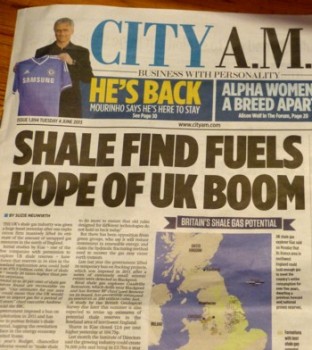
Here is the front page story.
Quote:
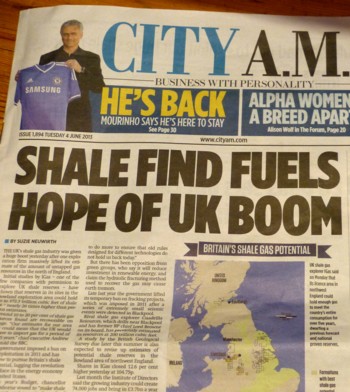
THE UK’s shale gas industry was given a huge boost yesterday after one exploration firm massively lifted its estimate of the amount of untapped gas resources in the north of England.
Initial studies by IGas – one of the few companies with permission to explore UK shale reserves – have shown that reserves in its sites in the Bowland exploration area could hold up to 172.3 trillion cubic feet of shale gas – nearly 20 times higher than previous estimates.
My favourite paragraph of this story is this one:
But there has been opposition from green groups, who say it will reduce investment in renewable energy, and claim the hydraulic fracturing method used to recover the gas may cause earth tremors.
Anything that reduces invetment in “renewable” energy, which is the stupid kind, is all to the good. As for those earth tremors, bring them on.
City A.M. Editor Allister Heath starts what he has to say about Britain’s shale bonanza with this question:
What are we waiting for?
Waiting, presumably, for the likes of Ed Davey MP to be dumped into the dustbin of history where they belong.
The British government wants to “eradicate undernutrition globally”. It has a department for it. This can not be good. There is also a committee of MPs who have released a report.
There is an argument in the report that since the population is expected, by Benny Dembitzer as far as I can tell, to increase to 9.3 billion people by 2050, and since consumption of meat is increasing, that there is going to be a general food shortage. Meat is singled out for being an inefficient use of resources. From the report:
Simply urging the Western world to stop consuming meat is neither feasible nor desirable. Moreover, nor is it necessary: meat production based on pasture-fed systems (e.g. pasture-fed cattle), as opposed to the mass production of grain-fed livestock, is markedly less problematic.(69) The Food Ethics Council therefore suggests a ‘less but better’ approach, with meat promoted as a occasional product rather than an everyday staple.(70)
Note that the Food Ethics Council is funded mostly by the Joseph Rowntree and Esmee Fairbairn charitable trusts. Even private organisations can be wrong.
So why is pasture livestock “less problematic” than grain-fed? Note 69 points to question 62, part of a series of testimonials which seem to make up most of the evidence used to make the report. I’ll highlight the most fun bits.
Q62 Fiona O’Donnell [committee member]: Finally, as carnivores, can we keep consuming meat in the way that we are? It is probably a rhetorical question.
Tim Lang [Professor of Food Policy, City University, London]: Is the “we” here? Do you mean us?
Fiona O’Donnell: Yes.
Tim Lang: The rich world, no. Let me be very hard, and I will speak now as a public health man. The case or reducing meat consumption in the West from our astronomic levels is overwhelming; it is a public health gain if you reduce it. The report that I led and that Oxford University and others fed into, on food security and sustainability and on sustainable diets, showed that there is a win-win for the environment and for public health if you reduce our meat consumption. It is not meat qua meat; it is processed meat. The evidence there is getting stronger and stronger.
Camilla Toulmin [Director, International Institute for Environment and Development]: It is also intensive livestock production.
Tim Lang: Exactly. You will get agreement from us. In our world, the three of us and the previous panel, we are worried about this assumption that 50% of grain or 40% of grain to the world must be diverted down the throats of animals to then give us meat. There are cases when that can be useful, depending on the climate. To factor in a meat engine, which is like a juggernaut driving our definition of what a good food system is, is crazy. It is a crazy use of resources, it is crazy economics and it is crazy public health.
Andrew Dorward [Professor of Development Economics, School of Oriental and African Studies]: Can I just add two things to that? Firstly, I would broaden it to livestock production. For example, butter is not very good for us either and eating too much cheese makes for the same sorts of problems. In terms of livestock production, it is basically the consumption of grains in intensive systems that is bad. Where you have more extensive systems, where you have pastoral systems and where you have more extensive upland systems in the UK, it is a different argument. For the intensive grain systems, the health and the environment, the food security and the water demand arguments are really overwhelming.
It is mostly incoherent ranting. Are they arguing for less intensive farming of animals to solve the problem of too much meat consumption, or something else? I’ll see how far I can get by assuming that this is about using resources in the most efficient way.
It seems to me that if people are hungry they will start to bid up the price of grain and stop buying meat anyway and that the problem will solve itself. I am not sure why pasture livestock is preferable. I suspect it is even less efficient than grain livestock, assuming all land is equal. It may be that grain for humans is always more efficient than grain for animals, however since there is land that is not suitable for grain that might as well, in that case, be used for livestock. There is also a hint here that grain production needs more water. But all this is a non-problem in a free market. In a free market the land is always used in the most efficient way and whatever shortages of grain or water come about will move the prices and hence the demand automatically.
This seems to be a big problem with the concept of “sustainability”. If you think that current levels of meat production are unsustainable, then if you are right they will not be sustained. If you are right, it doesn’t matter what anyone does. Coming up with innovative policies to reduce the consumption of meat seems to be a bit pointless unless what you really want is to reduce the consumption of meat even if you are wrong about its sustainability, or you are concerned about being blamed by the voters for its un-sustainability. I rather think that it is sustainable and we will end up eating less meat anyway to please these sustainability “experts”.
If some fundamental resource shortage does increase the price of food, an interesting question is at what point does food become so expensive that it takes more than one person’s labour to produce enough food for one person? I expect with 9 billion people (some of them rather more clever than the assembled committee members and witnesses at making food production more efficient) we are still a way off mass malnutrition caused by resource shortages. At some point hydroponics and 3D farming become cost effective.
Still, the rest of the conversation is a fascinating insight into the minds of the elite:
Q63 Fiona O’Donnell: Do you think the market price will choke off demand for meat? There is only so much horse meat you can put into a burger.
Tim Lang: You are back to a mass psychological problem. Meat has, historically, been associated with progress and feast days. The problem is that feast days are every day. Wearing different hats, let us just move to horse-burger land. Look at what is exposed there. You have got a culture that is now centred around plentiful meat and meat as the centre of the plate. These are deeply rooted—in different ways in different countries—cultural goals.
Camilla Toulmin: You are right that meat is too cheap. Meat production does not, in fact, cover the full costs of production. Until it does that, we are going to see too much of it around.
Q64 Fiona O’Donnell: We would almost be heading towards a vegan diet then for a lot of people, especially poorer people, in order to be healthier. Are we doing enough work to look at how we then should have a nutritious balance and how we produce it?
Tim Lang: The short answer is: no. I referred very early on to this issue of sustainable diets. There is a bubbling debate. I could spend my whole week, like Camilla, in the air going to meetings—they are cropping up everywhere. Last week I was in a one-day meeting, though I was only there for half a day, where experts from all over the country were brought in. I will quote, without naming, a leading nutritionist, who said, “Look, veganism can deliver a sustainable diet and can deliver a healthier diet, but the issue is culture and choice.” Without a shadow of a doubt, the ubiquity and cheapness of meat and meat products, as a goal for progress for Western agriculture, let alone developing world agriculture, is one we have to seriously question now for reasons of climate change, emissions, ecosystems and local reasons. Many of us in this debate referred to the Steinfeld et al./FAO’s Livestock’s Long Shadow report. This month, the new version of that report is going to come out, so I strongly recommend the committee has a look at that. I am not allowed to say what is in it.
Do these people listen to themselves? Meat is cheap and ubiquitous therefore we need to eat less of it. Climate change!
Andrew Dorward: This is something we all personally need to take very seriously, because it starts with us, not with telling policymakers what to do.
Fiona O’Donnell: I will take that away, if nothing else, from today.
Camilla Toulmin: In 20 years’ time we will look back at it in the same way as we now look back at smoking as it was 20 years ago.
Do not underestimate the power of these people. They may seem like idiots and professors talking nonsense among themselves but look what they have done with smoking. In 1999 I had to change seats on an aeroplane because there was too much smoke. Now people are cast out of society for lighting up at the far end of the empty railway platform. And it started like this.
Lots of conversations like that, then the report, now the news articles. Say the headlines: “Families should only eat meat as an occasional treat because the surge in global demand is unsustainable, according to a committee of MPs.” They are making the idea seem normal.
The committee also urged the Government to redouble its efforts to slash the amount of discarded produce – estimated to be around 30% globally… The committee wants ministers to set producers and retailers targets for food waste reduction, with sanctions imposed when they are not met.
The thing about food waste is that there is no such thing. There is a rational economic decision to choose excess food production to optimise for something else instead. In my house I sometimes buy or cook more food than I need because the computing resources needed to calculate exactly the correct amount are more expensive than the food that is thrown away. Everyone else is making similar choices. If the government invents innovative new policies to reduce “waste” X they necessarily make Y more expensive and thereby allocate resources less efficiently than before.
If existing policies are found to cause market distortions that cause food to be thrown away that would not be absent the policy, then these should of course be abandoned. But this should be applied generally to all policies that distort markets.
And it called on the UK to look at whether nations should stockpile food to protect themselves from price spikes.
Don’t we have market solutions to this already? Speculators?
They also warned that some biofuels are driving up prices and making them more volatile and, in some cases, could be even more damaging to the environment than fossil fuels.
Good thinking. Don’t stop there. Let me help you along. What do biofuel targets have in common with food waste targets and meat production targets?
The above is a lesson in how the ideas of certain classes of people – academics; politicians; journalists; social scientists – become law. These are the early stages, but something is afoot.
The pub chain Wetherspoons, whose chairman Tim Martin seems to be of sound mind, is opening a pub at a motorway service station. Cue whining and moaning from assorted fake charities and do-gooders of the kind who complain about the “message” that allowing such a business to exist “sends out” and advise drivers against even one drink with lunch because, though it does not follow, people who drink to excess cause traffic accidents.
Say Wetherspoons:
“We believe the majority of people that use the pub to drink will be people that aren’t driving – coach parties or people travelling with others.
“We won’t be asking them whether they are driving. It’s up to them.”
This is individual responsibility that alcohol lobbyists do not acknowledge.
The formula to determine how much each employee gets to keep for living expenses is called “the tax code,” and those who contribute to the national product are called “taxpayers.” The managers deciding how the pile is spent are “politicians,” who are chosen every two years in a shareholders’ meeting called an “election.” This system worked pretty well for quite a long time – until recently. It is only within the last few years that something remarkable happened: The number of contributing “taxpayers” in the country for the first time has fallen to approximately 50% of the population. Meanwhile, the number of unemployed, retired, disabled or indigent citizens grew, as did the number of citizens who earned so little in part-time or low-paying jobs that they paid no taxes, as did the number of people labouring in the untaxed underground economy, as did the number of bureaucrats.
The end result of this epochal demographic and economic shift is that for the first time in American history, the people who actually work for a living and contribute to the common good – the “proletariat” in Marx’s version, and the “taxpayers” in ours – no longer control the company. Vote-wise, the scales have tipped in favour on the non-contributors and the bureaucrats, and suddenly they are the ones making the decisions about what to do with our collective gigantic pile of money – while those who actually created the pile through their work and tax contributions have become powerless. It is outrage over this very power shift that spawned the Tea Party, which is essentially a movement of taxpayers angry that they no longer get to determine how their taxes are spent. Historically speaking, the Tea Party movement can be accurately defined as a workers’ revolution.
– Zombie, these two paragraphs having already been picked out this morning by David Thompson as deserving of wider circulation and cogitation. The words Thompson uses to introduce them: “Where Marxism meets the Tea Party”.
We in the UK arrived at the situation described above in the late 1970s, and I have long suspected that the USA is now also having its Thatcher Moment, the Tea Party being Thatcher, and President Obama being Arthur Scargill.
|
Who Are We? The Samizdata people are a bunch of sinister and heavily armed globalist illuminati who seek to infect the entire world with the values of personal liberty and several property. Amongst our many crimes is a sense of humour and the intermittent use of British spelling.
We are also a varied group made up of social individualists, classical liberals, whigs, libertarians, extropians, futurists, ‘Porcupines’, Karl Popper fetishists, recovering neo-conservatives, crazed Ayn Rand worshipers, over-caffeinated Virginia Postrel devotees, witty Frédéric Bastiat wannabes, cypherpunks, minarchists, kritarchists and wild-eyed anarcho-capitalists from Britain, North America, Australia and Europe.
|





Recent Comments