We are developing the social individualist meta-context for the future. From the very serious to the extremely frivolous... lets see what is on the mind of the Samizdata people.
Samizdata, derived from Samizdat /n. - a system of clandestine publication of banned literature in the USSR [Russ.,= self-publishing house]
|
Take this letter to the Times from 2 June 1913:
I submit that the only effective way of dealing with these habitual and professional criminals is to expel them from the community against which they wager incessant war. A third conviction at assizes, or at quarter sessions, should entail the offender’s loss of personal liberty for the rest of his life. He should be deported to some island and reduced to a state of industrial serfdom…
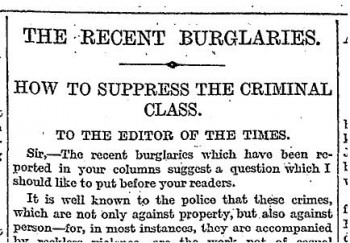
To view the whole page it seems you have to click on the image, right click and select “Open image in new tab” and then zoom in. This is for Google Chrome. Other browsers may be different.
Here.
Are the horses trying to tell us something?
When women tell us men how unhappy they are, our job is to listen, not to try to fix everything. What matters is empathy, not problem solving.
Here is a video that illustrates the principle.
My apologies to all those who saw this about half a year ago, which is often how these things work, and my thanks to 6000, which is where I first encountered it. Says 6000:
If my wife sees this, I’m dead. So let’s keep it between ourselves, ok?
So, commenters, try not to shout.
My main comment is that the still shot that introduces the video, and the title of the video, both give the game away. But maybe they have to, to get the video noticed.
“That commons had become too tragic for me”
– Doc Searls, author, columnist and all round guru, was heard to utter this last night at the reception for speakers for The State of the Net conference in Trieste, as we devoured the last of the exquisite Italian antipasti laid out on one table and moved on to the next table of communal yummies.
You are not supposed to take money away from the competent people and give it to the incompetent so that the incompetent can compete with the competent people with their own money. That’s not the way capitalism is supposed to work.
– Jim Rogers tells Zero Hedge what he thinks of bank bailouts. (Thanks to Adam Gilhespy for spotting this.)
Your argument of not visiting the magazine racks, well, what if I want to buy a magazine? And if I wanted a copy of “Jewish Idolatry”, would I find it next to the “Nazi Party Weekly”?
– Sceptical Antagonist in a comment that caused much mirth here in Arkham 😀
Ian Bennett made an interesting comment on an article published the other day that is worth making a discussion point. It actually makes two points… firstly that politicians will say whatever they think they need to say to stay in power… I regard this as a truism and so not really worth discussing other than to say “indeed”. The second point however was more contentious:
Religion is unconditionally dangerous, simply because it is irrational; the distinction between “extreme” and “moderate” adherents is a false one, and is better regarded as “consistent” and “inconsistent”. The inconsistent moderates may not actually call publicly for the murder of non-believers (despite that being a core dogma of their faith), but they provide the context in which the consistent extremists operate, namely that adherence to a religion is a perfectly acceptable way of life. Eating only fish on a Friday “because God tells me to” is no different in its motivation from committing any other act “because God tells me to”. If we accept the performance of an act which has no rational underpinning simply because of its motivation (“God told me to”), we must accept the performance of all acts with that same motivation. This is what consistent, “extremist”, religious adherents do.
I sort of agree… which is to say, yes but no but…
I think the nature of what “God tells you to do” is a non-trivial distinction between religions and whilst even Buddhism has gone through militant phases, some religions default suppositions are broadly positive (i.e. if you are actually being ‘consistent’ you really cannot justify slaughtering the Cathars based on anything Jesus said), whilst others have clearly negative default suppositions (i.e. yes you really can justify slaughtering apostates based on what Mohammed said and there really is not a lot of wiggle room if you are being consistent).
As a atheist myself, I regard God as nothing more than a psychological artifice, but it also seems demonstrably true that many believers are nevertheless entirely capable of rational moral judgement that is not of any practical difference to my God-free moral theory based way of going about things. Indeed many of the writers for Samizdata are people with religious beliefs.
Is this simply what Ian describes as the difference between consistent versus inconsistent believers? Not so sure. If a religion can include “God says be rational because you are responsible for your actions due to having free will and are not merely God’s meat puppet” and also says “you will roast in eternal hellfire if you murder anyone, so put that gun down dude!”… well I think a ‘consistent’ follower of that particular God will find it rather harder to say “Kill ’em all for God will know his own”. Indeed it seems rather inconsistent even if slaughtering Cathars is very much The Done Thing these days.
So I think maybe religions are conditionally dangerous rather than unconditionally so. When following “the word of God”, it is fairly important what that particular God has to say… and clearly contrary to what many adherents claim, the God Jesus was referring to and the one Mohammed was referring to have about as much in common as Freyja and Shiva.
Discuss.
I read an article describing confrontations between the fascist EDL and ‘anti-fascist’ protesters in the aftermath of the recent Woolwich atrocity. Ok, Marxist collectivists confronting non-Marxist collectivists, very much a row-within-the-family it seems… “Yah Boo Sucks! Our identity politics are better than your identity politics!”
But I have a question… were these fine anti-fascists also out in force when Islamic fascists were marching in London calling for the imposition of Sharia law?
Just curious, does anyone actually know?
John Stephenson has some views regarding the Woolwich attack and freedom of speech
The events witnessed this week in Woolwich, London, were a devastating reminder of the problem Britain faces regarding the threat of terrorist activity. However, much of the ensuing reaction has been one of confusion and has done little to aid the in the slow and painstaking process of combating such delusional ideology. On the one hand there are those who are determined to tar the events by forwarding their equally absurd beliefs. Demonstrations organised by the EDL and “Operation Fightback” were organised but quickly shut down by police, while mosques were attacked in places such as Gillingham and Braintree. On the other hand, I have to say that there appears to be an apologetic element within the public domain that is just as guilty of blemishing debate, although this has been done by shooting down anyone who is willing to speak openly about the nature of the attacks as “islamophobic”, “bigoted” or “racist”. Some of these attacks are justified – the support for Stephen Lennon’s EDL movement is undoubtedly host to anti-Asian racists and those who are prepared to beat up anyone they meet wearing a veil. However, many of their gripes come as a result of the confusion that surrounds the criticism of Islam.
The perennial problem for those who wish to speak frankly about organised religion is that in asserting their view they can sound similar to the bigot they would run a mile to get away from. However there is one fundamental difference; while the intolerant will tar a religion’s supporters with the same brush, the critic of religion will be averse to doing so. This can easily be put in a better light; suppose I am opposed to Conservative politics (which for the most part I am). This should say nothing about the way I treat Conservatives when I meet them in my day-to-day activities and should not prevent me from greeting them with the same friendliness I would give anyone else. However I should still have the fundamental right to speak my mind with regards their ideology or beliefs as long as my conduct towards them is not affected.
One objection to this may come from those who deem it “offensive” to voice anti-Islamic views. The problem is that it assumes that this gives the offended some sort of “rights” and in doing so seems to pay little regard or thought to the fact that the person of no religion may be equally offended by religious views. For all it’s worth I may be offended at the Bible’s description of a lady turning into a pillar of salt or offended at the Quran’s views on polygamy. However, I would not for one moment suggest that my offence should impede their right to voice those beliefs. As long as we do not discriminate against Muslims, we should be allowed to voice our views and people should have the right to be offended.
→ Continue reading: The Woolwich attack: criticism of Islam and the issue of free speech
Yet another assault of freedom of expression by the forces of repression. Sometimes it comes from priggish intolerant ‘Daily Mail Right’ and sometimes from the thuggish and profoundly intolerant ‘Thought Police Left.
Shops could face legal action over ‘lads’ mags’. Magazines on shelves Campaigners say shops stocking lads’ mags could be in breach of the Equality Act 2010. Retailers are being warned they could face legal action if they continue to sell magazines showing naked and semi-naked images of women. Pressure groups and lawyers say displaying the magazines or requiring staff to handle them could amount to sexual harassment or discrimination […] UK Feminista director Kat Banyard said so-called lads’ mags fuelled sexist attitudes and behaviour by portraying women as “sex objects”. She told the BBC the images caused “real harm”.
Well I regard any attempt to threaten people from selling magazines as “real harm. So perhaps it is time to pass some laws that threaten people who do that with the violence backed hammer of law. Sauce for the goose is also sauce for the gander and tolerance for people who wish to use force to impose their intolerance is both cowardice and ultimately suicidal.
And lets get rid of the Equality Act 2010 while we are at it.
Journalist Piers Hernu retorted:
“…no “right-minded individual” would consider the content of these magazines pornographic.
What we have here is a very deeply sinister and disturbing attempt by a group of fundamentalist, fanatical feminists trying to rope in some lawyers in order to bully the supermarkets into removing lads mags’ from the shelves by alerting both staff and customers that they may be able to win a court case”
Whilst I like his accurate characterisation of these thugs, he makes one very serious error. So what if the magazines are ‘pornographic’? Once you accept that as a legitimate reason to pass laws against a magazine, the enemies of liberty just start redefining what ‘pornography’ means until they get what they want.
The mass-man sees in the State an anonymous power, and feeling himself, like it, anonymous, he believes that the State is something of his own. Suppose that in the public life of a country some difficulty, conflict, or problem presents itself, the mass-man will tend to demand that the State intervene immediately and undertake a solution directly with its immense and unassailable resources. This is the gravest danger that to-day threatens civilisation: State intervention; the absorption of all spontaneous social effort by the State.
– José Ortega y Gasset, Revolt of the Masses (the Spanish original was first published as a series of articles in the newspaper El Sol in 1929 and as a book in 1930)… via the redoubtable serial commenter RRS.
On the last Friday of May, May 31, the Friday coming up, which happens also to be the last day of May, the speaker at my regular Last-Friday-of-the-Month meeting at my home will be Aiden Gregg.

I bumped into Aiden Gregg at another talk we both attended at the Institute of Economic Affairs, and quickly discovered two things about him. He is an academic psychologist, to be more specific: a lecturer at Southampton University. And, he is a straight-down-the-line, uncompromising libertarian. Those two facts alone were enough to get me inviting him to give a talk at my place. Libertarian economists are, if not two a penny, at least quite numerous, hence the existence of such institutions as the Institute of Economic Affairs. But libertarians in other academic specialities are much rarer, and we must, I think, do everything we can to encourage and make much of such people.
Just being a libertarian, and mingling and continuing to mingle with the kind of academics who are just about never libertarians and who in many cases have no idea that such a thing even exists, is itself something of an achievement. Even if you say very little about your libertarianism, and perhaps especially if you say very little, this can have all kinds of consequences. One particular consequence is that knowledge of what academic psychology typically consists of will be drawn into the libertarian movement. They may not learn much about our opinions, but we are far more likely to learn about theirs. As the late Chris Tame used to say, we need our people everywhere. And by that he meant especially everywhere in academia.
So, my attitude to Aiden Gregg is: well done mate, for just being what you are, never mind whatever else you might manage to do for the cause of liberty by actually saying stuff to your academic colleagues, and publishing things.
In that spirit of admiration, I said to Aiden Gregg, just talk about whatever you want to talk about.
Here is the email he sent me in which he said what he will be talking about:
The title of my talk will be “Sax and Violence”. “Sax” is not a typo but a contraction of “sex and “tax”!
In the talk I shall argue that, ethically speaking, the proactive seizure of one’s body and property by others, including for the greater social good, are analogous at an fundamental level.
According, it is either the case that both are generally legitimate, or that neither are generally legitimate, but not the case that one is generally legitimate but the other is not.
In Western cultures, however, the proactive seizure of a portion of someone’s property (or income, its monetary representation), for the purposes of enriching some while impoverishing others, if democratically elected rulers so dictate, is readily accepted by most democratic voters, and is seen not only as permissible, but also as obligatory, or at all events, regrettably necessary.
In contrast, in the same cultures (though not others), the proactive seizure of a portion of someone’s body, for the purposes of sexually satisfying some while sexually dissatisfying others, if democratically elected rulers so dictate, is firmly rejected by most democratic voters, and is seen as not only forbidden, but also as repugnant, and in any case, wholly unnecessary.
If, ethically speaking, it is not the case that one is legitimate but the other is not – and I shall attempt to rebut several key objections – then the acceptance of the first, but the rejection of the second, is an ethical bias stands in need of explanation.
One theoretical approach to accounting for such a bias would be system justification theory, developed by left-liberal thinkers to explain the persistence of social hierarchy, but arguably even better suited to explaining the perceived legitimacy of statist authority.
So, the talk will feature some ethics and some psychology.
So, this will be a talk that is in several ways outside the usual libertarian boxes, both in terms of who is giving it, and what it will be about. Good.
If this or any other of these meetings are of interest to you, and you aren’t already on my email list, get on it by emailing me. Click where it says “Contact”, top left, here.
|
Who Are We? The Samizdata people are a bunch of sinister and heavily armed globalist illuminati who seek to infect the entire world with the values of personal liberty and several property. Amongst our many crimes is a sense of humour and the intermittent use of British spelling.
We are also a varied group made up of social individualists, classical liberals, whigs, libertarians, extropians, futurists, ‘Porcupines’, Karl Popper fetishists, recovering neo-conservatives, crazed Ayn Rand worshipers, over-caffeinated Virginia Postrel devotees, witty Frédéric Bastiat wannabes, cypherpunks, minarchists, kritarchists and wild-eyed anarcho-capitalists from Britain, North America, Australia and Europe.
|





Recent Comments