We are developing the social individualist meta-context for the future. From the very serious to the extremely frivolous... lets see what is on the mind of the Samizdata people.
Samizdata, derived from Samizdat /n. - a system of clandestine publication of banned literature in the USSR [Russ.,= self-publishing house]
|
Tomorrow evening I have another of my last Friday of the month meetings at my home in London SW1. Recent Samizdata acquisition, and a friend of mine from way back, Patrick Crozier, will be the speaker. Regular readers of Samizdata will not be surprised to learn that Patrick will be talking about what life was like in Britain one hundred years ago, this being a regular theme of his postings on this blog.
In my email to Patrick about about what I hoped he might be talking about, I wrote this:
What I have in mind is: Were They Libertarians? Any more than now? At all? Or had Germanism by then done its stuff and turned everyone into rabid statists? That kind of thing.
Patrick’s reply:
In addition to attempting to answer your question I am going to try to give a picture of what life was like: unemployment, inflation, transport etc., as well as how people viewed the prospect of war.
Which is hardly a change of subject away from the libertarianism that is the ongoing agenda of all these evenings. Opinions are opinions, but events and existing arrangements and experiences shape opinions. Unemployment, inflation, transport and war are all regular objects of libertarian contemplation. So: excellent. I look forward to it all.
I am particularly looking forward to learning more about that last bit, about how people viewed the possibility of war. Did the sort of people whose opinions were reported by or published in The Times realise what they were about to unleash, or what was about to hit them? If they did think war was coming, what sort of war did they think it would be? And did they realise what a shot in the arm the Great War would be for the power of the state?
This time next year, Patrick’s postings here about events exactly a century ago will surely get very dramatic.
If you want to be told more about this and/or subsequent Last Friday of the Month meetings, email me, by going here and clicking where it says “Contact” (top left).
I don’t agree with all of what Charles Stross says here (I detect more than just a whiff of leftist nonsense when he refers to “neoliberalism”), but this article is worth a read, as it pertains to how attitudes towards issues such as national security and the role of the state are changing. Excerpt:
We experience cultural continuity with our parents’ and our children’s generations. Even when we don’t see eye to eye with our parents on political questions or we sigh in despair about our kids’ fashion sense or taste in music, we generally have a handle on what makes them tick. But a human lifetime seldom spans more than three generations, and the sliding window of one’s generation screens out that which came before and that which comes after; they lie outside our personal experience. We fool ourselves into thinking that our national culture is static and slow-moving, that we are the inheritors of a rich tradition. But if we could go back three or four generations, we would find ourselves surrounded by aliens — people for whom a North Atlantic crossing by sail was as slow and risky as a mission to Mars, people who took it for granted that some races were naturally inferior and that women were too emotionally unstable to be allowed to vote. The bedrock of our cultural tradition is actually quicksand. We reject many of our ancestors’ cherished beliefs and conveniently forget others, not realizing that, in turn, our grandchildren may do the same to ours.
And this:
Snowden is 30; he was born in 1983. Chelsea Manning is 25. Generation Y started around 1980 to 1982. But the signs of disobedience among Generation Y are merely a harbinger of things to come. Next up is Generation Z — the cohort born since the millennium.
Members of Generation Z are going to come of age in the 2020s, in a world racked by extreme climate events. Many of them will be sibling-less only children, for the demographic transition to a low birthrate/low death rate equilibrium lies generations in their past. They may not be able to travel internationally — energy costs combined with relative income decline is slowly stripping the middle classes of that capability — but they’ll be products of a third-generation Internet culture.
Generation Z will arrive brutalized and atomized by three generations of diminished expectations and dog-eat-dog economic liberalism. Most of them will be so deracinated that they identify with their peers and the global Internet culture more than their great-grandparents’ post-Westphalian nation-state. The machineries of the security state may well find them unemployable, their values too alien to assimilate into a model still rooted in the early 20th century. But if you turn the Internet into a panopticon prison and put everyone inside it, where else are you going to be able to recruit the jailers? And how do you ensure their loyalty?
If I were in charge of long-term planning for human resources in any government department, I’d be panicking. Even though it’s already too late.
The point that Stross misses, in his foolish line about “dog-eat-dog economic liberalism”, is that the older, more statist idea of people being forced to join big trade unions and having “jobs for life” was based on a zero-sum idea that the way to get ahead was through political pull and the coercive reach of the state, not through the voluntary exchange of the market and entrepreneurship. Sure, it is is the case that the liberalism associated with a more individualised economic situation (hooray!) is one in which ideas of loyalty to a company for life find it harder to take root. But is that such a bad thing? In other words, is what Stross is describing a feature or a bug?
Last night I attended a meeting of the End of the World Club, and by the end – of the meeting, not the world – the conversation had turned uncharacteristically optimistic. Oh, there were the usual prophecies of doom, and it is hoped that the next meeting will be someone talking about what it was like living through the Zimbabwe hyper-inflation. But the second of the two speakers last night was Rory Broomfield, speaking about the Better Off Out campaign, as in: Britain would be better off out of the European Union. That is an argument where at least some headway is now being made. How big the chances are that Britain might either leave or be kicked out of the European Union some time in the next few years, I do not know, but those chances have surely been improving. I can remember when the fantasy that “Europe” was going to cohere into one splendidly perfect union and lead the world was really quite plausible, if you were the sort already inclined to believe such things. EUrope, in those days, was a boat that Britain needed not to miss. Now, EUrope is more like a swamp into which Britain would be unwise to go on immersing itself, and should instead be concentrating on climbing or being spat out of.
Mention was made of shipping containers, i.e. of the story told in this fascinating book. Compared to the arrangements it replaced, containerisation has damn near abolished the cost of transporting stuff by sea, which means that the economic significance of mere geographical proximity has now been, if not abolished, at least radically diminished. Regional trading blocks like EUrope now look like relics from that bygone age when it would take a week to unload a ship, and when Scotch whiskey could not be profitably exported from Scotland because half of it would be stolen by dock labourers.
Containerisation also exaggerates how much business Britain does with Europe, because much of this supposed trade with EUrope is just containers being driven in lorries to and from Rotterdam, and shipped to and from the world. The huge new container port now nearing completion in the Thames Estuary is presumably about to put a demoralising (for a EUrophile) dent in these pseudo-EUropean trade numbers.
Mention was also made of a recently published map (scroll down to Number 29 of these maps). This map shows the economic centre of gravity of the world, at various times in history. A thousand years ago, this notional spot was somewhere near China. And the point strongly made by this map is that this centre of economic gravity is now moving, faster than it has moved ever before in history, from northern Europe (it was in the north Atlantic in 1950), right back to where it came from, leaving Europe behind.
Broomfield talked about how you convince people of such notions. For younger audiences, he said, just moaning on about how terrible EUrope is doesn’t do it. You have to be positive. But the trick, said Broomfield, is to be positive about the world. The important thing is that Britain, and you young guys, should not held back by EUrope from making your way in that big world.
The actual End of the World is not nigh any time soon, but the world is changing.
Some people wants to intervene in Syria to stop Al Qaeda backed people and Hezbollah backed people killing each other.
Really?
I have a better idea… sell ammunition to both sides.
Here is a short (under four minutes) video, of a designer and exhibition curator Tom Dixon talking about the changes being brought to the world by 3D printing.
Whenever something new comes along, people typically describe it with a noun which says what it is like, but also with an adjective attached to explain how it is different from that. Think “horseless carriage”. (What will “driverless cars” be called twenty years from now?)
So it has been with 3D printing. This is “printing”, sort of, but not printing as we know it.
Listening to Dixon makes me think is that “3D printing” is actually less like printing, and more like blogging. The crucial difference it makes is in enabling people with opinions about how a … 3D thing … should or could be, but who has not been able or who could not be bothered to interest a Big Manufacturer (think Mainstream Media for bloggers) can now just go ahead and make it (just like a blogger publishing his hitherto ignored opinions). And this new-style designer can sell his new design on the internet too, because distribution has also, already, been taken out of the hands of old school Big Distributors (unless you count Amazon and eBay as Big Distributors). Not all such new designers will do as well as they hope, in fact almost all of them will not. But a few will surely succeed spectacularly, and many will presumably be making lives and livings that could not have been made before.
Dixon uses the phrase “taking matters into their own hands”. These words were my first version of the title of this posting.
I stumbled across this rumination of 97-year old architect Jacque Fresco, about how to make a better world.
And it apparently involves living in symmetrical planned cities with identical modular architecture, no doubt presided over by wise technocrats like Jacque Fresco, who presumably decide who gets issued with what in a cashless future in which a drone class of otherwise superfluous people are free to go to school and write plays apparently.
His better future looks a lot like my vision of hell.
Edward Snowdon’s designated media conduit, Glenn Greenwald, has yet again played his hand with skill in a game that in theory is completely stacked against him. In response to information released by The Independent that purported come from Snowdon via him:
I have never spoken with, worked with, or provided any journalistic materials to the Independent. The journalists I have worked with have, at my request, been judicious and careful in ensuring that the only things disclosed are what the public should know but that does not place any person in danger. People at all levels of society up to and including the President of the United States have recognized the contribution of these careful disclosures to a necessary public debate, and we are proud of this record.
“It appears that the UK government is now seeking to create an appearance that the Guardian and Washington Post’s disclosures are harmful, and they are doing so by intentionally leaking harmful information to The Independent and attributing it to others. The UK government should explain the reasoning behind this decision to disclose information that, were it released by a private citizen, they would argue is a criminal act.”
How very very interesting.
Read this Greenwald article for the whole story. Might GCHQ be in the process of outsmarting themselves spectacularly?
For years, particularly with the advent of the Internet, people have been griping about lessening attention spans. But if someone can watch an entire season of a TV series in one day, doesn’t that show an incredible attention span? When the story is good enough, people can watch something three times the length of an opera.
– Kevin Spacey
The spooks are not stupid. There are two ways they can respond to this in a manner consistent with their current objectives. They can try to shut down the press — a distinct possibility within the UK, but still incredibly dangerous — or they can shut down the open internet, in order to stop the information leakage over that channel and, more ambitiously, to stop the public reading undesirable news.
I think they’re going for the latter option, although I doubt they can make it stick. Let me walk you through the early stages of what I think is going to happen.
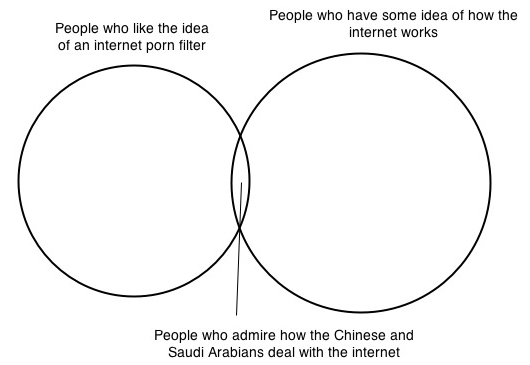
In the UK it’s fairly obvious what the mechanism will be. Prime Minister David Cameron has thrown his weight behind mandatory opt-out porn filtering at an ISP level, to protect our children from a torrent of filth on the internet. (He’s turned to Chinese corporation Huawei for the tool in question.) All new domestic ISP customer accounts in the UK will be filtered by default, unless the owner opts out. There’s also the already-extant UK-wide child pornography filter operated by the Internet Watch Foundation, although its remit is limited to items that are probably illegal to possess (“probably” because that’s a determination for a court of law to make). And an existing mechanism — the Official Secrets Act — makes it an offense to possess, distribute, or publish state secrets. Traditionally newspapers were warned off certain state secrets by a process known as a Defense Advisory Notice, warning that publication would result in prosecution. It doesn’t take a huge leap of the imagination to foresee the creation of a law allowing for items subject to a DA-Notice to be filtered out of the internet via a national-level porn filter to protect the precious eyeballs of the citizenry from secrets that might trouble their little heads.
On the other hand, the UK may not have a First Amendment but it does have a strong tradition of press freedom, and there are signs that the government has already overreached itself. We’ll know things are really going to hell in a handbasket when The Guardian moves its editorial offices to Brazil …
– Charlie Stross
When I was a boy of about sixteen or so, I had a conversation with my godmother, a Canadian lady of great warmth and generosity. She was a Christian and she asked me, having not met me face to face for a year or two, whether I was also. I said: No. She said: Why not? I said: Because it isn’t true. There is no God, Jesus was not his son, there was no virgin birth, and so on. Her answer to my atheistical declarations stuck in my mind, because it seemed then to be and seems still to have been such a very odd one. She said that I might want to consider being a Christian on the grounds that Christianity was, potentially, very comforting. In adversity, it is nice to believe that there is a God who is looking out for you and who is on your side.
The oddness of this comfortingness argument for Christianity is that it suggests that you can decide what you believe, or to put it another way, that you can be comforted by deciding to believe something that you did not believe until that moment. But belief – surely – doesn’t work like that. It doesn’t mean that. What you believe is what you believe. If you do not know what you believe but are curious (perhaps because someone else has asked you), then you face a task of discovery, not a decision. You need to study the claims being made about the alleged truth in question by others. If you already know about these claims, to the point where you are able to identify what you believe about them, then you need to look inside your own head to see what is there. But you don’t decide what is in your head. And you certainly do not decide what you “believe” to be true merely by thinking about what you would be comforted by if you thought it was true, but which you have no other reason to think is true. Truth is one thing. What would be comforting if true is something entirely different.
On a closely related matter, it would be very comforting if the world always rewarded virtue, but most, me included, agree that it does not. So, say some Christians, Christians not unlike that godmother of mine, wouldn’t it be nice to believe that if the world does not reward virtue, God does? Well, it might be, if you really do believe this. But, I don’t, and my reasons for not believing that God rewards virtue are likewise nothing to do with how nice it might be if he did. What a very bleak world you live in, say the Christians. Maybe, say I, but you live in it also. You just don’t realise it.
My central point here does not concern the truth or falsehood of my atheist beliefs, or of Christian beliefs. I believe what I believe and you all believe what you all believe, and no amount of commenting here or anywhere is going to change any of that. Rather, I am making a point about the nature of belief, and it is surely a point that many Christians would agree with me about, because they too often speak of their beliefs having been discovered by them rather than merely decided. I didn’t decide that Jesus is my savour, they say. I realised that he is, and he is. (When people really do believe something, they often omit the bit where they might say “I believe”, because they are dealing with truth itself, their own belief in the truth being a somewhat secondary issue.) I didn’t choose my atheism as if choosing a bag of sweets in a shop, and Christians mostly don’t choose Christianity in that kind of way either.
It would seem, however, that some people at least really can and really do decide what they believe. (I recall a conversation with a religious believer who described having chosen his religion in exactly this sort of way, as if choosing a house.) Others believe what they believe about such things as politics in a similarly decisive way. They really do seem to possess the power of wishful belief, as it were. They really can decide what they believe. To me, this is very odd.
The above – somewhat strange – ruminations began life as an attempted start to a rather different Samizdata piece to this one, about the kinds of things I believe that got me writing for Samizdata in the first place, and about some of the other things I also believe, all of which things I also believe because I believe them, rather than because the truth of them is any great source of comfort to me.
“No matter how much the government controls the economic system, any problem will be blamed on whatever small zone of freedom that remains.”
– Sheldon Richman
|
Who Are We? The Samizdata people are a bunch of sinister and heavily armed globalist illuminati who seek to infect the entire world with the values of personal liberty and several property. Amongst our many crimes is a sense of humour and the intermittent use of British spelling.
We are also a varied group made up of social individualists, classical liberals, whigs, libertarians, extropians, futurists, ‘Porcupines’, Karl Popper fetishists, recovering neo-conservatives, crazed Ayn Rand worshipers, over-caffeinated Virginia Postrel devotees, witty Frédéric Bastiat wannabes, cypherpunks, minarchists, kritarchists and wild-eyed anarcho-capitalists from Britain, North America, Australia and Europe.
|





Recent Comments