We are developing the social individualist meta-context for the future. From the very serious to the extremely frivolous... lets see what is on the mind of the Samizdata people.
Samizdata, derived from Samizdat /n. - a system of clandestine publication of banned literature in the USSR [Russ.,= self-publishing house]
|
My case to receive reparations is just as solid as the case for reparations to be paid to African-Americans by lesser-hyphenated-Americans.
Many members of a group to which I belong by accident of birth were enslaved by the group to which you belong by accident of birth (talking to you, heterogametic oppressors). Don’t waste my time with talk about how the law has given women equal legal status to men for generations now, because we are still poorer than you. Well some of us are poorer than some of you and some of us are richer than some of you, but let me tell you that even if I’m doing fine myself, the thought of people with bodies more like mine being on average poorer than people with bodies less like mine is a profound hurt that can only be assuaged by money.
No, the fact that you personally have never enslaved, beaten or otherwise oppressed a woman is not relevant. Can’t you see this thing is bigger than mere individual morality?
You can stop whingeing about how lots of men in history were oppressed quite as much as women were, or how people of both sexes were oppressed on many grounds other than gender, such as class, religion, nationality and race. I am quite aware of that already and join with all victim-groups in unbreakable solidarity, unless any of the oppressors included my ancestors such as to place me in a paying-out group, in which case the notion of paying reparations for the crimes of one’s ancestors is ridiculous. It is the present – a present in which many women are cruelly oppressed – not the past that matters! (Er, when it comes to us getting the money, that is. When it comes to deciding who pays the money, it’s the situation centuries ago that matters, obviously.)
Anyway, why should an artificial construct like “nationality” or “race” be the factor that determines who gets reparations? Gender, unlike race, can be determined objectively. Make gender the criterion and you will be troubled by very few of those pettifogging legalisms you get with race about how all the mixed ancestry people would have to pay reparations to themselves.
Cease your caterwauling about how your great-grandpa once put half a crown in a suffragette collection box. Obviously guilt can be inherited (by you) but the notion of heritable credit is contrary to reason.
None of your man-splainin’ nonsense about being partially descended from women, either. I’m certainly not going to let myself off from the solemn duty of identifying solely with my own gender just because some of my ancestors were men. See, if I can maintain decent standards of group segregation, so can you.
Do not presume to ask how many generations must go by before your group is to be permitted to cease its duty of unrequited toil (mediated via the tax collector and the Reparations Administration Agency) for the benefit of my group. Be assured that we will let you know when we no longer want your money. Until then, woe to that man by whom the offense cometh. That’s you, that is.
Throughout history, poverty is the normal condition of man. Advances which permit this norm to be exceeded — here and there, now and then — are the work of an extremely small minority, frequently despised, often condemned, and almost always opposed by all right-thinking people. Whenever this tiny minority is kept from creating, or (as sometimes happens) is driven out of a society, the people then slip back into abject poverty.
This is known as “bad luck”.
– Robert A. Heinlein
(As brought to my attention in a comment by “Plamus”.)
I thought Nigel Farage trounced Nick Clegg in the second of the two televised debates about Europe a few weeks ago. When he sticks to that subject, he’s an excellent proponent of the argument. But when he brings Romanians into it, when he smears an entire nation to make the case against immigration, he’s clearly doing the cause more harm than good. You can sense more moderate voters recoiling every time he strays into this territory. It’s as if the Ukip leader is confirming the caricature of Euroscepticism that the BBC, the FT, the Independent and the Guardian have been trying to paint for the past 30 years – the Eurosceptic as swivel-eyed loon, as Little Englander, as closet racist. People like me have always claimed that’s a straw man. But Nigel Farage is that straw man.
– Toby Young
There are other examples I can think of where a good argument – such as leaving a bureaucratic superstate – can be spoiled if those who argue for it seem to be, well, just not very pleasant people. Yes I know, one should not be distracted by that sort of shallow thing, etc, etc. The last few weeks I have heard a lot of stuff from UKIP fans about how, no matter how bloody ghastly many UKIP people are, and how crummy some of its views are, that it is still a force for good, pushing debate, etc. The trouble is that I think it does matter, a lot, if people form associations in their minds about a group and if that group helps to reinforce that association. In my view, Farage’s focus on what he claims are the negative effects of immigration, and his invocation of the idea that foreigners are taking “our” jobs etc (the lump of labour fallacy) has done damage. He should have been far more optimistic and positive about why leaving the EU is a good thing, rather than confirm the biases of those who all too easily dismiss the anti-EU case as being narrow and stupid. A shame.
In Douglas Adams famous non-fiction series on galactic economic history, “The Hitchhiker’s Guide to the Galaxy”, we are presented with a description of the tragedy of the planet Frogstar B.
On Frogstar B, for a time shoe production increased faster than the rate of overall economic growth. As a result, with time, shoe production became a larger and larger fraction of the economy, until finally the Shoe Event Horizon was hit, at which point nothing but shoes could be manufactured, and lacking any other goods or services, their civilization collapsed.
Thomas Piketty’s “Capital in the Twenty-First Century” describes a similar tragedy that lies inevitably in our future, the point at which the only economic activity left is investment, all money is held by a tiny minority of wealthy people, and our civilization permanently ends.
Will we be wise enough to learn from the people of Frogstar B, and place a heavy tax on capital before our doom is reached?
I hope not, because of course Douglas Adams was writing comedy, not an economic history. Sadly, Piketty appears not to be a parodist, and presents the claim, in all seriousness, that something like a Shoe Event Horizon, in this case the Investment Event Horizon, could actually happen.
Normally, I would ignore such a book, but numerous commentators (all of whom, by strange coincidence, were already enthralled by the idea of expansions state power) have responded to Piketty’s call for heavy wealth and income taxation with rapturous reviews, driving Piketty’s work to the center of much of our current political discussion.
It is therefore, sadly, our duty to seriously to consider his arguments and the effects of his proposed remedies…
→ Continue reading: Piketty and the Shoe Event Horizon
… Wrongly, for Castro is no Louis le bien aimé. The French royal personage whose mode of life was closest to that of Comrade Fidel before senility overtook him was Marie Antoinette, who played at being a milkmaid and a shepherdess in the Queen’s Hamlet built for her in the gardens of Le Petit Trianon. As the Queen found refuge from the demands of court life by milking cows into buckets of Sèvres porcelain in the company of her dear friend and confidante the Princesse de Lamballe, so the First Secretary
“enjoyed a private island, Cayo Piedra, south of the Bay of Pigs, scene of the failed CIA-sponsored invasion of 1961 . . . a “garden of Eden” where he entertained selected guests including the writer Gabríel Garcia Márquez, and enjoyed spear-fishing.”
Sharing that simple pleasure, they talked about books and the nature of absolute power.
The United States Government, feeling that it does not have a sufficient worldwide reputation for completely lacking self awareness, has decided to indict members of the Chinese PLA for conducting computer based espionage against US commercial targets.
Note that the Snowden releases have revealed that the US has engaged in precisely the same behavior, including numerous attacks against Chinese equipment maker Huawei.
Indeed, we currently lack evidence that the Chinese state has conducted wholesale interception of calls from entire countries, but the NSA has done precisely that. We have no evidence that the Chinese have intercepted US equipment shipments and sabotaged them, but the NSA has done precisely that. We have no evidence that the Chinese have systematically undermined internet standards or bribed security companies to sabotage their own software to make communications less secure, but the NSA had done precisely that. Indeed, I could reiterate dozens of Snowden revelations here, but I won’t waste everyone’s time by doing so. (Note that I do not claim the Chinese government has not done such things, only that we do not have evidence of it, while we know for certain that the US government has done such things.)
Today’s rhetorical question is therefore this: if foreign countries begin indicting and arresting US officials for espionage and industrial sabotage, will the US government protest?
Swiss voters reject plan to establish world’s highest minimum wage
Swiss voters have rejected a proposal to create what would have been the world’s highest minimum wage after siding with the government and business leaders in a referendum.
That should read “…after siding with the government, business leaders, and those Swiss people who could least afford to be unemployed.”
The plan, which would have pushed up the basic annual salary for a 35-hour week to £27,000, was rejected by 75% of voters. It would have required employers to pay workers a minimum of 22 Swiss francs (£14.66) an hour.
Government ministers opposed the proposal, made by the Swiss Federation of Trade Unions and supported by the Socialist and Green parties, arguing that it would put smaller companies out of business.
Fortunately for some of the poorest Swiss people, their so-called protectors overreached themselves.
So argues David Codrea, writing at the website of Jews for the Preservation of Firearms Ownership:
President Goodluck Jonathan’s government embraces “gun control,” both as a signatory to the United Nations Arms Trade Treaty, and also as a matter of national policy.
“In Nigeria, the right to private gun ownership is not guaranteed by law,” the GunPolicy.org entry for Nigeria documents. For those not familiar with that resource, it’s a project of the Sydney School of Public Health, and while of decidedly anti-gun bent, nonetheless provides instructive and useful compilations of gun laws from around the globe.
“[C]ivilians are not allowed to possess machine-guns, military rifles and handguns … private possession of semi-automatic assault weapons [and] private possession of handguns (pistols and revolvers) is prohibited,” the site advises. Add to that licensing, background checks and registration for what they are allowed to own, a prohibition on concealed carry and stiff criminal penalties for gun law violations, and Nigeria is one of those places where the “law-abiding” are at extreme disadvantage.
Boko Haram, which doesn’t let such details slow them down a beat, finds such conditions enabling.
Not all are satisfied with the status quo.
“[T]he youth vigilante volunteer group, popularly called the Civilian JTF, has called on the Federal Government to allow its members carry arms and ammunition in order to do its work well in Borno State,” The Nigerian Voice is reporting.
“We used sticks and knives and worked closely with soldiers and fought the Boko Haram members out of Maiduguri,” a spokesman for the group related. “They are now killing civilians in the villages.”
For a sceptical view of the likely efficacy of arming civilian vigilantes to fight Boko Haram, please read Tim Newman‘s comments to my previous post about Boko Haram. He can very reasonably back up his pessimism by saying that he has lived and worked in that part of the world, as I have not. Nonetheless it had not been quite clear to me until just now that arming the people has not yet been tried. Disarming them has. It has not prevented an extremely violent insurgency.
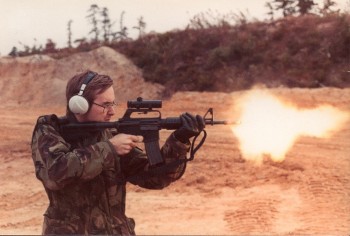
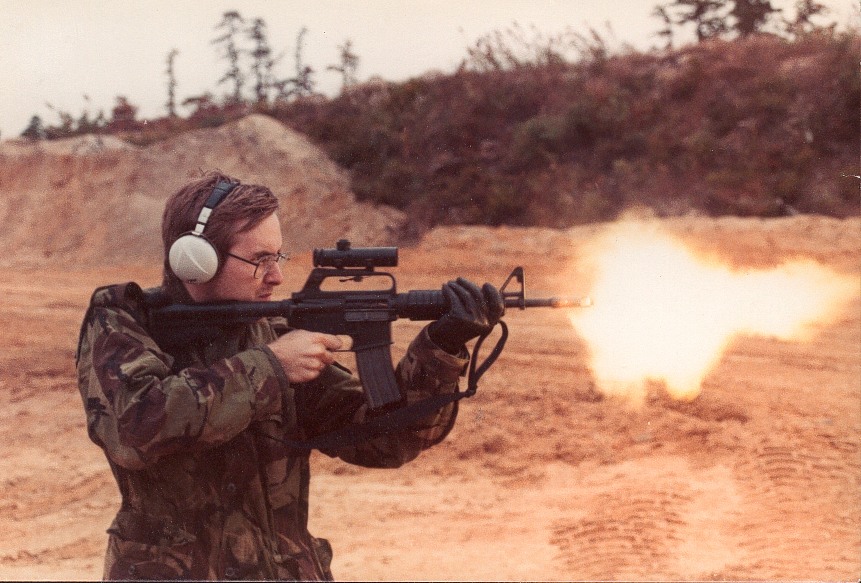
Ah Sarah Palin… hardly a libertarian, that is true (to put it mildly, with her casual penchant for torture of prisoners) but she does have an endearing talent for saying the right things to annoy the right people by suggesting a ‘scary looking’ rifle makes a wonderful present!
And indeed it does! When she is right, she is right!
It’s one thing to read a Guardian piece complaining about Uber. That certainly makes Uber seem like a fine thing, but you can’t trust everything you read, can you? Maybe Uber is not actually as great as the Guardian is making it appear. Last Friday evening, a week ago, by a lucky chance, I went one better. I had an actual trip in an Uber-taxi. It was a good experience.
Rooted as I am in the twentieth century, I was not the one who set this journey in motion. The man who did was my twenty first century friend Rob, who is as computer-savvy as I am computer challenged. I and Rob were guests at a dinner party, and I heard that he and another guest had some kind of lift home fixed, going back towards central London, and I asked if I could join in. Yes, fine. I then rather delayed things by taking what turned out to be rather too long to do my thankyous and farewells, because, basically, I am not used to taxis being this fast in answering the call. But, eventually I was aboard, and off we went.
It was only when I was in it that I learned that this was one of these new-fangled Uber taxis, this being why it had arrived so quickly to pick us up and why I should have been quicker off the mark when leaving the party.
What Rob had done, as soon as he and the other guest decided they needed to be off home, was crank up the Uber app on his smartphone and summon – and here’s the point of this system – the nearest Uber taxi, by looking for blobs on his smartphone Uber-map.
On our journey, we and the driver chatted about how the new system worked. New technology often has this effect, I find. It gets people talking. It reminded me a bit of the early days of blogging, which got all sorts of people in touch with each other who would never normally have been communicating.
Our driver preferred his new Uber-life partly because he now gets no grief from a demanding taxi-cab office with its rigid time and place demands and general stress and hassle. He now eludes that middle man and, via his new and improved middle man (Uber), instead relates directly to his passengers. There is an elaborate regime to register both complaints from drivers about passengers, and from passengers about drivers, but for a driver who wants to do an honest job, that’s all good, just as it is for passengers who are willing and indeed eager to behave themselves.
We passengers also like the service that the driver and his comrades provide, because it is cheaper than old-school taxis, and quicker, and easier to track. But given that Uber is so cheap for us passengers, and given that the driver pays twenty percent of the reduced fare that we pay him to Uber, how come the driver is nevertheless such a contented guy?
A big plus for the driver is that he now works exactly when he likes, that being what a lot of the grief between him and his former taxi office had been about. He can start and stop when he pleases, with no warning concerning either, provided only that he finishes all paid-for journeys he embarks on.
But just as impressive as the increased flexibility the driver enjoys is that the flip side of us having hailed the nearest Uber taxi to us when we wanted to start our journey is that our driver is immediately available to start his next useful journey just as soon as he has completed his previous one. Our driver had been taking someone to that particular part of suburban London, and within moments there we were, wanting him to take us back to the middle of London from that same out-of-the-way spot. He doesn’t have to drive back, empty, to some damn taxicab office. He resumes work at once. This is why Uber-taxis are cheaper. This is not done by lowering the standard of living of the drivers or the quality of the product. It is done by seriously improving the efficiency of the drivers and their vehicles.
You can tell that Uber is a massive efficiency gain by the fact that the regular black cab drivers are in a state of fury about it, and have been threatening to screw up London’s traffic, with some kind of demo/disruption or suchlike. Their excuse is that there is apparently some law or other which, in the opinion of the cabbies and their lawyers, these new Uber-taxis are breaking, concerning computer tracking or something. But such complaining seems likely only to publicise that if the law is getting in the way of Uber, then it should stop.
If you want some more jeering at those angry black cabbies, see what City A.M.’s Guy Bentley has to say about them.
That the black cabbies are demonstrating against Uber in particular, rather than against “Kabbee, Hailo, Addison Lee, GetTaxi, Uber and Green Tomato” merely serves to establish Uber in the public mind as the market leader. I daresay there are also “network” reasons why one big brand leader is advantageous to most customers. So, big win for Uber, I’d say.
I am sure that there are many, many tweaks to Uber that I am not even remotely aware of, the kind where not only do I not know the answer but where I had never even thought of the question. But presumably Uber-savvy commenters can fill in many more details.
In particular: what could go wrong? Our driver didn’t seem to have any worries. But, was he perhaps being a tad optimistic? Will his income maybe decline if lots more want in on the driving side of things? What about if robot cars join in, and snatch away his job? Great for us passengers, because if it’s not it won’t catch on. But not so great for our driver.
Once you start talking about systems like Uber and robot cars in the same sentences, is the longer term implication of things like Uber going to be: fewer privately owned cars? Will Uber 3.0 be the first robot car killer app?
But oh yes, back in the here and now, one further detail I do now remember the driver talking about. If you are an Uber customer based in Los Angeles (as a recent passenger of his was), you can use the exact same account to whistle up our London driver as you have already been using in LA. The exact same account. Think about that. In any Uber-enabled city, and there are now a lot of such cities around the world, you can use taxis with the kind of confidence you already have about Uber-taxis in your own back yard.
My guess would be that a characteristic Uber first time user is someone who is about to venture to a foreign city where Uber is in action, and he signs up for Uber beforehand, so that he knows his taxis in the strange foreign landed will then be sorted at non-punitive expense and without grievous risk. Where he lives, he has a car and trusts the local taxis. But in foreigner-land, Uber taxis will be a massive plus. Then, once he has sampled the service in a strange city, the obvious next thing will be to use it back home more regularly. If that’s all approximately right, you can see why the black cabbies are spitting blood.
But alas for the black cabbies, their complaints are only advertising Uber to a global audience of city-hopping tourists and businesspersons. London’s black cabs are famous the world over. So if they are now moaning about Uber, that’s a global story. With enemies like this, Uber hardly needs an advertising agency.
But that’s enough guessing from me about Uber. Over to our commenters and their amazing ability to share a collective conversation with us and with each other, thanks to the work of an earlier generation of computer-magicians.
I don’t know if (politicians) are enemies or more prey but I certainly didn’t go into Westminster to make friends and in that I’ve certainly succeeded.
– the ever splendid Paul Staines (aka Guido Fawkes)
The centenary of the Curragh Incident (or Curragh Mutiny as it sometimes known) took place a couple of months ago. I had been expecting to see a fair amount of comment on what was a fairly dramatic event but so far not a dicky bird. That is not to say that there hasn’t been any comment, just that I haven’t seen it. Assuming there hasn’t been any, perhaps, belatedly, it is about time I got the ball rolling.
Since 1910 the British Government had been attempting to grant devolution, or Home Rule as it was then known, to Ireland. Ulster and the Conservative Party (or Unionists as they were then known) objected. Some 500,000 of Ulster’s British population signed a covenant stating that they would resist it. When this failed to impress the government the Ulstermen established their own army, the Ulster Volunteer Force – not to be confused with more modern creations bearing the same name – and even set up a provisional government, just in case.
The government, at first thought the Ulstermen were bluffing. But by early 1914 they had realised they weren’t and that they were going to have to call in the military. Winston Churchill, First Lord of the Admiralty sailed a cruiser into Belfast Lough. At the same time orders were issued to the British garrison at the Curragh in Southern Ireland at which point the officers resigned their commissions, or to put it another way, walked out. This, incidentally, was something they were perfectly entitled to do.
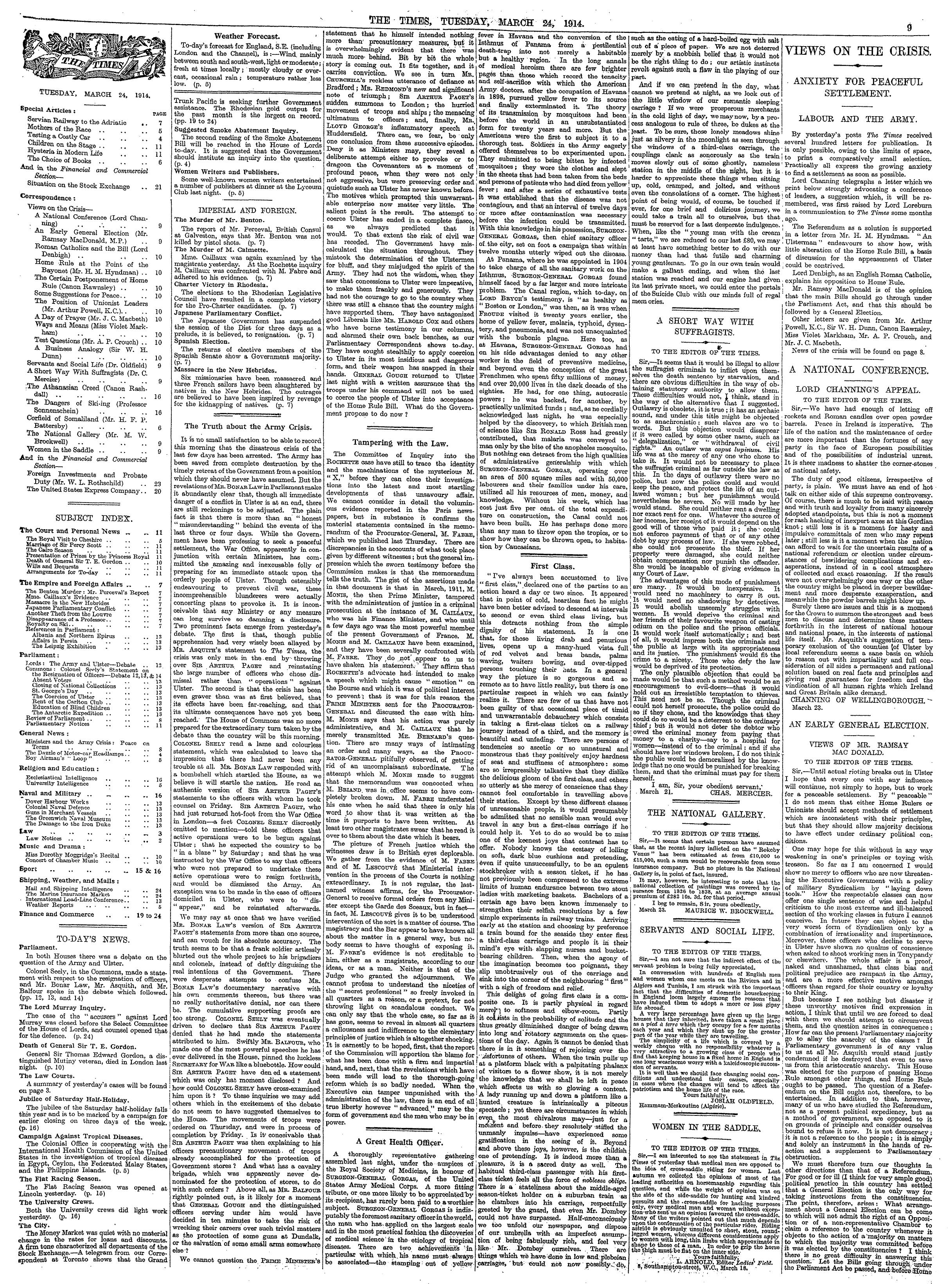
The government backed down while denying that they had done any such thing. The officers returned to their posts but the Secretary of State for War did not. One assumes that this meant the end of government plans to “coerce” Ulster but seeing as the First World War broke out at the precise moment things were coming to a head, we shall never know. 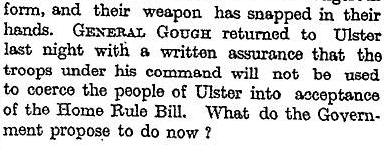 The Times 14 March 1914, p9 My guess is that the mutineers were right. Indeed I suspect that had their successors taken a similar stance in 1969 we would have saved ourselves a whole lot of trouble. But that’s another story.
|
Who Are We? The Samizdata people are a bunch of sinister and heavily armed globalist illuminati who seek to infect the entire world with the values of personal liberty and several property. Amongst our many crimes is a sense of humour and the intermittent use of British spelling.
We are also a varied group made up of social individualists, classical liberals, whigs, libertarians, extropians, futurists, ‘Porcupines’, Karl Popper fetishists, recovering neo-conservatives, crazed Ayn Rand worshipers, over-caffeinated Virginia Postrel devotees, witty Frédéric Bastiat wannabes, cypherpunks, minarchists, kritarchists and wild-eyed anarcho-capitalists from Britain, North America, Australia and Europe.
|





Recent Comments