We are developing the social individualist meta-context for the future. From the very serious to the extremely frivolous... lets see what is on the mind of the Samizdata people.
Samizdata, derived from Samizdat /n. - a system of clandestine publication of banned literature in the USSR [Russ.,= self-publishing house]
|
Ever since the universe obliged me by inventing digital photography, I have been taking a lot of photos (only click on that if you really want to see some of my photos and are willing to wait). One of the sorts of photos that I like to take a lot of is photos of other people taking photos. I particularly like it when they are holding something in front of their face, like a camera or a coat or a bag, so that I can then stick my photo of them photoing up on the internet without them being very recognisable, by which I mean face-recognition-software-recognisable.
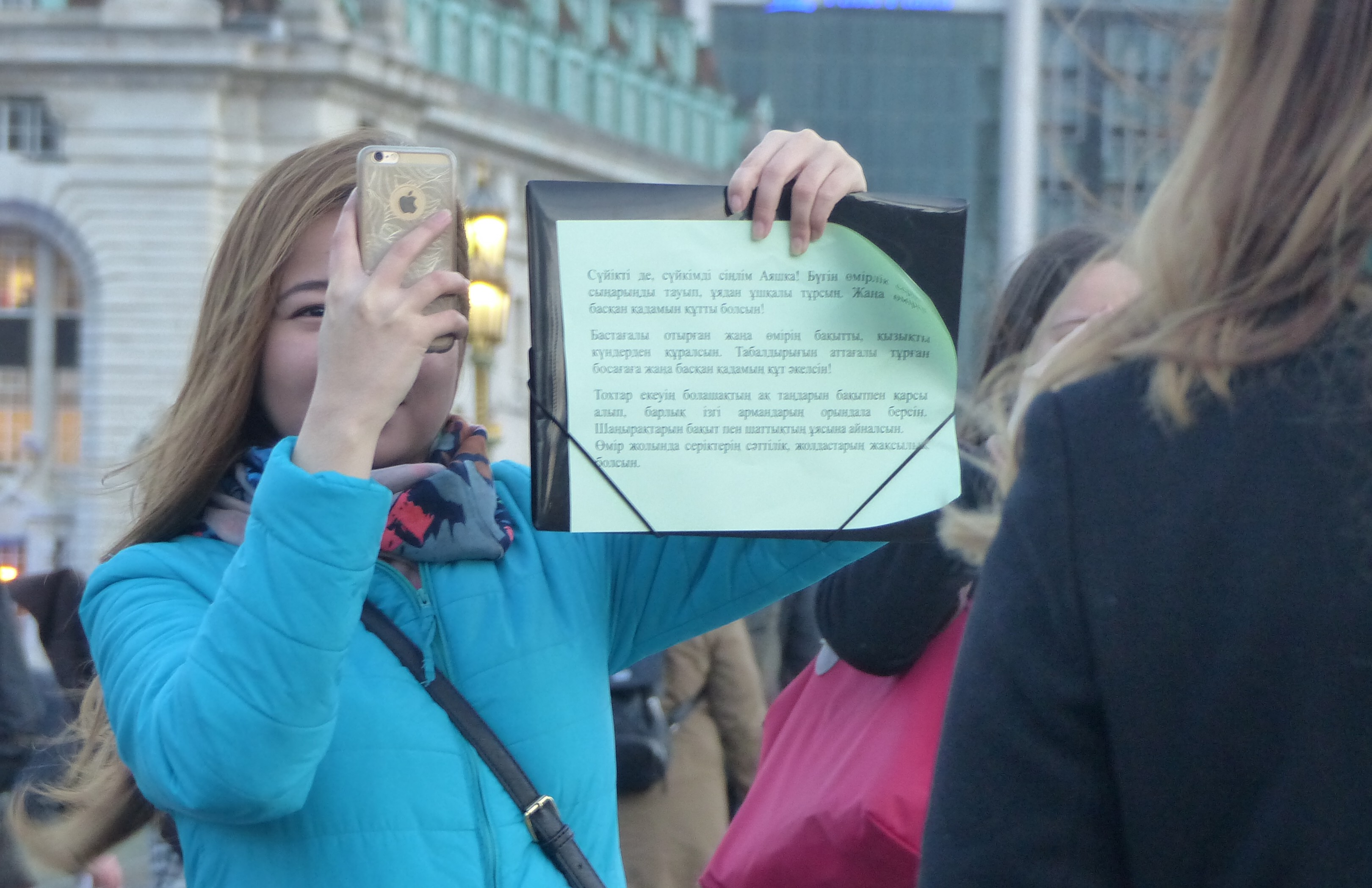
And earlier this month, I took this photo, of a lady on Westminster Bridge, taking a photo of another lady. Well, that’s what I at first thought, but later I realised that she was almost certainly videoing the other lady. That’s because in addition to holding up her iPhone (over most of her face) she was also holding up a hand-made teleprompter, covered in text:
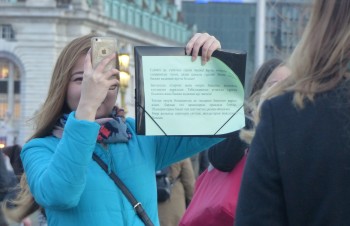
I did a few months of schoolboy Russian about half a century ago, so I am pretty sure that this is Russian. But what does it say?
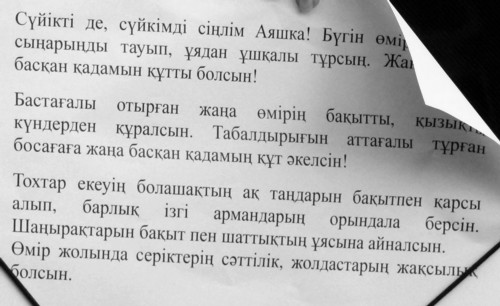
Here it is closer-up and more easily readable, with the blueness removed:
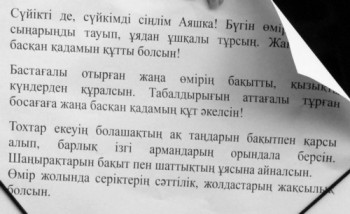
So, is this harmless tourist guidance? Viciously mendacious Putinite propaganda, full of nonsensical lies about the Ukraine? Some kind of personal message? I have enjoyed wondering, but now I would really like to know.
I am sure that at least one of our most knowledgeable and obliging commentariat can knowledgeably oblige with the answer.
“Libertarian men are the most romantic people in the world”.
– Priya Dutta.
I am reading the latest piece at Libertarian Home by Nico Metten, a man whose thoughts and thought processes I am coming greatly to admire. I am only a tiny bit into this piece so far, but already I have read this very lucid observation, which I think is worth passing on:
A prominent libertarian advocate of consequentialism is David Friedman. Consequentialists argue that it is useless to deal with philosophy or morals, as these are very unclear and subjective. What matters are the outcomes of certain policies. As long as the outcomes are ok, the rest does not matter so much. People like David Friedman simply don’t seem to want to deal with philosophy and morals. They are uncomfortable with it. Because of that, they only deal with what they consider more objective, which in this case is economics.
Personally, I don’t have a problem with people getting into libertarianism through economics. Economics seems to play a major role in exposing the state and it can make a lot of converts. I myself have learned a lot from economists when it comes to questioning the state. Labelling this approach as consequentialist however suggests that this follows a distinct philosophy. And here I am not so sure.
To me it seems impossible to be a pure consequentialist. I would agree that results matter. However, how do we know which results are good results? It seems in order to evaluate results, one first will need an evaluation tool. This evaluation tool logically needs to come before the actual consequences and is therefore not consequentialist itself. If this is true, then consequentialism as a stand alone philosophy seems logically impossible. But how come intelligent people like David Friedman can think that they are consequentialists? Friedman clearly must have an evaluation tool. I think the reason for this is that his evaluation tool is completely tacit. It is there, but Friedman is not consciously aware of it.
Good point. I have certainly been vaguely aware of this point, rather as Metten says that Friedman must have been. But I have never read it spelt out quite so clearly and so explicitly. Or, if I have, I wasn’t paying attention.
I am now reading the whole thing.
Today I visited the Click & Collect counter at Debenhams, a department store. This is an arrangement whereby one orders goods using a web site then visits the premises to collect them. “Sorry about the wait,” said the clerk when I reached the front of the queue. Later she asked if I wanted a bag in which to carry my purchase. “You have to pay 5p.” I did not have any change, and withdrew from my wallet a pristine £20 note. The Click & Collect counter must not be set up for cash payments, as the clerk looked slightly panicked but decided her job was to make me wait some more: “Could you join the queue over there to pay?”
At the front of that queue I declared, “I am to pay for this bag.” The look of confusion that was the reply made me wonder if, perhaps, the intention all along had been for me to shrug and walk away without paying. “You want to pay for that bag?” Yes, I did. The cashier slid the £20 back towards me and muttered something that I took to mean, “get out of here.” I thanked her and left.
The UK’s 5p “bag charge” is not a Pigou tax to cover the externality of disposing of the bag. Neither is it to raise money for charity. It is explicitly designed to change people’s behaviour. “We expect to see a significant reduction in the use of single-use plastic carrier bags as a direct result of the charge”, says the Department for Environment, Food & Rural Affairs, while looking sternly over the top of its spectacles, one imagines.
More than that, people who insist on continuing to use plastic bags are to be made to feel awkward and deviant. Like smokers, we are to be de-normalised.
The mechanics of buying groceries are tedious. I would prefer the transaction to go gracefully with the minimum of conscious thought. I do not want to be made to consider such philosophical questions as, “do you want a bag for life? We have to charge 5p for the other ones. You don’t? Oh well, I will try to use the minimum number of bags to save you money. What’s that? You don’t care? You want me to use the number of bags appropriate for secure and efficient carrying of the volume, mass and tessellation properties of the items you have purchased? What a strange customer you are.” I feel that social disapprobation every time.
A while ago, at a supermarket, I paid by credit card for my items before realising the cashier had not bagged them. “Can I have a bag?” Then I fumbled around for change until the customer behind me in the queue insisted on paying for me. I left haunted by the idea that he thought I had arranged this situation on purpose. When it happened again at a newsagent the other day, I insisted on paying even though the cashier offered to waive the fee. Partly to assure everyone in the vicinity that I was not a skinflint and partly because, like a feeble imitation of an Ayn Rand hero, I want to force Them to confront what They have wrought. Next time, to spread fear, uncertainty and doubt, and to make more miserable the lives of future shoppers, I might point out that they should be careful about waiving the charge as there are DEFRA agents in our midst, carrying out secret shopping operations. Yes, I will fight back!
I will continue to use single-use plastic bags for as long as I am able. Not just because I am too disorganised to plan my shopping jaunts in advance and ensure that I set out with the correct number of re-usable bags, but also as a service to you, dear readers, that you may from the safety of your laptops observe the abuse and ostracisation of a misfit; that you may know the nature of the state.
I had some incoming from Uber yesterday. The TFL consultation on their proposals to bugger-up-all-competition-to-the-cossetted-black-cab-mafia is underway. I am usually rather sceptical about these things but Uber is such an obviously Good Thing that I participated anyway. You never know, it might make a difference.
Autonews reports that programmers working on driverless cars have found that having made them perfectly law-abiding, unable to commit traffic infractions, the result is that they have double the accident rate of driven cars, as they cannot cope with the anarchic driving of humans.
They obey the law all the time, as in, without exception. This may sound like the right way to program a robot to drive a car, but good luck trying to merge onto a chaotic, jam-packed highway with traffic flying along well above the speed limit. It tends not to work out well.
As the accidents have piled up — all minor scrape-ups for now — the arguments among programmers at places like Google Inc. and Carnegie Mellon University are heating up: Should they teach the cars how to commit infractions from time to time to stay out of trouble?
“It’s a constant debate inside our group,” said Raj Rajkumar, co-director of the General Motors-Carnegie Mellon Autonomous Driving Collaborative Research Lab in Pittsburgh. “And we have basically decided to stick to the speed limit. But when you go out and drive the speed limit on the highway, pretty much everybody on the road is just zipping past you. And I would be one of those people.”
Undaunted by collisions with reality, the diagnosis is that the problem is human driving.
Driverless vehicles have never been at fault, the study found: They’re usually hit from behind in slow-speed crashes by inattentive or aggressive humans unaccustomed to machine motorists that always follow the rules and proceed with caution.
Or might it be, as a libertarian might say, that government rules setting arbitrary speed limits create conditions where collisions are more likely?
In the UK, there is now some police advice in a video on what to do in the unlikely event of getting caught up in a terrorist attack. The first tip is to run, the next is to hide, phone the police if you can and say where you are, and wait for the armed police to turn up, and when they do, try not to get shot by them by waving your hands around too quickly.
For those unfamiliar with hiding from armed killers, the video suggests.
“The best hiding place with protection from gunfire will have a substantial physical barrier between you and the attacker.”
Another handy tip is:
“Insist others come with you, but don’t let their indecision slow you down,” the video says.
A fuller version of the video is here.
Well that’s made it all fairly clear then. The video is pretty much what you might have expected. As Bob Geldof put it in ‘I don’t like Mondays‘ ‘…And the lesson for today is how to die…’.
Truth be told, the advice is realistic given the legal situation in the UK. Do our friends in Texas have a different take on what to do?
“On November 21, Iran conducted its second test of a nuclear-capable ballistic missile in direct contravention of two U.N. Security Council prohibitions, including one that incorporates the current nuclear agreement — which bans such tests for eight years.”
– From National Review.
Another report via Reuters
Can anyone be in serious doubt that the deal between the US/EU and Iran to lift sanctions against the latter over Iran’s supposed co-operation over being good on nuclear tests is a crock? Another blinding result for Mr Obama’s foreign policy. We have another year of this man in the White House.
Stefan Stern wrote the standard Guardian article about the awfulness of Uber, only this time it wasn’t Uber it was a bunch new to me called “Deliveroo”: “Deliveroo and its ilk are serving up low wages, insecurity and social division”. He wrote,
But we have clearly not even begun to think deeply enough about the implications for workers in all this.
A commenter called “narnaglan” replied,
There is nothing in this for you to think about. Deliveroo has nothing to do with you, since you are not a shareholder. The people who work for it choose to do so and are not forced. It is entirely legitimate, and ethical.
Your only response to Deliveroo, if you have a feeling that they are not doing it “right” is to start your own business, where the delivery people are under contracts and conditions that you feel are acceptable. If you are correct in your assumptions, Deliveroo will be driven out of business, and your new, ethical delivery service will immediately dominate.
But you will not do this.
Why? Because you are comfortable sitting on the sidelines telling other people how to live and run their affairs. You are not willing to take risk yourself, and have no original ideas of your own. All you are able to do is react to what other people invent, and criticize it through your distorting and inverting Guardianista Socialist lens.
Deliveroo and all other businesses that allow people to start work are useful and beneficial. The more companies in the market like it, the more jobs there are, and the better off people are. Someone with an idea will disrupt Deliveroo, which is the latest in a line of home delivery services that have existed for at least 18 years, one of the first being the Room Service delivery service that did not even have a website.
You people simply do not understand the market, innovation and how things really work. All you know how to do is destroy, call for people to be made unemployed and business to be made inoperable because you think you have the right to tell other people how to live, how to organize and what private contracts they make between themselvs are ethical.
You are wrong. About everything.
In my book, Everything Has Two Handles: The Stoic’s Guide to the Art of Living, I argue that the values of the ancient Stoics can help us achieve personal happiness. I believe that these same values can help our children grow into strong, responsible, and resilient citizens. And what are Stoic values? It’s not just a matter of keeping a stiff upper lip, nor does Stoicism hold that you should tamp down all your feelings. Rather, Stoics believed that the good life is one characterized by virtuous beliefs and actions—in brief, a life based on duty, discipline, and moderation. The Stoics also believed in the importance of taking life on its own terms–what they would have described as “living in harmony with nature.” Stoics did not whine when they were passed over for an award, nor did they throw a hissy fit when they didn’t get their way. As the Stoic philosopher, Seneca (106-43 BCE) put it, “All ferocity is born of weakness.” Perhaps most important, Stoics understood the tremendous value of gratitude — not only for the gifts we have received, but also for the grief we have been spared. Maybe if more children were inculcated with these teachings, we would find our celebrities showing more gratitude and less “attitude.”
– Ronald Pies.
In another article, the author of this item argues that narcissism may explain the recent spate of mass shootings in the US; he seems to acknowledge, which is to his credit, that overall violent crime in the US has actually fallen in recent years, however.
The UK media is getting quite excited about British astronaut Tim Peake and his trip to the International Space Station. I was watching on Sky News. Their guest expert was space journalist Sarah Cruddas, and after the launch they allowed her to gush excitedly about private space travel for a couple of minutes.
She was not entirely coherent as she was talking excitedly — but that is the point. She mentioned “Space 2.0”, a new term to me, and Elon Musk, and Planetary Resources who want to mine asteroids which contain enough wealth to make everyone a billionaire. She talked positively about wealthy people making money in space. She talked about how Internet access in the developing world has an “absolutely revolutionary effect on the number of people on our planet who will have access to knowledge”, improving education and increasing the pool of talent and getting them rich. She talked about businesses making space travel more efficient. She talked about the UK space industry, which “does exist and should be celebrated”.
It struck me that all this private enterprise and wealth creation should be brought up and positively plugged during a government space launch.
In the ’50s and ’60s it seems as if it was normal to be optimistic and excited about technology. In the ’90s and recently we seem mostly to hear about how greedy rich industrialists trample the poor and destroy the planet. Perhaps that pendulum can swing back the other way.
|
Who Are We? The Samizdata people are a bunch of sinister and heavily armed globalist illuminati who seek to infect the entire world with the values of personal liberty and several property. Amongst our many crimes is a sense of humour and the intermittent use of British spelling.
We are also a varied group made up of social individualists, classical liberals, whigs, libertarians, extropians, futurists, ‘Porcupines’, Karl Popper fetishists, recovering neo-conservatives, crazed Ayn Rand worshipers, over-caffeinated Virginia Postrel devotees, witty Frédéric Bastiat wannabes, cypherpunks, minarchists, kritarchists and wild-eyed anarcho-capitalists from Britain, North America, Australia and Europe.
|





Recent Comments