We are developing the social individualist meta-context for the future. From the very serious to the extremely frivolous... lets see what is on the mind of the Samizdata people.
Samizdata, derived from Samizdat /n. - a system of clandestine publication of banned literature in the USSR [Russ.,= self-publishing house]
|
As president [Hillary Clinton] wouldn’t merely run off with the White House silver (again) and line her pockets to an extent which would make Ferdinand Marcos blush. She would do real, permanent, damage to the republic, to an extent which neither Trump nor Sanders could match. She’s greedy, evil and dangerous; Trump is merely greedy and Sanders is merely evil.
– Laird, serial commenter in this parish and oft-times wordsmith.
The value of the Pound is reacting to every last little bit of news about the EU referendum. The mainstream media would like us to worry that its value could drop if we vote to leave. Everyone is talking about it. Even City AM, though the two comments point out that it depends what time spans you look at. In any case, past Guardian articles bemoan a high value Pound, so Guardian readers must now vote to leave.
The value of the Pound also reacts to traders with fat fingers. I conclude that there is nothing to see here.
Anyway it is quite obvious what will happen to the economy in the event of Brexit: some short term turmoil while things reconfigure themselves to the new arrangements, followed by a bit more growth than there would have been otherwise thanks to slightly less friction from interfering politicians.
Sometimes.
We are discussing whether the British people are to be allowed to elect those who make the laws under the which they are governed. The argument is nothing to do with whether we should get more maternity leave from Madame Papandreou than from Madame Thatcher. That is not the issue.
I recognise that, when the members of the three Front Benches agree, I am in a minority. My next job therefore is to explain to the people of Chesterfield what we have decided. I will say first, “My dear constituents, in future you will be governed by people whom you do not elect and cannot remove. I am sorry about it. They may give you better creches and shorter working hours but you cannot remove them.”
I know that it sounds negative but I have always thought it positive to say that the important thing about democracy is that we can remove without bloodshed the people who govern us. We can get rid of a Callaghan, a Wilson or even a right hon. Lady by internal processes. We can get rid of the right hon. Member for Huntingdon (Mr. Major). But that cannot be done in the structure that is proposed. Even if one likes the policies of the people in Europe, one cannot get rid of them.
Secondly, we say to my favourite friends, the Chartists and suffragettes, “All your struggles to get control of the ballot box were a waste of time. We shall be run in future by a few white persons, as in 1832.” The instrument, I might add, is the Royal Prerogative of treaty making. For the first time since 1649 the Crown makes the laws–advised, I admit, by the Prime Minister.
We must ask what will happen when people realise what we have done. We have had a marvellous debate about Europe, but none of us has discussed our relationship with the people who sent us here. Hon. Members have expressed views on Albania and the Baltic states. I have been dazzled by the knowledge of the continent of which we are all part. No one has spoken about how he or she got here and what we were sent here to do.
If people lose the power to sack their Government, one of several things happens. First, people may just slope off. Apathy could destroy democracy. When the turnout drops below 50 per cent., we are in danger.
Mr. Peter Hardy (Wentworth) : Like the United States.
Mr. Benn : As my hon. Friend says, in the United States turnouts are very low. That is partly caused by the scale of the country. The second thing that people can do is to riot. Riot is an old-fashioned method of drawing the attention of the Government to what is wrong. It is difficult for an elected person to admit it, but the riot at Strangeways produced some prison reforms. Riot has historically played a much larger part in British politics than we are ever allowed to know.
Thirdly, nationalism can arise. Instead of blaming the treaty of Rome, people say, “It is those Germans,” or, “It is the French.” Nationalism is built out of frustration that people feel when they cannot get their way through the ballot box. With nationalism comes repression. I hope that it is not pessimistic–in my view it is not–to say that democracy hangs by a thread in every country of the world. Unless we can offer people a peaceful route to the resolution of injustices through the ballot box, they will not listen to a House that has blocked off that route.
– The Rt. Hon. Tony Benn MP, speaking on 20th November 1991 during the Commons debate about the Maastricht Treaty.
Is it any wonder we that we find ourselves today without a means to measure greatness? To those in the know, the experts who understand the fight game, Ali earned his place among the true greats of boxing but fell a little short of the very top. He was perhaps the greatest heavyweight (though I find it hard to believe anybody could beat Mike Tyson at his youthful rampaging best) but heavyweight champions are a peculiar breed of fighter. Watching those great ‘Rumbles’ and ‘Thrillers’ now, they are characterised by tired lumbering men stumped on the hard breathing end of slow jabs. In terms of technique, you’d need to look to a lighter man (or at Ali at his peak before television made him a superstar). You would look to Sugar Ray Robinson who, more than any boxer, could claim to have been the best.
– David Waywell, writing at CapX.
John Lloyd is by-lined as “co-founded the Reuters Institute for the Study of Journalism at the University of Oxford, where he is Senior Research Fellow”. And he has written a very revealing article on Reuters. In this, he criticises Trump, Boris Johnson, Marine Le Pen and Beppe Grillo for using intemperate language in political debate. Now these are widely divergent figures coming from different ideological directions (but they do have one thing in common: I will leave the readers here to speculate what that is), and I am a fan of none of them. Even the odious Cameron comes in for a bit of criticism but he is a bit of an outlier compared to the above list.
Hillary “Clinton has admitted that it was a mistake that she used her private server to conduct State Department business when she was secretary of state”, so given that, John Lloyd feels Trump calling her “crooked” is simply beyond the pale. Likewise him calling Elizabeth Warren “Pocahontas” when she made an extremely dubious claim to be part Cherokee, is just ghastly.
Lying, well that is just politics (which is why Cameron may not be quite such an outlier after all, and he did share a platform with the person he “insulted”). But being disrespectful to a lying politico? Well clearly one of the pillars holding up western civilisation, not to mention all that is good and decent (but one could argue the typo “descent” is more appropriate), is being kicked away by these barbarians! Essentially John Lloyd, who is if you recall the co-founder of the Reuters Institute for the Study of Journalism at the University of Oxford, is writing about the frightfulness of lèse-majesté.
Oh I feel so much better about the state of journalism today having seen this.
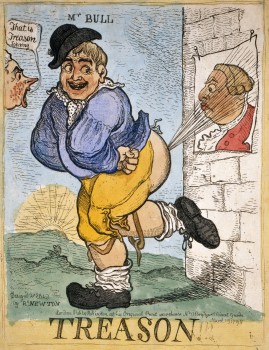
A long standing and quite appropriate traditional form of British political discourse.
A long list of foreign leaders, including U.S. President Barack Obama, have said they wanted Britain to stay in the bloc, but Gove dismissed those interventions, saying those leaders would never cede sovereignty in the way required of EU members.
“Don’t pay attention to what they say, pay attention to what they do,” he told the audience.
Gove also attacked U.S. banks Goldman Sachs and JP Morgan, which have donated funds to the “Remain” campaign, saying they were doing very well out of the European Union and portraying them as part of an elite that cared little for ordinary people.
“Banks like JP Morgan and Goldman Sachs said that Greece could enter the euro and they knew that that was wrong. Banks like JP Morgan and Goldman Sachs spend millions lobbying the European Union in order to rig a market in their favour.”
– Michael Gove
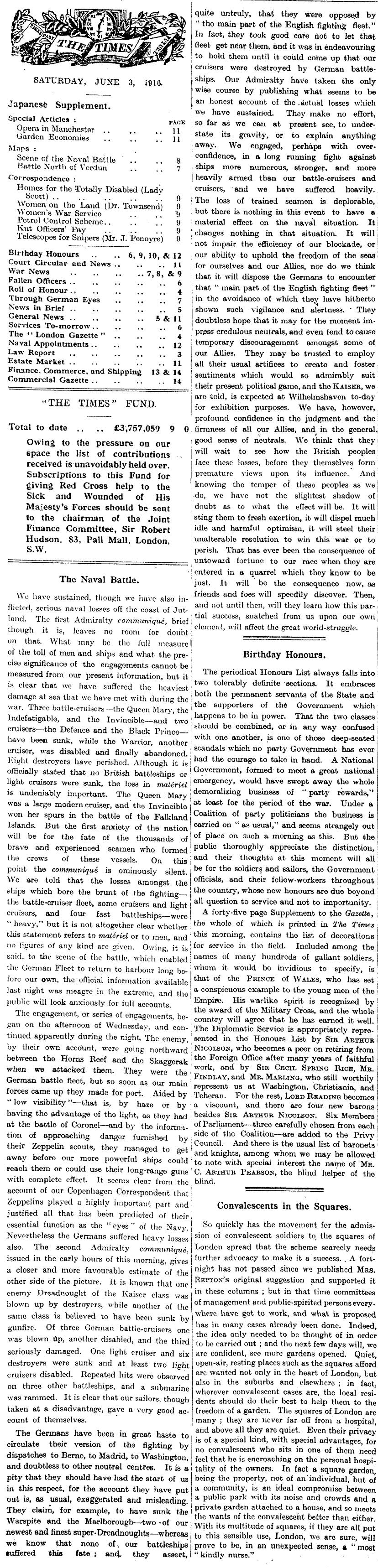
On 3 June 1916, the British public finally got to find out about the Battle of Jutland. Sort of. At this stage things look bad. The British have lost more ships and more men than the Germans. And they have lost the opportunity to annihilate the German High Seas Fleet. But worse is to come. The Admiralty is claiming to have sunk 2 German dreadnoughts when they have done no such thing. Over the years it will emerge that explosive handling practices were appalling and communications were poor.  The Times 3 June 1916 p9 Fortunately, there is a crumb of comfort, a rather large one. The Times nails it:
It will not impair the efficiency of our blockade, or our ability to uphold our freedom of the seas for ourselves and our Allies, nor do we think that it will dispose the Germans to encounter that “main part of the English fighting fleet” in the avoidance of which they have hitherto shown such vigilance and alertness.
Jutland may not have been as decisive as Trafalgar but it was decisive enough.
Incoming from the Adam Smith Institute:
Tax Freedom Day is four days later this year than last year, and the latest it has been for fifteen years.
For more of the grizzly details, go here.
We Brits now face choosing between a government that is raising taxes really quite fast, and an alternative government that would raise them a hell of a lot faster. Stagnation, or ruination. More about Tax Freedom Day here, and here.
The weather today, here in London where I sit, is really cold and grim and gloomy. Would that Tax Freedom Day, which is today, was now moving backwards towards some time like February, instead of us having to wait until June 3rd, which only feels like February.
This tweet was the first I’d heard of it.
The overall effect of Donald Trump: Bombastic; but you can obviously deal with bombastic people. Occasionally contradicts himself; you can obviously deal with people like that. Has some views that, let’s say, perhaps, most people don’t hold; you can obviously deal with people like that. He can’t be that bad. The American system is designed to limit the power of the president. Nothing that bad is going to happen. He’s going to build a wall. He’s going to fix trade. […] Everything else seems to be up for grabs. Which is fine. Who wants an activist president? Who said we had to have all these presidents who wanted to do things? The best president in history was Calvin fucking Coolidge who did nothing.
I think Trump is going to quickly find he is not able to do much after he builds his wall and fixes trade and that’s fine. He’s going to be a slightly more bombastic Coolidge and I think most people are fairly relaxed about that. But the cultural effect of Donald Trump is going to be marvellous. Donald Trump represents the single greatest threat to the left’s thirty year history of shaming, name-calling, silencing, bullying, nannying, bossing around, the schoolmarmishness of the left: he just blows through it like a juggernaut. He represents an existential threat to the regressives we hate so much because he shows them up for the nonsense that they are. Every time he’s accused of being sexist he either doubles down or shows with evidence why it’s not true. Every time he’s accused of being racist he laughs it off and moves on. Any time he’s accused of any of these things it doesn’t work; it doesn’t affect him. And the media, which is so in hock to these ridiculous liberal social-justice lunacies and platitudes has lost its power to affect how people vote. The power of the American media to shape elections is fucking gone. It’s over.
[…]
Trump has come along at exactly the right moment when people are prepared to vote culturally. And people are prepared to vote for a wacky, outside candidate because they realise that nothing is going to change otherwise. […] The people who are the most angry about Trump are the people who realise that the gravy train just skidded to a halt. There is no more money for you. And why? Very simple: you’re losers. You lost every possible argument with the possible exception of guns and maybe abortion. Everything else you lost. Conservatives are losers. The public is tired of looking at conservative media and conservative politicians and seeing losers.
– Milo Yiannopoulos at UCLA explaining why he thinks a Donald Trump presidency would be a good thing.
You know the world is in a strange place when the authoritarian Islamist thug and all around violator-of-goats who runs Turkey, Recep Tayyip Erdogan, sues Uwe Boll for making unkind remarks about him.
Uwe Boll: the voice of reason. What a time to be alive 😀
|
Who Are We? The Samizdata people are a bunch of sinister and heavily armed globalist illuminati who seek to infect the entire world with the values of personal liberty and several property. Amongst our many crimes is a sense of humour and the intermittent use of British spelling.
We are also a varied group made up of social individualists, classical liberals, whigs, libertarians, extropians, futurists, ‘Porcupines’, Karl Popper fetishists, recovering neo-conservatives, crazed Ayn Rand worshipers, over-caffeinated Virginia Postrel devotees, witty Frédéric Bastiat wannabes, cypherpunks, minarchists, kritarchists and wild-eyed anarcho-capitalists from Britain, North America, Australia and Europe.
|





Recent Comments