We are developing the social individualist meta-context for the future. From the very serious to the extremely frivolous... lets see what is on the mind of the Samizdata people.
Samizdata, derived from Samizdat /n. - a system of clandestine publication of banned literature in the USSR [Russ.,= self-publishing house]
|
I receive emails from Google about, among other things, 3D printing. These 3D printing emails link to pieces that mostly confirm my current prejudice about 3D printing, which is that it is an addition to the technological armoury of current manufacturers rather than any sort of domesticated challenge to the conventional idea of manufacturing being done by manufacturers. Far from making manufacturing less skilled, 3D printing is, as of now, making manufacturing more skilled. Which is good news for all rich countries whose economic edge is provided by being able to deploy an educated rather than merely industrious workforce.
Here is the kind of story that these emails link to:
… my colleagues and I have found a way to print composite material by making a relatively simple addition to a cheap, off-the-shelf 3D printer. The breakthrough was based on the simple idea of printing using a liquid polymer mixed with millions of tiny fibres. This makes a readily printable material that can, for example, be pushed through a tiny nozzle into the desired location. The final object can then be printed layer by layer, as with many other 3D printing processes.
The big challenge was working out how to reassemble the tiny fibres into the carefully arranged patterns needed to generate the superior strength we expect from composites. The innovation we developed was to use ultrasonic waves to form the fibres into patterns within the polymer while it’s still in its liquid state.
The ultrasound effectively creates a patterned force field in the liquid plastic and the fibres move to and align with low pressure regions in the field called nodes. The fibres are then fixed in place using a tightly focused laser beam that cures (sets) the polymer. …
The patterned fibres can be thought of as a reinforcement network, just like the steel reinforcing bars that are routinely placed in concrete structures …
In earlier pieces I have done here about 3D printing, commenters have compared the current state of domestic 3D printing with the state that domestic 2D printing had reached in the days of the dot matrix printer. Remember those? Maybe not. They disappeared from common view quite a while ago now.
The above description of miniature reinforcing rods makes me think that something like a 3D printing analogue to the 2D domestic laser printer may be about to emerge. Laser printers supplied, once their price had fallen to something domestically tolerable, unprecedented clarity and flexibility to domestic computer users. The process described above, and all the other 3D printing advances that those google emails tell me about, will, if all develops well, supply unprecedented internal strength, and hence just all-round quality, to cheaply printed 3D objects.
None of which means that specialised 3D printing by specialisers in all the various different sorts of 3D printing that are now coming on stream will cease to be a way to make a living, any more than specialised 2D printing experts have all now been run out of business by amateurs in their homes. (Quite the opposite – that link being just one for-instance of a hundred that I might have picked – I just happen to have particularly noticed taxis covered in adverts.) It is merely that, in the not too distant future, domesticated 3D printing may actually become seriously useful to people other than hobbyists and 3D printing self-educators.
However, even as supply gets ever cleverer, when it comes to domestic 3D printing there remains the problem of demand. As I asked in this earlier posting here (commenter Shirley Knott agreed): What 3D printed objects will be demanded domestically in sufficient quantities, again and again with only superficial variations (in the way that black-on-white messages on paper are now demanded) to make domestic 3D printing make any sense? No answer was supplied in those comments three years ago, and I have heard no answer since. So the above ultrasound-arranged reinforcing rods trick will almost certainly turn into just another manufacturing technique for old-school manufacturers to apply to their old-school specialist manufacturing businesses. Which means that this posting becomes just another Samizdata Ain’t Capitalism Great? postings. Which is fine. On the other hand, few can see killer apps coming, until suddenly they come. So maybe a future beckons, which sees us all eating out, but making other, inedible stuff in our kitchens.
The reinforced concrete reference also makes me even more eager than I long have been to see how 3D printing impacts on the world of architecture, architecture being another enthusiasm of mine. Postings like this one at Dezeen make it clear that this is a question that lots of others are wondering about also.
I don’t need a special month or special channel. What’s sad is that these insidious things only keep us segregated and invoke false narratives.
– Stacey Dash
Normally I would not bother to unpick the economic nonsense of Corbynista Owen Jones, but he has the sort of article up on the Guardian that passes for conventional thinking among a sizeable chunk of the population, so I am going to quickly have a pop at it:
Travel outside London….Britain’s deregulated bus system reveals itself as the source of widespread, justified disgruntlement – an overpriced, inefficient, poor-quality mess. According to a report to be published this week, since deregulation in 1986 – unleashed with the promise that “more people would travel” – bus trips in big cities outside London have collapsed from 2bn to 1bn a year. In London, on the other hand, where everything from how much we pay to which routes exist is decided by the mayor and Transport for London, bus use since the 1980s has gone in the opposite direction: from around 1bn to more than 2bn trips a year. Britain’s bus privatisation disaster is a story of profit before need, and a discomfiting tale for those who believe the private sector automatically trumps the public realm.
Jones doesn’t use the term, but he presumably thinks that the fact of there being far fewer bus services in the UK than a certain period in the past is a case of what economists call “market failure” – where there is a lot of supposed demand for X, but and under-supply of it, which needs to be fixed by, you guessed, the State (supported by the taxpayer, the very same people who are supposedly unable to pay for the under-supplied service). There are several issues here. First of all, services run by a municipality (ie, a monopoly with no competition) typically don’t lend themselves to good consumer service. Second, in a large metropolis such as London, where an organisation such as Transport for London runs things, there is still quite a lot of competition (cycling, walking, cars, etc) the abuse that any monopoly power has is constrained, although the situation is far from ideal. Funnily enough, the other day TFL, which had been lobbied by taxi drivers to go after Uber, seems to have decided against it, which is good news.
In the countryside, it may well be true that there are a dearth of buses. It may not be profitable to run them on certain routes, but is that an argument against private provision and for state control? In very sparsely populated parts of the country, it is a serious mis-allocation of scarce resources to provide such things when there are more urgent requirements instead for the resources in question. Second, if a person goes to live in the country, part of the pro/con of living in the back of beyond is that you don’t have lots of rapid-transit transport nearby. You may have to rely on having a car, driven by either you, or by a neighbour, partner, etc. That is part of the trade-off that comes from choosing to live in the sticks, rather than in the city. Why should those who have chosen the option to live in the country, or to stay there, be subsidised in transport terms by those who do not? In some cases, the persons paying for the subsidy will be far less well off than those taking advantage of it. That is the sort of regressive transfer of wealth that I assumed a lefty such as Jones would be against. This sort of issue also explains why, other things being equal, the cost of buying a home in central London is far higher than, say, the middle of Norfolk or Yorkshire.
Jones states that because, in his view, people “need” X that it is the responsibility, in the event of some alleged market failure, for the State to step in. But leaving aside whether the need is real or a figment of Jones’ socialist imagination, consider a basic example of a human need: food. Food is, despite some interventions and distortions created by the State, such as import tariffs and subsidies for farmers, largely handled in the private sector here. Ask yourself whether we would be better off in having food supplied by something such as Transport for London, or Sainsbury’s, Tesco’s or Asda. It does not even come close, does it?
The other day I linked to an item about Donald Trump’s economic illiteracy. Today, there is an item in the Daily Telegraph by Emma Barnett (whoever she is). She piles on Trump for the endorsement he has received from Sarah Palin. Her article is about how deranged most American voters, and by extension, much of the political class, are and is. But the article itself is an example of a different kind of stupidity, mixed up with a generous loading of condescension and superciliousness. And I just loved this about the approach Brits are supposed to take to what is going on Stateside:
If the US political stage were solely split between the reasonable wings of the Democrat Party, a socialist Bernie Sanders and hawkish Hillary Clinton, we’d probably be better able to relate.
So let me get this straight: the UK would be fine with an election between an economically illiterate fool (Sanders) and a probable criminal (Clinton). OK, we currently have an official opposition led by a terrorist-supporting sub-Marxist (Corbyn) and a government led by a patrician Tory of mixed accomplishments (Cameron), although “call me Dave” is probably not as venal, or as congenital a liar, as H. Clinton (we are talking in relative terms, in case people object that DC isn’t particularly honest). So yes, there is much about American politics that a lot of Brits, marinated in mixed economy juice and decades of socialism, cannot relate to, but please, don’t let’s assume that we’d all be quite content with a race between Sanders and Clinton for ultimate power any more than most Americans would.
Oh and by the way, if H Clinton is “hawkish”, I am not sure how that assessment fits with the running sore that is the siege on the Benghazi Embassy, and her behaviour over said.
I read this…
Pope tells Davos elite: Consider your role in creating poverty
…and my immediate response was “Fine, and then consider your role in creating poverty”. This economically illiterate collectivist favours precisely the sort of top-down state run economics that strangle innovation and distort markets to favour whoever can best manipulate the means of collective coercion.
I will admit to rather enjoying the sight of Donald Trump storming through the Republican race. It’s simply refreshing to see someone over turning the established and perhaps too measured way that politics has been approached recently. However, my enjoyment is as nothing to the perils of the economic policy which he’s just announced, which is that he’ll get Apple to start making “their damn computers” in America instead of in other countries. This is really not a sensible policy at all even though it accords with his other misunderstandings about trade. Because the net effect of such a policy would be to make America a poorer country. Something we’ve known since David Ricardo published in 1817. And, since making the country, or the people of the country, poorer is not at all the point nor purpose of having an economy, or even a public policy about the economy, this is something we really shouldn’t try to do.
– Tim Worstall.
Of course, I suspect that Trump knows full well that protectionism is a lousy idea and harms those who advocate it. I am guessing that he doesn’t care.
National Review’s Kevin Williamson has a book on Trump that makes for sobering reading. If anyone thinks Trump is any kind of supporter for limited government conservatism, I have a beach resort in Leeds I’d like to sell you.
Recent events in Germany may have led some to ask if Germany still controls its borders. Well of course the German Federation does, it had an entire Border Police Force, the Bundesgrenzschutz to do that, and it has quietly been building a Federal Police Force by merging the Railway Police with the Border Police. However, the German Federal State does not seem to regard border control as that much of a priority.
It wasn’t always thus for German governments, we all know about the Berlin Wall, or the ‘Anti-Fascist Protection Rampart‘, an example of German bureaucracy showing some resolve as to who crosses its borders. The Wall was of course, the weak point in the East German border, although technically it did not divide the Germanies, but the Allied Occupation Zones from the Soviet Zone and from the DDR, and for most of the time, there was no point fleeing to comradely Poland or brotherly Czechoslovakia, but that changed in the late 1980s. At the Berlin Wall, some 138 deaths have been recorded, there may have been many more.
But there was a more deadly border defence put in place by a German state, Imperial Germany, it was called the Dodendraad, a lethal electric fence, the implementation of which left, by one estimate, around 850 people killed, other reports say around 2,000 – 3,000 people were killed, including shootings etc. at the fence. You may well say ‘It doesn’t quite sound German‘, and you would be right. It wasn’t even ‘protecting’ Germany’s border, but someone else’s. The Dodendraad (Wire of Death) was put along the frontier between occupied Belgium and the Netherlands in the First World War, as a means of controlling movement over the frontier. A frontier that had two peoples with effectively one language joined by trade and family, and separated by murderous force. The Wire did not cover all of the Belgian/Dutch border, as the Kaiser did not violate Dutch neutrality by seeking to place it around Baarle-Hertog’s many borders with Baarle-Nassau.
The task facing the Imperial Army was demanding, there were no Belgian power stations to power the 2,000 Volt wires along the over 200 miles of the fence, as Belgium (we are told) had no power grid at that time.
Around the clock there was a guard every fifty up to one hundred and fifty metres. At nighttime the number of border guards was doubled, there were also more patrols. German soldiers were ordered to fire immediately after every unanswered warming. Yet they were not allowed to fire in the direction of The Netherlands. The soldiers walked from one switching cottage to the next one, returning when they met with a colleague halfways.
For the poor border Belgians, life was grim:
Placing the wire of death made it impossible to enter The Netherlands. Border traffic was reduced. For inhabitants of the border region this was a painful ordeal as their friends and relatives very often lived in both countries. All traffic to The Netherlands was forbidden or required a strict German control. Whether one could visit a relative or a friend on the other side of the border, depended on the arbitrary decision of the local commander who might – or might not – grant a written (and paid for) permit to leave the country for just a few hours or days. Belgians had to leave the country through a specific gate and had to enter again through the same gate, subject to scrutinous control and registration. If one failed to return in time from a visit to e.g. a sick relative, one simply risked having family members imprisoned or you were forced to pay a heavy fine.
So even before the Germans sent Lenin to Russia to found and then electrify the Soviet Union, they had built a model death strip that many a socialist thinking about the good old days of East Germany could have been proud of.
Tim Montgomerie, over at the CapX site, writes about his fears of how the UK will fare longer term while the main opposition party, Labour, slides further and further into lunacy. That it is becoming more brutishly statist/mad isn’t in doubt. We have Jeremy Corbyn’s support for secondary picketing in union disputes with employers, calls by him for powers to ban firms from paying dividends if they are not deemed to pay staff enough, ending a nuclear deterrent – while keeping submarines (for what, deep-sea fishing?); potentially moving to give Argentina some sort of stake in the Falklands, talk of reaching out diplomatically to ISIS, “people’s quantitative easing”, and so on. It is a mixture so mad, so evidently mad to anyone with a basic understanding of state-craft and economics, that I remain convinced that Corbyn is not really interested in winning power soon, but is interested in discrediting the very tradition of parliamentary democracy by enabling the Tories to retain power for a long time and hence building up resentment about it. Maybe I am, however, assuming too much in the way of feral cunning on the part of Corbyn and his unlovely allies. Maybe these men and women are sincere, and just unbelievably thick.
Montgomerie’s point about the dangers of their being a miserable excuse for an opposition is true in a sense (competition is healthy) but it is worth noting that when, as in recent years, parties competed over who could provide the best sort of managerialist/half-capitalist/half statist arrangement, the quality of governance was not notably great, in my view. And consider this shocker of a paragraph from Montgomerie, who is, remember, a supposed Conservative:
I can think of many things that the Blair-Brown governments did that benefited Britain and which a Tory-led government would unlikely to have initiated (but has now embraced – and sometimes extended). The minimum wage. Free access to museums and galleries. The targeting of institutional racism in public bodies like the Metropolitan Police. The smoking ban in public places. The (near) abolition of hereditary peers. The establishment of the Department of International Development. Active measures to increase the diversity of parliament. A lower age of consent for gay men.
The minimum wage. This is an economically illiterate measure that to the extent it makes a difference, does so by raising unemployment, particularly among the young, unskilled and among minorities. True, the current Tory government has embraced the idea, but that was more out of low political calculation over trying to “shoot the Labour fox” than out of understanding of labour markets. Bad idea.
Free access to museums and galleries. I am a taxpayer and pay for museums and galleries. Anyone who buys anything like a pint of beer or fills up a car with petrol pays taxes. Clue to Mr Montgomerie: these things aren’t free. Someone get this man an economic textbook.
The targeting of institutional racism in bodies like the Metropolitan police. “Institutional racism”: a sloppy term. Just because the share of police officers on the beat doesn’t match 100 per cent with the makeup of the population in area X does not, ipso facto, prove that there is racism around or that it was a decisive factor at work, absent other forces. And the same applies to arrest data – that X per cent of arrests in London are among young males from ethnic group X does not, of itself, prove there is a problem unless you could prove intent. To discriminate is to choose – which involves a conscious agent. A lot of nonsense gets committed by ignoring this basic point.
The smoking ban in public places. This was a draconian step that, while it is good for non-smokers such as me, is not so great if you value tolerance. Appallingly, it applies to spaces owned by private sector bodies, such as offices and pubs, where the decision should be down to the owners of said as much as possible. With publicly-funded bodies, the taxpayer rightly should have an important say in the matter. A genuine Conservative ought to be able to make that distinction, rather than support a blanket ban.
The (near) abolition of hereditary peers – well, if this system was to be replaced by one that meant the House of Lords remained a vigorous check on the Commons and prevented foolish, ill-drafted legislation getting through, that would be worthwhile. The jury is out.
The establishment of the Department of International Development – a body that takes taxpayer’s money to fund government-to-government aid. There is now quite a body of research proving that much state-backed of foreign aid is worthless, if not actively harmful, and far less effective than encouraging free trade and open access to markets so as to build self-reliance and foster growth. Also, there is the small matter of taxpayers having the right to decide what to do with their own money if possible, as the default position. (Which is what Conservatives are supposed to assume, right?)
Active measures to increase the diversity of parliament. Translation: more women and ethnic minorities. The composition of a political party should be down to the party and its members, rather than decided in any other way. By “active measures”, does Mr Montgomerie support coercive interference with how MP candidates are selected? I should hope not. Parties are voluntary bodies and paid for voluntarily, and should remain so and retain autonomy to select MPs how they like, whether it be for rational or daft reasons.
A lower age of consent for gay men. Sure, encouraging the notion of respecting relations between consenting adults is a good idea. Shame it is honoured so rarely by what passes for respectable opinion these days.
The current plight of the Labour Party is a source for some concern but unlike Montgomerie, I don’t feel particular sorrow over its demise. Labour has presided over a number of disasters in our history. To give some examples, its nationalisation of much of British industry post-1945, based on notions of state control and central planning, did immense harm, and the punishingly high income tax rates after the war, which the Tories did not really reverse until 1979, meant the UK had little in the way of a start-up, entrepreneurial culture for decades. There may have been some incremental good done along the way (some of the criminal law reforms in the 1960s were good) but by and large the achievements of Labour have been negative. If Corbyn finishes this lot off, I am not going to cry into my cornflakes. Sooner or later, the market for a moderate liberal/left, if it is big enough, will be filled.
Oxfam are at it again: The 62 richest people own more than the bottom half of all people. The last time this was measured it was 80, and before that 388. All this means the world is getting worse. Something Must Be Done. And so on.
Some thoughts in response, and I am glad to see that many Guardian commenters have had similar thoughts:
This is a really bad way to measure things. To be in the top 1% you just have to own a normal house in London. What do the top 62 have that the others do not? A bigger house in London and a functionally equivalent but shinier car. They are certainly not eating all the food and making everyone else hungry.
There is not a fixed quantity of wealth. The rich people being rich takes nothing away from the poor people. They control resources, in the sense that they get to have a bigger influence over what gets made, but for the most part they got rich by making useful things, so they are probably the right people to be making such decisions. Their idiot children who inherit the money will soon fritter it away on fancy cars and restaurant food, so it will get redistributed to factory workers and waiters in the end anyway.
By any real measure, such as infant mortality, nutrition, life-expectancy, number of people subsistence farming, access to clean water: things are getting better. There is a web site showing all this but I can not find it.
And what would Oxfam do about it, anyway? Force the rich people to give it to governments, probably. See my previous comment about who has proven themselves able to make useful things.
Andrew Rawnsley has joined the crowd round the cadaver at the pollsters’ post mortem for the May 2015 General Election:
“Now if only I had followed my own advice about opinion polls…”
At 10pm on 7 May last year, Martin Boon, the head of the polling company ICM, spoke for his entire industry in a two word tweet: “Oh, shit.”
There follows some discussion of what went wrong, and then it gets to the part that really interests me:
It might even be paradoxically true that by forecasting a hung parliament, the polls helped to produce a Tory majority government. I think there is something in this, but the trouble with the hypothesis is that it is just a hypothesis. Since we can’t rerun the election with accurate polling, it can’t be proved.
That hasn’t stopped some voices from responding to the polling failure by demanding a ban on their publication in the days before an election. That is a rotten idea. It would be anti-democratic, unfair and it wouldn’t work anyway. In a free society, it should not be illegal to collect opinions and publish the results. Another objection to a ban is that it would be partial. A privileged minority, commercial interests and the political parties themselves would still conduct and have access to private polls. In any case, a ban looks highly impractical because it could not prevent websites abroad from publishing polls.
He writes good sense, but it does not stop many, many of the commenters to Mr Rawnsley’s article demanding that polls be banned in the run-up to an election. Many of these want polls banned simply because they think it would help the Labour party. Amusingly, a lot of the same commenters who now say that the pollsters conspired to exaggerate the chance of a Labour victory in order to frighten Conservative voters off their sofas were saying before the election that the pollsters were conspiring to exaggerate the chance of a Conservative victory in order to demoralize Labour supporters. And now they refuse to believe the recent polls that say Jeremy Corbyn is widely considered unfit to be prime minister.
The group above overlaps with those who want to ban opinion polls because fantasizing about banning things is one of their few pleasures in life, but there are also some calls for polls to be banned from people who do not give the impression of being quite such control freaks.
These less visibly freakish commenters often want a ban on polls specifically because – get this – voters might change their intentions if they know more about what other voters are likely to do. If you think about it, this is a very weird argument. For one thing, under this argument the case for a ban (such as it is) becomes stronger the more consistently accurate polling becomes. For another, the people making it generally rail against the voters for not bothering to inform themselves, but in this matter they demand that the voters be forbidden to inform themselves. Why that particular exception? Why should voters be encouraged to consider the effect their vote will have by looking at the party manifestos, or by using the results of the previous election to decide how best to place their vote tactically, but be forbidden to consider what their fellow voters are planning to do? If the protest vote I am considering making against Party X turns out to be rather more likely to propel the dreadful Candidate Y into the seat than I had previously thought, I want to know about it.
The Cold War ended a quarter of a century ago. Some are forgetting about it, others are never even learning about it. Many others are deliberately forgetting about the Cold War, because it, and how it ended, made them look bad. But the Cold War needs to be remembered. What it was. What it meant. And why it was such a good thing that the good side won and that the bad side lost.
Sights like this poster, I suggest, which I managed to photograph at Pimlico tube station yesterday before the train I was awaiting blocked it from my view, might help. It is advertising a German series now running on British TV, set during the final years of the Cold War:

I have not been watching Deutschland 83. Comments from any who have would be most welcome. If such comments materialise, I would not be surprised to learn that it contains many little touches of moral equivalence, inaccuracy, and deft little claims to the effect that the winners of the Cold War won it by mistake and that the losers of the Cold War lost it on purpose. I don’t know, but fear the worst on that front. (A little googling led me to this piece, which, with its typically snearing Reagan reference, does not reassure me.)
But meanwhile, the above poster struck me yesterday and strikes me still as a breath of fresh, clean, truthful air.
I particularly like the colour contrast. I further like that Marx and Lenin get blamed for this colour contrast. I like that there is barbed wire on the bad side but none on the good side, grim and grey sky on the bad side and blue sky on the good side, privation and militarism on the bad side and an abundance of tasty food, romantic pleasure and technological inventiveness on the good side.
Perhaps the makers of this poster – and if not them than at least some of those distributing it and displaying it in this country – thought that they were being ironic rather than truthful. Perhaps some of these people think that this poster does not so much present truth as mock the truthful opinions of people like me and my fellow Samizdatistas, for being “simplistic”. If so, to hell with such anti-anti-communist imbeciles. I prefer the truth about the Cold War and I rejoice that this poster proclaims that truth, especially to people who may not now be aware of it.
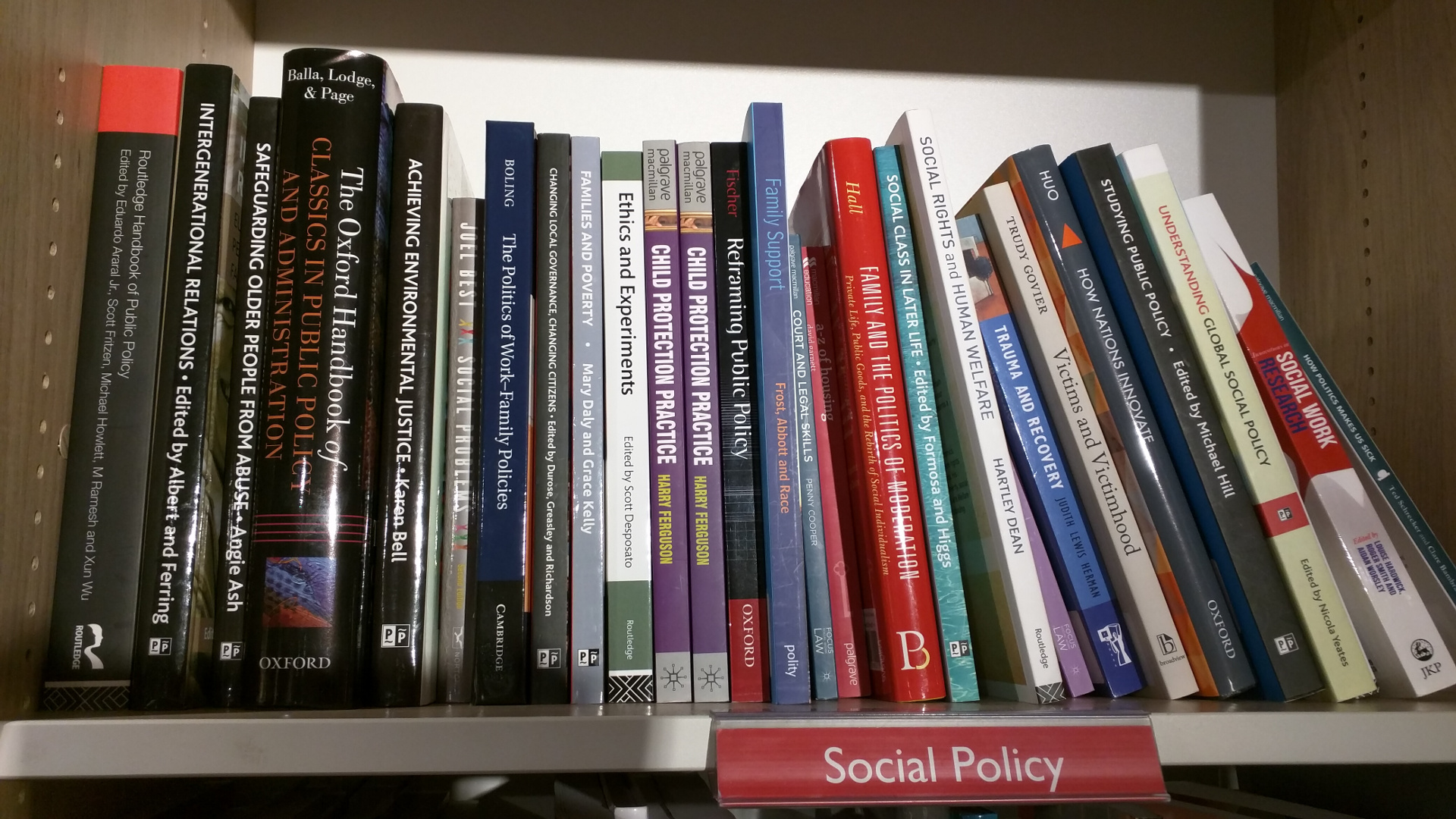
I have been spending a bit of time in Foyles, recently. It is my favourite bookshop in London for the vastness of its selection, though if any readers know better I am all ears. It does contain, however, the bookshelf from Room 101:

Can you imagine what kind of dinner party guests these authors would make? Just look at the blurb on the back of the Fischer book:
In recent years a set of radical new approaches to public policy, drawing on discursive analysis and participatory deliberative practices, have come to challenge the dominant technocratic, empiricist models in policy analysis. In his major new book Frank Fischer brings together these various new approaches for the first time and critically examines them. The book will be required reading for anyone studying, researching, or formulating public policy.
Required, good and hard, as punishment for being involved in such a dismal endeavor, perhaps. Opaque writing like this always makes me wonder if there is real content to be dug up. I had a quick look inside. Irritatingly, from the point of view of trying to poke fun, I found (on page 170) what might be some insight.
It is common in politics to portray our opponents as engaging only in ‘rhetoric’: that is, concealing the real story, they offer us a version of events constructed to promote their own interests and concerns. Missing from this view, however, is the recognition that all politics operates this way. Symbolic representation, in short, is basic to political argumentation. […] An important feature of symbols is their potential ambiguity. Symbols often typically mean two (or more) things at the same time: ‘equal opportunity in education can either giving everybody tuition vouchers for the same dollar amount’, or it can mean ‘providing extra resources for those with special needs’
[…]
For the empiricist conception of science, of course, this is problematic. The interpretation of events, social as well as physical, has to remain clear and constant for the work of the empiricist.
I have written before about the problem of language being used deliberately to muddy thinking. It seems likely that, since libertarianism is correct, looking at the world empirically leads inevitably to it. Therefore libertarians are likely to be empiricists. And bad at rhetoric, and therefore bad at winning at politics. (And often more interested in more empirical pursuits, like building rockets.)
Can we possibly beat them at their own game? I used to think that just sticking to the facts of the matter in debate would be good enough. That on-the-fence observers would detect who was making the most sense and pick the right side. I am starting to think that rhetoric has its place: if you really want to convince people, and, empirically, people are convinced by rhetoric, perhaps it is unavoidable.
Vox Day, in what amounts to a manual for beating Them at Their own game, wrote a whole chapter on it. He quoted Aristotle: “Before some audiences not even the possession of the exactest knowledge will make it easy for what we say to produce conviction. For argument based on knowledge implies instruction, and there are some people whom one cannot instruct.” Mr Day goes on to explain:
I strongly prefer communicating in dialectic myself, but that is a language reserved for those who are intellectually honest and capable of changing their minds on the basis of information. So I speak dialectic to those capable of communicating on that level, and I speak rhetoric to those who are not.
Before I even opened the Fischer book I found myself writing, in a Facebook discussion about heavily drinking relatives who had nonetheless lived to a grand old age, in response to others who complained that this was mere anecdote: “Anecdote is not evidence but it *is* rhetoric, and you need to develop good rhetoric to win at politics.” I am beginning to see how I might start to use rhetoric without feeling dirty, as a means to a well-intended end. I am not sure whether I would be any good at it, though. Worse, I sense that it is the road to hell.
|
Who Are We? The Samizdata people are a bunch of sinister and heavily armed globalist illuminati who seek to infect the entire world with the values of personal liberty and several property. Amongst our many crimes is a sense of humour and the intermittent use of British spelling.
We are also a varied group made up of social individualists, classical liberals, whigs, libertarians, extropians, futurists, ‘Porcupines’, Karl Popper fetishists, recovering neo-conservatives, crazed Ayn Rand worshipers, over-caffeinated Virginia Postrel devotees, witty Frédéric Bastiat wannabes, cypherpunks, minarchists, kritarchists and wild-eyed anarcho-capitalists from Britain, North America, Australia and Europe.
|






Recent Comments