We are developing the social individualist meta-context for the future. From the very serious to the extremely frivolous... lets see what is on the mind of the Samizdata people.
Samizdata, derived from Samizdat /n. - a system of clandestine publication of banned literature in the USSR [Russ.,= self-publishing house]
|
The island of Sark, a small, remote Channel Island, with a population somewhere around 500, part of the Duchy of Normandy and the Bailiwick of Guernsey, but almost entirely autonomous, noted for not having any cars, having been one the last feudal jurisdictions in the World and having had very low taxes, is currently in crisis over its electricity supply. The problem can be summed up in two words ‘price control’. Sark is taking on the appearance of a small, cooler, oil-free Venezuela (or perhaps a preview of Corbyn’s – or even May’s- UK in 2022). It even has the example of France, home of ‘égalité‘, the guillotine and generally poor economic ideas (and some excellent ones), a few miles away over the choppy Channel.
It will no doubt not surprise almost all our readers that Sark, having in recent years had democracy foisted on it, has got a legislature (28-strong) that seems to think that it has solutions to problems. The islanders have also found that as the price of electricity has risen in recent years, and as people have not been happy with the sole supplier to the Island, they have been generating their own power. Falling demand has led to higher unit costs for the supplier, which creates a vicious circle.
Enter the Commissioner established and authorised, nay, required, under the The Control of Electricity Prices (Sark) Law, 2016 to look into the price of electricity and to set a ‘fair and reasonable price’.
Looking at his powers more closely we see that they are in fact, nothing short of miraculous, under Section 13:
Determination of fair and reasonable price.
13. (1) Following completion of an investigation under this Law, the Commissioner shall, determine whether a price which is charged by a regulated electricity supplier for the supply of electricity is, or is not, fair and reasonable.
(2) In determining whether a price is, or is not, fair and reasonable the Commissioner shall take all material considerations into account, including without limitation the following matters –
(a) the cost of generating and distributing the supply of electricity, including the cost of –
(i) acquisition and maintenance of any plant and equipment,
(ii) fuel and other consumables, and
(iii) labour, required to generate the supply,
(b) the replacement cost of any plant and equipment required to generate and distribute the supply,
(c) the quality and reliability of the supply of electricity and the economy and efficiency with which the supply of electricity is generated and distributed,
(d) the margin of profit obtained by the regulated electricity supplier,
(e) the margin of profit obtained by such other electricity suppliers, generating and distributing a supply of electricity in similar circumstances in such other islands or territories, as the Commissioner thinks fit,
(f) the entitlement of the regulated electricity supplier to receive such reasonable return, as the Commissioner thinks fit, on the value of assets (including plant and equipment and working capital) operated or used by the supplier for the purpose of generating and distributing the supply, and
(g) any representations made in response to a request given under section 14, or otherwise.
Funnily enough, he is not expressly directed to consider the laws of economics, or supply and demand. You can see where this is going I am sure. So why can’t the fools on Sark? How many thousand of years and examples will it take? Here we have the closest thing to a laboratory for economics, 500 or so ‘lab mice’, and yet we already know how it ends. Here is his consultation paper.
So cutting to the chase, a price control has been issued, and the Island’s sole electricity provider intends to close on 30th November 2018, as they are losing £20,000 a month supplying power at the ‘fair and reasonable‘ (and that’s official) price. May I introduce here, the Managing Director of the Sark Electricity Company Ltd, Mr Atlas Shrugger (I jest), his name is… Mr Gordon-Brown (David being his first name), and his company wishes to challenge the commissioner’s decision.
SEL was to mount a legal battle against the commissioner move this December.
However, a review of the company’s financial affairs by its independent auditors found that although the company could withstand the temporary £20,000 loss per month caused by a new 52p price for electricity, SEL could not afford to mount the legal case at the same time.
Back in December, the tariff was set at 69p per unit.
‘We have already suffered through a 40% decline in consumption caused by Sark’s economic collapse and we cannot cut our costs any further,’ said SEL managing director David Gordon-Brown.
‘A 25% price cut for a company that has already lost £65,000 this year is obviously unmanageable.
‘Attempting to operate the company under these conditions would be a breach of my responsibilities as a company director.’
He said if Chief Pleas wanted the company to continue providing power, it would have to provide for the cost of fighting the commissioner order.
‘We cannot operate the company at a loss over £20,000 a month under the new pricing scheme nor can we find the money necessary to fund the legal fight.’
He added that if Chief Pleas did not come to the table as a financial backer in time, it would be required to shut down, leaving the island without water or electricity.
This, I understand, is because the cost of a legal challenge (in this tiny island) to the Regulator would be in the region of £250,000, and Mr Gordon-Brown has asked the Chief Pleas (the Parliament of Sark) to fund a legal challenge to the body established by the Parliament, as obviously, his company can’t afford that sort of money. Can anyone else see the obvious short-cut here, the one that doesn’t involve legal fees?
Mr Gordon-Brown was reported last December as saying:
David Gordon-Brown, the manager of Sark Electricity, says the recommendation by the island’s first electricity regular to reduce electricity prices tells “a story of betrayal”.
For the past eight years the people of Sark have been betrayed by a committee of incomers with so little understanding of Sark that they expect Electricity Prices here to be comparable to their experience in the UK.
Now the Company has been betrayed by a commissioner with so little understanding of Sark that he expects the costs of producing electricity here to be comparable to his experience in the UK.
The commissioner is doubtless a dedicated and decent chap, committed to fulfilling his statutory duty, he is only following the law and only giving orders, safe, as it happens, in his home in Long Buckby, Northamptonshire, England.
But has the Commissioner considered economies of scale, transportation costs, economic law and reality? Does he have to?
The situation now is that the Electricity Company is shutting down on 30th November 2018, and they supply water.
I have to say that all those who voted for those who voted in this law, and those who voted it in and implement it, are quite simply, fully deserving of their adumbrated trip back to the Stone Age. I would propose evacuating from Sark all those who opposed it, or were too young (or insane) to know better (i.e. under 16), and leaving the rest to enjoy their new, low prices. To keep us safe from contamination, we should establish an an air and sea blockade, and air-drop a copy of Bastiat’s writings so that they may learn the error of their ways. Socialism (or price fixing) is just slow-motion cannibalism. It looks like Sark is heading that way, by choice. But as the BBC reported, they did have this terrible problem:
In August 2018, Sark Electricity was forced to lower its price by 14p to 52p per kilowatt hour (kw/h) after the island’s electricity price commissioner found the cost “neither fair nor reasonable”.
Despite the reduction, Sark residents still pay significantly more than the 17p per kw/h in nearby Guernsey or the UK the average of 14p.
Meanwhile over in Jersey, the press speculate about the evacuation of the island.
Asked if there was a real possibility of people having to leave Sark, Mr Raymond -(deputy chairman of Sark’s Policy and Finance Committee)- replied: ‘Not if we can get our contingency plans in place.
‘They are in the development stage at the moment so I can’t give out too much detail, but it will involve consolidating around certain centres – making sure there are certain buildings that have power so people can congregate there. It really is a war-time mentality. Do you really expect people to be living like this in the 21st century?’
Yes, I do, because if they are socialist dickheads implementing their plans, they will eventually get what is coming to them, good and hard.
Author’s note: I gave a talk at one of Brian Micklethwait’s end-of-month Fridays on the Brexit process and why and how libertarians should think about it. This is a sort of distillation of my views, with added material from events of this week. Thanks again to Brian for giving me a chance to hash this out in a congenial atmosphere, along with the likes of Patrick Crozier, also of this parish.)
I haven’t anything particularly original to add to the immediate furore about Mrs May’s plan but thought I would set out a few thoughts here, particularly as people on the pro-liberty side of the fence are often divided on the Brexit question. (Yes, there are libertarian Remainers, and may the Lord have mercy on their souls.)
Mrs May’s “deal” is awful, in my view, and my former editor, Allister Heath, says what needed to be said yesterday in a typically trenchant Daily Telegraph column. To paraphrase (the DT is behind a paywall), he notes that, for example, members of NATO are free to leave without having to get permission from the others first, whereas under this “deal”, the UK would have to ask Brussels’ permission to leave the Customs Union. (In the 1960s, De Gaulle took France out of NATO in certain respects at the height of the Cold War, let it be noted.)
In all walks of life, people can and do end agreements – they get divorced, change jobs, leave membership organisations of all kinds. I even cancelled a gym membership once – I don’t recall asking any civil servant’s consent. And the world continues to turn. Only the EU, it seems, wants to lock the UK into an indefinite arrangement, like a form of involuntary servitude. The only way that such a deal would ever be overturned is by extra-legal means (yes, and that might even include military action). The fact that the EU demands such terms from a country that is making very few other changes to its post-EU situation and paying £39 billion for the privilege, is so evidently unjust that one wonders if there is a secret agenda for the UK to crash out. (I sometimes wonder if this is what is going on, but then remember the more obvious reason which is that Mrs May, who supported Remain, does not and did not want Brexit to happen, other than superficially, such as getting blue passports and being meaner to immigrants, as part of her generally authortarian mindset.)
The oddity about our situation is that while the EU moves on towards becoming ever more centralised – assuming the euro-zone doesn’t crack up under its contradictions – the new technologies and ideas shaking up business and creating our future are going to come from free, open economies, where the State is relatively small, taxes are low and flat, regulations are strict but not wide, and where entrepreneurship and grit are prized qualities. The EU, by contrast, trundles on, poisoning national politics, stirring up ugly populism, and lining the pockets of a group of people who are so convinced of their own virtue that they express open contempt for democracy. We forget, for instance, how the EU recently helped to stamp out seccession of Catalonia from the rest of Spain. The Scottish independence folk who think Brussels is their friend should take note.
My dislike of these forms of bullying and obduracy are in general the reasons I voted for Brexit over two years ago. This was never going to be a clean or easy process – there’s too much invested psychologically in this project of an EU state for its architects to give up easily. For some on the Remain side, this goes deeper than “market access” or the ability to hire a Polish cleaner without fuss. It’s about virtue, modernity, of being part of the progressive side of history.
For those on the Brexit side like me who hew to classical liberal ideas on society, in the tradition ranging from John Locke all the way through to Ayn Rand and Milton Friedman, it is also important to acknowledge that some on the Brexit side are as collectivist, and fans of Big Government, as some Remainers appear to be, while some on the Remain side hold broadly liberal views and genuinely worry that Brexit will mean the return of socialism and protectionism. Those worries should be taken seriously.
Brexit does not have to involve any diminution of a drive towards a freer society – ultimately, what will make the difference are the values of the people who make up a political construct. To those libertarian Remainers who – rightly – object to the idiocies that we Brits are capable of inflicting on ourselves (and the list is long) I make this point: it is a damn sight easier to chuck out a national government than it is to chuck out a whole political class from 28 separate countries, with different languages and political traditions. And that, for me, is the most important argument of all.
I know all of us on this side of the Atlantic are terribly excited about the latest Brexit/leadership crisis but – unbelievable as it may sound – there are even bigger fish to fry. A stock market crash is looming. Yes, I know I have said that every year since the 2008 financial crisis but this time it really, really, really might actually happen.
In this presentation – which sadly includes a little bit of advertising – Jesse Colombo outlines why he thinks a crash is imminent.
Things are lively in Westminster tonight. According to the Guardian Theresa May has secured the backing of the Cabinet for a Brexit deal. And according to Guido Fawkes, Jacob Rees-Mogg has finally made his move against Theresa May. After saying that he had initially supported Mrs May’s efforts to negotiate Brexit, the Mogster now takes a different view:
Unfortunately the proposals for a UK/EU agreement released today do not match up to those early expectations. For four key reasons.
1. The proposed agreement will see the UK hand over £39 billion to the EU for little or nothing in return. The prospect of an agreed free trade agreement is as far away today as it always has been. The 15 page political declaration is neither binding nor clear in its intentions. If it aims to put in place the Chequers proposal it is neither workable nor respectful of the referendum result.
Next comes some side-of-the-bus stuff about nurses, just to remind us that JRM is only the “Member for the Eighteenth Century” in his manners. He is thoroughly twentieth century when it comes to Our NHS. The letter continues,
2. The proposed agreement would treat Northern Ireland differently than the rest of the UK. This is unacceptable to Unionists particularly in Northern Ireland, and Scotland where the SNP will seek to demand similar internal UK borders to weaken the Union.
A funny way of putting it, but presumably he means that Scotland would seek to be more deeply in the EU.
3. This agreement will lock us into an EU customs union and EU laws. This will prevent us pursuing a UK trade policy based around our priorities and economy. Without the ability to regulate
That word again
our own economy and form our own trade agreements we will lose out on the opportunities that Brexit affords us.
That was a key point.
4. Agreeing to be subject to the rules of an EU Customs Union, in contravention of the 2017 Conservative manifesto, without any votes or influence is profoundly undemocratic. This is compounded by the lack of any ability for the UK to unilaterally escape, making the UK a permanent rule taker.
Personally, though I do object to being subject to the rules of an EU Customs Union, I do not object because of a lack of democracy. However he has a good point about being locked in.
Cutting to the chase,
For these reasons I can not support the proposed agreement in Parliament and would hope that Conservative MPs would do likewise.
Yours
Jacob Rees-Mogg MP.
Whaddya think?
For instance, antifa groups have objected strongly to being lumped in with the Tommy Robinsons and Proud Boys of this world, whom they vehemently oppose. But they have no grounds to complain. The Guardian reports that these same activists welcomed PayPal’s ban on McInnes. They are all too comfortable with big corporates policing political activity, they just want other people to be policed.
Regardless of one’s political views, we should be as worried by PayPal’s decision to bar Tommy Robinson as its decision to bar antifa groups. We need to push back against PayPal’s attempts to clamp down on groups it considers to be hateful or intolerant, and we need to challenge those who want to outsource censorship to the tech giants.
– Fraser Myers
“…my own view is that signing up to this backstop with this review mechanism would be mad, simply mad….”
So writes Martin Howe QC, of Lawyers for Britain (sounding for all the World like a certain denizen of this parish) in a message to supporters, summarising his advice. He is referring to the proposed deal that the UK Cabinet is being asked by the FFC to agree to:
This is the advice I would give the Cabinet about the Irish border “backstop” arrangement.
First, the existing confusing December 2017 text about the “backstop” is not legally binding. We still have a brief, golden opportunity to walk away from this mess. The UK is free under international law to walk away. By contrast, if we sign a treaty text embodying a backstop arrangement, it would become legally binding. It is not realistic to say (as some have) that it is just a treaty and we can either change it in future or just break or leave it. We cannot do this unless its terms allow us to.
But it gets worse:
Trade treaties normally contain clauses which allow either party to withdraw on notice. I can’t think of a single existing trade treaty which does not contain such a notice clause. So what the EU is currently asking for – a clause which would allow the UK to terminate the backstop only if it is replaced by a subsequent agreement with the EU – is wholly exceptional in international treaty practice. This would lock the UK into a relationship with the EU which the UK could not escape except with the EU’s permission.
Instead of pressing for a simple clause which gives the UK the right to withdraw from the backstop on notice, the government is contemplating a clause under which the UK’s right to withdraw is dependent upon satisfying a ‘joint review mechanism’ or arbitral body.
It is virtually unheard of in international treaty relations for states to agree to be bound by decisions of tribunals which are not strictly neutral. Typically, an international arbitration panel will consist of an arbitrator appointed by each party and a neutral chairman. However, the Chequers White Paper has proposed an arbitration process modelled on Ukraine’s humiliating deal with the EU under which the arbitration panel is obliged to refer issues of EU law to the ECJ and is bound by its decision.
The legal black hole of the proposed treaty.
So my advice to the Cabinet is that agreeing to a backstop which the UK can only leave if we satisfy a review mechanism risks dropping the UK into a legal black hole for probably a number of years and quite possibly for longer .
While in that black hole, we would be subject to EU control of our tariffs and external trade policy and of wide areas of our internal laws, without having any vote on the rules which bind us, and we would be unable to negotiate trade agreements with non-EU countries.
We know have a clear legal right to terminate the application of EU laws to ourselves by giving two years notice under Article 50. We would have swapped that to a situation where our right to escape from EU laws would be not under our control, and in the worst case might lock the UK into the backstop permanently.
So it’s really a Brezhnev Doctrine for the EU, the acquis communautaire, with the UK conveniently deprived of voting rights, like a caterpillar injected with a wasp’s egg that slowly consumes the poor beast from within, when it thought it was going to pupate and become a butterfly.However, it’s not clear to me how the sovereignty of the UK Parliament could be subordinated (or suborned) to a treaty, presumably there will be some ‘supremacy clause’ seeking to establish Parliament’s subordination, it may be the Lawyers for Britain have the answer here, subordination to the ECJ.
Today is the 100th anniversary of the armistice that ended World War I, which killed something between 15 and 19 million people, an astonishing and colossal waste of human life and potential.
Sometimes it is necessary to engage in violence to prevent even worse violence, but it is always a terrible thing when that happens, and is nothing to be celebrated. At best, the “victory” of the allies was that nothing particularly worse happened, although what happened (including the deaths of about 2% of the population of Great Britain and 4.25% of the population of France) was pretty much as awful as one would imagine to begin with. As an anti-nationalist, I note that there is no good reason to believe the deaths of millions of Austrians and Germans (something like 4% of the population in those countries) was any less of a tragedy. All deaths are tragedies, and all deaths are premature.
War is not glorious. It achieves no great goals. It cures no diseases, it bridges no rivers, it builds no great cities, it does not launch people into space, clothe the naked, or feed the hungry. Those are worth celebrating, those sorts of achievements represent mankind at its best. War does quite the opposite thing — it destroys resources in bulk, kills vast numbers of people, and sets back human achievement, sometimes by years, sometimes by decades or longer.
Nor is participation in war laudable. Sometimes it is necessary to defend oneself, but there is never any glory in it. Dying face down in the mud is tragic, not glorious, and World War I was almost nothing but one tragedy after another, over and over, multiplied by the millions.
So, today is properly a day of mourning, for a world that was happily growing in population, accumulating capital, and engaging in peaceful trade, which was rent asunder by a stupid, useless waste of human life.
At one point, this trauma was deeply etched into the minds of most average people, but the memory has faded as the generations have passed, and thus the world flirts with horror again and again. Humans do learn, but far too slowly, and there are many people who work actively to tell other people things that are not true.
Sadly, intelligence and rationality are not universally revered, and thus, many are forced to learn the same things over and over, with bloody results.
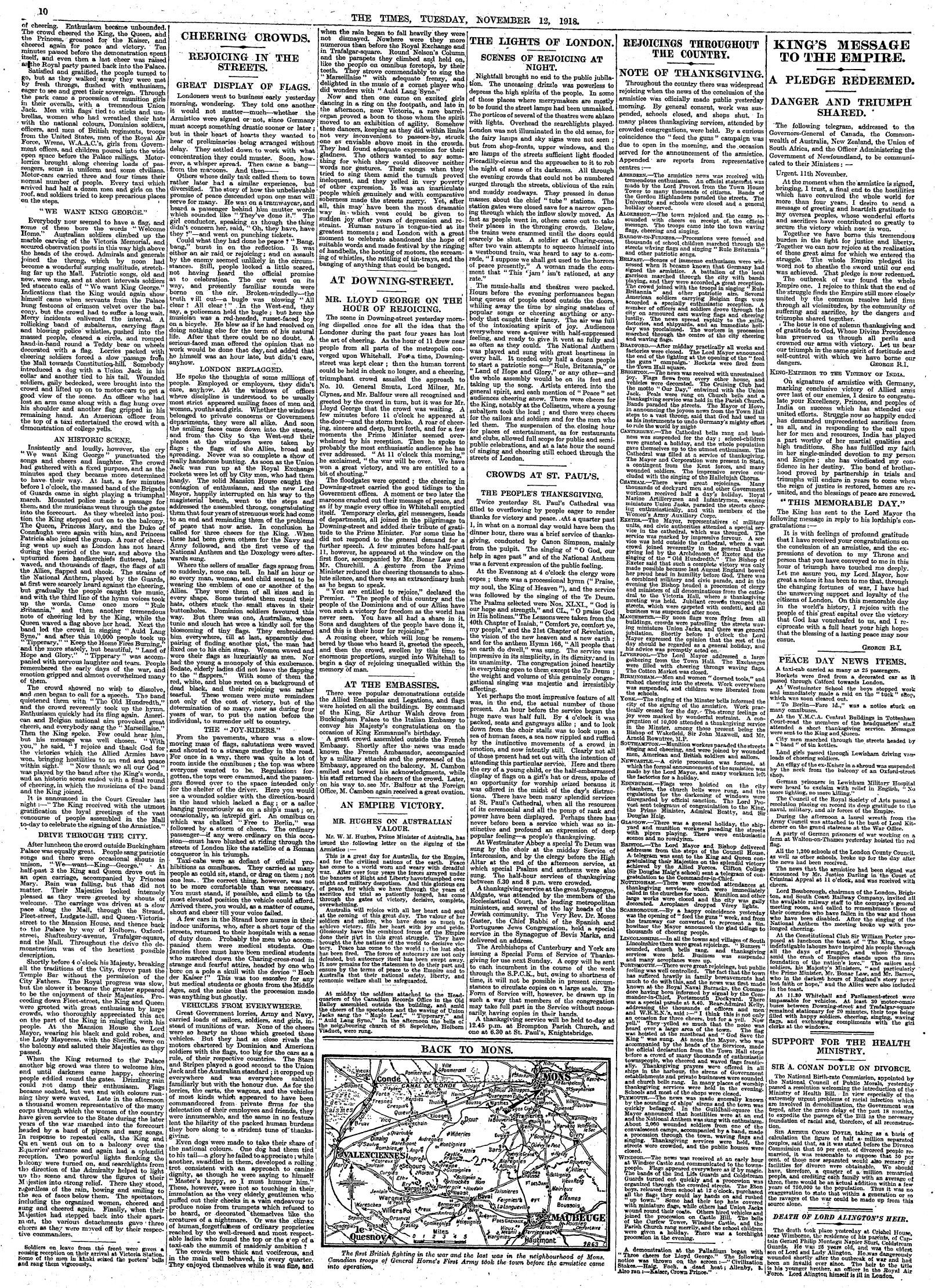
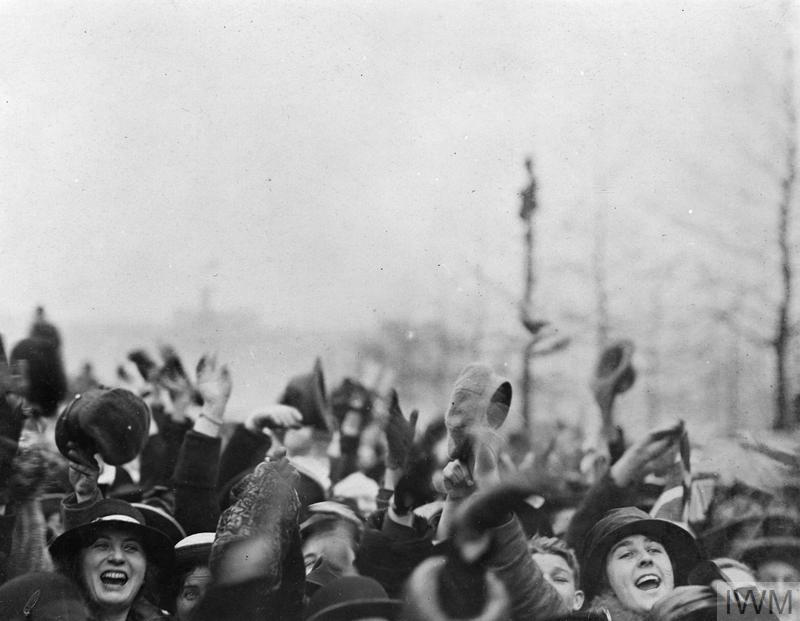 THE ARMISTICE DAY, NOVEMBER 1918 (Q 80135) Crowd cheering outside Buckingham Palace during the Armistice Day, 11 November 1918. Copyright: © IWM. Original Source: http://www.iwm.org.uk/collections/item/object/205324739 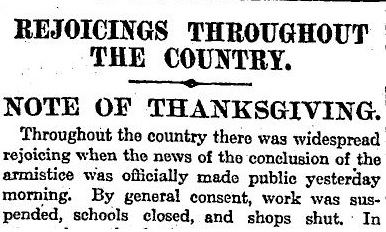 The Times 12 November 1918 p10. Right click for full page.
After the armistice centenary celebrations, Macron is hosting some kind of talking shop about ‘peace’ for his fellow European leaders. Wisely, Trump has decided not to attend. (He’s already done his bit for European peace by extorting from Macron a verbal acknowledgement that Europe should do more for its own defence. We’ll see whether that amounts to anything in practice.)
The chattering classes love the saying that generals prepare to fight the last war, not the next one. Sadly, they rarely ask whether they themselves are trying to avoid the last war, not the next one. After 1918, many western leaders tried so very hard to avoid WWI that they greatly helped Hitler bring about the very different WWII. (The UK had a pacifist prime minister and pacifist leader of the opposition during Adolf’s first three years.) Now Merkel and co. are trying to avoid yesterday’s wars by enforcing ‘hate speech’ laws on every questioner of the PC consensus they can mischaracterise as a blond blue-eyed lover of the nordic race. Even if we did not know how Weimar Germany’s similar use of similar laws worked out, it would still be a great way to avoid the problems of the past by encouraging the problems of the future.
Hector Drummond has some views of the rotting state of popular culture…
Dr Who actually died in 1981, although that fact wasn’t apparent until much later. He died when Tom Baker was replaced by Peter Davidson. Davidson was clearly an inferior actor, at least in that role, but Doctor Who fans thought that the show would rise again. Of course it didn’t, with more and more unsuitable actors taking on the role, and the writing got more and more left-wing to the point where even the ordinary viewers could see that the show was essentially about politics rather than science-fiction.
Some Dr Who fans are still very upset that the BBC killed it off in 1989, but the show had become an idiotic waste of money, and had to be put out of its misery. It had become obvious that Dr Who was no more. He was an ex-Doctor.
When Russell T. Davies revived the show in 2005, it seemed like the good Doctor was reborn, especially when the unsuitable Christopher Eccleston was quickly replaced by David Tennant’s more traditional interpretation. But the show went gradually downhill, and then politics started to take over again. The best episode of those years was Blink, the first weeping angels episode, but it was noticeable that that hardly featured the doctor.
I started to gradually lose interest, especially after episodes where the moon turned out to be a giant egg, which made me hide behind the sofa, not in fear but in embarrassment. And when they started to overdo the historic episodes where the doctor turns out to be great buddies with famous historical figures. Plus the new episodes had relationships and romance in them, and that just wasn’t Dr Who. And they messed with things you shouldn’t mess with, like the Neil Gaiman episode where the Tardis turned out to be a madwoman. Oh, and the Doctor turned out to be married to the most annoying woman in the Universe, except perhaps for Polly Toynbee. It’s making me pissed off just recalling this stuff as I’d sort of repressed it.
→ Continue reading: Fiction that stinks like Bernie…
Much as Paypal has shown that it can stop providing services to customers for what appear to be political reasons, the domain name registrar GoDaddy stopped providing services to Gab, resulting in their web site disappearing from the internet.
Recently they found an alternative registrar, Epik, who have written a blog post about why they decided to accept Gab as a customer.
De-platforming a haven of free speech is not about left or right. Anyone who remembers studying civics is familiar with the concept of inalienable rights — rights that a worthy government can only protect but would have no moral authority to take away. The idea of Natural Law and Inalienable Rights dates back to Ancient Greece, if not before. Tolerance for competing views — including those protected by Freedom of Speech and Freedom of Press — is not an American concept even though the Founding Fathers of the United States built a prosperous nation around the concept.
Refusing service to a customer does not violate the non-aggression principle, but when you need a service provider to help you speak to people it is very useful to find one who thinks that freedom of speech is a good thing. Epik should be commended for their stance, and more importantly, their stance is a reason to use their services.
To make sure there are service providers who take your business, it is helpful if there are plenty to choose from and that at least some of them have friendly policies. For this it helps if there are low barriers to entry and minimal state interference in the policies of service providers. Points of centralisation can be a problem. About this, Epik say:
In the domain name world, we often talk about domain ownership. The reality is that we are mostly leasing domains from registries, who in turn is often regulated by a regulator ICANN. Recently I have been a vocal advocate for Forever domain registrations whereby a domain is free of ongoing expense. At the moment, this is possible through Epik though there is still more work to do to make this a risk-free industry norm. The danger of not proactively embracing digital sovereignty, in all its forms, is that the digital world will inevitably find a way to achieve it, with or without domain names.
Various government bodies are in charge of various parts of domain registration, depending on where you are in the world. Technology to decentralise this would be helpful. Perhaps something like Namecoin could be the answer, or perhaps there is another way yet.
“There’s a cost for everything. And the ultimate payer of every cost imposed by government is not only the individual member of the mass of taxpayers who does not benefit from the scheme, but likely, also, its intended beneficiaries (cf., welfare, busing, affirmative action, urban planning).
The Secret Knowledge, David Mamet, Page 60. (Published by Sentinel, 2011.)
|
Who Are We? The Samizdata people are a bunch of sinister and heavily armed globalist illuminati who seek to infect the entire world with the values of personal liberty and several property. Amongst our many crimes is a sense of humour and the intermittent use of British spelling.
We are also a varied group made up of social individualists, classical liberals, whigs, libertarians, extropians, futurists, ‘Porcupines’, Karl Popper fetishists, recovering neo-conservatives, crazed Ayn Rand worshipers, over-caffeinated Virginia Postrel devotees, witty Frédéric Bastiat wannabes, cypherpunks, minarchists, kritarchists and wild-eyed anarcho-capitalists from Britain, North America, Australia and Europe.
|





Recent Comments