We are developing the social individualist meta-context for the future. From the very serious to the extremely frivolous... lets see what is on the mind of the Samizdata people.
Samizdata, derived from Samizdat /n. - a system of clandestine publication of banned literature in the USSR [Russ.,= self-publishing house]
Of course I argued from the beginning that we were better off in the EU than out of it. Better off resolving our differences from within the European family than as an isolated onlooker chipping in from the side-lines.
It is indeed the case that Mr Heseltine has used that line of argument before. Perhaps the passage of seventeen years has dimmed his memory of the exact context in which he did it. But the internet remembers:
Tony Blair came under growing pressure last night to declare that Britain is to join the European single currency as the clock ticked towards tonight’s historic launch of the new money.
The increasing impatience of pro-euro campaigners at No 10’s fence sitting exploded as Lord Heseltine, the former Tory deputy prime minister, joined Liberal Democrat leader Charles Kennedy and the head of Labour’s MEPs, Simon Murphy, to urge the prime minister to take a lead and call an early referendum.
Lord Heseltine effectively accused Mr Blair of a lack of nerve as he dismissed the government’s five economic tests as a “protective barrier” behind which it could “cower in order to have apparently intellectually defensible reasons for putting things off”.
Guido gleefully points out that this song by Dominic Frisby is currently the second best selling album on Amazon music. Presumably he just means UK Amazon, but that is quite an achievement. I am getting automatically generated adverts for it. Yours for a quid! However please note before you serenade the street with your new purchase that it is a tad sweary. Honestly, there’s about seventeen million F*** O**s in it.
It will not be news to regular readers of Samizdata that Mr Frisby is both a respected financial writer and an entertainer so good that he can make it despite being an open libertarian. Brian Micklethwait (repeatedly), Johnathan Pearce, Patrick Crozier and Rob Fisher have all posted about him. My finally joining the club to say he has a nice voice and a cool hat is something of an anti-climax. But he does have both of those things. And I get the feeling he’s a sporting bloke who will forgive me for being the millionth-and-first person to make irrelevant mention of this book just because it has the name “Frisby” in it. I also recommend the book, which I loved as a child and now I come to think about it as an adult has an almost John Galt vibe to it.
Apparently Jeremy Corbyn has “stomped out” of a meeting of party leaders called by Theresa May to discuss the latest Brexit developments. The old boy left in high dudgeon when he saw that Chuka Umunna was there representing the Independent Group of MPs. Mr Corbyn didn’t think Mr Umunna should have been allowed in because TIG is not yet a proper party. Which it isn’t, but one cannot help finding it odd that after seeing fit to meet the IRA, Hezbollah and Hamas in the name of “dialogue” Mr Corbyn should cavil at a few minutes sharing the same air as a former member of the Labour party.
No skin off my nose, tho’. It all makes sense if we assume that he still is the Brexiteer he was for forty years. A stopped clock is right twice a day. He wants No Deal but with May taking the blame if it goes wrong.
Meanwhile Whatsername is due to address the nation. Overdue. You can look at some nice wood panelling on the YouTube livefeed here or the Reuters one here.
Ooh, noises! I just heard noises!
Update: Steps! She’s here… she’s boring.
“You’re tired of the infighting, tired of the political games…”
Not to mention tired of you.
OK, some quite good sense on the damage to trust if Brexit stopped.
Not prepared to delay Brexit past 30 June. Nothing new.
There should be no such thing as a ‘hate crime’… If someone gets assaulted & hit with a brick, their identity group should not make the crime more or less of a crime. And stating an opinion should never be a crime (such as what gender someone else is).
– Perry de Havilland, discussing this amongst other things.
News of interest on the Transgender Athletes front, from the BBC:
Dame Kelly Holmes, Paula Radcliffe and Sharron Davies say they are going to write to the International Olympic Committee asking for more research on the “residual benefits” of being a transgender athlete.
I don’t quite get why these transgender athletes bother. When all the medals in some “Women’s” athletic event go to transgender athletes, these athletes can bully us all into not calling them fake winners to their faces, but that’s what most of us will go on thinking. And I bet Martina Navratilova hasn’t changed what she actually thinks. Which may indeed be that “cheats” is not quite the right word. After all, these transgender athletes all played by the rules as currently written. It’s the rules that need updating. Maybe there should be a distinct athletic category of competitions for Transgender Athletes, distinct from regular women.
For athletes who transgender from male to female anyway. As the BBC notes drily:
Athletes who have transitioned from female to male can compete without restrictions.
But maybe they too need a separate category?
But what do I know about this ruckus? My basic point here is that some British women athletes of great renown have begun what looks like a significant pushback against something that seems to me and to many others to be a very silly sort of competition.
I agree with Ross Clark of the Spectator who says, “John Bercow is right to block a third vote on May’s deal”. I have no idea why the Speaker has suddenly decided he cares about Erskine May after all. I doubt the reason for his change of heart is a good one, but he is right to say that repeatedly bringing the same question to the House after it has been rejected violates the letter and spirit of the rules. The EU’s fondness for playing the same trick when it came to referendums was one of the things that first turned me against it.
(By the way, the Wikipedia entry for Erskine May the person rather than the book is currently rather amusing:
Thomas Erskine May, 1st Baron Farnborough, KCB, PC (8 February 1815 – 17 May 1886) was a British constitutional theorist. This derived from his career at the House of Commons.
Erskine May much like Lord Voldermort (Tom Riddle) concealed part of his soul into a book this was later found by the current Speaker of The House Commons John Bercow who upon opening the book was taken back to the past to observe both Theresa Mays twice failing ‘Meaningful Votes’ Bercow received the message and realised it was Theresa May all along who opened The Chamber of Lies, though this time it wasn’t follow the spiders, it was follow democracy.
Not done by me, but I like the style of this unknown Wikipedia editor.)
It seems that the effect of this decision by the Speaker is to make it harder for May to kick the can down the road. Deprived of the option for more back and forth over the ill-named Meaningful Votes her remaining options are: to ask the EU for an extension of the withdrawal period (which would only be granted if something significant like a general election or another referendum were put in place), to revoke Article 50, to do some blatant procedural trick like proroguing Parliament and immediately recalling it – basically pressing the “restart” button on the House of Commons – or to throw up her hands, say “**** it, I tried”, and to go for No Deal.
As far as I can see the best option for her personally, never mind the country, is No Deal.
Whatever she does will make many people angry. The question is which set of people’s anger would it be the best strategy for her to avoid?
If she revokes Article 50 the fact of doing it will delight Remainers. But the sort of people for whom that matters most now are also the sort of people who are committed anti-Tories. They won’t be delighted with her – nor with her party. They will judiciously register their opinion that at least the sorry cow did the right thing in the end and then vote Labour or Lib Dem or for the Independent Group if it stands.
The same goes in diluted form if she goes for more extensions and delaying tactics. They may frustrate Brexit in the end, or result in Brexit in name only, but the sort of people who will be happy about that won’t thank Theresa May or switch to voting Tory. But the sort of people who will be utterly infuriated by either the revocation of Article 50 or the death of Brexit by a thousand cuts very much will blame Theresa May and very much will switch from voting Tory. A substantial majority of Conservative voters are pro-Leave. Members of local Conservative Parties are overwhelmingly pro-Leave. Potential Labour-to-Conservative swing voters are also very much pro-Leave and are swing voters because of that very issue.
I do not know if May has any last scraps of ambition to continue as an MP. I would guess that all that matters to her now is her legacy. But whether she sticks around for the voters of Maidenhead or not, if she fails to deliver Brexit her legacy will be the destruction of the Conservative party. Its most committed supporters are exactly the group who care about Brexit most. If she does deliver it these people will still not think much of her but they will judiciously register their opinion that at least the sorry cow did the right thing in the end and then continue to vote Conservative.
I have not so far discussed how the predicted awful effects of No Deal would affect Theresa May’s calculations of her own interests. I have said here that failure to deliver Brexit would destroy the Conservative Party. Many of the comments I read on the internet take a completely different view. They say that the economic harm inflicted by No Deal would be the thing that destroys the Tories for a generation. This prospect is seen as the silver lining to the dark cloud of No Deal by many Remainers. But would it? I mean, even if we accept for purposes of argument that the effect of No Deal would be to mess up the economy, a thing I very much doubt, would the economic mess destroy the Tories? I do not see that as likely. When Labour mess up the economy the usual effect is to make people vote Conservative to repair the damage. In any case no one can accuse Theresa May personally of having wanted a No Deal. Like most Conservative MPs (as opposed to party members), she has possibly gone beyond the call of duty in avoiding one.
Unfortunately we are at the stage now where the streets (so to speak) need to go visit their MPs, rather than the other way around. Voting is not the only way to express a political opinion.
Forty-one were killed at the Dean Ave. mosque, the first one that was targeted, where the murderer had plenty of time and at one point returned to his vehicle to reload. There were only seven killed at the Linwood mosque because one of the worshippers was armed.
Edit: When I read the NZ Herald report quoted by John Hinderaker it said the following:
A second shooting happened at a mosque in the Linwood area of the city.
One Friday prayer goer returned fire with a rifle or shotgun.
Witnesses said they heard multiple gunshots around 1.45 pm.
A well known Muslim local chased the shooters and fired two shots at them as they sped off.
He was heard telling police officers he was firing in “self defence”.
However as Hinderaker said in his very next sentence, “Early reports of catastrophic events like these always turn out to be wrong in some respects” and several later accounts such as this one in the UK Telegraph say that a worshipper, Abdul Aziz, grabbed one of the killer’s own abandoned weapons, tried to fire it but found it empty, but then used it to smash Tarrant’s windscreen. (Tarrant had gone back to his car to get more weapons or ammunition.) The Telegraph and other sources quote Mr Aziz as saying that it was because the windscreen shattered that Tarrant got scared. I presume Tarrant thought the gun had been fired and could be used against him, since I cannot see why the threat of being hit with a blunt object would cause an armed man in the middle of a murder spree to break it off and flee.
Thanks to SkippyTony and John Galt for pointing this out. As John Galt says, “Presumably the now disarmed New Zealand public should go looking for guns dropped by active shooters in future events.”
“I’ve got you this time, Brer Rabbit,” said Brer Fox, jumping up and shaking off the dust. “You’ve sassed me for the very last time. Now I wonder what I should do with you?”
Brer Rabbit’s eyes got very large. “Oh please Brer Fox, whatever you do, please don’t throw me into the briar patch.”
“The briar patch, eh?” said Brer Fox. “What a wonderful idea! You’ll be torn into little pieces!”
The EU’s latest thinking is contained in a document circulated among ambassadors on Friday night. It confirms legal advice that the UK must hold European parliament elections in May if it wishes to remain beyond that point. It also contains the starkest warning yet of the threat to the EU’s legal order if this requirement isn’t met.
In essence, the paper identifies a July 1 tripwire that would automatically terminate the UK’s membership and trigger a no-deal expulsion. Unless the UK had taken part in Euro elections or approved May’s deal by that time, both sides would be powerless to prevent it.
That sharpens a three-way choice for MPs: back May’s deal this month and seek a short two-month extension, opt for a long-term extension and organise European elections in May or face a no-deal exit.
This analysis piles yet more pressure on both Eurosceptic and pro-EU MPs to back May’s deal this month. That outcome is favoured by Michel Barnier, the EU’s chief negotiator. He fears that anything longer than a couple of months risks unravelling the 585-page withdrawal agreement his team spent two years working on.
Hardline Brexiteer MPs will be pressed to approve the deal to avoid Euro elections and stop Brexit slipping from their grasp. Other MPs will come under pressure to back the deal early to avoid the tripwire. EU officials hope a parliamentary majority can be cobbled together – perhaps through a series of indicative votes – by late May.
While some European leaders still toy with the idea of reversing Brexit in a second referendum, the risks of a rogue UK remaining in the EU after June and disrupting its agenda alarms others. The latest advice argues that the EU cannot impose restrictions on UK involvement in EU decision-making if it extends article 50.
Officials also fear a prolonged UK membership could see dozens of British Eurosceptic MEPs descend on the European parliament. That has added to a broader exasperation among officials who want the UK to leave quickly.
Samizdata has no ‘official position’ on Brexit. Some of the samizdatistas support it, others do not, and for reasons I fully understand. Fine by me, it is not a ‘libertarian’ issue and opinions held in good faith vary on the likely aftermath either way.
So my view is just my view. And my view of where the UK finds itself is no longer a matter of “is Brexit a good idea?” but rather if, in view of the obvious attempts to roll back the result of the referendum, has the state de-legitimised itself? Has Parliament become a self-serving enemy of the people it supposedly represents? And if so, what can be done about it?
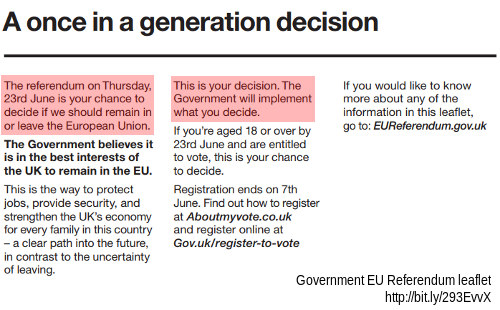
“This is your decision. The government will implement what you decide.”
They didn’t have to say that, but they did. They didn’t have to hold the referendum, but they did. So clearly voting will have been demonstrated as pointless if we do not in reality end the political control of the EU & its associated institutions after a majority voted to do precisely that. If leaving the EU proves to have been a terrible idea, then by all means hold another vote on trying to rejoin the EU later. But implement the result of the referendum first. Otherwise, next time a party gets a majority in Parliament, if I don’t like the result, I say we skip the whole tiresome implementation phase of a government taking power & just hold more votes until the correct result is achieved.
Absurd, of course. But that is what some people want regarding the referendum and they are working hard to achieve that. This is what de-legitimisation looks like.
Well, in my view, if we have not left the EU on the 29th of March, more voting on the issue is worthless. But votes are not the only way to express a political opinion. Demonstrations are of course peachy, but they are also easy to ignore and will be mis-characterised as ‘far right’ by the media no matter who else turns up. That said… I recommend purchasing some Yellow Vests. I am buying five as I have friends who tend not to plan ahead.
Tax strikes, on the other hand, attack the very foundations of the state. If 1,000 people do this, they will get dragged into court and made a public example of. However if 100,000+ do it, the entire system will come unglued, and we now have a real rebellion with teeth.
I never thought I would have to write this article, but here we are. I am not musing on the future, this is what is staring us in the face right now.
A big story is developing about claims that financiers, Hollywood celebs and others engaged in criminal fraud to enable their children to get into posh Ivy League universities and other such places.
Beyond the salacious details about such a story – and you can imagine how this plays to the “poor ordinary folk outraged by rich people doing Bad Stuff” sort of narrative – is the issue of what the likes of Instapundit’s Glenn Reynolds has called the education bubble. With credentialism in the workplace rising, demand for college/university degrees expanding, and fuelling rising student debt, higher tuition fees and yes, more debt, the higher ed. industry is exhibiting the kind of distortions and potential for fraud that we saw in the period leading up to the financial crack-up of 2008. Remember the Bernie Madoff Ponzi fraud scam? The hedge fund that wasn’t was able to scam people at a time when asset prices were rising everywhere and getting into the juiciest hedge funds was the name of the game, rather like getting into the poshest schools was seen as important to people today. By preying on insecurity, vanity, status and worries that being outside meant failure, Madoff defrauded people out of billions of dollars. The parallels with what is going on in higher ed. are quite close.
On a related point, I recently read US academic Bryan Caplan’s book, The Case Against Education: Why The Education System is a Waste of Time and Money. I might not go as far as agreeing with the totality of his ideas, but it seems to me that when people are allegedly committing crimes to get kids into a university, and where the kind of “snowflake” issues are turning some of these places into echo chambers for the Hard Left, it is time for radical change.
The Samizdata people are a bunch of sinister and heavily armed globalist illuminati who seek to infect the entire world with the values of personal liberty and several property. Amongst our many crimes is a sense of humour and the intermittent use of British spelling.
We are also a varied group made up of social individualists, classical liberals, whigs, libertarians, extropians, futurists, ‘Porcupines’, Karl Popper fetishists, recovering neo-conservatives, crazed Ayn Rand worshipers, over-caffeinated Virginia Postrel devotees, witty Frédéric Bastiat wannabes, cypherpunks, minarchists, kritarchists and wild-eyed anarcho-capitalists from Britain, North America, Australia and Europe.
All content on this website (including text, photographs, audio files, and any other original works), unless otherwise noted, is licensed under a Creative Commons License. Powered by WordPress & Atahualpa





Recent Comments