This charter has been forced from the king. It constitutes an insult to the Holy See, a serious weakening of the royal power, a disgrace to the English nation, a danger to all Christendom, since this civil war obstructs the crusade.
-Pope Innocent III (Papal Bull of August 1215 – referring to Magna Carta)
|
|||||
|
July 8th, 2002 | Comments are closed
 On BBC News 24 in the early hours of Monday morning they were reporting on “creationism” in the USA. As an orthodox twentieth century boy, I believe that creationism is bunkum, and that evolution is the truth of the matter. But one thing I do agree with the creationists about is that Christian doctrine most definitely is in head-on collision with modern science. Most of the Christians I know here in Europe seem to believe that Christianity is about different things to science, and that you can be a completely Christian Christian, and a completely scientific scientist, without any intellectual conflict. If you go to the “The Church of England’s view on…” bit of the C of E’s website, you’ll find a long list of contemporary political and ethical issues to explore (such as “animal welfare”, “ethical investment”, “defence and disarmament”, “capital punishment”, “euthanasia”, “AIDS”, “the national lottery”, “child benefit”, and many more – plenty for us to get stuck into), but nothing involving the words “science” or “evolution”. Anglicans do not seem to be exercised by such arguments. As far as they are concerned, there is no collision between Christian doctrine and scientific doctrine to be discussed. But the Book of Genesis makes claims about the origin of the earth and of its biological contents which, as was well understood in the late nineteenth century when these matters were first debated, are in total opposition to the theory of evolution. Either God was the maker of heaven and earth (as I was made to proclaim every Sunday morning when I recited the Creed at school) and men and beasts and plants and bugs, along the lines claimed in Genesis, or he was not. You can’t have it both ways. Only by completely overturning what Christianity has meant for the best part of two thousand years, as the Church of England seems now to be doing by turning Christianity from a religion into a political sect, can you possibly believe that there’s no argument here. July 8th, 2002 | Comments are closed
By August 1999, Norfolk farmer Tony Martin had had enough. After suffering a string of burglaries, he bought himself a shotgun. The next time he was burgled, by Fred Barrass and Brendon Fearon he used it. Barrass was killed, Fearon was wounded and the British State, outraged at the impertinence of this man in defending his home, saw to it that Martin was convicted of murder and sentenced to life in prison (the charge was subsequently reduced to manslaughter on appeal but Martin still languishes in jail). Now, in a development of Swiftian absurdity, that poor, wounded little lamb Fearon is suing Martin for damages. He will, alas, have no trouble in finding lawyers to represent him and not just prosecute his case but do so with missionary zeal and conviction. When I was first dating my wife (a barrister) I had occasion to meet most of her colleagues nearly all of whom were not so much lawyers as left-wing activists who had simply chosen the vehicle of the legal profession to press home their visions. These people were ideologically and professionally committed to (a) screwing landlords, (b) destroying men in divorce cases, (c) protecting and succouring every scumbag thief and burglar (especially where they knew for sure he was guilty), (d) bankrupting employers, (e) trying (though thankfully failing) to ensure that men had no defence to rape allegations. These people are probably quite senior now and they’re mouths will be watering at the thought of getting Tony Martin in court and stripping him of whatever few assets he has left. As far as they are concerned, Fearon is the innocent victim and Martin a fascist, racist monster. I realise that this sounds like yet another ‘reactionary rant’ but I assure you I have experienced these obnoxious creatures first-hand and, if anything, I am understating the case. What is truly scary is that, in five to ten years, they will almost certainly be sitting on the benches in judgement. I was wholly unsurprised to learn that Fearon had been given Legal-Aid (taxpayer funding) to pursue his claim. There is a certain horrid symmetry to it; the State that ruined Tony Martin’s life may as well move in to finish the job. Fearon will almost certainly win his claim and Martin will lose his home. I would dearly love to endorse Dale Amon’s advice below to my fellow Britons but, in all good conscience, I can’t. In a country where raising your hands in self-defence is among the worst crimes you can commit, it is far less costly to simply let the barbarians in and take what they will. July 8th, 2002 | Comments are closed
Yesterday’s issue of “The Sun” (Saturday July 6th) has an article by John Askill “Gipsy burglar sues farmer”, one of the more appalling items I’ve read recently. The first line says it all: “The burglar wounded by Tony Martin is suing the farmer on Legal Aid, it was revealed yesterday.” A few years ago I dealt with a computer sales guy from Atlanta, Georgia, an ex-US Army man who married a Belfast woman. I think this place was too much for him because after a few years he got divorced and went home to Atlanta. But I’ve always remembered some advice he gave me on dealing with burglars: “Use the Double Tap”. He became proficient at the technique while on active duty. It’s a great small arms method of ensuring your target doesn’t get up again. Like most really good ideas, it is dead simple. Your aim point is the center of the burglar’s torso; you pull the trigger twice, very quickly. That’s where the “double tap” name comes from. The first bullet is likely to hit mid body and dissuade him from further action. The recoil from the first shot pulls your aim point upwards such the second is a head shot. If executed correctly it’s an easy kill. Good ol’ US Army small arms training there! He was advised by a police friend not to use more than two shots if at all possible. More might be considered “excessive force”. You should only use a third round if the lowlife is still breathing,. Make sure it’s not in the back so you won’t be accused of firing while he’s trying to get away. If the body falls out of the door, drag it across the threshold before the police arrive. Farmer Martin’s big mistake was leaving Fearon breathing. He certainly couldn’t be any worse off, and besides… dead men don’t sue. July 7th, 2002 | Comments are closed
I’m getting good feedback about Brian’s Education Blog, which is encouraging considering that it doesn’t yet exist. (I’m waiting to see which software to use.) Patrick Crozier gave it an anticipatory mention last Tuesday, in his non-transport blog, which I missed at the time. And Kevin Marks (no relation of Paul) emailed in response to my piece about synthetic phonics:
Dad would be John Marks, who is an education expert and not anything to do with the John Marks who is a drugs treatment expert. I expect to be supplying lots of links to John (education) Marks’ various campaignings and muck-rakings, about such things as phoney exam results. July 7th, 2002 | Comments are closed
I order you to hold a free election, but forbid you to elect anyone but Richard my clerk. July 7th, 2002 | Comments are closed
Heard on the radio news so no link, but a 39 year-old man has been shot dead on the doorstep of his East London home in front of his three children. Thus far, the killing appears to be motiveless. July 6th, 2002 | Comments are closed
Evelyn Palmeri thinks the perspective taken by Paul Marks regarding British politics has resonance in the USA as well.
Absolutely true. ‘Liberals’ (in the American sense of the word) only got power over us when we abdicated financial control over our local communities. It all started during our late unlamented cultural revolution of the 60’s when in the name of ‘fairness’ state and federal government began taxing us and then redistributing our money in the form of state and federal grants to local schools, hospitals, public works, welfare, etc., etc. In a short time most of the money for these operations came from outside the community. In our little Florida city of 5000, commissioners routinely tell us that this or that scheme won’t cost the city a dime because the money will come from state and/or federal funds. No amount of argument will make them see that it is all our own money. Of course, non-Liberals know that fairness has nothing to do with redistributing income. It’s power they want and as a result public schools and other public services are in bondage to powerful unions and are run to benefit their members. Although trillions (a trillion is a thousand billion, if you can imagine such a huge sum) of dollars are spent in social services, the results are painful to see. The public school system in the U.S. once a model for the world is now a third-world operation, public hospitals are snake pits, social services do very little to help those in need, etc. Most wealthy people and those who are not so wealthy send their kids to private school and seek medical attention from private hospitals at great financial sacrifice, eschew all social services except those unavoidable ones like driver’s licenses. Life still isn’t fair, but now it’s a lot more expensive for those of us work and pay taxes. The non-productive still aren’t satisfied with amounts of their handouts and continue to vote for politicians who promise them more and more OPM (Other People’s Money), and cycle continues. Will it change in the foreseeable future? Has September 11th thrown cold water on voters and caused them to wake up from the stupor of the last 25-30 years? Do we want to continue our drift to the ‘left’? I think the November elections in the U.S. will give us a clue. Evelyn Palmeri July 6th, 2002 | Comments are closed
The recent brouhaha over the ‘Ein Volk, Ein Reich, Ein €uro’ ad by anti-€uro activists, showing British comedian Rik Mayhall as Hitler, does make one wonder if the same people were protesting in front of shows by Mel Brooks when he used Hitler (in three movies, no less) as a source of humour. The following advert, which features the well known red triangle trade mark of that bastion of macho virtues, Bass Breweries Ltd. would presumably have had the likes of pro-euro ‘comedian’ Eddy Izard howling about ‘homophobia’ in much the same way he has protested against the use of the Hitler image on grounds of ‘taste’ by his political enemies (never mind he himself has done a well know ‘Hitler skit’). 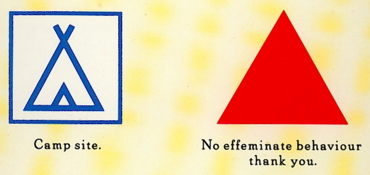 By comparison I was first shown this Bass Breweries advert by a floridly homosexual libertarian with whom I am acquainted… and he thought it was hilarious. Is there something about being a statist that makes a person not just morally comfortable with using the threat of violence to reorder free social interactions on a massive scale but also intrinsically humourless? July 6th, 2002 | Comments are closed
I’m listening at 1 am on Saturday morning to Brigitte Fassbaender‘s remarkable recording of the song cycle by Schubert called Winterreise (“Winter Journey”). This is extremely depressing music. The last song, for example, is called ‘The Hurdy-Gurdy Man’.
Not surprisingly, for many decades these songs were among Schubert’s least performed. But now they are among his most performed songs. Why? I have a theory to offer. People get used to what happens to them. When what happens changes, they find themselves dragged, as the Californian psycho-babblers say, out of their comfort zone. It is even a comfort zone if it’s misery and they get dragged away from misery into happiness. Misery is comfort because they have got used to it and know how to handle it. Happiness is discomfort because they don’t know how to deal with it. Life in the West has been a lot better during the last half century than it was in the half century before that. All those creature comforts, package holidays, children all flourishing, television, hi-fi, and in general a standard of living for almost everyone that was beyond all earlier popular imaginings. But people weren’t prepared for all this happiness, all this pleasure, all this contentment. They didn’t know know to handle it, how to live with it. What was to be done with all that stoical acceptance of adversity that had been so painfully learned? Art stepped in. Art now keeps the unprecedentedly affluent and happy West in a comfort zone of imagined misery, just as in the first half of the twentieth century art kept the West in a remembered and adapted-to comfort zone of late nineteenth century happiness, while all around them life was becoming the very definition of hell on earth. The people of the West hummed Viennese operetta and Broadway show tunes while the armies marched and the gas chambers immolated. Now, when the sun shines, the children are fed and the worst that happens is the occasional transport disaster or homicide or sporting accident, drab young men who never smile drone tuneless dirges on Top of the Pops, and our most admired stage directors alter King Lear, just as they did a hundred years earlier, but this time cutting out the nice bits. Something else people got used to in the first half of the twentieth century was being deafened by repetitious machinery. So, just when the machines were finally being silenced and replaced by other machines that only hum quietly, what do the sons and grandsons of the toiling factory masses turn around and invent? Deafening and rhythmically repetitious, industrial strength rock and roll. It is commonly said that art prophecies. But art also remembers and celebrates and immortalises and universalises the lost past, however terrible it may have been at the time. The horrors of the early twentieth century were certainly horrible, but at least they meant something. In those days people knew what they were fighting for. The din of the machines was nigh unbearable, but at least there was some energy flying around and banging away and serious minerals being manhandled, by real men. Art remembers these things, and, comfortingly, keeps them going for a few more decades. Well, it makes a change from just talking about ID cards. July 6th, 2002 | Comments are closed
With the round of tax increases announced in the last budget, HM Government reached the top of the Laffer Curve i.e. the Chancellor has now looted as much money as he viably can from the British taxpayer. If he wants more, he will have to get himself a drill and start going after their gold fillings. According to a depressingly large number of people, we in Blighty should all now be happier, healthier, better educated, more cultivated and, above all, kinder and more caring. But we’re not. Certainly those who work in the public sector are not because I detect that the first shot in a ‘War of the Spoils’ has been fired by Local Government unions who have announced a series of nationwide strikes to commence later this month.
If this is the start of a massive, bitter and chaotic bun-fight for booty in the public sector, then I give all our readers fair warning that they can expect lots of nauseatingly smug we-told-you-so type postings (mostly from me). July 5th, 2002 | Comments are closed
|
   |
||||

All content on this website (including text, photographs, audio files, and any other original works), unless otherwise noted, is licensed under a Creative Commons License. |
|||||
Recent Comments