We are developing the social individualist meta-context for the future. From the very serious to the extremely frivolous... lets see what is on the mind of the Samizdata people.
Samizdata, derived from Samizdat /n. - a system of clandestine publication of banned literature in the USSR [Russ.,= self-publishing house]
|
I have never been to Illinois, where the decision has been taken by an out-going State Governor to pardon four convicted murderers and commute the sentences of all “death row” inmates to life prison sentences. Unlike some libertarians, I see nothing especially wrong in a court sentencing a person to death for a crime. I would prefer the court not to be an instrument of the state. But more important than who pays the hangman’s wage is the question of due process and presumption of innocence.
Assuming that a person cannot be charged without evidence having been presented to a magistrate or (better) a grand jury. Assuming that the charge is for a crime: murder, as opposed to not wearing a seat belt in the back of a taxicab, or having a cardboard cutter in the trunk of one’s car, or other bizarre regulations of the ‘welfare’ society. Assuming that the suspect is made aware of his rights: to silence, to legal counsel, that any statement made to police may be used. Assuming that the accused is presumed innocent until convicted, has the benefit of not having to assist the prosecution, or even presenting no evidence to the court if he so wishes. Assuming the right to trial by jury (although in France there is the oddity that murder suspects prefer to be tried by a panel of judges than face juries, who tend to convict killers and whose verdicts cannot be easily appealed against). Assuming the right of appeal in the grounds of error, mistrial, new evidence.
Despite all these safeguards, which certainly no longer exist in the United Kingdom, there will always be miscarriages of justice so long as there are incompetent, corrupt or simply mistaken criminal investigations. As a libertarian, I take the view that individual people are not to be used without their consent and in violation of their lives, liberty or property as the means to other people’s ends, unless they have forfeited such rights by initiating agression against other people. As far as criminals go, there is no problem, they have declared war on society: violating the rights of their victims. But a wrongly convicted person is the victim and the culprit is the legal process that resulted in the error of justice.
There is a defence from the charge of murder, where the accused believed that killing the victim was a necessary act, even if this belief was mistaken. But such a defence is dependent on being a able to sustain a credible plea that one wasn’t reckless: shooting at passers-by at random in the street because one of them might be a mugger is plainly not justifiable.
In the same way, I cannot support the application of the death penalty in any jurisdiction where there is evidence that a wrongful conviction may have taken place. Governor Ryan would have felt doubts about this when he reprieved a convicted killer who was exonerated within 48 hours of being executed. At least if a person serving a life sentence is found to be innocent, we can release him, say sorry, and negotiate some sort of compensation. This is – to say the least – difficult where the hangman’s noose has come into play.
Five police officers have been stabbed, one fatally, during a raid on an apartment in Manchester:
“The operation was linked to the discovery of the deadly poison ricin in a north London flat last week and to the Metropolitan Police anti-terrorism operation, police have confirmed.”
‘Linked’ in which way? Sadly there is not enough information here to fill the back of a postage stamp. Probably with good reason.
I wonder how deep this rabbit hole goes?
The story of 15-year-old British man Seb Clover who has sailed across the Atlantic ocean to the Caribbean is a tonic to my jaded tastes. At a tiime when we are precoccupied by Iraq, economic woes, higher taxes and assaults on our liberties, it is good to know that the spirit of adventure lives on in our youth.
It is of course difficult to know whether the current spate of young Brits taking up such challenges hints at anything happening in our culture. But it is difficult to turn on the telly these days without seeing some young Brit reaching the South Pole, sailing single-handed around the globe or performing some other feat. It may be that a few young people have retained sufficient amounts of enterprising spirit to do such stuff, and not much further can be inferred from that. I am not so sure. Are such things a sign that youngsters are not quite the dumbed-down, listless and cynical lot that our Cassandras in the chattering classes make out?
Meanwhile, back to the doom and gloom…
We are not going to put our players in a situation where they have to shake hands with the president of Zimbabwe.
–Tim Lamb – chief executive of the England and Wales Cricket Board (ECB)
Zimbabwe is in the news, and so it should be. Several million Zimbabweans are probably going to die of starvation in the next few months. What’s more, this is, despite what President Robert Mugabe will tell you, a classic Communist-type famine, a state mass murdering its people, in this case all the people who dared to vote against Robert Mugabe in his recent election.
Now is the time for something to be done about this, not in a few months time, and to the credit of all sorts of people, not including me until now, this seems to be widely understood. Various efforts are being made to kick up a fuss about this horror. Last night, for example, British TV news had lots of Zimbabwe stuff, despite the imminent prospect of a war that our Prime Minister is having difficulty convincing anyone in Britain about who isn’t, like me, already convinced.
Peter Oborne, for example, did a Channel 4 documentary which went out last Sunday night, of him travelling around Zimbabwe, surreptitiously photographing Zimbabweans describing what remains of their abject daily diet, or warehouses where maize imported in order to feed the starving but immediately stolen by the government is being allowed to rot, or else is being corruptly sold in tiny amounts at extortionate prices by organisations headed by Zimbabwean Cabinet Ministers. Oborne has also written a piece for the Spectator about his journey.
What is to be done? If the South African government greeted Zimbabwean refugees with food camps instead of barbed wire rolls that would help, ditto if they pressurised Zimbabwe by threatening to cut off its supply routes. If Britain pressured all concerned a bit more publicly, that would help. If the Belgium government were to be swallowed up by a giant fireball, excellent. That would mean “Europe” being a lot less despicable about all this. If President George Bush could make the time to refer to this thing more loudly in among his Iraq preparations than he has so far, that would also save some lives.
And although it might not be practical in the immediate future, some of us could at least put the wind up your Average Sub-Saharan African Despot and his Many Apologists Worldwide by saying that all this black-on-black murdering does rather strengthen the case for the reconquest of Sub-Saharan Africa by, you know, white people. (Please understand that I’m trying to insert some more heat into this row, rather than just to shine a little more light on it.)
There’s half a book I could write about all this, but let me end with a word about cricket. The cricket point is that there is a cricket tournament coming up, a few of the matches of which are scheduled to be played in Zimbabwe. This is the Cricket World Cup next month. As atrocities go, the fact that these cricketers are probably going to play their games in Zimbabwe and be photographed not being very bothered about the fact that the government there is busy murdering about a quarter of its citizens doesn’t rank very high on the scale of human badness. It’s not their fault. And frankly, I don’t care one way or the other whether this tournament is deranged to the point of serious derangement by protests about the mass murdering in Zimbabwe or not. If I had a button to push that would do it, I’d probably dig up every tournament pitch now, and fly a plane over the mess with the slogan (thank you Peter Tatchell) “Berlin 1936 Zimbabwe 2003” attached to it. Or something. But the bigger point is, this cricket tournament has turned a very boring little report about Africans murdering one another – and what’s newsworthy about that? – into an already noisily singing and dancing Major Western News Story. The opening ceremony for this World Cup will be on February 8th, and the timing is good.
So, blogospherists, if you are looking for a hook, use cricket to spice up this story, which I very much hope that you will tell to each other and to anyone else you can interest. Say how much you loath and despise cricket, and how completely you would normally be ignoring it, but … Or like me, say how much you love cricket, except that in this case … Or say that cricket isn’t the point; mass murder on the other hand … (That’s what Oborne did at the start of his Spectator story.)
One way or another, please spread this news. It already is news. Please help to make it bigger news, before too many more people die.
One of the advantages of giving up smoking (10 days now, folks) is that you can defend the rights of other smokers from a higher strategic ground; nobody can accuse you of having a personal axe to grind.
But not having an axe leaves me with a free hand with which to take up cudgels against busybodies and their campaigns for increased state bullying:
“The survey was carried out on behalf of Cancer Research UK, Marie Curie Cancer Care, QUIT, ASH and No Smoking Day.
Officials said they hoped the survey would encourage ministers to take steps to ban smoking at work.”
My own view is that it is up to the owners of the business to decide upon the issue of smoking on the premises and what I find grating is not that these organisations disagree with me or even that they publicise their views on the matter. No, what I find questionable if whether ‘charities’ should be engaging in these kinds of campaigns.
Incidences of charities behaving as political lobbyists are far too frequent to be dismissed as symptoms of altruistic exuberance. In fact, whilst this is probably not true in the case of organisations like Cancer Research UK or Marie Curie, one could be forgiven for suspecting that the label ‘charity’ is, in some cases, used as a fig-leaf to mask a wholly political ambition. It provides an automatic authentication for the views they express and an insulation against criticism of either their opinions or motives.
I wish to make it clear that I am not against charities. In fact, I am very much in favour of charities as voluntary organisations which can and do provide real help to the distressed and the weak with far greater efficiency and humanity that any number of indifferent state bureaucracies. But I do think that the parameters of ‘charitable status’ are overdue for some scrutiny. Organisations that confine their activities to distributing hot soup to the destitute or arranging day-trips for orphans deserve the title and the advantages it brings. Organisations which exist merey to egg on Big Brother and advance an ideological agenda are lobbyists and should be treated as such.
I honestly fail to understand all the fuss over the Judicial decision not to incarcerate burglars. It is perfectly understandable in light of the fact that, in London, the burglars are not even going to be apprehended in the first place.
Burglaries in London are only going to be investigated if the crime is “deemed solvable”, according to new guidelines for the Metropolitan Police.
What they mean by ‘deemed solvable’ is if the investigating officer actually finds the felon climbing out of a householders window wearing a zorro-mask and holding a bag marked ‘swag’. Short of that, they can’t be bothered. A complaint to the police from a householder that a burglar has assaulted them may stir the sediment in their feet and, naturally, they will still whip themselves instantaneously into a frenzy of righteous froth should a burglar ever complain that a householder has assaulted him. After all we can’t have people getting away with that sort of thing, can we.
However, mass voluntary redundancy is not on the agenda just yet:
Crimes which will be given priority must come under four categories: serious crimes like murder and rape, major incidents, hate crime and incidents that are the priority of a particular borough.
‘Priority of a particular borough’ and ‘hate crimes’ are largely synonymous and is likely to lead to victims of burglary or theft fabricating an element of racist abuse in order to get their complaints taken seriously. Thus the incidence of ‘hate crime’ will dramatically rocket and prompt politicians to hastily enact even more anti-hate legislation.
Also, I wonder how long it will be until ‘low-profile’ (i.e. non-politically sensitive) murders and rapes are quietly dropped from the agenda?
Hopefully though, some sections of the public wll begin to appreciate that the police, like all other nationalised industries, are indifferent to their customers. Equally, they may begin to re-evaluate the assumed social contract which the state is now unilaterally shredding.
In the long term, this may be good news. Though not such good news, I fear, in the short term.
The excellent folks at Stand.org.uk, who describe themselves as “a group of volunteers who originally came together in 1998 in a vain attempt to fix the worst aspects of the Regulation of Investigatory Powers (RIP) Act”, are mobilising efforts to oppose the imposition of ID cards in the UK. They enable you to contribute your comments to the ‘consultation’ process, which Downing Street is claiming shows Growing support for entitlement cards… We think you should go to Stand.org.uk website and let them show you how to tell the British government exactly how you feel about this. I did and left comments saying:
To put it bluntly, this is clear evidence, not that any more is needed, that the Labour government is as utterly inimical to civil liberties as the Tory party was. I shall never cooperate with what is clearly just a euphemism for a national ID card which will enhance the state’s ability to monitor and control its subjects. It is clear that any ‘voluntary’ system you offer up will just the thin end of the wedge for a mandatory system that will enable policemen to stop you on the street and demand “your papers”. I will never consent or cooperate with this.
Be polite but tell them what you think. Kudos to Stand.org.uk for their efforts to defend what is left of civil liberties in the United Kingdom.
The state is not your friend
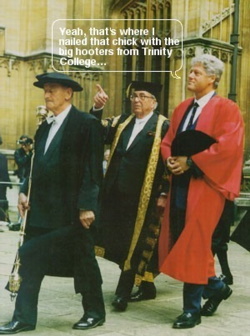
Bill Clinton is the favourite candidate for the office of Chancellor of Oxford University. He is facing growing opposition from dons who fear that his election would endanger the reputation of the institution and the virtue of its undergraduates.
The arguments against his candidacy are many and varied:
- The former President of the United States would harm “the dignity of the office” as Mr Clinton’s sexual peccadilloes, including his affair with Monica Lewinsky, render him unsuitable for such a prestigious post
- His lies on oath about the Lewinsky affair and his decision to award presidential pardons to a number of well-connected criminals just before he left office in January 2001 should disqualify him from the role.
- Mr Clinton’s patchy academic record hasn’t been particularly distinguished in any field – he went to Oxford as a Rhodes scholar in 1968 but failed to complete his degree and his extensive commitments in America.
Mark Almond, a fellow of Oriel College and a lecturer in 20th-century history, added that Mr Clinton would face “endless allegations of sexual scandal”.
“There’s bound to be trouble…We need a woman chancellor, not a womanising chancellor.”
As far as I know, the main argument for is Mr Clinton’s fundraising abilities. Since leaving office he has embarked on a series of lucrative foreign tours, giving lectures for a reputed £1,200 a minute. Oxford University being starved of state funds and facing transatlantic competition for its academics, grossly underpaid in the British academia, is desparate for more cash. And I suppose some dons are reasoning – if he brings more money, sod the dignity of the office or the potential damage it may do to the university’s image.
I can see how that happened – during my university days we came to appreciate the unique tutorial system at Oxford that the government has been threatening to scrap as it is five times more expensive per student than the usual seminar/lecture style of university education. Both Oxford and Cambridge are constantly under attack for their allegedly ‘elitist’ admissions policies and forced to fulfill quotas for students from ‘state’ schools.
I do have a problem with Clinton being the next Chancellor of Oxford University. I also want the university to raise enough funds to continue in its distinguished tradition, without the need to force change because of a lack of them. However, there must be better candidates for the post, both morally and academically more accomplished as well as able to attract sufficient funds for this ancient institution.
Still, if you will not fight for the right when you can easily win without bloodshed; if you will not fight when your victory will be sure and not too costly; you may come to the moment when you will have to fight with all the odds against you and only a precarious chance of survival. There may even be a worse case. You may have to fight when there is no hope of victory, because it is better to perish than live as slaves.
– Winston Churchill
“You teach people that it’s wrong to care. You tell them that the right course of action is to “not get involved”. When they see a crime being committed, then if they try to stop it they may end up in prison, but there’s no punishment for looking the other direction and not seeing. And thus fewer people will get involved.”
– Steven Den Beste writing on what happens when you punish people for killing robbers. Emphasis added by me.
At the heart of almost all ‘redistributive’ statism lies the idea that it is perfectly okay to take money from one person, backed by the threat of state violence, in order to give it to other people deemed more worthy of that money. The ‘worthy’ people are those who have managed to make the political process work in their favour in some manner, such as students in Britain.
People like Will Straw, son of British Foreign Secretary Jack Straw, call education a ‘public good’ and thus sees that as ample justification for the National Union of Students demanding that students like himself have their education paid for by money taken from others… and yet is not the opening of a corner shop or supermarket a ‘public good’ as well? It offers not just needed products but also employment. Is not almost any lawful economic activity between two willing parties a ‘public good’ for much the same reason, as it generates wealth and satisfies needs?
Yet unlike education funded by theft, these other activities involve only consensual relationships and private capital allocated with private insights and information… If I buy a product or open a shop, it is because I think it is in my interests. However I am not going to use force to extort people into buying products at my shop or acquire things by violent robbery.
Although Will Straw may think it is in my interests for him to be educated, I happen to disagree. However he is quite prepared to have the state use force to compel me to provide for his education. Like most who feed at the public trough, he casually accepts the morality of the proxy violence of the state provided it benefits him.
There are some actual ‘public goods’ in the sense Will Straw uses the word, such as defence, the prevention of crime and perhaps discouraging communicable diseases, but those are really the only legitimate role of state… for the likes of Will Straw to think something like his personal education is something that compares to those true ‘public goods’ is strange thinking indeed, for it violates the true public good of the prevention of crime: he would have the state rob me for his benefit.
|
Who Are We? The Samizdata people are a bunch of sinister and heavily armed globalist illuminati who seek to infect the entire world with the values of personal liberty and several property. Amongst our many crimes is a sense of humour and the intermittent use of British spelling.
We are also a varied group made up of social individualists, classical liberals, whigs, libertarians, extropians, futurists, ‘Porcupines’, Karl Popper fetishists, recovering neo-conservatives, crazed Ayn Rand worshipers, over-caffeinated Virginia Postrel devotees, witty Frédéric Bastiat wannabes, cypherpunks, minarchists, kritarchists and wild-eyed anarcho-capitalists from Britain, North America, Australia and Europe.
|





Recent Comments