We are developing the social individualist meta-context for the future. From the very serious to the extremely frivolous... lets see what is on the mind of the Samizdata people.
Samizdata, derived from Samizdat /n. - a system of clandestine publication of banned literature in the USSR [Russ.,= self-publishing house]
|
I suppose that to many Samizdata readers the quotes below will be old news. But it was newsworthy news to Patrick Crozier when he wrote it, and it was news to me when I read it about two days ago. I realise that two days in blog time is a lifetime, but I think this double titbit may still have enough pep left in it to be worth recycling here in full. I hope so.
Two bits of news today (or at least news to me today) suggest that there’s going to be a hell of a battle between rival blog management systems.
First up is Movable Type who are introducing a new system called TypePad. This will be a sort of Movable Type Lite with the additional features of a template design facility and inclusive hosting. The idea is to appeal to the casual ie not very technical blogger and bearing in mind that the lack of templates and fact you have to find your own host are the very things that put people off switching to Movable Type it would appear that they could be on to something.
Meanwhile, not to be outdone, Blogger is hitting back with Dano, the Blogger that works ie a Blogger where the archives don’t do a runner every five minutes. I assume that they will lick their archives problem which should prevent a haemorraging of customers but that still leaves the problem of lack of flexibility which the introduction of no more than about five new tags will do little to alleviate.
So, to sum up, MT are going to compete on Blogger’s ground of being easy to use and Blogger are going to compete on MT’s ground of actually working. Things are about to get very interesting in the Blogosphere
And the morals of that are, I suppose, (a) that if you are still with Blogger and you are a technophobe, give them a few more months to fix their archiving nonsense; and (b) that blogging as a whole is about to conquer the known universe, or they wouldn’t be fighting over it like this.
Patrick has been quietly writing things at CrozierVision, but hasn’t been telling anybody. What I’ve been telling him is: stick with your two blogs, CrozierVision and Transport Blog, and help the rest of us sort ourselves out. Transport Blog is slowly improving its regularity and broadening its scope, now that Patrick is being assisted by a handful of Transport Blog occasionals: me, Michael Jennings, David Farrer, with more to come I expect. It is slowly becoming a group blog. I wonder where he got that idea from.
Patrick and I have been collaborating on the look of my two blogs, starting with the Education one. It has taken me months to persuade some blog-techno-savvy person to sit next to me in my kitchen and press buttons for me while I strode about making aesthetic judgements, because it has taken months for Patrick to decide that being blog-techno-savvy is what he does, but finally it has happened.
The verdict so far is: a few like it and the antis have stayed quiet. Which is as it should be. I made it clear that I was only in the market for compliments and would be ignoring all complaints.
The London-and-surrounding-areas blogosphere is showing no signs of running of out steam.
A Message to the British People:
Jacques Chirac wants to thank you
for saving France on the beaches of Normandy
by giving you
10% unemployment
the Napoleonic code
a Franco-Belgian style military defense
vive le UK
– Clio
In the last few days Britain has been depicted as the Paradise (soon to be) Lost in the clutches of the Federasts. Hope has been expressed that the British public may stir eventually and oppose Blair’s finishing touches on handing over the country’s sovereignty. The word “bovine” has been mentioned in descriptions of the UK public and the adjective is excruciatingly close to the truth.
Only with a public as sleepy and ‘tolerant’ of the destructive antics of its politicians and bureaucrats as the British public has been, a particular breed of Homo politicus characteristic to these isles could have evolved.
The species, known as Bureaucrat idioticus can be found in most governmental bodies, with highest density around local councils. In the last 50 years, it has adapted to a change in its original natural habitat from large forested ministerial departments to smaller, murkier quango marshlands.
It belongs to a larger family of Homo collectivicus, sub-group Homo nonsensicus, indigenous to Great Britain, a genetic dead-end variation on Homo socialist (see below).
However, the most famous branch of Homo collectivicus family is Homo communist, spread around the globe in the last century but currently experiencing an evolutionary hiatus.
The ubiquitous Homo socialist, another influential branch, occupies the same evolutionary niche in its biological family as the cockroach in the insect family. Finally, the recently prospering Homo transnationalis has made some headway to the top levels of the British public institutions, the Government and the Courts.
In the last decade, the Bureaucrat idioticus has been inter-breeding with Bureaucrat corruptus (its continental variety, as well as with its closely related Bureaucrat sanctimonis), which resulted in a virulent Bureaucrat federalis whilst facilitating deeper and wider entrenchment of Homo transnationalis in Great Britain.
Oh, we are so ready for the EU primeval soup!
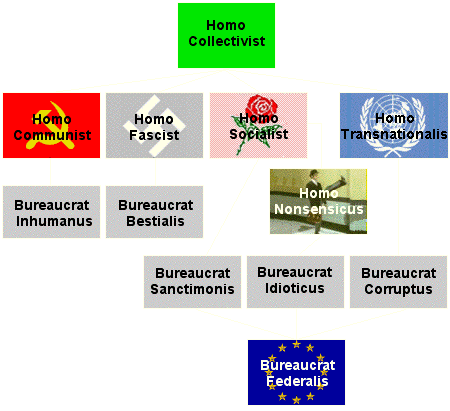
Note: The ‘family tree’ for Homo Liberalis (original meaning) to follow.
In case our esteemed readership has not yet heard of FLAIR (the Far-Left Alliance of Indignant Revisionists) I have the pleasure to relay an interview taken from its case files.
The interview was conducted by Barry Fest, a long-time associate and one-time student of Brummagem Groat, who agreed to interview his erstwhile mentor on behalf of FLAIR. The occasion was the publication of Dr. Groat’s latest book, I Dunno: The Working Person’s Guide to Postmodern Relativism by the Belverton University Press. Dr. Groat is professor emeritus of Talkmatics at Belverton.
An Interview with the Relativist
FLAIR: Thank you for your time today, Dr. Groat. I’d like first to ask you about the subtitle of your new book, “The Working Person’s Guide to Postmodern Relativism.” Why does the working person need a guide such as this?
GROAT: For too long the working person has played victim foot soldier for the corporate conglomerates and their Pentagon enablers. Whenever the corpagon has wanted to go to war to protect profits, it has used absolutes – most notoriously the absolutes of “right” and “wrong” – to persuade the working persons of one nation to take up arms against the working persons of another. And whenever working persons have seemed ready to establish a government for working persons, the interested powers have eliminated the threat by appealing to the absolutes embedded, like post-hypnotic suggestions, in the subconscious of the working person. The rote inculcation of these absolutes is performed at an early age by traditional family units, which act as manufacturing plants for the corpagon’s future pawns and patsys.
The result is that by the time the working person is old enough to actually start working, he is a thrall of these absolutes and does not even know it.
I Dunno is intended to persuade the working person that he is better off without absolutes. – What we in the West consider right and wrong is not what everyone else in the world considers right and wrong. I try to make it plain that, in fact, one man’s wrong is another man’s right. Until working persons learn to accept this they will continue in their roles as ad hoc button men for their corporate bosses.
FLAIR: At what point did you realize there was a need to convince Joe – if you’ll pardon the colloquialism – Sixpack of the need to trade in his old absolutes for new ones?
GROAT: I’ve always – Wait a minute, I think you may be missing a very important point. It isn’t that this so-called Joe Sixpack needs newer or what you might even call better absolutes. He needs to discard the notion of absolutes entirely.
FLAIR: And what is the most compelling reason for him to do that?
GROAT: As I said, it will be impossible for him to find that his notions of right and wrong will be accepted by everyone. A notion of virtue produced by the Western process of reason will not be accepted in those societies that reject reason. – And how can you have a universal truth that is not endorsed universally? The Westerner, and that includes the working person, needs to take another approach: the approach I describe in I Dunno.
For the full text of the interview visit The Radical Capitalist.
“I’ll tell you why people find it “hard” to give up smoking: they don’t really want to do it, is why. Using force against yourself is a bad idea. It sets you up for magnificent failure later on, as anyone with bulimia will tell you. What I say to people who don’t 100% completely absolutely and totally actively want to give up smoking, actually enjoy the idea of living without smoke, anticipate with joy the thought of nurturing their health and becoming energised breathing human beings, is: don’t bother. Carry on smoking, because if you don’t want to give up, you’re only setting yourself up for failure. Anyway, the rest of us aren’t interested in your self-sacrificial whining. It’s your life you’re saving, not ours, don’t expect us to be grateful!”
– Alice who is back from her camping expedition
[Editor’s note: apropos the second link, as usual the blogger.com/blogspot archives are not working correctly]
If there are any talented graphic designers out there perhaps they might want to grasp this opportunity to design a symbol that will, from now on, represent the ‘Country formerly known as Britain’.
The instrument of conquest, the draft EU constitution, was presented in Brussels today. For those of your with the time and fortitude all 148 pages (yes, 148!) of this document can be found here.
Fortunately, the Telegraph has an edited version which sets out the ‘money’ clauses (the ones that British federasts would rather nobody spoke about). Among these are:
Article I-2: The Union’s values
The Union is founded on the values of respect for human dignity, liberty, democracy, the rule of law and respect for human rights.
These values are common to the Member States in a society of pluralism, tolerance, justice, equality, solidarity and non-discrimination.
Meaningless, empty prattle that might have been drafted up by the editorial team of the Guardian. What ‘solidarity’? What does that mean? And ‘equality’? Does this mean Mao suits for everyone? If not, then what? And why on earth the prohibition on ‘discrimination’? Discrimination just means ‘judgement’. Are we supposed to live without it?
2 The Union shall offer its citizens an area of freedom, security and justice without internal frontiers, and a single market where competition is free and undistorted.
Which means that Anglo-Saxon common law and Habeas Corpus are out to be replaced by Napoleonic Code and Corpus Juris.
The Union shall work for a Europe of sustainable development based on balanced economic growth, with a social market economy aiming at full employment and social progress.
Semi-planned economies with rigid labour laws and an omnipresent dead-hand of state.
It shall contribute to peace, security, the sustainable development of the Earth, solidarity and mutual respect among peoples, free and fair trade, eradication of poverty and protection of human rights and in particular children’s rights, as well as to strict observance and development of international law, including respect for the principles of the United Nations Charter.
Euro-sclerosis for the whole world!!
Article I-5: Relations between the Union and the Member States
1 The Union shall respect the national identities of its Member States, inherent in their fundamental structures, political and constitutional, including for regional and local self government.
2 The Member States shall facilitate the achievement of the Union’s tasks and refrain from any measure which could jeopardise the attainment of the objectives set out in the Constitution.
The potemkin clause. This is the one the federasts will refer to in an attempt to rebut concerns over loss of sovereignty. As per usual, they will be lying. It only says that ‘national identities’ will be respected, not sovereignty which is clearly abolished by Part 2 of the clause.
Article I-6: Legal personality
The Union shall have legal personality.
So no question that this is any longer about ‘co-operation of sovereign states for mutual benefit’. The EU will exist as a formal entity separate from the national governments. → Continue reading: And this is how it ends
Just to make sure we don’t go the whole day without anything being posted to Samizdata at all (even if it is a holiday in both the US and the UK) might I direct people to this stunning panoramic view from the top of Mt Everest. (Quicktime required). I do so simply because it is beautiful. (via James Russell).
I have not been to the top of Everest myself, but I have seen a similar view from the top of Mt Lobuje East, which is about five kilometres away in horizontal terms, and two and a half kilometres lower in elevation. This was high enough to see the same astonishing view of moutains to the horizon in all directions, although a few peaks were level with or above me, whereas from Everest everything is down. Seeing this view was one of the great experiences of my life.
In recent decades, Nepal has had a population explosion. One consequence of this has been deforestation. People need energy of some sort for cooking and heating. Traditionally, the mountain peoples of the Himalayas have chopped down trees for firewood. With relatively sparse populations, this has been sustainable, but with the denser populations of recent decades people have had to go further and further afield to find firewood, and a larger and larger proportion of their trees have been chopped down. This has led to obvious environmental problems of erosion, and it clearly isn’t sustainable if people are chopping trees down faster than the trees are growing back. Plus, a lifestle consisting of walking large distances, chopping down the vegetation, and then walking home with a large amount of firewood tied to your back is not especially pleasant.
More importantly, it is unnecessary. This is the mightiest mountain range in the world. Its energy resources, in terms of hydro-electric potential, are gigantic. → Continue reading: Panoramic view from Mt Everest
Whilst perusing Harry’s Place, I discovered a reference to an essay written by Labour MP Peter Hain in 2000 about ‘libertarian socialism’ over on the Chartist website called Rediscovering our libertarian roots.
The whole notion of this alleged form of libertarianism is something I have commented on before, but I have probably never seen a more clearly written explanation of the true thinking that underpins ‘libertarian socialism’ than this article by Hain.
It is very important to understand what Hain’s essay is and is not. It is not a philosophical paper making logical links between socialism and libertarianism. What it is is a tactical paper very much along the lines of the one I wrote called Giving libertarianism a left hook, only with the opposite objective.
Rather than fisking Hain’s article, I will just quote what I think are the most illustrative sections (emphasis added):
The key elements of libertarian socialism – decentralisation, democracy, popular sovereignty and a refusal to accept that collectivism means subjugating individual liberty.
[…]
Discredited by its association with statism, socialism’s rehabilitation can only be achieved through a recovery of its libertarian roots, applying these to the modern age through Labour’s Third Way.
[…]
Underlying libertarian socialism is a different and distinct notion of politics which rests on the belief that it is only through interaction with others in political activity and civic action that individuals will fully realise their humanity. Democracy should therefore extend not simply to government but throughout society: in industry, in the neighbourhood or in any arrangement by which people organise their lives.
[…]
However, power can only be spread downwards in an equitable manner if there is a national framework where opportunities, resources, wealth and income are distributed fairly, where democratic rights are constitutionally entrenched, and where there is equal sexual and racial opportunity. This is where socialism becomes the essential counterpart to libertarianism which could otherwise, and indeed sometimes is, right wing. It means nationally established minimum levels of public provision, such as for housing, public transport, social services, day-care facilities, home helps and so on. The extent to which these are ‘topped up’ and different priorities set between them, is then a matter for local decision.
[…]
Most individuals need active government to intervene and curb market excess and distortions of market power. For choice and individual aspiration to be real for the many, and not simply for the privileged few, people must have the power to choose.
Nevertheless the old left nostrum that markets equal capitalism and the absence of markets equals socialism, is utterly simplistic. As Aneurin Bevan argued, the extent to which markets are regulated or subjected to strategic intervention by government is not a matter of theoretical dogma, but a practical matter to be judged on its merit. That is why a Third Way Labour government is not passive, but highly active, working in partnership with business and investing in the skills and modern infrastructure which market forces and the private sector do not provide
There are so many problems and manifest contradictions that leap off the page it is difficult to know where to start. The core of what makes this so wrong lies as usual at the meta-contextual level. The problem is one of the distorting lens of the writer’s world view, based as they clearly are on utterly utilitarian principles. Hain says libertarian socialists are characterised by a “refusal to accept that collectivism means subjugating individual liberty”, whereupon he follows with an article which lists the many ways in which his socialist system would in fact do precisely that.
The core of Hain’s view is that politics, which is a euphemism for ‘the struggle for control of the means of collective coercion’, is the essential core around which ‘society’ exists and interacts. Thus when he says society must be ‘completely democratic’, he means society must be completely political (based upon collective coercion). Yet the argument that it is only by this that individual liberty can be realised falls at the first fence by virtue of the fact you cannot opt out of a political society and particularly a democratic political society: if my neighbour gets to vote on all aspects of “any arrangement by which people organise their lives”, then clearly my individual wish regarding what I may do with my own life is by no means my choice unless that choice is quite literally a popular one.
Secondly, if democratic rights are to be ‘constitutionally enshrined’ and the society is completely democratic in all its aspects and therefore completely political, then how can the individual rights of people be insulated from the democratic political process which may seek to abridge them? You can either have complete democracy enshrined or, as the American founding fathers tried with limited success, you can have individual rights enshrined and placed outside the reach of democratic politics, but you cannot logically have both.
The notion that a completely politicized democratic ‘society’ of the kind advocated by Hain could by its very nature allow any personal liberty whatsoever in a meaningful sense is manifestly absurd. If you cannot opt out of something you have not previously agreed to, in what manner are you free? If society is totally political, then you may have ‘permissions’ to do this or that, won by the give and take of democratic political processes but you do not have super-political inalienable rights at all. Politics can in theory make you ‘free from starving’ perhaps (in practise of course it tends to do the opposite), but what about being free to try or not try some course of action? When every aspect of life is subject to the views of a plurality of other people, there is no liberty to just try anything at all on your own initiative. What Hain is arguing for is by his own words collectivism.
It seems to me that one thing all forms of collectivism share is that individual choice is always subordinate to The Group, be it the fascist volk or a local soviet or an anarcho-syndicalist people’s council or whatever other fiction of ‘society’ the state decides to use. So talk of individual rights within the context of a collectivist ‘society’ is either incoherence or if not it is nothing more than a tactical ploy to conflate a violence based system of total governance with its antithesis in a manner well understood. As I wrote in a recent article, unlike a collectivist kibbutz, which is a voluntary collectivist commune, you cannot just walk out of the door of a collectivist ‘society’ and start setting up private arrangements with other willing people if the majority do not want you to do that: they will in fact deputise the use of violence to prevent it.
The logical flaws in the ‘collectivist society replacing collectivist state’ notion are so obvious that they have been pointed out a great many times by a great many people, but I will add my voice to the throng anyway. Hain, like Marx before him, clearly sees libertarian socialism as working towards the ‘withering away of the state’ as a true collectivist ‘society’ comes to replace it. But to maintain such a condition of total political governance will require the use of force to prevent any consensual but not democratically sanctioned acts between willing individuals. To maintain this suppression of spontaneous several relationships, a collectivist socialist ‘society’ must be organised and structured in certain ways that make it indistinguishable from a collectivist socialist state.
So if for a collectivist ‘society’ to function there must be a high degree of politically imposed non-spontaneous behaviour from its ‘citizens’ (such as preventing a person selling their own labour for less than the political community will allow them to), and those mandates must be backed with the threat of violence (i.e. law) if they are not to be ignored, then what we have a political State by any reasonable definition of the word ‘State’, much as Rousseau would have defined one. In fact, socialism must be the most ironic use of language in the history of human linguistics: it is the advocacy of the complete replacement of social interaction with political interaction, the very negation of civil society itself. ‘Politicalism’ would be a more honest term.
Now of course all societies have laws, be it polycentric law or state imposed law. Even the most libertarian society plausibly imaginable will have force backed prohibitions against the unjustified use of violence, which is to say (in very crude and simplified terms) libertarian law deals with ‘that which you may not do without consent of the person to or with whom you are doing it’. You may not cause me harm with dioxin from your factory because I have not given you leave to put your chemicals in my lungs. This law is based on the principle that the individual’s rights to his body (and property) are his own.
However the collectivist places the protection of the political collective as more important than the individual and thus collective law is whatever the political collective says it is. If the political collective says ‘a factory may not put dioxin in Fred’s lungs because we want a more environmentally safe place to live for all of us’, then that is the law because the political collective has said so, not because Fred has the right to control the contents of his own lungs.
But if they say ‘a factory may indeed put dioxin in Fred’s lungs because we want a better economy and more stuff for the rest of us’ then that too is the voice of the collective. And Fred? If he does not like it, well, it is “only through interaction with others in political activity and civic action that individuals will fully realise their humanity”. And if Fred finds himself in the minority? Now Fred has a problem because as the society is ‘totally democratic’, we will have none of this nonsense of independent and politically neutral courts stepping in to support the objective and several rights of Fred against the collective, as if that could happen in our libertarian socialist paradise, we would no longer have our totally democratic society.
So as Hain says it is only through trying to control the means of collective coercion, the means to use force to make people do things, that Fred can ‘fully realise his humanity’, how is this ‘libertarian socialism’ going to protect the individual called Fred’s rights? What if the majority in Hain’s total democracy don’t like Fred? And who will define these ‘individual’ rights? The political collective, of course. Forget constitutions which constrain democracy because those are anti-democratic (which is rather the point). Forget consensual several relationships because everything is democratic, meaning no politically unpopular relationships will be allowed. Forget custom and culture as a means to moderate interactions because that is not political. If Fred is not popular, Fred is just out of luck.
Fascist collectivists try to prevent mixed race sex, socialist collectivists try to prevent ‘undemocratic’ private trade, but the principle of collectivism is always the same. If an individual does something he wants to do in a collectivist ‘society’, it is because the political collective allows him to do it, not because it is his right to do as he pleases with those who are willing participants.
Clearly this democratic ‘society’ of Hain’s is willing to use force to prevent free trade between willing individuals unless they happen to be acting in a manner which is politically favoured. Much as most states currently use force to try and prevent free trade in drugs between willing individuals, the same will be done to any relationship the political collective dislikes. Put another way, this democratic society is in fact a state which will be organised to enforce the political will of the plurality on an epic scale, given that this would be a totally political society. And any time someone tries to opt out, they will quickly discover just how ‘withered away’ the state is under ‘socialist libertarianism’: not very.
Of course just as modern states may be more repressive or less repressive (running on a continuum from, say, Switzerland to North Korea), some implementations of so-called ‘socialist libertarianism’ may be more savage or less savage in their interpretation of an unfettered total political democracy at a given point in time. An individual who shares the views, aspirations and prejudices of the majority may well think that life seems equitable and good. After all, if he is allowed to do the things he wishes to do, why complain? But as the democracy advocated by Hain is total, what if he wants to do that which not popular?
I have long thought that supporters of collectivism (be it of the socialist, nationalist or conservative kind) who are homosexuals or who are people with other lifestyles that will never be popular (in the literal sense of the word, actually favoured by the majority) are unwise in the extreme to advocate anything that does not reserve rights to individuals before collectives. Socialism is by Hain’s own words seen as “…where socialism becomes the essential counterpart to libertarianism which could otherwise – and indeed sometimes is – right wing”. Of course by ‘right wing’ Hain means individualist. Libertarianism puts the rights of the individual as the first of all virtues. Libertarian socialism is individualist collectivism, ergo libertarian socialism is an oxymoron.
So what is Hain’s total political ‘society’ in reality? It is locally organised totalitarianism with Big Brother based in the local town hall rather than in Whitehall.
A Telegraph opinion piece sums up the Home Office’s attempts to introduce compulsory ID cards in the UK:
Benefit fraud, illegal migration, the terrorist threat since September 11: all have been pulled out of the Government’s hat as reasons for introducing compulsory identity cards. The Home Office, which has long favoured them, is aware of the political charge they carry. It has, therefore, tried to deter accusations of seeking to curtail basic freedoms by the euphemism “a universal entitlement card scheme”, and by using whatever emotive issue is to hand as an argument for their introduction.
It is more than half a century since the wartime national registration card was abolished. An illiberal Home Secretary is now trying to use the age of terror and his failure to adopt sensible immigration and asylum policies as a means of setting up a system of national surveillance. The Cabinet should rebuff him without further ado.
Hear, hear… If you stay tuned, you will.
Note: Everyone over 16 would be required to register with a national citizens’ database and would be issued with a personal number. The card is expected to carry core information about the holder, and biometric details such as fingerprints or iris patterns. The cost would be met by adding about £25 to the fee for a driving licence and passport.
Anyone who knows anything about oppressive totalitarian regimes knows that nothing is as it seems and politically loaded public displays in such countries should be dismissed out of hand. This rule should have been applied to the images from Saddam ruled Iraq of convoys of taxis, with tiny coffins of dead infants strapped to their roofs slowly driving through the streets of Baghdad. The children were allegedly killed by United Nations sanctions.
The moving scenes, accompanied by crowds of women screaming anti-Western slogans, were often filmed by visiting television crews. The western media, so shrewd and cynical when it comes to reporting on Western politicians and so naive and gullible when manipulated by dictators’ propaganda, provided valuable ammunition to anti-sanctions activists such as George Galloway, who routinely blamed Western governments for the deaths of 500,000 Iraqi children. And to the Guardian, who regularly reported on the beastly US and its minions as being responsible for the death of the (cynically paraded) babies and the on-screen grief of their mothers (mock grief of the members of the Iraqi Women’s Federation).
As expected, the reality behind the Ba’athist regime’s dystopian methods is slowly coming out. In the case of ‘baby parades’ Iraqi doctors in Baghdad tell Charlotte Edwardes, a Telegraph reporter that UN sanctions did not kill the hundreds of infants displayed over the years – it was neglect by the former regime.
According to the Telegraph, Iraqi doctors say they were told to collect dead babies who had died prematurely or from natural causes and to store them in cardboard boxes in refrigerated morgues for up to four weeks, until they had sufficient corpses for a parade.
Many of the children died, they say, as a result of the Iraqi government’s own neglect as it lavished funds on military programmes and Saddam’s palaces in the knowledge that it could blame sanctions for the lack of medicines and equipment in hospitals and clinics. Dr Hussein al-Douri, the deputy director of the Ibn al-Baladi hospital in Saddam City, a Shia district in eastern Baghdad explains:
We were not allowed to return the babies to their mothers for immediate burial, as is the Muslim tradition, but told they must be kept for what became known as ‘the taxi parade’. The mothers would be hysterical and sometimes threaten to kill us, but we knew that the real threat was from the government.
Asked what would have happened if he had disobeyed the orders, Dr al-Douri replied: They would have killed our families. This was an important event for the propaganda campaign. The government then ordered members of the Iraqi Women’s Federation, an organisation funded by the regime, to line the streets of Baghdad and wail and beat themselves in mock grief.
Dr Amer Abdul al-Jalil, the deputy resident at the hospital, said:
Sanctions did not kill these children – Saddam killed them. The internal sanctions by the Saddam regime were very effective. Those who died prematurely usually died because their mothers lived in impoverished areas neglected by the government. The mortality rate was higher in areas such as Saddam City because there was no sewerage system. Infectious diseases were rampant.
Over the past 10 years, the government in Iraq poured money into the military and the construction of palaces for Saddam to the detriment of the health sector. Those babies or small children who died because they could not access the right drugs, died because Saddam’s government failed to distribute the drugs. The poorer areas were most vulnerable.
We feel terrible that this happened, but we were living under a regime and we had to keep silent. What could we do?
What could they do? Not much, if they wanted to live and continue in their profession. But those who lapped up Saddam’s obvious propaganda for their own purposes should now recant their accusations as loudly as they heaped them.
Let’s hear it, the Galloways of this world!
“My song is a hymn for individualism and against collectivism. I am also for balls and against circles, for corners and against edges, for trees and against the forest. In my performance it is not so much the song that counts but the moral attitude behind it. Whoever votes for me is against being standardized and cemented in by ‘European Banality’.”
Alf Poier, Austrian entrant to the European Song Contest.
(Via Michael Jennings.)
(In the end, Mr Poier got a respectable 94 points. It seems Britain got no points at all. Politically, this is all to the good.)
In London just now there is a big push on to make the place more pedestrian friendly, and less car-dominated. The Congestion Charge is part of this trend. So are the three new footbridges across the Thames, in the form of the Millenium Bridge between the City and Tate Modern, and the two new footbridges they’ve put on either side of the old Hungerford (railway) Bridge to replace the one old puddle-ridden sewer of a footbridge that used to be there.
As a confirmed pedestrian, I consider all these changes to be big steps in the right direction, especially the Congestion Charge. The long term threat is that London may one day stop being a living city, and become a tourist city, like Paris. Paris is pretty. Of course it is. But the trouble with Paris is that increasingly, that’s all that it is.
In London, for the time being, tourism is no threat. London is far too big, busy and ugly for that. Tourism is the seasoning of this great city, not its basic nourishment. And one of the more entertaining sights to be seen in London in recent years has been the tourist related one of seeing one of these things trundling about, these being DUKWs.
DUKWs, or “Ducks” as they have always, inevitably, been called, were originally used for amphibious landings during World War II, and although I’ve never witnessed them actually making the transition, the London ducks are amphibious here too, being both buses and boats at different stages of their travels about London.
While putting this together, I found myself wondering, not for the first time in my life: why DUKW? Well, according to this:
D = First year of production code “D” is for 1942
U = Body style “U” utility truck (amphibious)
K = Front wheel drive. GMC still uses that on trucks today (K5 Chevy Blazer)
W = Two rear driving wheels (tandem axle)
So now you know.
I also learned on my google-travels that London is not the only city where DUKWs are still making themselves useful, and keeping people employed driving them and looking after them. They are to be found all over the place, it seems.
|
Who Are We? The Samizdata people are a bunch of sinister and heavily armed globalist illuminati who seek to infect the entire world with the values of personal liberty and several property. Amongst our many crimes is a sense of humour and the intermittent use of British spelling.
We are also a varied group made up of social individualists, classical liberals, whigs, libertarians, extropians, futurists, ‘Porcupines’, Karl Popper fetishists, recovering neo-conservatives, crazed Ayn Rand worshipers, over-caffeinated Virginia Postrel devotees, witty Frédéric Bastiat wannabes, cypherpunks, minarchists, kritarchists and wild-eyed anarcho-capitalists from Britain, North America, Australia and Europe.
|





Recent Comments