We are developing the social individualist meta-context for the future. From the very serious to the extremely frivolous... lets see what is on the mind of the Samizdata people.
Samizdata, derived from Samizdat /n. - a system of clandestine publication of banned literature in the USSR [Russ.,= self-publishing house]
|
At the risk of inviting opprobrium, I must admit that the murder of Anna Lindh did have me reaching for the tin-foil to wrap around my head.
Even with the solid support of the entire Swedish political class, the ‘yes’ camp was still trailing the ‘no’ camp in every single opinion poll and it did briefly cross my mind that a ‘heroic sacrifice’ might have been arranged to swing the vote. The stakes here are certainly high enough.
But, on balance, probably not. Political assassination is common enough in Europe not to have to ascribe a conspiracy to this one. Even if there was more to her murder than meets the eye, it didn’t work. The Swedes voted ‘no’ to the Euro.
On any reading this is a blow for the EU project and the coming weeks will see a deluge of federast seething, threatening and whining. Their will has been thwarted and that it just intolerable. They will even try to float the notion that the result of the Swedish referendum was ‘undemocratic’. I also expect the Swedish government to begin agitating for another referendum to get the desired result but, given the margin of the ‘no’ victory, they may not get away with that.
Quite aside from all the furore and recriminations that are bound to follow, I wonder if this could be the catalyst which leads to the unravelling of the whole project. It isn’t very likely but neither is it altogether impossible. In fact, I quite like the idea of a ‘Euro-Watch’ sweepstake: who will be the first to bail out of the Euro?
For the record, my money (sterling!) is on the French. The Germans will stick with it because they have always had an emotional investment in the European project. It enables them to be ‘Europeans’ and thus serves to expiate their guilt about being German. They will endure a lot more economic pain before they begin to think the unthinkable.
But not the French. For them, the EU has always been about advancing their national interests. All the kumbaya mummery about a united Europe is just window-dressing to disguise the self-serving reality. If it looks like wrecking their economy (or, more particularly, it begins biting into the privileges of the political class) the French will simply dump the Euro and swan off to look for another boondoggle.
Not inevitable by any means, but possible. In anticipation, I would like to extend my thanks to the Swedish electorate. They may just have done us a great favour.
This Associated Press article discusses how the US Department of Justice has been using its increased powers granted under the Patriot Act just after September 11. Suffice to say that the DOJ and state prosecutors managed to get many items that had nothing to do with terrorism but which had been on its wish list for years into the bill, and it is now being used to tap phones, seize assets, and intrude on people’s liberties in ways that weren’t possible before.
Civil liberties and legal defense groups are bothered by the string of cases, and say the government soon will be routinely using harsh anti-terrorism laws against run-of-the-mill lawbreakers.
“Within six months of passing the Patriot Act, the Justice Department was conducting seminars on how to stretch the new wiretapping provisions to extend them beyond terror cases,” said Dan Dodson, a spokesman for the National Association of Criminal Defense Attorneys. “They say they want the Patriot Act to fight terrorism, then, within six months, they are teaching their people how to use it on ordinary citizens.”
It is terrific news, not just for those who like his writing, but for the blogosphere in general (and therefore even for those bloggers who don’t like his writing), that Stephen Pollard has now got himself a brand spanking new blog, which really is a blog, and that it is now no harder to link to his blog postings than it is to anyone else’s, which wasn’t the case with his previous arrangement.
Consider his piece for today’s Sunday Telegraph, which he has also put up at stephenpollard.net, entitled, in his (to quote the top of the new blog) “never knowingly understated” manner, Why Israel is right to assassinate Hamas leaders.
The comparison with the IRA is entirely specious. If the IRA had espoused not merely the separation of Northern Ireland from the UK but also the murder of every Unionist and every Anglican in Great Britain, the abolition of the United Kingdom and its replacement with a Catholic state, run by the IRA and dedicated to converting the rest of the world to Catholicism by force, then there might be some merit in the comparison.
Hamas is explicit about its aims. In August 1988 it published the Islamic Covenant, which makes clear its opposition to Israel’s existence in any form. It states that “there is no solution for the Palestinian question except through jihad (holy war)”. Any Muslim who leaves “the circle of struggle with Zionism” is guilty of “high treason”. It calls for the creation of an Islamic republic in Palestine to replace Israel. Muslims should “raise the banner of Allah over every inch of Palestine”.
In a statement released on May 19, after a wave of suicide murders in previous days, Hamas said: “These attacks will continue in all the territories of 1948 and 1967, and we will not stop attacking the Zionist Jewish people as long as any of them remain in our land.” A Hamas member explained to an interviewer last month that: “The Jews have destroyed your Christianity just like they are trying to destroy our Islam. You should read the words of the Prophet. Join us. We do not just want to liberate Palestine. We want all countries to live under the Caliphate. The Islamic army once reached the walls of Vienna. It will happen again.”
If Stephen Pollard were the average waffling egomaniac blogger, the fact that linking to him used to be a combination of an obstacle race and an egg-and-spoon race wouldn’t have mattered all that much. It would have been a pity, but no more than that. As it is, and quite aside from whether you happen to agree or disagree with Pollard’s attitude to all this (personally I’m pretty much in complete agreement), this is heavyweight journalism. Facts are being assembled and deployed, not just impressions or feelings. Those gruesome quotes are for real. This man is not merely clearing his throat and finding his voice. He has found his voice. And he has the regular, big-media columns, like this one, to prove it.
And now, his blog-microphone, so to speak, is also in full working order. Other Pollard pieces, not originally for a big print newspaper, can now also be linked to by the rest of the blogosphere with impunity. → Continue reading: All hail the new Stephen Pollard blog
For web design that hurts, you really need to visit…

It’s around 8 pm London time, and so far the result is only in the form of exit polls, but it looks, touch wood, as if Sweden has voted NO to the EUro.
An exit poll suggests that Sweden has narrowly voted to reject the euro, in a referendum days after the killing of Foreign Minister Anna Lindh.
The Swedish television poll of 7,000 people gives the No side 51.8% to the Yes side’s 46.2%.
Preliminary results are expected at 1930 GMT (2130 local time), one-and-a-half hours after polls closed.
Lindh was the main face of the Yes campaign, and her stabbing in a Stockholm department store appeared to trigger a last-minute sympathy vote.
Anna Lindh murdered. The Swedish establishment united in favour of the EUro. Yet still they couldn’t bully it through.
The establishment here is anything but united if favour of the EUro, so this result means that Britain is that much more unlikely to be joining it in the foreseeable future. So this is a big blow to the entire project.
I’ve been watching a EUro-yes-man on the TV saying that if Britain stays out of the EUro, that means that we’ll be in the same silly position as we’ve been in for the last fifty years, namely playing “catch-up”. We will eventually, grudgingly, joining a EUro-institution which we had very little part in shaping. But that’s a double-edged argument, because there is another way for Britain to be more decisive about the EU as a whole. We could get the hell right out of it. We wouldn’t be playing catch-up then, would we? The chances are, if the EU doesn’t meanwhile improve its economic policies, that we’d be the ones they’d then be trying to catch up with. Which is why I’ve never understood this argument that non-membership of the EU, or of the EUro, will diminish Britain’s power. Do you reckon that Sweden today is having no major impact upon the European Union?
Did Hong Kong, by “staying out of China” for so long, have no influence on China, just because its political bosses didn’t constantly share dinners with Red China’s bosses and constantly get told what to do by them, in exchange for the occasional “concession”, concerning, I don’t know, not locking up dissidents for a few more years? Did Hong Kong, by “going it alone”, thereby deny to itself “power”?
Meanwhile Estonia, in contrast, is definitely voting YES to joining the European Union as a whole, by a big margin. Having visited Estonia for several days about twelve years ago, I know all about that place. They were dead set on getting into the EU then, and on paying whatever was the price of entry, basically to protect themselves against any future that Russians might one day dream up for them. So it’s no surprise to me that this is still their majority attitude now. And if they don’t get any protection against Russia, they’ll leave the EU and look for another club to join.
The day started off with ominous signs as I left the house, a raven seemed to be calling a warning from atop the church…

Even when I arrived at the appointed place, I found nervous animals, disquieted by a change in the ether…
And then, suddenly, he was there! The rumours were true! He had returned and the room exploded into chaos!

In no time at all, he was back to his old tricks as though he had never left…
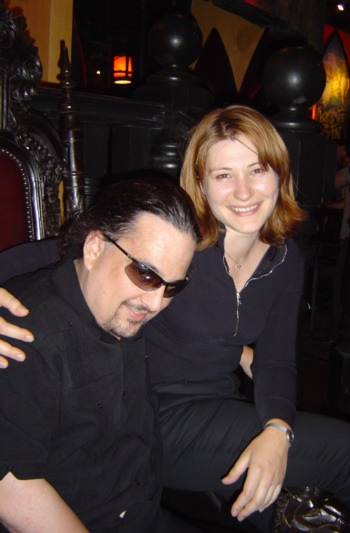
Andrew Dodge is back in London after his long exile in the colonies. God save us all!
More from today’s New York Times, this time about a high tech company which makes its mega-bucks by betting that future security/Patriot Act legislation will be more intrusive than it is now. This is the Security-Industrial Complex getting into its stride, and its vested interests getting dug in.
This company makes X-ray snooping kit. There must be hundreds more doing similar stuff which we aren’t necessarily ever going to hear about.
This from the New York Times speaks for itself:
WASHINGTON, Sept. 13 – For months, President Bush’s advisers have assured a skittish public that law-abiding Americans have no reason to fear the long reach of the antiterrorism law known as the Patriot Act because its most intrusive measures would require a judge’s sign-off.
But in a plan announced this week to expand counterterrorism powers, President Bush adopted a very different tack. In a three-point presidential plan that critics are already dubbing Patriot Act II, Mr. Bush is seeking broad new authority to allow federal agents – without the approval of a judge or even a federal prosecutor – to demand private records and compel testimony.
This may not be quite so central to the White Rose agenda. I don’t know. Are more severe punishments part of our beat?
Mr. Bush also wants to expand the use of the death penalty in crimes like terrorist financing, and he wants to make it tougher for defendants in such cases to be freed on bail before trial. These proposals are also sure to prompt sharp debate, even among Republicans.
But this is definitely for us:
Opponents say that the proposal to allow federal agents to issue subpoenas without the approval of a judge or grand jury will significantly expand the law enforcement powers granted by Congress after the attacks of Sept. 11, 2001. And they say it will also allow the Justice Department – after months of growing friction with some judges – to limit the role of the judiciary still further in terrorism cases.
Indeed, Senator Arlen Specter, Republican of Pennsylvania, who is sponsoring the measure to broaden the death penalty, said in an interview that he was troubled by the other elements of Mr. Bush’s plan. He said he wanted to hold hearings on the president’s call for strengthening the Justice Department’s subpoena power “because I’m concerned that it may be too sweeping.” The no-bail proposal concerns him too, the senator said, because “the Justice Department has gone too far. You have to have a reason to detain.”
There’s a lot more. My thanks to David Sucher for the email that made sure we noticed this, and which definitely got us noticing it quicker than otherwise.
CNN reports that America’s top security official has urged European leaders to cooperate with U.S. demands to share information on airline passengers such as names, place of birth and date of birth, saying European resistance was hampering anti-terrorism efforts.
Tom Ridge, secretary for homeland security, said the European Union’s demand to protect passengers’ privacy must be balanced by the right of those passengers to travel safely. He noted that the United States wasn’t requesting information on health or religion.
The new U.S. law came into effect March 5. It requires airlines to provide the U.S. government with passenger details such names, phone and credit card numbers as well as meal choices. Because of the EU law banning the sharing of such information, European airlines face fines of up to $6,000 a passenger and the loss of landing rights if they fail to comply.
The EU Internal Market Commissioner, Frits Bolkstein, warned Ridge in June that if negotiations to bridge the two laws failed, a “highly charged trans-Atlantic confrontation” could ensue. If there is no deal, EU officials have said the EU would have to instruct national data agencies to stop sharing data with Washington and fine carriers that do so, leaving airlines caught in the middle.
It’s like a cancer that we can battle against but never truly defeat. As it creeps purposefully through our national lymph system some of us can summon up the courage to fight it back and, for a while, it can appear as if we are in remission. But then comes the hoping and the praying for the final ‘all clear’ that signals a rebirth and a new lease of disease-free life.
It never comes. The cells are corrupted again and the cancer returns to devour us:
Sweeping powers for Government agencies to carry out covert surveillance, run agents and gather the telephone data of private citizens were contained in legislation published yesterday.
State bodies ranging from the police, intelligence services and Whitehall departments to local councils, the Postal Services Commission and the chief inspector of schools will be able to authorise undercover operations.
The measures were activated by David Blunkett, the Home Secretary, under the controversial Regulation of Investigatory Powers Act, which became law three years ago. They need to be approved again by both Houses of Parliament before they can be used.
These horrors first made their appearance about a year ago and set off a call-to-arms that, in turn, caused the Home Office to drop the proposals. Or, at least, they made an appearance of dropping them because, like that lurking cancer, they never really went away. They were merely stacked neatly in the pending trays until an another opportune moment presented itself. Seems that the moment is now.
Shami Chakrabarti, director of Liberty, said the British people were “the most spied upon in the Western world”.
I reckon that’s a pretty fair prognosis. But why? Why are our political elites so determined to construct this panopticon? Why are they so single-minded about this project that they appear immune to sweet reason, protest or appeals to decency? What exactly is driving them? Are they so riddled with paranoia and insecurity that they see monsters and assassins lurking behind every curtain? Is that how they see us? I cannot think of any other reason why a democratically elected government would come to think of themselves as colonial occupiers of their own country.
What has led to this calamitous collapse of trust? Is it repairable? I rather fear that it is not.
Questions, questions. Answers may come in due course but I suspect none will be satisfactory or stop the cancer from spreading. Time for palliative surgery?
[This has been cross-posted from Samizdata.]
It’s like a cancer that we can battle against but never truly defeat. As it creeps purposefully through our national lymph system some of us can summon up the courage to fight it back and, for a while, it can appear as if we are in remission. But then comes the hoping and the praying for the final ‘all clear’ that signals a rebirth and a new lease of disease-free life.
It never comes. The cells are corrupted again and the cancer returns to devour us:
Sweeping powers for Government agencies to carry out covert surveillance, run agents and gather the telephone data of private citizens were contained in legislation published yesterday.
State bodies ranging from the police, intelligence services and Whitehall departments to local councils, the Postal Services Commission and the chief inspector of schools will be able to authorise undercover operations.
The measures were activated by David Blunkett, the Home Secretary, under the controversial Regulation of Investigatory Powers Act, which became law three years ago. They need to be approved again by both Houses of Parliament before they can be used.
These horrors first made their appearance about a year ago and set off a call-to-arms that, in turn, caused the Home Office to drop the proposals. Or, at least, they made an appearance of dropping them because, like that lurking cancer, they never really went away. They were merely stacked neatly in the pending trays until an another opportune moment presented itself. Seems that the moment is now.
Shami Chakrabarti, director of Liberty, said the British people were “the most spied upon in the Western world”.
I reckon that’s a pretty fair prognosis. But why? Why are our political elites so determined to construct this panopticon? Why are they so single-minded about this project that they appear immune to sweet reason, protest or appeals to decency? What exactly is driving them? Are they so riddled with paranoia and insecurity that they see monsters and assassins lurking behind every curtain? Is that how they see us? I cannot think of any other reason why a democratically elected government would come to think of themselves as colonial occupiers of their own country.
What has led to this calamitous collapse of trust? Is it repairable? I rather fear that it is not.
Questions, questions. Answers may come in due course but I suspect none will be satisfactory or stop the cancer from spreading. Time for palliative surgery?
[This has been cross-posted to White Rose.]
Like I said, respect for the law appears to be on the wane. Although the word ‘hostility’ might be even more apposite:
They are the black knights of the road; balaclava-wearing highway hitmen out to burn, bomb, decapitate and dismember. But drivers need not fear, for it is speed cameras that this growing band of rebels are after.
Up and down the country, the tools used to keep roads safe are being ripped down, blown up and even shot apart as part of a campaign orchestrated by a gang of web-surfing outlaws. They threaten to become the most popular gang of criminals since Robin Hood and his Merry Men stalked the countryside.
Forsooth, methinks the commoners may be in need of folk-songs.
From the south coast to the Highlands no camera is safe. Known as Gatsometers, or Gatsos, they are being destroyed at a rate that has alarmed police forces. Particularly destructive cells are operating in north London, Essex and Wales – where they rage against machines deployed by renowned anti-speeding police chief Richard Brunstrom.
With each unit costing £24,000 to replace, a huge bill is being run up. But the rebels are unrepentant, claiming the cost is more than met by speeding drivers’ fines. Speed cameras, they argue, are not about keeping roads safe, but about raising revenue. The charred remains of their victims are often adorned with stickers or graffiti which declare cameras to be stealth tax inspectors.
Of course, we at Samizdata.net could not possibly condone these irresponsible actions by an anti-social minority. 
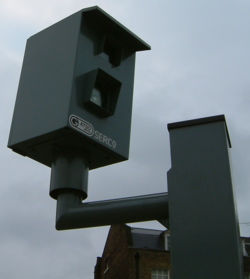
The Target for Tonight? [My thanks to Dr.Chris Tame for posting this story to the Libertarian Alliance Forum.]
|
Who Are We? The Samizdata people are a bunch of sinister and heavily armed globalist illuminati who seek to infect the entire world with the values of personal liberty and several property. Amongst our many crimes is a sense of humour and the intermittent use of British spelling.
We are also a varied group made up of social individualists, classical liberals, whigs, libertarians, extropians, futurists, ‘Porcupines’, Karl Popper fetishists, recovering neo-conservatives, crazed Ayn Rand worshipers, over-caffeinated Virginia Postrel devotees, witty Frédéric Bastiat wannabes, cypherpunks, minarchists, kritarchists and wild-eyed anarcho-capitalists from Britain, North America, Australia and Europe.
|





Recent Comments