We are developing the social individualist meta-context for the future. From the very serious to the extremely frivolous... lets see what is on the mind of the Samizdata people.
Samizdata, derived from Samizdat /n. - a system of clandestine publication of banned literature in the USSR [Russ.,= self-publishing house]
|
Mark Steyn is one of those writers whose effortless prose intimidates me into not taking up a writing career. An expat Canadian who lives in New Hampshire, he has a very nice piece on the apparently permanent supine position that conservatism has assumed in England. Starting about halfway down, though, he gets to the really interesting part, when he talks about the dangers of centralization and the benefits of devolved power:
Conservatism should be committed to as decentralised a politics as possible. If my town has lousy policing, it’s no skin off my neighbours 15 miles down the road. Conversely, if my town hits on a good idea, my neighbours are happy to borrow it. Decentralisation is the best way to ensure a dynamic political culture, full of low-key field studies. That’s one reason why every good idea Britain’s law-and-order monopoly takes up was started in a local American jurisdiction (the ‘broken window’ theory) and every bad idea was cooked up by the national Home Office bureaucracy (the gun ban).
Decentralisation is also the best way to get new politicians in. London’s Euroleft conventional wisdom disdains not only the rude unlovely electorate at large but also any representatives chosen from without the full-time political class. As the Guardian sniffed, ‘Putting Arnie in charge of the world’s fifth largest economy is like making Benny Hill Chancellor of the Exchequer: quirky but unreal — and not very funny.’ Get a grip, lads. Benny Hill would have made a terrific chancellor.
Go for the wit. Stay for the ideas. Ponder how to raise decentralization and devolution on the political radar screen.
There is an enormous hill to climb, of course – politics seems to be subject to a law of centripetal gravitational convergence, where power naturally centralizes, but only devolves during catastrophes or revolutions. Still, devolution strikes me as a fundamentally libertarian project, if for no other reason than it lays the groundwork for that bane of statism – competition between jurisdictions.
George Galloway has been expelled from the Labour Party. Well, well, well. I wonder on whose toes he trodded. Perhaps Tony’s? He must have seriously pissed off the NuLabour powers to be since expulsions from the party are extremely rare.
But to be fair he was accused of inciting Arabs to fight coalition troops during the Iraq war and encouraging British troops to disobey what he called “illegal orders”. Although the official reason for giving the flamboyant Mr Galloway MP a boot was his denouncement of U.S. President George W. Bush and Prime Minister Tony Blair as “wolves” during the Iraq war, there were other charges, most of stemming from an interview the left-wing firebrand gave to Abu Dhabi Television in March 2003.
The charges faced by Mr Galloway before the National Executive Committee of the Labour Party were understood to be that:
- He incited Arabs to fight British troops
- He incited British troops to defy orders
- He incited Plymouth voters to reject Labour MPs
- He threatened to stand against Labour
- He backed an anti-war candidate in Preston
He was found guilty of all but the third charge.
His supporters praised him for speaking his mind while his critics accused him of being an apologist for former Iraqi leader Saddam Hussein, whom he visited in 2002, and mockingly labelled him “MP for Baghdad Central”. He was defiant to the end, telling reporters:
This was a politically motivated kangaroo court whose verdict had been written in advance in the best tradition of political show trials.
I want to apologise to the wolf. Mr Bush and Mr Blair are a jackal and a jackass. I will ensure Mr Blair regrets this day.
Unfortunately, Mr Galloway has supporters and the anti-war movement will now turn him into their very own martyr. Let’s just sit back and watch the garbage percolate through the British political system.
Many of you know me already. As I have been haunting the blogosphere for the last three years through comments, emails, and guest articles. Those of you that do not will in due time, so I will skip the typical bio/Curriculum Vitae stuff. I was going to post a Micklethwaitian tale of my 50 mile journey of Southern California’s quite righteously maligned public transit system to Brian Linse’s blogger bash, where I met Perry & Adriana face-to-face for the first time. But that got a bit longish for a forum such as this, so I guess I will have to save it for a chapter in my memoirs.
One of the subjects which has piqued my fancy recently is the concept of N-dimensional variants on the classic Nolan chart. This was initiated a few weeks ago when I read this TCS article by Eugene Miller, on a link from Virginia Postrel. In it Miller attempts, quite successfully, to typify political philosophies on a Nolanesce grid – embrace of change forming one axis, and the need for control over change forming the other.
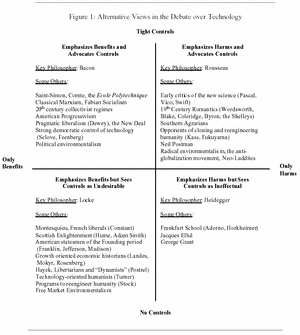
click for larger image
It occurred to me that one could map this function on top of the typical Nolan chart by equating ‘liberty’ with ‘change’. Further analysis led me to sumise that this conjunction of the two concepts was better expressed in differentials. But, for the purposes of both brevity and accessibility, we will spare that dissertation for another day.
Further indulgence of my curiosity led me to this article by Kelley L. Ross. Therein, Ross expands upon the basic Nolan chart with another dimension of what form of government safeguards what liberties (or not). It’s an interesting read. But the average Samizdata.net reader would likely find the first ten pages review, and should skip right to Liberties in Three Dimensions. Although, this little graphic, concerning the US Supreme Court is rather interesting:
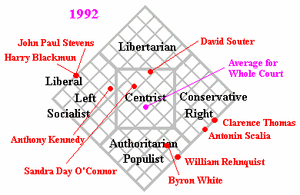
click for larger image
The final seven or so pages constitute the meat of the article, where he makes the point that democracy is no guarantor of liberty. In it, he makes an interesting and rather open-ended point with this:
A Republican form was envisioned by people like James Madison, who wished to impose practical, and not just theoretical limits on government by the use of the Separation of Powers and a system of Checks and Balances. This worked well enough but was ultimately undermined by one grave oversight: The United States Constitution provided no mechanism for its own enforcement. That task was soon taken up by the Supreme Court, but Thomas Jefferson realized that the Supreme Court, as a part of the federal government, could not be trusted to faithfully maintain the limits to the power of the federal government itself: “How can we expect impartial decision between the General government, of which they are themselves so eminent a part, and an individual State, from which they have nothing to hope or fear?”
[Autobiography]
In the end, especially during the Civil War, World War I, the New Deal, and the Sixties, the Supreme Court began to concede extra-Constitutional powers to the federal government simply on the principle that it wanted them. The only mechanism that existed to check the failures of the Court was the torturous avenue of Constitutional Amendment, politically impossible when so many people had begun to believe that unlimited power for the federal government was actually a good thing. And then again, it is hard to know how a newer version of the 10th Amendment could be more plainly worded than the old one. A new Amendment would have to descend to the ignoble level of contradicting specific Supreme Court pronouncements that the original Amendment was simply a “tautology” or “truism” that wasn’t really meant to limit federal power. (See Two Logical Errors in Constitutional Jurisprudence.) An effectively updated Constitution would have to address all the sophistry and dishonesty that was used to undermine the original one, besides providing for such additional checks and balances as would abolish the dictatorial powers of the Court.
Indeed, how does one establish practical limitations on power within a republic? Jefferson’s answer was to have an armed revolution every twenty years or so. Serious talk of that today will get you twenty years or so behind bars.
A hastily convened Blogger Booze Up has been called by Gavin Sheridan and Dan Gillmor
When: Friday at 6:30 pm.
Where: Red Lion, Westminster, 48 Parliament St.
Who: Whoever wants to show up.
Why: You have to ask?
I am about to install some bot-killing software, so if comments happen to break for awhile or the site rolls over with its itty bitty paws flailing in the air, you will know why…
Update: Samizdata.net comments will now require you to enter a security code that you copy off a graphic that will appear in the comment pop-up window. This should prevent spam-bots from auto-posting their garbage all over the blog.
Also, we have updated some code to stop spammers harvesting the e-mail addresses of commenters as well.
 
In Australia it is common for voters to receive letters from their political representatives, and these letters are becoming more and more sophisticated in targeting the interests of the individual voters.
The two major political parties are able to do this because they have established databases. The inner workings of the databases have been somewhat elusive, but Wayne Errington and Peter van Onselen have written an academic paper (warning- PDF file) on how these databases work. The implications for the privacy of voters are odious, especially considering the temptations for political parties in government to cross check their party databases with government ones.
I found this via Ken Parish, and check out the comments on his post where Wayne Errington makes some further good points about the database’s operation. He says the saving grace (so far) is that the political parties are actually rather slack in maintaining their databases; however, as time goes on, you can expect the party machines to become more professional in this matter.
noun. The community of people who leave comments on a blog.
Usage: “We got some useful suggestion from the commentariat today on how to deal the spammer problem.”
During my recent travels in the US, I encountered many a ‘security’ measure at various airports. By the end of my stay and a fair number of flights, these were beginning to really get on my nerves. I am not singling the US as the only security-mad country, although it seems that something certainly got out of hand there. The airport searches are interminable – going through metal detectors that seem to have the highest sensitive settings was most annoying as my travel companion is one of those people who will fail to fish out the last quarter from their pockets or forget to take off his watch/belt/keys. (By the way a dime in my pocket did go through just fine…)
Another inexplicable measure is the never-ending checks of one’s boarding pass. After the full check-in with bells and whistles on – passports and security questions, our boarding documents were checked no less then five times before we finally settled down in our seats. Most of them happened within three yards of each other.
My harping on about this may be a bit off the point especially as I was not subjected to anything as drastic as overzealous security personnel and most people seem to accept the ordeals. The flights were uneventful and most likely not delayed by the searches and checks and screenings. What is most frustrating is the fact that none of those measures are effective or make much sense. They certainly are not efficient, spawning a huge mass of regulation, petty rules and turning customers into a fair game for any hung-up, power-crazed ‘little official’. While they may provide an effective therapy to thousands of sufferers of inferiority complex and to the ordinary people who would otherwise never have ‘tasted power’, the costs, born by the airlines i.e. their customers, act as a throttle on the demand for air travel.
It is a sad ocurrance that airports, the hubs of modern travel and civilisation, have become Kafkaesque worlds where bureaucracy has been allowed to run amok. To be fair, there are other places and institutions that manage similar achievements as the winners of Privacy International Stupid Security Contest testify.
Over on the Adam Smith Institute blog, Madsen Pirie makes an excellent point about the joys of borders and the competition they bring:
In the US I like to cross state lines to go for the lower sales taxes and duties. It is reckoned that ‘leakage’ (cross border shopping) will be a significant factor if there is a 3 percentage point tax differential. And it’s not only competition in sales and purchase taxes which works. I love French food and wine, and the priority they are given, but I don’t feel the same way about their income tax and social insurance. The Danes do pickled fish on rye bread superbly, but there’s no way I want to pay Danish taxes. I enjoy the Swedish forests and lakes, but not their government.
Which is of course why so much of the USA’s political class have supported the steady march towards ever more federal power and why the EU’s political classes love ‘harmonization’ to prevent ‘unfair’ tax competition. The Adam Smith Institute is often seen as just being about the life of homo-economicus but as Madsen’s remarks show, they are in fact concerned about the impact of liberty on culture and society and not just the Dow Jones Index.
One of the reasons so many French families can be found living in Kensington (‘Frog Valley’) is that there is a two way exchange going on between Britain and France: a ‘brain drain’ in which French entrepreneurs, executives and high tax bracket individuals are moving to relatively less regulated more dynamic Britain to escape the deadening (and grasping) hand of the French state, whilst at the same time retired British people who do not actually have to work for a living, and are thus unlikely to have to deal with the nightmarish French state, are buying up property in the Dordogne to experience the cheese, fois gras and claret idylls of bucolic France.
Yes, there is something to be said for borders.
Guardian reports that the prime minister declared today that the only obstacles to a UK identity card were “cost and efficiency” and that arguments about civil liberties were outdated.
I think these arguments have gone far beyond the old civil liberty arguments about it and are really to do now with cost and efficacy. Can you get a cost-effective programme that is actually effective? That does what you think it is going to do.
Now that is where the debate is centred and I have an open mind on that but in principle I think it is right. It is not something I think that is considered completely noxious to do.
Guardian reports that Tony Blair’s hopes of winning cabinet support for identity cards have been dealt a further blow after Alistair Darling, the transport secretary, submitted a five-page cabinet letter opposing their introduction. Mr Darling is the fourth cabinet member to challenge the home secretary David Blunkett’s goal of introducing a bill in the Queen’s speech.
He points out that passports and driving licences are already due to be upgraded using biometric technology. The Driver and Vehicle Licensing Agency is establishing links with the passport service database to enable electronic validation of identity information. Passports are due to include embedded biometric information from 2005.
According to those who have seen his letter, Mr Darling claims an ID card would only add value if citizens were required to carry it – something the government has ruled out.
Adam Nicholson, writing in the Daily Telegraph, tells what presumably are its predominantly middle class readers that it is entirely fit and proper for Britain’s finance minister, Gordon Brown, to take a big grab at the wealth locked up in our homes through a new tax .
I suppose Nicholson is one of those writers the Telegraph occasionally hires to annoy its usual readers. I was inclined to dismiss the piece as usual class-warfare nonsense until, after various paragraphs of tortuous logic and barely disguised dislike of Middle England, our scribe hit on a fair point. That point being that the construction of new housing in the south of England, the most prosperous bit of it, has fallen off dramatically in recent years.
I agree. Nicholson may be a jackass in his support for a swingeing tax assault on millions of people, who have already seen their pensions looted by the government, but he is right on the money in his understanding that unless supply of housing comes close to matching demand, the only way folks like me will be able to afford anything decent will be by winning the National Lottery.
Such a rise in supply will, of course, annoy a lot of people, particular those who’s homes have been made artificially expensive due to our planning and zoning laws. But Nicholson deserves some praise for grasping this point.
Of course, there is always the option of emigration. I have been thinking rather a lot about it lately.
|
Who Are We? The Samizdata people are a bunch of sinister and heavily armed globalist illuminati who seek to infect the entire world with the values of personal liberty and several property. Amongst our many crimes is a sense of humour and the intermittent use of British spelling.
We are also a varied group made up of social individualists, classical liberals, whigs, libertarians, extropians, futurists, ‘Porcupines’, Karl Popper fetishists, recovering neo-conservatives, crazed Ayn Rand worshipers, over-caffeinated Virginia Postrel devotees, witty Frédéric Bastiat wannabes, cypherpunks, minarchists, kritarchists and wild-eyed anarcho-capitalists from Britain, North America, Australia and Europe.
|





Recent Comments