We are developing the social individualist meta-context for the future. From the very serious to the extremely frivolous... lets see what is on the mind of the Samizdata people.
Samizdata, derived from Samizdat /n. - a system of clandestine publication of banned literature in the USSR [Russ.,= self-publishing house]
|
A mere coincidence? Not when election results go wrong:
A fire burning out of control in southern California has grown four times bigger in less than 24 hours.
Several thousand people have been evacuated, as the flames move towards built-up areas.
By Tuesday at the latest, there will be op-ed in the Guardian blaming this on Arnold Schwarzenneger.
Woe to those who enact evil statutes, and to those who constantly record unjust decisions, so as to deprive the needy of justice, and to rob the poor of my people of their rights, in order that widows may be their spoil, and that they may plunder the orphans.
– Isaiah 10: 1-2
We have written a couple articles recently about the passing of Concorde, but I have just seen yet another twist which, as I am also someone who lives directly under what was that magnificent bird’s flight path, brings an incredulous smirk to my lips.
Anti-noise activists in Queens, New York, are claiming that it was their protests against the aircraft that lead to its withdrawal from service. Ok, so let me get this straight… this supersonic aircraft has been flying in and out of the USA for 25 years following the utter defeat of attempts to prevent that in 1977, and against a backdrop of the well known fact that civil aviation has suffered a general reversal in fortune in the aftermath of September 11 , and yet we are to believe1…
“We lost a few battles, but after 25 years, we finally won the war,” said Frans C. Verhagen, the president of a coalition of civic groups in Queens, Sane Aviation for Everyone. “It took 25 years, but a bunch of citizens in Queens stopped the SST from proliferating into the rest of the United States and the world.”
I wonder if this is all a result of the irrationalist cult of self-esteem. It reminds me of the comical Greenham Common Women jubilantly dancing and banging drums claiming they had seen off the USA when the missiles were removed from the UK between 1989 and 1991… as if the Intermediate-Range Nuclear Forces (INF) Treaty signed in 1987 with the rapidly collapsing Soviet Union did not have just a little something to do with it. Doh!
It is widespread delusional mindsets like, these with an inability to grasp anything beyond the most rudimentary causal links that sometimes get me muttering things like “the more people I meet, the more I like my cat”.
1 = NY Times link requires free registration.
Maria of Crooked Timber has posted this, warning that there are proposals afoot to oblige those who register domain names to give lots of personal information.
Here is a clip from Maria’s post:
Next week the body that oversees the technical co-ordination of the internet, ICANN, meets at Carthage in Tunisia. The top item on the agenda, for anyone who cares about privacy and freedom of expression, is the WHOIS database. This is the set of data of domain name owners which was originally collected so that network administrators could find and fix technical problems and keep the internet running smoothly.
Of course no collection of personal data can remain long without various interests campaigning to open it up to a variety of unintended uses. In this case, those interests include IP rights holders, law enforcement, oppressive regimes, stalkers, and of course spammers.
While the first two groups have some legitimate interests in this data [Some of us here might disagree re law enforcement – NS], the others clearly do not. (I have blogged before about the unholy alliance of law enforcement and IP holders on this issue.) But instead of pushing for proportionate lawful access requirements, the latter are demanding that the entire database be policed for accuracy and published on the internet for all to see. Which means that if A.N. Other wants to publish a website, he/she must be content for his email and postal address to be made completely public. There are plenty of good and legitimate reasons to want to publish a website anonymously (and you don’t have to be a Chinese dissident to think of them)…”
The rest of the post includes some sample letters to the bods at ICANN. I am not sure I would sign up to every word in them, but it does look to me as if now might be a good time to register our protest.
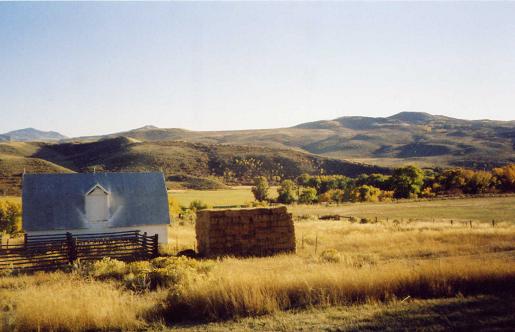
This year’s hunting trip to the Great American West was (another) success, venturing forth heavily armed into the lovely country in south-central Wyoming, amongst the sagebrush flats and quaking aspen. The view from our line cabin:
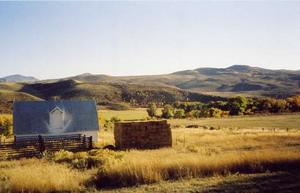
Another look at the countryside: → Continue reading: Home from the hunt
Nick Timms recounts a new yet sadly familiar tale of how the state just sees us as things to be managed for its convenience. The state is not your friend.
My friend Ron, a semi-retired gentlemen, who after a working life fairly high on the corporate greasy pole, now pursues several different activities including taking his pedigree dogs to shows and sitting as a magistrate, told me today about a visit he had recently from an employee of his local planning office.
I should explain that first he had a visit from the local environmental health department because a lady neighbour of his had complained about the smell of his kennels.
Ron has kept fairly rare pedigree dogs for showing for the last fifteen years and he is meticulous about hygiene and cleanliness. His home is in a semi-rural area backing onto some woods and running behind his house is a pathway used by some of the locals as a shortcut. This area is also frequented by foxes and the dog foxes mark their territory with a particularly pungent urine. Apparently when Ron’s bitches are in season the dog foxes make a special effort and spray the whole area thus causing the offending stink.
Ron showed the environmental health officer around his kennels and the officer was apparently satisfied that he kept his dogs in a good and healthy manner.
However, very shortly after this he was visited by the local planning department. His visitor told him that as he kept more than six dogs at his home he had to apply for change of usage. Ron asked for what usage he should apply and was told he should apply as a breeder. Ron explained that he was not a breeder as he only occasionally had litters and he kept the pick and sold the rest only to what he considered would be good homes. He did not do this as a commercial venture so he was not a breeder.
He was told he would still have to apply for change of usage because case law indicated that local town planners could decide for what purpose he used his home and they had decided that having more than six dogs was one of their criteria. (Apparently all homes are granted rights of usage when they are registered and the local planning office can withdraw or alter these rights.)
Ron asked how much this application cost and was informed that it was around £250 [note: about $400]. Ron then asked would his application be approved and was told “No” because the local planning office wanted him to appeal so that they could have a test case. The appeal application would cost Ron another £200-£300. And he could still lose the case.
Ron resorted in the end to telling his officious visitor that he was a local magistrate and that under the Human Rights Act – and he made up some paragraph – the local planning office was unlikely to win the argument.
This seems to have silenced the secret police for the moment, although they may just have decided to pick a softer target. Ron is anxiously awaiting further developments but as he commiserated to me, his council tax went up by nearly 20% this year which is probably paying for more little führers who cannot get a real job.
Nick Timms
It is a little late in the week for all the dust to have settled, but surely by the following Sunday’s talking head shows, a big winner will be Donald Rumsfeld, and the big losers John Kerry and the sensationalist liberal media, over Rumsfeld’s recently leaked memo concerning the War on Terror.
The reason for this is simple: these are precisely the sort of questions the effective senior executive must ask of his/her subordinates. This war calls for outside the box thinking. If you want that, than it is necessary to shake the box from time to time.
I wonder if Rumsfeld is a fan of Denis Waitley?
Nothing like a nice bit of Frog-bashing to fire up the commentariat and get the weekend off to a good start.

Alstom, builder of high speed trains (TGV), nuclear plants and cruise liners, was the showcase of French technology. It is now the showcase of French bankruptcy.
Like France, Alstom is badly managed, unable to balance its accounts, and encumbered with debt. Alstom illustrates the failure of French “social-capitalism,” a state driven capitalism that is actually closer to socialism.
Hmm. State-driven capitalism. Where have we heard of that before?
The socialo-gaullist elites, who control French media groups, buy their support by distributing money to Communist (CGT) and Trotskyite (FO) unions, to 7 million public servants (often useless), to 12 million retirees (often pre-retired), plus millions of immigrants living on welfare. But French politicians are so “generous” that even with the highest taxes of any OECD country, they chronically accumulate huge debts in all public entities: state, regions, cities, social programs, public companies. Having been unable to balance any French budget for more than 30 years, they are driving France to a financial crisis that will shake all of Europe.
A very satisfying rant against the enarquist elite ensues, bringing on a moment of nostalgia for past French contributions to the cause of liberty.

Matthew O’Keeffe also feels the same pangs as Johnathan Pearce at the passing of that magnificent artifact of the 1960’s
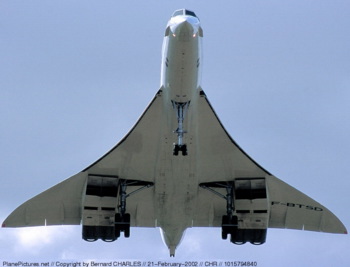
I had mixed feelings watching the footage of Concorde’s last flight today.
Concorde belongs with Eurotunnel in the category of things which should never really have been built – at least not by profit-seeking realists. This may even be unfair to Eurotunnel which will now be with us in perpetuity and was built with private money. Concorde, by contrast, was financed by the British and French taxpayers at the behest of the very ridiculous Tony Benn (as Minister for White Hot Technology or some such nonsense). And now it is heading for the scrapyards.
And yet, and yet, through the 1980’s and 1990’s Concorde was the very symbol of the bull market. The shock troops of capitalism could lunch in London before having dinner and closing their deals in New York (it never really made sense the other way round, incidentally, on account of the time differences). As Jeremy Clarkson put it on the radio today, fast is good.
I travelled on the rocket only once myself – and that was the day after the Paris crash. I had a business trip to Wall Street planned that week, purely by chance. Meanwhile, all the supermodels, actors and other weak-kneed types had cancelled their Concorde tickets leaving British Airways happy to upgrade me from Club World to Concorde – with a seat in row one to boot! I was almost ecstatic as we went through the sound barrier and promptly ordered a bottle of their finest champagne – much to the disapproval of the partners from Goldman Sachs who were siiting next to me. Happy days …
One of the more striking statistics of 9-11 is that Concorde lost 40 of its frequent flyers. I’m not sure how many Concorde frequent flyers there could have been but my guess would be not more than a few hundred. Concorde has suffered from the slump in the stock markets on either side of the Atlantic in general but from the particular horror of 9-11.
To end on an optimistic note, historians may look back on this day as the real start of the next big upturn in the world’s economies. One thing that denotes economic cycles is that companies nearly always invest too heavily at the top – and cut back too savagely at the bottom. (British Airways is particularly bad in its timing – they sold Go for £100m to venture capitalists who sold it on to EasyJet a year later for £400m). That our national carrier should retire its flagship, on a route between the two centres of world capitalism, suggests to me that we may be at such a trough point right now. So farewell Concorde – but here’s to the next twenty year bull market.
Matthew O’Keeffe
Yep, I know it was supported by taxpayers’ money (boo, hiss) but I think one would have a piece of brain missing not to feel a pang of sadness that Concorde, the world’s only supersonic jet airliner, has landed for the last time at Britain’s Heathrow airport. An incredible plane, beautiful and able to take folk across the Atlantic at a speed unthinkable to our ancestors.
As a free marketeer, I do of course recognise that state-backed endeavours such as this are largely indefensible, particularly as only the rich could take advantage of something paid for by the poorest taxpayer. But on a more upbeat note, let’s hope that in the years to come, the possibility of superfast transport such as this remains a reality, and not just the stuff of science fiction novels.
And that is why, like Dale Amon and other contributors to this blog, I am eagerly awaiting the start of the race for the X-:Prize. You can read about all the privately-funded space ventures involved here
The age of Concorde is over. But another age may hopefully be about to begin. Chocks away!
Ivelina Konstantinova has made the transition from native of a small city in Bulgaria to US citizen and USAF Airman serving in the Middle East:
“I wanted to serve my country, continue my education, and travel,” said Senior Airman Konstantinova, a recreation services specialist assigned to the 379th Expeditionary Services Squadron here. “The military opened doors. And even though I may not be a natural citizen, I feel proud to serve America.”
With people like her out there, keep those “…huddled masses yearning to breathe free” coming!
Adriana & I recently returned from a two week business/fun trip to the USA which took us to initially to New Jersey for a couple days…
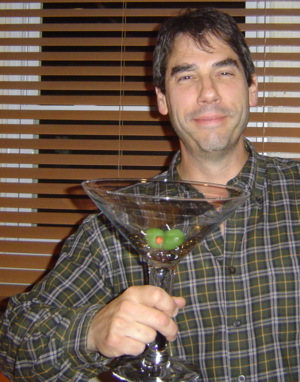
Samizdatista Walter Uhlman demonstrates conclusively
that things are… bigger… in America

Adriana thought she should practice a little before venturing out
And thence to Los Angeles, where we lurked in the stygian cigar fog that is Brian Linse‘s rather nice home in the Hollywood Hills. We also ventured from there into the equally pungent Cigar Club The Grand Havana Room in Beverly Hills, as this proved to be the perpetual hang-out of our illustrious host. Therein amongst its Armani’ed and Prada’ed denizens, we encountered the splendid actor Robert Davi, who had some, interesting, things to say to us which I cannot repeat 

Welcome to Los Angeles!
Your papers, please
Your papers, please
Your papers, please
Your papers, please
Your papers, please
Your papers, please
your papers, please
→ Continue reading: Odyssey across America
|
Who Are We? The Samizdata people are a bunch of sinister and heavily armed globalist illuminati who seek to infect the entire world with the values of personal liberty and several property. Amongst our many crimes is a sense of humour and the intermittent use of British spelling.
We are also a varied group made up of social individualists, classical liberals, whigs, libertarians, extropians, futurists, ‘Porcupines’, Karl Popper fetishists, recovering neo-conservatives, crazed Ayn Rand worshipers, over-caffeinated Virginia Postrel devotees, witty Frédéric Bastiat wannabes, cypherpunks, minarchists, kritarchists and wild-eyed anarcho-capitalists from Britain, North America, Australia and Europe.
|





Recent Comments