We are developing the social individualist meta-context for the future. From the very serious to the extremely frivolous... lets see what is on the mind of the Samizdata people.
Samizdata, derived from Samizdat /n. - a system of clandestine publication of banned literature in the USSR [Russ.,= self-publishing house]
|
Googling “privacy” took me to this piece about the problem of junk mail sent to dead people.
After this scribe found black humor last year at the ceaseless stream of direct mail advertising directed at my recently deceased partner, an admonition arrived from a reader who lost her husband in 1999.
“Write about this again in a year,” she said. “The junk will just keep arriving, and by then you may have stopped laughing.”
Yes it really isn’t that funny, especially as the failure to find good ways to stop junk mail (and junk email) will mean bad ways, i.e. ways that don’t stop the junk, but stop other things which are good, like, I don’t know, freedom of communication.
Look, matey, I know a dead protocol when I see one, and I’m looking at one right now:
Russia says it will not ratify in its present form the Kyoto Protocol designed to mitigate global warming.
“The Kyoto protocol places significant limitations on the economic growth of Russia,” presidential aide Andrei Illarionov told a conference in Milan.
The landmark environmental pact cannot now enter into legal force, especially since the US has also repudiated it.
It’s not pinin’! It’s passed on! This protocol is no more! It has ceased to be! It’s expired and gone to meet it’s maker! It’s a stiff! Bereft of life, it rests in peace! If you hadn’t nailed it to the perch it’d be pushing up the daisies! It’s metabolic processes are now ‘istory! It’s off the twig! It’s kicked the bucket, it’s shuffled off it’s mortal coil, run down the curtain and joined the bleedin’ choir invisibile!! THIS IS AN EX-PROTOCOL!!
Empathy is the thing in schools history these days. You get the kids to think their way in to what it was really, truly like to be a fourteenth century Bohemian swineherd and feel their pain. Empathising with groups neglected and derided by the “Kings ‘N’ Battles” school of history is particularly favoured.
As part of my personal commitment to this school of thought, I’d like to bring up for public view the sufferings of a marginalised and stigmatised group. Slaveowners. Ever thought about their problems, huh? You probably think a person who can legally demand the unlimited services of another human has everything he wants. But you’d be wrong.
The ancient and modern chroniclers agree. Slaves were frequently lazy, dishonest and obstructive. Lacking initiative and zeal. Endlessly prone to saying, “yes massa, coming massa,” and yet still somehow unwilling to put their hearts, souls and scrubbing arms into bringing out that deep-clean sparkle when scrubbing out the vomitorium.
Here is Seneca, writing in the Rome of the first century AD: “A household of slaves requires dressing and feeding; a crowd of ravenous creatures have to have their bellies filled, clothing has to be bought, thieving hands have to be watched, and the service we get is rendered with resentment and curses.” (From On Tranquillity.)
Seneca knew no other system than slavery. In contrast English observers of the US writing after 1833 could observe the system from outside. I found several quotations in the Penguin Portable Victorian Reader illustrating how shoddy slave-work was. A passionate enemy of slavery, Charles Dickens, wrote “Richmond is a prettily situated town; but like other towns in slave districts (as the planters themselves admit) has an aspect of decay and gloom which to an unaccustomed eye is most distressing.”
Even an opponent of slavery as lukewarm as William Makepeace Thackeray had to admit, writing to a friend in England: “Every person I have talked to here about it deplores it and owns that it is the most costly domestic machinery ever devised. In a house where four servants would do with us …. there must be a dozen blacks here, and the work is not well done.”
→ Continue reading: Life is still tough for the owners of lazy slaves.
Just how long will the European Union last? Unarguably it is well dug in. Will it hang in there just long enough to condemn an entire continent to a painful and lingering death?
Few people are prepared to confront such a possibility or even entertain any such notion. Fortunately, one of those few is Ruth Lea:
The tectonic plates of the global economy are shifting. After a gap of several centuries, India and China are re-establishing themselves as major economic heavyweights. China, in particular, is becoming the “workshop of the world” and its economic rise will be as significant as the USA’s arrival on the global scene in the 19th century.
We may complain as jobs are “exported” to these emerging colossi but, whether we complain or not, this seismic shift is occurring and we cannot ignore it. The need to remain internationally competitive is becoming ever more critical for all the “western” economies.
I have little doubt that the US, with its “can-do” entrepreneurial attitudes and enormous economic power will continue to make the grade. But I am increasingly unsure that this can be said about the major euro-zone economies or even, in my darkest moments, Britain. After all, over the past five to six years, Britain has been slipping down the competitiveness league tables compiled by the World Economic Forum and the International Institute for Management Development reflecting higher taxes, heavier regulations and poor public services.
Government policymakers, while singing the praises of enterprise, competitiveness and high productivity, have undermined them all. The EU’s regulatory zeal has undoubtedly played a significant role in damaging British competitiveness. Over the past six years, one of British business’s greatest complaints about Government policy has been the rapid increase in the number and complexity of employment regulations.
And, as if right on cue, yet another set of Brussels-mandated employment regulations comes into effect in the UK today. → Continue reading: Laughable
Melanie Phillips links to and comments extensively on this article about NHS nursing by Harriet Sergeant from last Saturday’s Telegraph, which flags up a publication also by Sergeant from the Centre for Policy Studies, entitled Managing Not To Manage (.pdf only). That’s about the management of the entire NHS, and not just the nurses, but the bit of the Telegraph article that particularly caught my attention concerns the way that the education of nurses is now heading:
The training of nurses has promoted them further and further away from the interests of their patients. In the late 1980s, nursing turned itself into an academic profession. Nurses desiring increased status and greater parity with doctors sought to transform their training into a graduate profession. The result is “a frigging mess”, according to a member of the King’s Fund, a charitable foundation concerned with health.
One senior staff nurse at a hospital in the West Country, who teaches at the local university, pointed out – logically enough – that the academic status of the qualification means “there has to be a lot of theory”. But there is too much theory, too much emphasis on social policy and communication skills – and not enough practical work.
At a London A&E department, a staff nurse who had recently qualified complained to me that her training had not prepared her at all. In 18 months of study, she had spent only one and a half hours learning how to take blood pressure and a patient’s temperature. On the other hand, a whole afternoon had been devoted to poverty in Russia. …
The usual assumption is that if there is a problem, it will take money to put it right, but that enough money will do it. But training nurses who knew how to nurse didn’t take any more money than teaching them about poverty in Russia costs now, surely. The problem will be forcing through the decision to teach nurses well instead of badly. My answer would be to phase out the NHS – gradually, no rush, say over a period of, I don’t know, three months – and thus allow a world to re-emerge in which good nurses get paid far more money than bad ones.
Melanie Phillips blames feminism. But why does feminism only seem to do damage to public sector institutions?
A project to create a comprehensive graphical representation of the internet in just one day and using only a single computer has already produced some eye-catching images. The Opte Project uses a networking program called “traceroute”. This records the network addresses that a data packet hops between as it travels towards a particular network host. The project is free and represents a lot of donated time.

Click for larger image and enjoy
via Network Edge
I linked to this story earlier today on my Culture Blog. And then I had supper at Perry’s earlier this evening, consisting of the leftovers from the Blogger Bash on Saturday, and I told him about it. He laughed, so here it is here. It’s from the Guardian, which has a Strange Things section:
In Romania, local media report that the country’s “first” institution of higher learning, the University of Arts, in Iasi, was the scene of an official investigation this month after police removed the corpse of a man believed to have hanged himself on the campus. Builders and students at the university had initially mistaken it for a modern work of art.
According to Reuters, the body hung for a whole day in a sculpture-laden garden building that had been re-opened for repairs before onlookers twigged to what it was and called the cops.
Cue commenters with stories about how granny went to sleep in Tate Modern and got confused with an exhibit. These are old gags now, in fact they go back to Duchamp’s Urinal, but as long as Art goes on being ridiculous, they will go on being funny.
For a textbook example of rent-seeking, look no further than that pustulent petri dish of corruption, Illinois, for a dandy look at how it is done with affirmative action, casino licensing, and (of course) political connections. It has to do with the troubled Rosemont casino, which would have been located just outside of Chicago. (Sorry, this post has been rattling around in draft long enough for my links to rot. You’ll just have to take my word for it).
The State of Illinois licenses casinos, generally under terms that skim off obscene amounts of the profit to various appendages of the state. I suppose the State earns its money; since Illinois licenses very few casinos (Rosemont would be the 10th), it suppresses competition and thus enables those high profits to a significant degree. Regardless, I defy anyone to distinguish this racket from the more straightforward protection racket run by organized crime. Let the record show that the State of Illinois, through its protection racket for casinos, is perhaps the uber-rent-seeker in the whole sordid arrangement. → Continue reading: Rent seeking
It’s useless new law time again in the UK.
From today it will be an offence to drive a vehicle on a public road while using a mobile telephone (or ‘cellphone’ for our North American readers).
A complete waste of time. Which is not to say that driving a vehicle while using a mobile telephone certainly can be dangerous, so is driving a car while unwrapping a sandwich, tying shoelaces, fiddling with the buttons on the radio or playing the accordion. Whatever the object of distraction, the point is that the motorist is driving without due care and attention and since that is already an offence, surely no elaboration is required.
If the police are unable or unwilling to prosecute motorists for extant offences then what on earth is the point of merely enacting more?
Really this all smacks of the the short-term ‘something-must-be-done’ mentality and the impulse which requires the demonisation of objects rather than the uses to which those objects are put.
The UK media are blitzing the issue as a part of which I have been drafted in as libertarian voice-du-jour. I have not long returned from the BBC studios in Central London where I got my oar in on the Jeremy Vine show and, this evening, I will adding my piece to a similar debate on Classic Gold radio.
For anyone interested enough to listen in or phone-in, the show will be streamed live on-line at just after 8.00pm UK time.
The past is not another country, it is another world.
Remember all that strutting triumphalism of the EU enthusiasts? Remember their blustering certitude and stainless steel non-stick bravura? The European Union was unstoppable, invincible and the wave of the future. It was an historically-inevitable behemoth gearing up to straddle the globe and lock all of mankind into its eternal Bonapartist embrace.
Soon there would not be so much as a single molecule on the face of the earth that would not be regulated by Brussels. Resistance was futile and dissent was pointless. It was written in stone. The European union will conquer the known universe!
That was then.
This is now:
There is no doubt that 2004 ought to have been a great year, the year East Europeans became full members of a revived, streamlined and more democratised European Union. Instead, Europe is in its worst shape for years.
There is only so much battering, criticism and friendlessness any institution can take before it breaks. Europe is no different.
Victory is within sight. Just one, big, final push and we can send the whole rotten edifice crashing down.
[My thanks to Peter Briffa for the link.]
The Fourth British Blogger Bash in Chelsea was a chaotic and noisy affair…but then they always are, so no change there. Thirty-five worthy souls dived into the famous Chilli con Chelsea and only a few were slain by the lurking habanero demons therein…
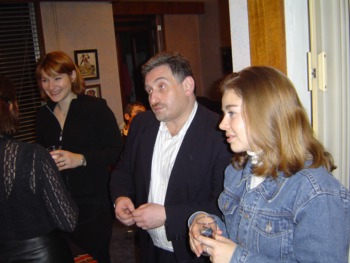
Adriana, David and Luisa looked on as Perry ritually sacrified a civil servant to get the party swinging
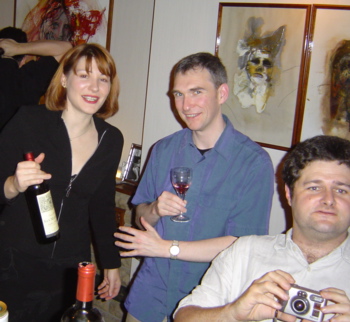
Adriana and Philip amused themselves by hiding the bottles that were inexplicably protruding from Michael’s back pockets

Hair? Ha! Hair is for weaklings!

For some reason the oxygen was getting sucked out of the room…
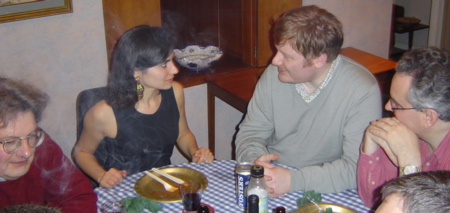
Brian rather unkindly ate Claire’s Chilli whilst she was in a staring competition with Antoine

Briffa and Sherrif look on nonplused whilst Frank Sennsenbrenner does his Nixon impersonation
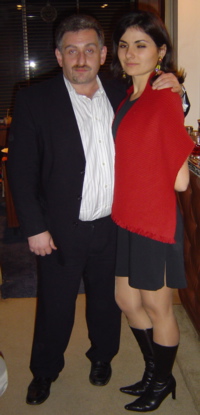
David and Claire do the ‘La Dolce Vita’ look rather well

Debbie, Jackie & Simon laugh, little knowing the camera is stealing their souls!
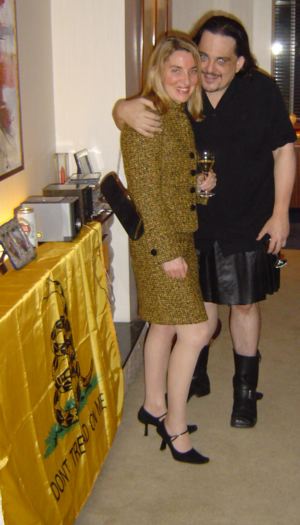
Andrew gets the message and does not tread on Linda
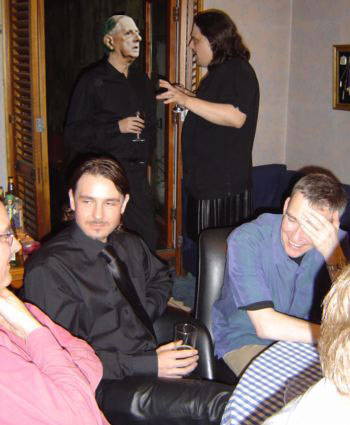
The Dissident Frogman morphs whilst talking to Andrew. Paul and Philip pretend not to notice

Even the hard core started to feel the strain after a while…. but he was just ‘resting his eyes’ really.
Yes… another highly successful blogger bash!
 Update: And the Dissident Frogman has a scary Blogger Bash picture of his own. Update: And the Dissident Frogman has a scary Blogger Bash picture of his own.
When a government starts to slide seriously into the dustbin of history, the very things which it tries to do to halt the slide become part of the slide. All occasions are now starting to inform against this government:
Labour’s new initiative to listen to voters, The Big Conversation, appears to be a big con: a Telegraph investigation has revealed that party officials have handpicked contributors – and have then edited out their negative comments.
The disclosure will be an embarrassment for Tony Blair, who launched the exercise on Friday, saying it was proof that the Government was listening to the people of Britain.
The Prime Minister called for “an honest and serious debate about the future”, and urged voters to text or e-mail their views to a special website, www.bigconversation.org.uk.
The Telegraph discovered yesterday, however, that many of the stories on the website were crafted by Labour officials who interviewed carefully selected individuals known to be broadly sympathetic to Labour – and then cut out any negative comments.
This government started quite impressively, with temporarily persuasive talk of not increasing taxes, and of reforming public services in ways that might have worked, e.g. by sort-of privatising them. But it is all now dribbling away into incompetence. As a devoted opponent of collectivist delusions of all kinds, I supported and still support the invasion of Iraq and the toppling of Saddam Hussein. No doubt some still have high hopes for the future, but frankly it doesn’t look as if there’ll be many achievements to come.
Let’s someone who is not me rephrase that. The government started impressively. I support the toppling of Saddam Hussein. High hopes. Many achievements to come.
“Have your say” says this fatuous website. I especially loathe that expression. You have your say, and then they do whatever they were going to do anyway.
We at Samizdata are anxious to hear from all our suckreaders. Any critical comment on this post will be severely edited in a way which will completely change its overall meaning until we approve of it, and will then be ignored.
|
Who Are We? The Samizdata people are a bunch of sinister and heavily armed globalist illuminati who seek to infect the entire world with the values of personal liberty and several property. Amongst our many crimes is a sense of humour and the intermittent use of British spelling.
We are also a varied group made up of social individualists, classical liberals, whigs, libertarians, extropians, futurists, ‘Porcupines’, Karl Popper fetishists, recovering neo-conservatives, crazed Ayn Rand worshipers, over-caffeinated Virginia Postrel devotees, witty Frédéric Bastiat wannabes, cypherpunks, minarchists, kritarchists and wild-eyed anarcho-capitalists from Britain, North America, Australia and Europe.
|





Recent Comments