We are developing the social individualist meta-context for the future. From the very serious to the extremely frivolous... lets see what is on the mind of the Samizdata people.
Samizdata, derived from Samizdat /n. - a system of clandestine publication of banned literature in the USSR [Russ.,= self-publishing house]
|
Why are governments so deeply concerned to protect us all from pornography? Simple. To protect us from it properly, they have to watch it. Protecting us from savage debt collectors is not nearly so entertaining, so they don’t bother with that, even though the kind of savagery that can involve is much closer to being their real business.
Canadian civil servants have been condemned for inspecting sex shops and adult cinemas while apparently ignoring a flood of consumer complaints.
Ontario’s provincial auditor says the Ministry of Consumer and Business Services officials have carried out almost 1,600 inspections of adult video retail stores after claiming to have received eight complaints – none in writing.
Those inspections involved checking whether the stores had valid licences “and were selling adult videos only with proper stickers indicating their ratings,” the report states.
In the same time there were about 4,000 complaints and inquiries related to debt collectors last year, including 800 written, formal complaints.
Despite the avalanche, it’s claimed the ministry carried out only 10 inspections. Similarly, almost 2,000 complaints about motor vehicle repairs prompted just six inspections.
Assistant provincial auditor Jim McCarter has described the situation as “pretty weird”, saying he wasn’t sure whether inspectors were in fact screening porn. “My understanding is that is not a primary part of their job,” said McCarter
As usual, Dave Barry gets to the stories that matter, and I pick out some of the ones that are serious as well as funny for Samizdata. And he has quite a few of those, let me tell you.
Last night I attended the Adam Smith Institute Christmas Party, and I was once again struck by what seems to me to be a major fact of modern social life, and a major difference between the times we now live in and the times in which people lived in earlier times, say two or three hundred years ago.
Present at the party were some hundred or more people, ranging from posh and clever schoolgirls enticed only a few hours earlier with the promise of free food and a rest from schoolwork, to opposition front benchers, and assorted policy wonks, friends of the ASI of extremely variable wealth, and of course a decent sprinkling of bloggers, ditto. And what I noticed, again, was that when you are in a gathering like this, it is impossible to tell at a glance how grand the person you are talking to is, unless you happen already to know.
Take the nice chap I found myself talking to. Fifty-ish, matching jacket and trousers (that’s pants if you’re American), educated somewhere, you know, good. Pleasant, a job being Something in the City which I didn’t quite hear properly because the din was a bit loud and nuances got lost. And as I said to the man himself in my bonharmonious liven-up-the-party way, I simply had no idea how important a chap he might be. Dressed like that, I said, you could by anything from a wage slave to a billionaire, from a failing journalist to a major media player, from a pathetic wannabe politician to a Bilderberg Commissioner. I wasn’t that eloquent, but that was my point, and he got it well enough and with no offence meant or taken. Indeed, he amplified the point, by saying that me being dressed as I was (vomit coloured corduroy jacket, red cardigan, no tie, black corduroy trousers with safety pins to keep the improvised turn-ups turned up), I too could be anyone or anything. He reminisced about the various ultra-grand personages he had met in his time who dressed in a similarly down-market way.
The big immediately visible social gulf, now, it seems to me, is the one at the lower end of society, between those who are just about clinging on, and those who have fallen off the social edge into the untermenchen class. Dressing as I do, in a socially concerned manner (i.e. badly), I get a lot of attention from the street begging variant of these people, and I can tell at once what sort of person I’m dealing with. I don’t know this person. Certainly not. But I do know exactly which side of the great divide he or she is on, and he or she is on the wrong side of it. Sorry. No. → Continue reading: Where the social gulf is now – thoughts after a Christmas Party – and on long-distance bus travel
Both us civil libertarians and our critics are in the habit of arguing that technology, especially in the hands of government, never works properly, so either (civil libertarians): it should never be relied upon – or (anti civil libertarians): why are civil libertarians making such a fuss about it if it’s so useless? My own opinion is that this stuff is getting inexorably cleverer, and that to assume permanent techno-incompetence, in these times of all times, is ridiculous. Bureaucratic and legal confusion can be relied upon to continue indefinitely. But technology can be depended upon to improve.
Here’s a BBC report today, about the inexorable development CCTV software:
Visitors to a South Yorkshire science centre are helping the FBI in a project to improve CCTV evidence.
Scientists from the University of Sheffield were asked to help the US law enforcement agency develop a way of identifying often blurry faces caught on video footage.
Now 3,000 volunteers at the Magna Centre in Rotherham are to have their heads scanned to form a three-dimensional image which can then be compared with enhanced CCTV footage.
Researchers at the university’s department of forensic pathology hope the resulting technique will revolutionise the way CCTV evidence is used in court cases on both sides of the Atlantic.
“Magna” eh? Anything to do with Magna Carta?
Gordon Brown is facing voter unrest according to a poll that suggested Middle Britain has grown weary of tax rises and no longer believes higher spending can deliver improved public services.
The ICM survey carried out for the think-tank Reform found that 82 per cent believe services have not improved despite tax rises. Nearly as many – 78 per cent – think they need reform not extra money. Worryingly for Mr Brown, the poll found strong support for the principle of lower taxes, even among Labour voters, nearly three-quarters of whom believe British competitiveness depends on keeping taxes low.
For those who think that the Tory party will now ‘get off the fence’ and trumpet their low-tax message to the world, there is some bad news. As their tiny derranged statist minds catch a whiff of power, the Tories get cold feet on their tax-cut promise (well, more like mumbling).
Despite behind-the-scenes pressure from colleagues, Mr Howard has signalled his determination to move away from Iain Duncan Smith’s talk of tax cuts amid fears they would be difficult to deliver.
Oliver Letwin, the new shadow chancellor, warned at the weekend that such a pledge would be “irresponsible” and even hinted that an incoming Tory government could face “transitional costs” to implement its manifesto that would push up public spending.
‘Irresponsible’ and ‘transitional cost’, oh yes. Bigger government anyone? It woudl be fair to say that Samizdata.net position is that the folks who see the ‘resurgent’ Tory party as ‘just the ticket’ to rescue us from Tony Blair not just wrong but deluded.
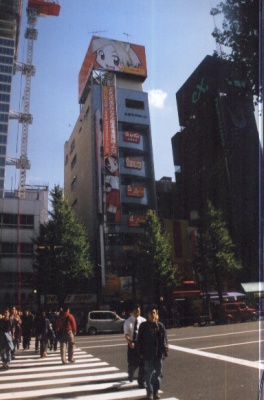
A question. What exactly is the function of the shop in this photograph?

I will get to this in good time, but first, a little travelogue.
A couple of weeks ago, I spent the weekend in Tokyo. I did this because Tokyo is one of my very favourite cities, and because the 23 hour plane journey from Sydney to London is much more pleasant if you take a break in the middle. On Sunday morning, I went for a walk around Akihabara, famously the section of Tokyo where you go to buy the latest electronic products. This area consists mainly of a group of buildings filled with small shops and market like stalls selling components and generic products near the railway station, and a long wide street. Down both sides of this street are a large number of seven or eight floor shops that sell nothing but electronic equipment, in this case mainly consumer equipment. And, mixed in with the electronics shops, are manga shops. These are seven or eight floor shops selling nothing but comics. The comics sold on the lower floors are fairly innocuous, but get steadily more pornographic as you ascend the building, and those sold on the top level are quite hard core.
As I walked down the street, I was repeatedly approached by young Japanese women in short skirts who would hand me flyers about electronic products, or (usually in broken English) attempt to ask me if I already had DSL. (My answer, which was “Yes”, and “Anyway, I live in London” was not what they were looking for, although one of them thought it would be cool to live in London).
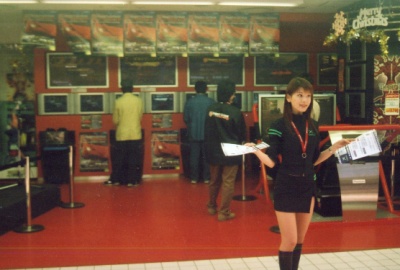
Not too different from what I might find in certain places in the west. But things would get stranger. → Continue reading: Bureaucracy and Political Incorrectness in Tokyo
It is such a comfort to know that our public authorities are prepared to crack down hard on this sort of thing:
A prison officer was sacked for making an allegedly insulting remark about Osama bin Laden two months after the September 11 attacks, an employment tribunal heard yesterday.
Colin Rose, 53, was told he had to go because, although he did not know it, three Muslim visitors could have heard his “insensitive” comment about the world’s most reviled terrorist.
The assistant governor at Blundeston Prison, near Lowestoft, Suffolk, gave him a ticking off at the time. But he was sacked after a six-month investigation.
Mr Rose, a former Coldstream Guardsman with a 21-year unblemished record in the Prison Service, is claiming unfair dismissal.
The Norwich hearing was told that on Nov 15, 2001, he threw some keys into a metal chute at the prison gatehouse. When someone said it sounded as if he had thrown them so hard that they were going through the tray at the bottom of the chute, Mr Rose said: “There’s a photo of Osama bin Laden there.”
Just in case Mr Rose happens to be reading this, he should memorise and repeat the following statement:
“Osama bin Laden is merely the poor, desperate victim of oppression and social injustice”.
With sufficient sensitivity training, I am quite confident that unpleasantness of this nature can be avoided in the future.
Tonight the intrepid Samizdatistas ventured into the heart of darkness (Westminster) to attend the Adam Smith Institute Christmas party at their rather splendid offices overlooking the Houses of Parliament. Vast quantities of champagne were consumed (well I certainly did).
The party was absolutely jam packed with free marketeers of all shapes and sizes.
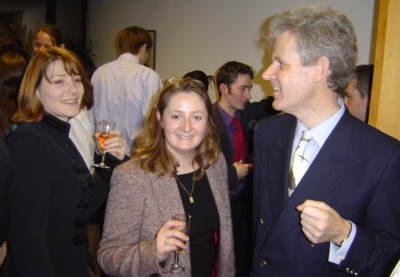

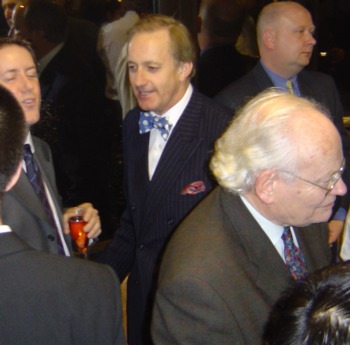

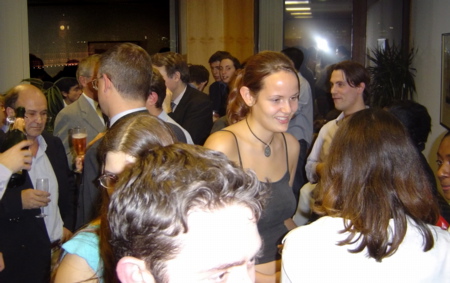
The crowd was lively and, compared to pretty much any other UK think-tank, of a remarkably young average age.
I rarely add a new blog to my list of daily visits, but Belmont Club makes the cut.

What does Belmont Club bring to the blog party, you ask? Adamantine analysis of the military situation in Iraq, for one thing, as well as a very interesting look at the pending takeover of the European left by radical Islamists.
As for the Iraqi situation, Mr. Wretchard thinks that the Baathists and Islamists are getting their asses handed to them,

and backs it up with trenchant strategic analysis.
→ Continue reading: First-rate analysis
Over at the Adam Smith Institute Blog, Mark Griffin says they’re about to legalise spam, by defining it, incompetently. That means whatever dodges its way around the definition ain’t spam, right? So by trying to stop it they are going to allow it.
Patrick Crozier’s Transport Blog is steadily becoming a blog to be reckoned with. And yesterday and today, Patrick posted two White Rose Relevant bits, on the new law against mobile phones in cars, and (this presumably being kit that will also help to enforce the new phone law) surveillance cameras for spying on speeding motorists.
On mobiles in cars, Patrick agrees with David Carr. Bad new law. On the cameras? Well, his piece is entitled: “It’s not the speed cameras that are to blame – it’s the law”.
More on vote (mis?)counting machines, from Paul Krugman in today’s New York Times. As always with the NYT, hurry.
Opening paragraphs:
Inviting Bush supporters to a fund-raiser, the host wrote, “I am committed to helping Ohio deliver its electoral votes to the president next year.” No surprise there. But Walden O’Dell – who says that he wasn’t talking about his business operations – happens to be the chief executive of Diebold Inc., whose touch-screen voting machines are in increasingly widespread use across the United States.
For example, Georgia – where Republicans scored spectacular upset victories in the 2002 midterm elections – relies exclusively on Diebold machines. To be clear, though there were many anomalies in that 2002 vote, there is no evidence that the machines miscounted. But there is also no evidence that the machines counted correctly. You see, Diebold machines leave no paper trail.
Representative Rush Holt of New Jersey, who has introduced a bill requiring that digital voting machines leave a paper trail and that their software be available for public inspection, is occasionally told that systems lacking these safeguards haven’t caused problems. “How do you know?” he asks.
What we do know about Diebold does not inspire confidence. The details are technical, but they add up to a picture of a company that was, at the very least, extremely sloppy about security, and may have been trying to cover up product defects.
I think if people are seriously about democracy, they should keep it all on paper. That way, onlookers and overseers can see fair play, and with luck they can spot at least some of the unfair play. Put your vote in a computer system, and who the hell knows where it ends up?
Denis Dutton is a new name to me, but I have the strong feeling that this says a whole lot more about me than it does about Denis Dutton. Unless I’m grievously mistaken, Dutton is a New Zealander. He is certainly based there, at the University of Canterbury, and writes a lot about New Zealand.
Arts & Letters Daily today linked to Dutton’s excellent review article about piano playing, classical music etc., which I enthusiastically recommend to anyone who is even slightly interested in such matters. I’ve just been saying all that on my Culture Blog, and then had another of those this-guy-should-also-be-on-Samizdata reactions. So I followed the links I’d just been setting up, and got to this 1998 review article, which starts thus:
That the old politics of right and left are obsolete is demonstrated in the very person of the Rt. Hon. Mike Moore. A Labour man with a unionist, shop-floor background, he was once a hero of the working man. He still ought to be. But when he became New Zealand’s Trade Minister, he saw it as his “patriotic duty” to pull down this country’s Berlin Wall of import controls both for the benefit of New Zealanders and incidentally to help our small Pacific neighbours to make a living for themselves.
This was viewed as a betrayal of working-class interests. “From hero to traitor in a decade!”, he writes. But this stubborn bloke knows vastly more than his embittered critics about trade and the creation of wealth in the brave new borderless world of international commerce and he’s not about to be shouted down. In A Brief of the Future he mounts a persuasive case for the increased internationalization of New Zealand and for greater individual liberty and responsibility: “democracy and the ingenuity of our species know no bounds when freedom unleashes the genius of the people.”
The word “reactionary” once applied exclusively to the political right. The reactionary conservatives who count most today include not only jingoistic provincials like the Australian Pauline Hanson, but leftists who, disappointed by the failures of socialism and embarrassed by the stupendous successes of capitalism, are keen for any excuse to reintroduce their programmes of government economic control. (I’ve been told by at least a half-dozen friends and correspondents from the left that the recent share-market setbacks are clear evidence that capitalism is on the ropes. Or so they seem to hope.)
Hardly, says Moore, pointing out that the living standards of at least half a billion people have doubled since the early 1980s, and it wasn’t state socialism that achieved it. The setbacks Southeast Asia don’t negate that. Even countries such as India that once seemed backward basket cases now have prosperous, growing middle classes of hard-working people. Singaporeans, to whom New Zealanders used to send food parcels, now earn more per capita than we do, have a lower infant mortality and higher life expectancy.
For Mike Moore, the key to New Zealand’s future is to take an open and competitive attitude toward world markets. We must eschew protectionism and commit ourselves, both intellectually and technologically, to the information revolution.
See what I mean about a guy who should be plugged by Samizdata? All that, and he knows his piano playing.
It’s also good to know that being called Mike (née Michael?) Moore doesn’t automatically make you an idiot.
|
Who Are We? The Samizdata people are a bunch of sinister and heavily armed globalist illuminati who seek to infect the entire world with the values of personal liberty and several property. Amongst our many crimes is a sense of humour and the intermittent use of British spelling.
We are also a varied group made up of social individualists, classical liberals, whigs, libertarians, extropians, futurists, ‘Porcupines’, Karl Popper fetishists, recovering neo-conservatives, crazed Ayn Rand worshipers, over-caffeinated Virginia Postrel devotees, witty Frédéric Bastiat wannabes, cypherpunks, minarchists, kritarchists and wild-eyed anarcho-capitalists from Britain, North America, Australia and Europe.
|





Recent Comments