We are developing the social individualist meta-context for the future. From the very serious to the extremely frivolous... lets see what is on the mind of the Samizdata people.
Samizdata, derived from Samizdat /n. - a system of clandestine publication of banned literature in the USSR [Russ.,= self-publishing house]
|
U.S.-based music download business Napster, which is now a paid-for service after its chastening battles in the law courts against the music companies, is extending its services to European customers, according to this report. Well, when it comes to stirring up a hornet’s nest of controversy, few subjects generate more angry buzzes than the case for or against the right to download music on the net, in my experience.
If the record companies ever thought that Napster would vanish without trace, they were deluding themselves. Personally, while I have my questions about the intellectual property right aspects to Napster-style downloading technology, there is no doubt that it has thrown traditional business models into the dustbin. But does it mean the death of music recordings, orchestras, book authors and film-makers? I don’t really think so.
As a related point, there is an interesting article here on the website of science fiction publishing house Jim Baen, making a good point about how downloading can, in the medium to long run, raise rather than cut book sales. I suppose that the argument works for music and possibly films as well.
Will the German embassy protest, one wonders? Hardly the spirit of reconciliation.
French state schools, unlike the British or American varieties, were founded explicitly to oppose clerical power. They are the most visible and enduring bastions of secularism in France. Originally, the prohibition of religious symbols in schools was aimed against Catholics. Many of the supporters of secularism in the 19th century in France were non-conformist or atheist: often Protestant or Jewish. The antisemistism of such groups as Action Française from the 1890s onwards is in turn a reaction against the French radical assault on Catholic society. In the early 20th century a deal was worked out that allowed religious schools to operate alongside the secular system.
The Islamist campaign against secularism is what the headscarf law is about. In some schools, violence has been threatened against girls who refused to wear scarves. Apologists for fundamentalists (ususally socialists hoping to play the race card) condoned the violence and have allowed a climate of terror in French schools.
As a libertarian, I oppose state schools. But also as a libertarian, I also support the prohibition of Islamic fundamentalist intimidation. If Islamic schools really allowed freedom to exit, I could back Moslem campaigns for lifting any restrictions the French government might have against their own schools.
When I visit a mosque, I take off my shoes, I do not interfere with the religious devotions of the worshippers, and I do not demonstrate my own devotions to eating pork and drinking beer. The person who chooses a turban ahead of an education has got “I’m a loser!” stamped all over him. But the people who organise the headscarf campaigns do not want freedom of choice: they want a licence to coerce.
This is not a campaign for religious freedom: Moslems are free to set up their own schools. It is a campaign to separate the public and the private sphere: in the school each pupil’s religious affiliation is a private and not a public matter.
Far be it from me to condone the criminal régime of Chirac. But, this is the same fight as the Turkish Army’s fight to defend a secular state against the fundmentalist tyranny. It is a small corner of the War on Terror, and compared with the some of the antics of the Department of “Homeland Defense” a.k.a. Minipax, one worth fighting.
It is also a campaign against obscurantism. French people often mock those parts of the USA where it is illegal to teach Darwin, or where Creationist theories have to be accorded equal credibilty in the classroom.
The European Commission has released the latest press release on demographic developments in the European Union during 2003. This shows that the long-awaited time when deaths outweigh births and immigration maintains the population of the European Union is beginning to arrive.
The population of 380.8 million increased by 1,276,000 during 2003, of which three-quarters was due to natural migration. However, there are two worrying trends that suggest Europe’s demographic problems can only worsen in the coming years.
Germany, Italy and Greece would all have faced population declines without immigration. More countries will join this select group in the first decade of the twenty-first century.
Secondly, half of the accession countries that are scheduled to join the European Union on the 1st May 2004 are already facing the problem of population decline, a problem that will be exacerbated by migration towards Western Europe.
There always has to be a disclaimer using the figures from Eurostat since demographics are one of the most unreliable of all collected statistics. Neverthless, taking this disclaimer into account, the population decline is beginning to take hold at a rapid pace.
It is the accession countries who probably have most to fear. Enlargement can be viewed as a cannibalisation of the labour markets of the accession countries by existing Member States and the newcomers face huge problems of tightening and declining labour markets in the long run. If they join the Eurozone, they will lose the remainder of the economic flexibility needed to combat this problem, since their adoption of EU laws, known as the acquis communautaire, will lead to far greater regulation from May 1st.
The European solution to the problems that they have created will be further subventions to cushion the blow of joining the European Union and satisfaction at removing a possible ring of economic competitors along their eastern border. Hopefully, Russia and the Ukraine will begin to attract more investment in the next few years and prove too large to swallow.
Instapundit links to this:
The capture by the United States of thousands of centrifuges on board a German-owned vessel, the BBC China, en route to Libya has raised suspicions in Washington and London that Col Gaddafi offered to abandon his weapons programme after threats from America, rather than the lengthy British and American diplomacy vaunted by Tony Blair.
Instapundit is pleased because this report says what he and lots of others have also said, that it was American military muscle and the threat of more of it, not merely polite requests to Col Gadaffi to be nicer from Blair or his fellow Europeans. Quite so. The idea that recent American military activity had nothing to do with Gaddafi’s change of heart is very far fetched.
But what irritates me is that Blair, the Telegraph, Instapundit, the lot of them, are all talking about “threats” and “diplomacy” as if these were two entirely different and opposite things, when in truth threats and diplomacy go hand in hand, and neither can work properly without the other.
Take this particular set of circumstances. How were those American threats communicated, if not through diplomatic channels, and how did Col Gaddafi signal his desire to comply with American wishes if not through that same diplomatic process? And did not the Americans then respond very diplomatically to the Colonel’s climbdown?
As for that non-American diplomacy which is imagined by some to have persuaded Gol Gaddafi to change his ways, well, this report illustrates that this too would have consisted of threats, diplomatically communicated and responded to, in this case the threat of not allowing such things as centrifuges to journey from China to Libya on ships controlled by those doing the threatening. An unwillingness to make any such threats would have rendered European diplomacy toothless, and hence ineffective. And that seems to be what happened.
But that is not my central point. All I here insist on is the true as opposed to sentimental and ignorant meaning of the word “diplomacy”. Diplomacy doesn’t mean being nice only. It also means being nasty, while explaining nicely – or perhaps not so nicely – what you want in exchange for being less nasty.
What does anyone think that diplomats actually say?
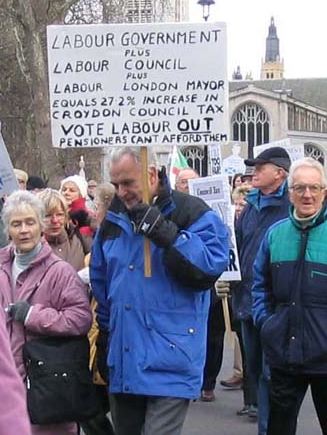
Yesterday afternoon I was out and about walking in London, and just before I got to Parliament Square I encountered a demo. It was not raucous or unpleasant. It was nice. It was old people complaining about their council taxes, which obviously I am all in favour of.
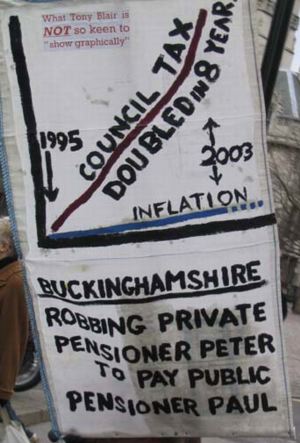
Following the example of supreme Samizdatista Perry de Havilland, I now take my DigiCam with me whenever I go a-wandering, so I was able to start snapping. At first it was just nice old people accompanied by nice policemen, with nice buildings in the background, but only very crude signs to say what it was all about. However patience was rewarded, and some of the signs were highly informative.
27.2%. Ouch! Whatever happened to stealth taxes? (Hey hey LBJ, you killed 27.2% more kids today than yesterday, you bad bad person. Not the same ring to it, somehow.)
And this one takes onlookers into the university lecture theatre.
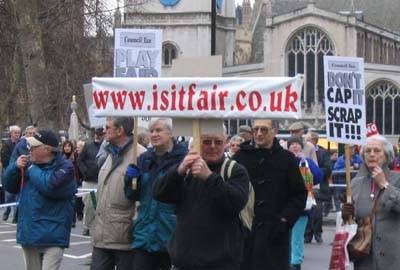
Okay, okay, I’m excited, and I want to know more. How can I follow it up?
Wow, a website. They say, in fact Perry just said it to me in connection with this post, that a picture is worth a thousand words, but I reckon best of all is pictures with words embedded in the pictures, explaining everything. Preferably with an internet link.
There is an interesting and deeply depressing article in Time Europe about how EUrope is falling behind the USA in the funding of scientific research. European scientists are flocking the research labs in the USA, where the money and conditions are far better.
The article reveals the usual EUro-procedure whenever catching up with America is the agenda.
Question asked by EUropeans: how much money is America spending? Answer: A lot.
Question not asked by EUropeans: where does all that American money come from in the first place? Answer: by having lots of trade, done by tradesmen.
Question also not asked by EUropeans: who is spending all this American money and how? Answer: American research money is, a lot of it, spent by those same tradesmen, who spend it quite sensibly, in ways that produce innovation and profits.
Next question asked by EUropeans: what is to be done? Answer offered by EUropeans: EUropean governments must spend a lot more on research than they do now. Result: EUrope as a whole has even less money for tradesmen to spend on anything, and research in EUrope becomes even less sensible and even more stupid. Total spending doesn’t grow very fast, which is just as well, because if EUro-governments spent as much as “America” (i.e. the American government and all those American tradesmen, added together) spends on research, that would bankrupt EUrope completely. → Continue reading: The decline of EUro-science
Government-fetishists are always trying to justify their demands for ever-bigger state by claiming that only the state can ride to the rescue of the public to correct what they call ‘market failures’.
So, who is going to come riding to the rescue to put this right?
Thousands of parents who had children taken away from them on the evidence of the controversial paediatrician Professor Sir Roy Meadow will not have them returned.
Ministers are to review as many as 5,000 civil cases of families affected over the past 15 years by Prof Meadow’s now-discredited theory of Munchausen Syndrome By Proxy. This accused mothers of harming their children to draw attention to themselves.
Many mothers say that they have been vindicated in their insistence that they were wrongly accused and now want their children back. However, Margaret Hodge, the minister for children, has ruled out any widespread return.
Mrs Hodge said that the exact number of civil cases where Prof Meadow’s theory had been used to remove children from mothers was unknown, but could run into “thousands or even tens of thousands”.
She added, however: “If a miscarriage of justice was made 10 or 15 years ago, what is in the child’s interest now? If the adoption order was made on the back of Meadow’s evidence and that was 10 years ago, what is in the real interest of the child? If they were taken as babies the only parent they know is the adopted one. It is incredibly difficult. It is a really tough call to make.
“The sort of families that are coming forward are heartbroken families. But if the child was adopted at birth the sensible thing to do is to let it stay. As children’s minister my prime interest has to be the interests of the child.”
I would be willing to wager that the ‘prime interest’ of Margaret Hodge is Margaret Hodge.
As for the thousands of parents who may have had their children abducted by the state, well, tough titties. Live with it.
What the government puteth asunder, let no man join together again.
When the French government decided to place a prohibition of overtly religious symbols in state schools (or ‘the headscarf ban’ as it is more widely know), I bet they thought that they were removing a splinter from the soft tissue of the body politic.
But it looks like the wound is beginning to fester:
Muslim protests have been taking place in France and other countries against a French bill which would ban headscarves from state schools.
Up to 5,000 protesters, mainly Muslim women in scarves, rallied in Paris.
Many of France’s five million Muslims see it as an attack on their religious and human rights.
And that view is not confined to French Muslims either:
“Ultimately, if I have to choose between further studies or my turban, I will keep the turban.”
Fourteen-year-old Vikramjit Singh, who lives in suburban Paris, says giving up his studies would perhaps ruin his material life.
“But if I have to give up my turban, I am sacrificing my spiritual life. And that is totally unacceptable to me,” he told BBC News Online.
For Sikhs, wearing the turban is crucial to their religious identity.
I get the feeling that this one is going to run and run.
Bruce Bartlett has one of the most thought-provoking columns on economic history that I’ve seen in a while. In recent months, we’ve seen a number of lame attempts to compare Bush to Hitler. (Blogger Stephen Green is doing a good job of documenting these things.) I’ve seen a number of sites that display a series of Bush photos, each juxtaposed with a photo of Hitler in a similar pose … Bush is seen here eating a ham sandwich, and here’s Hitler eating a ham sandwich in 1937. Here’s Bush talking to some children, and here’s Hitler doing the same. See? Bush = Hitler! QED. Self-indulgent celebrities and hard-left ideologues have picked up on this tiresome Bush = Hitler meme, and the wave of moral equivalence crested with the recent controversy over MoveOn.org’s anti-Bush ad contest.
Meanwhile, Bartlett is seizing on this theme to take issue with some, both on the left and on the right, who want to compare Keynes to Hitler. He starts with Alexander Cockburn, quoting his most recent effort in The Nation:
Hitler, genocidal monster that he was, was also the first practicing Keynesian leader. … There were vast public works, such as the autobahns. He paid little attention to the deficit or to the protests of the bankers about his policies. … By 1936, unemployment had sunk to 1 percent …
Then, to pick an example from the opposite end of the spectrum, he points to an August 2003 column by Llewellyn Rockwell, longtime chairman of the Mises Institute. Here is the full text of the Rockwell piece that Bartlett is citing.
While I admire the Mises Institute and enjoyed the time that I spent at the Mises annual seminar in ’96, my take on Rockwell is that his writing style often loses focus due to its underlying anger. This is a classic example. And note that even he can’t help but juxtapose images of Keynes and Hitler, striking similar poses, just as those sophomoric “Bush = Hitler” websites do.
The money quote from the Rockwell piece, which Bartlett cites in his column, is this non sequitur:
Keynes himself admired the Nazi economic program, writing in the foreword to the German edition to the General Theory: “[T]he theory of output as a whole, which is what the following book purports to provide, is much more easily adapted to the conditions of a totalitarian state, than is the theory of production and distribution of a given output produced under the conditions of free competition and a large measure of laissez-faire.”
I don’t see how the quote from Keynes is tantamount to “admiration of the Nazi economic program.” Taken in full context, Keynes is just pointing out that it would be much easier to implement an activist fiscal policy in a state that is already centralized and forceful than in a state that was characterized by decentralization and federalism, a point that I would take to be obviously true. How this is supposed to represent Keynes’ “admiration” of the Third Reich is not clear.
Yes, Nazi Germany, in a roundabout way, did employ policies that Keynes would have prescribed if he had been running Germany at the time. This does NOT mean that Keynes’ idea of “public works” was building prison camps. Bartlett is correct in concluding that there are enough substantive problems with Keynesianism that we don’t need to resort to ad hominem criticisms of the man himself — just as there are plenty of ways that one can oppose the policies of Bush without resorting to the same. I disagree with a lot of the policies of the Bush administration (campaign finance reform, Medicare “reform”, on and on) but I have better things to do than try to fit this opposition into some tortured “Bush = Hitler” framework.
To put the shoe on the other foot — Rockwell was against the war in Iraq, and so was Noam Chomsky, but that doesn’t mean that “Rockwell = Chomsky!” or anything close to it. It doesn’t mean that Rockwell “is an admirer of” Chomsky, or that Rockwell also agrees with Chomsky’s denial of the holocaust, or even that Rockwell would use his brakes if Chomsky was crossing the street in front of his car.
Now, when are we going to see the article that says, “Bush used Keynesian fiscal policy, and so did Hitler, therefore Bush = Hitler!”
Peter Briffa catches Polly Toynbee talking sense:
The middle classes, who benefit most, might have preferred an earmarked income tax rise to extra university fees.
The government replies that 80% of taxpayers never went to university, so why should they pay too? Besides, if taxes rose, there are better spending priorities. Why should the 50% with too few opportunities fork out for the lucky ones? That’s very nearly a good enough answer – but it raises key questions, too.
For that is not social democratic thinking: on that basis, why should those without children pay for schools? Or those without cars pay for roads? Or the great majority who never use trains pay for the 4% who commute by rail? Or those outside London contribute �1bn a year to the tube? Or southerners pay for the Angel of the North, while ballet-haters pay for Covent Garden? And why should the majority pay for social housing or tax credits they will never use?
Once you start to question who should pay for what, the idea of national collective provision crumbles. Where is the line in the sand? Where does it stop? Is there really something about universities that is clearly, qualitatively different to any of the above? You might just argue that there is a stronger personal financial gain to be had from a degree which justifies a personal contribution. But the same case might be made for why the suburban commuter should pay the full cost of his train, paying for his pleasure at living somewhere salubrious. �
Very good! PT of course intends that all these very good questions should be answered with:yes. Yes, southerners should pay for the northern angel, yes ballet-haters should pay for ballet, etc. And yes, higher education despisers should pay for other people’s higher education. But for once, I like the cut of her jib. Asks Briffa mischievously: Is the penny finally dropping for La Toynbee? No of course not. She is incorrigible. But might not some of her readers find their brain cells being prodded into unfamiliar directions by all this flagrant logic.
This spasm of Toybee sanity reminds me of when people say that I should oppose some little government tyranny not for being tyrannical (that being perhaps too difficult or unpopular to do effectively), but for being inconsistent with some other not-so-tyrannical arrangement. Beware of asking for consistency in such circumstances, I reply, you just might get it, in the form of consistent tyranny. Toynbee starts by arguing for consistency and immediately finds herself sounding for the duration of her point like the purest sort of libertarian.
Heh.
Given the global prominence of this brand, I find it quite surprising that only now are Starbucks about to open their first branch in Paris:
When Disney arrived with its theme park they called it a cultural Chernobyl. Many Parisians will view as an even bigger disaster the opening today of the city’s first branch of Starbucks.
Six years after it served up the first decaf cappucino in Europe, the Seattle-based global coffee giant is ready to take on the nation that invented café society.
They better hire some burly security guards as well. If they manage to get through the first month without succumbing to a Jose Bove-led sit-in protest they will be able to consider themselves fortunate.
Despite the global success, purists are predicting that in France, where ordering an express (often consumed with a cigarette) is a sacred tradition, the brand will flop. Bernard Quartier, spokesman for the organisation that represents French café owners said: “I don’t believe this concept is going to work because nothing can replace the conviviality and sociability of the French café.”
Now this is a different matter. If Starbucks fails to ignite the interest of the Parisians then so be it. The market rules and, in as much as he is basing his dismissal on his understanding of local market conditions, then Monsieur Quartier has got a point.
After all, if your idea of a good night out is lashings of Sartre and dollops of Foucault washed down with litres of bitter café noir and a lungful of Gitanes then the child-friendly play areas and sanitised chirpiness of Starbucks is probably not for you. → Continue reading: Would you like guilt with your coffee, sir?
|
Who Are We? The Samizdata people are a bunch of sinister and heavily armed globalist illuminati who seek to infect the entire world with the values of personal liberty and several property. Amongst our many crimes is a sense of humour and the intermittent use of British spelling.
We are also a varied group made up of social individualists, classical liberals, whigs, libertarians, extropians, futurists, ‘Porcupines’, Karl Popper fetishists, recovering neo-conservatives, crazed Ayn Rand worshipers, over-caffeinated Virginia Postrel devotees, witty Frédéric Bastiat wannabes, cypherpunks, minarchists, kritarchists and wild-eyed anarcho-capitalists from Britain, North America, Australia and Europe.
|





Recent Comments