We are developing the social individualist meta-context for the future. From the very serious to the extremely frivolous... lets see what is on the mind of the Samizdata people.
Samizdata, derived from Samizdat /n. - a system of clandestine publication of banned literature in the USSR [Russ.,= self-publishing house]
|
If you think the French ‘headscarf ban’ is going to cause friction, then I cannot wait to see where this is going to lead:
A proposed ban on religious symbols in French state schools could include a ban on beards, according to the French education minister.
The decision as to whether or not to grow a beard should be left to the individual schoolgirl. After all, it is what is going on inside that counts!
Instapundit quotes from this, which is about how the North Korean regime may finally be coming to its last days.
The bit he quotes concerns aid. Apparently foreign donors are refusing to just throw good money after bad, because they are not being allowed to see if the aid they sent last time has reached its intended donees. Instead, the assumption is that the North Korean army is gobbling it all up, as I am sure it is.
This is all excellent and a credit to the aid givers. First your target the vile regime you intend to topple. You then give it a succession of vast aid bribes. The regime accordingly becomes addicted to your aid for its continuing survival, and stops bothering about finding resources anywhere else. Then you cut off the aid, and start dangling the thought of resuming aid if certain political concessions are made.
Instead of crushing the regime militarily, we simply buy it.
Bad luck for the millions of poor bastards on the receiving end of the vile regime in question, of course, but at least this way they have hope that their torment may end one day, provided they can live to see “one day”.
On the other hand, maybe the aid givers achieved this outcome by mistake. They were trying truly to help the vile regime. No matter. When it comes to toppling a vile regime, idiots trying to help can be just as effective as competent people trying to topple.
I recall how the Communist regime in Poland never ever really recovered from all the aid it was given by idiot merchant banks in the nineteen seventies. The rulers of the place became addicted to a lavish lifestyle that their bankers eventually got bored with paying for, and it all unravelled from there.
As Instapundit says of North Korea just now: stay tuned.
Hosting Matters was having some ‘server issues’ which caused Samizdata.net to be briefly unavailable. We are also having other technical problems but expect to be fully operational again shortly.
Beautiful thoughts from Lileks on Monday, at the end of a piece which starts with him complaining in a humdrum way about some humdrum journalists saying that space program money ought to be spent instead on curing cripples:
Just thought of something: What holds the paraplegic in their chairs? What keeps them from shooting around the room, stopping their progress with a finger, floating from desk to desk?
Gravity.
And gravity isn’t a big issue . . . where?
I love the internet. And especially the bit where I or other intelligent people have chosen to stick something up every day, but allow themselves to put up boring nonsense if that is all we can think of. That way, two bits of boring nonsense (space programme money should cure paraplegia instead, no it should not) combine and catch fire, while you are doing the piece. Thesis (yawn – but I have to put something so I will complain about this particular something), antithesis (yawn again – but I am right, aren’t I?), synthesis (just thought of something … wow!).
Ron Crickenberger, a well known libertarian activist of several decades standing, passed away overnight.
He is survived by his partner Noelle Stettner, two children, and one grandchild.
The movement will miss him.
If you knew Ron, please add your remembrance to our comments section.
I feel about skyscrapers the way lots of other libertarians feel about space travel. I may have all kinds of doubts about the purity of the capitalism that gives rise to them, but… wow! And I want now to mention here a particularly impressive one, soon to be built in London.
I’m talking about London Bridge Tower.
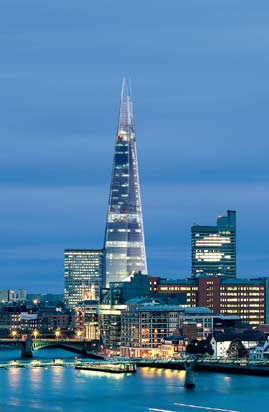
I have already commented on this tower as a mere plan on my Culture Blog, here, and before that here. But what I later missed was that last November, the building received planning permission and is now definitely going to be built.
My first reaction to the first faked photos I saw of this immense spike was that it looked like a paper dart that had already been thrown a few times and had had its spike somewhat damaged. Now, I find myself looking forward to its construction immensely. Expect photos here of it as it takes shape in the years to come. Building starts in 2005 and will be complete, or such is the plan, in 2009.
It is to be built in one of my favourite London places, namely on the south bank of the River Thames, which just gets better and better with every year that passes. Recently they have added the Wheel, and the undeniably impressive if decidedly fascist looking Bankside Power Station has metamorphosed into Tate Modern, the interior of which is very fine even if it does not seem to contain much else that is much good most of the time. Eventually they may even sort out that nothing space next to the Wheel. You can already walk all the way along the river on the southerly side through the centre of London, and this tower will only add to the fun.
The reason why London Bridge Tower will be such a draw is that we will not just be able to walk past it and gawp up at it; we will also be allowed to ascend within it and gaze out upon London, from a viewing gallery half way up, and from another public spot near the top. What this will cost I do not know, but I will be doing one of those trips at least once, I can tell you. Quite how all this public participation was contrived, I don not know, and no doubt some of the politics involved was of the sort we here might not approve of, but personally I am delighted about all this.
This tower is the work of Renzo Piano, who co-designed the Pompidou Centre in Paris. Of this massive object he has this to say:
I don’t believe it is possible to build a tall building in London by extruding the same shape from bottom to top. It would be too small at the bottom and too big at the top.
Likewise, symbols are dangerous. Often tall buildings are aggressive and arrogant symbols of power and ego, selfish and hermetic. The tower is designed to be a sharp and light presence in the London skyline. Architecture is about telling stories and expressing visions, and memory is part of it.
Our memory is permeated by history.
How nuanced. How European. He even manages to turn the tallest building in Europe into an anti-American statement. Well, if that is what it takes to get a thing like this built, then well said Renzo, I say.
And even if you disapprove, it can not possibly end up being as big an embarrassment as this. Although I find that I like the look of that also, more and more, however totally useless it may be. It is the Space Shuttle of skyscrapers, you might say. Concorde pointing upwards.
See what happens when I do not pay attention to what The Dissident Frogman is doing? He sneaks off goes and makes another side-splittingly funny flash animation. I visit his site often but for some reason I neglected to ‘press the red button’. Big mistake.
I suggest you go and do so… right now.
I think it is at least plausible to propose that a vast swathe of bad ideas and damaging policies are borne on the wings not of malevolence or even stupidity, but simply economic illiteracy: a fundamental failure to grasp how money actually works.
If that is the case, then this kind of thing is encouraging:
Personal finance education looks set to become a regular part of school life, following a series of successful pilot schemes across the country.
The charity the Personal Finance Education Group (Pfeg) has been working with teachers to help them provide extra-curricular lessons covering everything from straightforward budgeting to calculating interest and getting a good deal on a mobile phone.
One teacher said: “I think it will broaden their horizons; they will certainly have a better understanding of how to manage money. I think they’ll also have a better understanding of the taxation system and why you pay tax.”
However, enthusiasm should be tempered by the possibility that the subject is not being taught very well or, worse, that the whole thing is the project of ghastly statists who want to use this as a means of driving home pro-tax propaganda to a new generation.
But, those caveats aside, this could be welcome because even if it transpires that this is really all part of a lefty ‘get-them-while-their-young’ programme, the effect might be to start prodding young brain cells in directions that their teachers never intended them to go.
Police are set to get a host of new powers to crack down on anti-social behaviour.
Officers will be able to close down drug dens within 48 hours, and keep them shut for up to six months. For the first time, the Government’s Anti-Social Behaviour Act gives police-style powers to accredited private security guards. Later in the year, security guards and Community Support Officers will get further powers under the same Act.
Also introduced are controversial new police powers to disperse groups of people who have gathered in an area designated an anti-social hotspot by the local council. The host of new powers created by David Blunkett, the Home Secretary, were designed to target yobs, nuisance neighbours, vandals and drug dealers who make life a misery for law-abiding residents.
New restrictions on air weapons, raising the age for legal possession from 14 to 17, also come in today. It will also be an arrestable offence to carry air guns in public “without lawful authority or excuse”.
Clearly nothing escapes the hawk-eyed attention of these rapier-witted and attentive public servants:
A tax office official in Finland who died at his desk went unnoticed by up to 30 colleagues for two days.
The man in his 60s died last Tuesday while checking tax returns, but no-one realised he was dead until Thursday.
Getting a fiddled expenses claim past them must be a doddle. Let’s all move to Finland!
He said everyone at the tax office was feeling dreadful – and procedures would have to be reviewed.
From now on, mandatory pulse-checks every 24 hours.
From the Guardian, a perfect illustration of the importance of ‘anti-junk-food’ campaigning as the newfound cause du jour of the British left. It is hard to tell which aspect of his own report the author finds more disturbing: capital punishment or the lack of healthy food options for the condemned:
Raymond Rowsey got his deadly dose on January 9, in North Carolina. The sole white among these executed men, Rowsey was convicted for the killing of a convenience store clerk – or perhaps his accomplice half-brother did it, no one seemed quite sure at the trial. Their takings? Two pornographic magazines and $54. Rowsey had a history of horrific childhood abuse. His last meal was pizza, chicken wings, two packets of peanut M&Ms, and a Pepsi.
Junk food and judicial killing. Feel queasy?
But would not the offer of a balanced, healthy last meal be a bit…well, redundant?
It is a seldom-recognised fact that the British are world leaders in the art of grumbling. By a long margin, it is our most popular national pastime. In fact, if grumbling was an Olympic sport (or perhaps synchronised grumbling) then it would be British competitors taking gold, silver and bronze. The other nations do not stand a chance.
And I can find no better example of this kind of world-class, cutting-edge grumbling than this article by Philip Johnston:
Do you ever feel like Howard Beale, the character played by Peter Finch in the film Network? He was a news presenter on American TV who became so frustrated at the refusal of anyone to listen to reason that he invited viewers to open their windows and yell into the streets: “I am as mad as hell and I am not going to take it any more.”
Such conspicuous expressions of indignation are more acceptable in America than they are here. When we are as mad as hell, the most forceful manifestation of our emotions tends to be a resigned shrug or a heavy sigh. Understatement is one of our endearing national characteristics; but it also means we can more easily be taken for a ride.
And that is why we lead the world in grumbling. We have the ideal training programme.
Our predisposition to react benignly to developments that would have other people taking to the streets is to be applauded. But this quintessential mildness relies on governments, local councils and others who can interfere in our lives to do so only when it is absolutely necessary, and then in a fair and balanced way. The current Government is no longer able to identify this fulcrum. It brings in legislation because it believes that its very function is to pour forth a cascade of new laws each year, even when there is no demand for them.
Suggest to a minister that he might try to get through the parliamentary session without legislating and he will look at you as if you are crazy. Propose that existing laws should take effect before new ones are introduced and expect a blank stare. After all, what are politicians for if not to bring in laws? “We legislate therefore we are,” should be written on the gates of the Palace of Westminster.
But what else are politicians for? Pray tell, Mr Johnston?
For those fed up with high taxes, street crime, late and dirty trains, inane regulations, the unjustified use of fines and charges, bloody-minded parking restrictions, excessive public sector waste, preposterous European directives, multi-culturalist busybodies, useless and unaccountable council officials and six-hour waits at the local hospital’s A&E centre, a shrug and a sigh are no longer enough.
And so what? What follows from that? If Mr Johnston is proposing that our time-honoured traditions of heavy sighing, eyeball-rolling, muttering and impotent resignation are no longer sufficient grist for the national mill, then so be it, but where do we go from there?
|
Who Are We? The Samizdata people are a bunch of sinister and heavily armed globalist illuminati who seek to infect the entire world with the values of personal liberty and several property. Amongst our many crimes is a sense of humour and the intermittent use of British spelling.
We are also a varied group made up of social individualists, classical liberals, whigs, libertarians, extropians, futurists, ‘Porcupines’, Karl Popper fetishists, recovering neo-conservatives, crazed Ayn Rand worshipers, over-caffeinated Virginia Postrel devotees, witty Frédéric Bastiat wannabes, cypherpunks, minarchists, kritarchists and wild-eyed anarcho-capitalists from Britain, North America, Australia and Europe.
|





Recent Comments