We are developing the social individualist meta-context for the future. From the very serious to the extremely frivolous... lets see what is on the mind of the Samizdata people.
Samizdata, derived from Samizdat /n. - a system of clandestine publication of banned literature in the USSR [Russ.,= self-publishing house]
|
The Conservative government of Spain has conceded defeat to the opposition Socialists following today’s election:
Opposition Socialists have claimed victory in Spain’s general election as voters apparently punished the government over Madrid bombings that may have been retaliation by al Qaeda for the Iraq war.
“It’s a victory,” senior Socialist official Jose Blanco told cheering supporters in Madrid on Sunday. “The Spanish Socialist Working Party is ready to take charge of government in Spain.”
Official results showed the Socialists leading the ruling centre-right Popular Party by 43 percent to 37.5 percent with 85 percent of votes counted.
So disaster follows hot on the heels of tragedy. For Spain this probably means a reversal of some or maybe even all of the tentative reforms that the Aznar government managed to institute over the last few years and which enabled that country to enrich itself considerably.
But the implications are not just domestic:
The Socialists have pledged to withdraw Spain’s 1,300 troops from Iraq if the U.N. does not take control by June 30 when Washington plans to hand power back to Iraqis. Opinion polls showed as many as 90 percent of Spaniards opposed the Iraq war.
It sounds as if the ‘Coalition of the Willing’ is about to lose one of its members.
Having no knowledge whatsoever of the Spanish political landscape, I cannot say whether the result of this election was on the cards or whether it was influenced by the Madrid train bombing. Maybe the Socialists were on course for victory today regardless. Maybe it was all about domestic issues. Who knows?
But in one sense, it may not matter why Aznar and his centre-right government lost. If Al-Qaeda did orchestrate the Madrid attack (and it appears increasingly likely that they did) then they will chalk this up as a major success. In their own minds, they have successfully terrorised the Spanish electorate into installing a government that was more to Islamicist liking.
That may not actually be true, but the danger lies in these maniacs believing it to be true.
While the terrorists were busy in Spain, the ‘militants’ have been at work in Israel:
A double suicide bombing in the southern Israeli port area of Ashdod has killed at least 11 people.
A Palestinian militant had entered the port and asked for water – and the moment he was shown where there was a tap “he blew up” – an employee of the port quoted one of his injured colleagues as saying.
Well, there is no reason why the work of terrorists should disrupt the busy schedule of ‘militants’ is there? Mind you, these trade unionists agitating for better working conditions have got a very strange way of going about it.
There is something very Georgian and 18th Century about this but I suppose it qualifies as entrepreneurialism of sorts:
The final punch lands, exploding the fighter’s nose into the braying crowd, and the broken, unseeing, bare-knuckle boxer submits. The winner lifts his bleeding hands in celebration, knowing the victory won by his fists will line his pockets.
Welcome to the boxing underworld of bare-knuckle fighting, where the exhausted victor can hobble away with as much as £50,000 in cash.
Tax-free cash as well I should think.
These brutal confrontations have long been outlawed. But even now in country lanes, fields, barns and warehouses, grown men are pitting themselves against each other to settle old scores – and earn big money – at the risk of appalling injuries.
A reaction to the ‘risk aversion’ culture, perhaps?
Organisers say the police rarely break up a fight – it’s easier to let the contest finish naturally than risk a riot.
Also they might get the crap beaten out of them.
Ricky English, an unlicensed promoter, has signed up hundreds of fighters in the three years since he started in the fight promotion game. It is big business – he is organising fights up and down the country, charging spectators up to £50 a head.
“This is for the novices,” he said. “Fighters won’t go amateur any more. They’re sick of all the rules, the standing counts and the tap, tap, tapping. They want to have a fight and earn money. And they’re earning money.”
So is he trying to tell us that overregulation has spawned a thriving ‘underground’ industry?
“It’s great fun. I had one fighter with a glass eye who’d take it out before a fight. Crowds just love it,” said Rocky Rowe, who promoted unlicensed fights for many years. “It’s a bit like karaoke.”
Surely it cannot be that painful?
She gazes at the moon
The fragrant earth remains
Tears and thunder fall.
Sometimes when I feel the need to see the world through very strange eyes indeed, I wander over to the Pravda website for a bit of paleo-collectivism using language little different from Soviet days. I am rarely disappointed.
There is a splendid example of entertaining pretzel logic in slightly fractured English called West against Russia. The article discusses that the fact many articles appear in the western media which are critical, unflattering and disparaging regarding modern Russia and particularly Vladimir Putin. The author of the article, Mikhail Chernov makes it clear that the western reports are not just reportage but are a campaign and ‘Russian experts’ know why this is happening:
The main task of the new media campaign is making Vladimir Putin (who will probably be elected for the second term) not legitimate in the minds of Western audience. Meanwhile, some Russian experts believe that toughening the position of the West did not result from Russian political events and certain economic interests in Russia. The EU and the USA increased their criticism of Russia because of the crisis of the “Western” model of social order and simultaneously express their rejecting Russian social order model in this way.
So western criticism actually has nothing much to do with Russia, it is just a facet of the crisis of our social order, hence…
Many Russian experts believe that moving Western politics into anti-Russian direction is inevitable. Director of Pamir-Ural research group Alexander Sobyanin said that there is no special plan to undermine Russia. Western elites do not think bad about Russia and are not going to bring Russia down.
Quite so, there is not much interest in ‘bring Russia down’ anywhere other than Chechnya. In truth, western elites (whatever that means) do not really tend to think overmuch about Russia at all. But the fact Russia is seen as a far of basket case by most western elites is not the thrust of the article at all. Quite the contrary in fact.
According to Mr. Sobyanin, sharp increase of anti-Russian propaganda resulted from the crisis of the Western society elites. “The elites of only three countries were in the mainstream of the global economic and social development in the last century – Russia, the USA and Great Britain. The world entered the stage of changing dimensions – it has to abandon outdate absolute “financial criteria” and elaborate the new paradigm of development. Implementing changes will be accompanied by wars and social conflicts. Anglo-Saxon elites are not ready for this yet”, said Alexander Sobyanin. He believes that there is a chance that Russia can elaborate new, alternative algorithm for global development (in last century it was socialism), and for this reason the West perceives Russia as the dangerous ideological competitor.
Well I did tell you that I go to Pravda because I enjoy reading things that are surreal. This appears to say the thing that is wrong with the Anglo-Saxon model is that it looks at the ecomony in economic terms! And so what is this ‘new paradigm of development’? It is not spelled out so let me guess: economics must be managed politically for fairness and efficiency in order to avoid ‘wasteful competition’? I am just speculating here but who feels brave enough to disagree and tell me this is not at the root of this ‘new paradigm of development’ being hinted at? The notion that Russia is a source of a viable economic algorithm likely to challenge ‘Anglo-Saxon’ capitalism is quixotic to put it politely… laughable to be a bit more blunt.
As Russian civil society exists only precariously, the Russian social model is simply that of subordinating ‘social’ interactions to politically regulated interactions strongly influenced from the top. In short, the Russian social model is ‘people being told what to do’. The socialist ‘ownership’ based method of doing that has simply been replaced with the more effective fascist style ‘control’ based method. Which is to say, rather that nationalising everything, the Russian state simply regulates things and imposes controls on what people can do with what they nominally own.
This is of course also the approach of regulatory statists even in Britain, the USA and elsewhere in the west, but unlike those places, Russia has the ‘advantage’ of a civil society with no significant intermediate organisations between it and the state, moreover it is a society conditioned to a top down approach by centuries of Tsarist autocracy followed by Communist totalitarianism. The article then goes on to talk about how in the ‘Anglo-Saxon’ way, it is competition which defines our civilisation:
Western model” implies having certain “agreement” accepted by the society. One of the backbones of this agreement is competition between individuals. Russian tradition does not recognize competition as positive factor because competition awakes low instincts in people and does not improve the quality of products, but, on the contrary, worsens their quality.
Which no doubt explains the huge flood of high quality Russian products sweeping the world. That pesky toleration of individualism will be the undoing of us poor Anglo-Saxons. In reality, that there are any successful businesses at all in Russia is testament to the ingenuity of individual Russians and their ability to operate in spite of the ‘Russian model’.
Quite apart from the fact this utter tosh claims to be ‘reasoned analysis’, the fact that the people who think of themselves as Russia’s elites still think in such delusional terms shows the extent to which things have not yet recovered intellectually from that nation’s poisonous past. Who needs The Onion when you have Pravda? Sorry, but there is only one kind of Russian model that has any interest for the rest of the world.
Although it is more or less a policy of mine to not write directly about comments made regarding Samizdata.net articles, it is a policy occasionally worth ignoring.
Many commenters have reacted poorly to David Carr’s article AZNAR KNEW!!!. Whilst it is the readers prerogative to judge articles here as they see fit, I must disagree with some of the views put forward that it was an inappropriate article at a time of such truly hideous moment. I do not say so out of an urge to ‘circle the wagons’ but rather because many of the commenters are fine people whose opinions are of value to me. And because I think they are quite wrong, I feel I must say why, as Chief Editor of Samizdata.net, that I am delighted David wrote such a piece and published it now.
It is a ‘humorous’ article in so far as satire is an appeal to humour, but that does not mean David is laughing at what happened. Just as Jonathan Swift was not laughing at the Irish famine when he penned A modest proposal, so too is David drawing attention to something deadly serious.
It is at times like this when we most need to pour scorn on the people who are, by virtue of their world views, indirectly part of the problem. This hideous and evil act must be met with force and implacable resistance… and it is that sort of response that the people who are the targets of David’s satire will work tirelessly to prevent.
All David is doing is shining a light on them and now, not later, is the time to do that. The fact that what David wrote is close to the bone is what makes it effective. Why? Because it is only a few degrees off the non-satirical screeds we will actually be reading in a few days.
Now of all times, while the stench of death and horror are fresh in Madrid, it is right to point out that some well meaning people’s views, and some not so well meaning, are nothing less than an apologia for mass murderer. Ideas have consequences and that it what David was writing about.
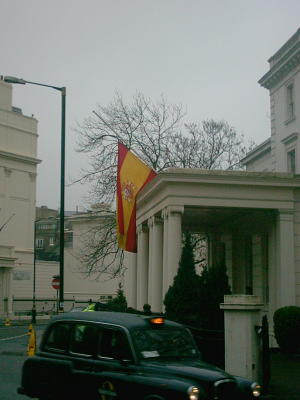
I made a brief visit to the Spanish Embassy in Belgravia this afternoon. At about 4pm there were no queues, but a trickle of people were going in and out. There was a large pile of wreaths of flowers outside the door. There were two thick condolence books, which contained the signatures of many people from many places. I signed one of the books. A Spanish official thanked me as I walked out the door. There was not really anything to be said. I was last in Spain about six weeks ago, and I had a wonderful time, as I always do.
River Town: Two Years on the Yangtze
Peter Hessler
HarperCollins, 2001
The Great Wall of China: From History to Myth
Arthur Waldron
Cambridge University Press, 1992
“If you read only one book about China, let it be this,” says Jonathan Mirsky (whoever he is) on the cover of River Town, and, although I must have read fewer books on China than he has, I find it hard to disagree with him, at least if China today is the subject. Only Behind the Wall by Colin Thubron, comes to mind as a competitor, and even his more travelled account, just as China was opening up, is to some extent challenged by Hessler’s journeys, done in his job vacations. But to understand China today, there is much that should be known about its past. To know the history of The Great Wall of China is to realise it was a great mistake, an exercise in institutionalised, bureaucratic xenophobia whose failure did not even teach a lesson to those who rendered it useless. → Continue reading: Chinese walls
I was and am a devout anti-Communist. I rejoice that civilisation won the Cold War, detest the evil folly that was Marxism-Leninism-Stalinism-decrepitudism, and regret that the Russian Revolution was not strangled at birth. But (and you could hear that coming couldn’t you?) as far as I am concerned, Dimitri Shostakovich (1906-1975) was almost certainly a better composer after Stalin had given him his philistine going-over following the first performances of Lady Macbeth of Mtsensk, than he would have been if Stalin had left him alone. Although both are very fine, I prefer Symphony Number 5 (“A Soviet Artist’s Reply to Just Criticism”) to Symphony Number 4.
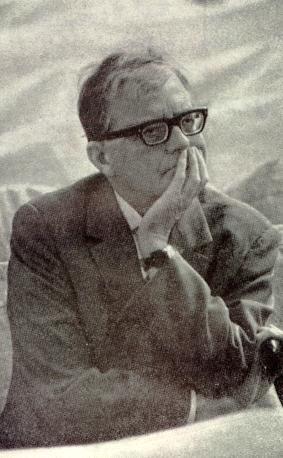 Had Shostakovich continued unmolested along the musical path he was travelling before Stalin’s denunciation of him, I don’t think he would merely have become just another boring sub-Schoenbergian modernist. He was too interesting a composer for that already. But I do not think his subsequent music would have stirred the heart in the way his actual subsequent music actually does stir mine, and I do not think I am the only one who feels this way. → Continue reading: Dimitri Shostakovich was a very nervous man
We may be off the air for a short time due to some maintenance issues. Back soon!
Update: Well that was rather painless. Our downtime was hardly a blink
You may not have noticed, but in the UK this week is Fairtrade Fortnight – that time of the year when we are encouraged to buy ‘fair trade’ coffee and other ‘fairly priced’ products. I spent Monday going on TV and radio shows explaining why the scheme is counter-productive, much to the fury of its supporters.
For a start, we should be realistic about the scheme’s potential. In Britain, despite ten years of advertising, 97% of coffee sold is not on the scheme. Most consumers are likely to continue buying coffee according to cost and quality. Its potential for increasing wealth among coffee producers is thus extremely limited. Some argue that the scheme is taking us away from thinking about more radical solutions to poverty.
Secondly, the real problem with ‘fair trade’ is that it is based on economic illiteracy. The low price of coffee is caused by production increasing by 15% since 1990, and supply is bigger than demand. This cannot be blamed on multinational buyers of coffee. There are simply too many people employed in coffee production. With new technology, the price may well decline further. In Brazil, five people and a machine can do the work of 500 people in Guatemala. The low coffee prices are a signal to exit the market, or switch up to higher value coffee.
‘Fair trade’ – though it helps some farmers – encourages people to stay in the coffee market and gives them confidence to increase production. That is all very well, but this has a downside. More supply means a lower price on the world markets. Perversely, ‘fair trade’ makes matters worse for the vast majority coffee producers.
Criticism of the multinational buyers of coffee abounds, but these people have probably done more to help the lives of coffee producers than ‘fair trade’ has – by promoting coffee drinking to members of the public, and putting trendy coffee shops everywhere.
Instead of ‘fair trade’, we should concentrate on real solutions. Like getting rid of the Common Agricultural Policy and EU tariffs, which limit the goods overseas producers can diversify into. And coffee producing countries need to make the economic reforms that enable enterprise to flourish. ‘Fair’ pricing schemes may sound like a good idea, but they fail the market test.
Alex Singleton can be contacted via his personal website.
This article by young Freddie Sayers in the latest Spectator can be simply summarised. The EU is boring, and it is especially boring to Youth.
The youthfulness of Freddie Sayers is not something I am pointing out gratuitously. He makes much of it himself, when he writes things like this:
Sooner or later, the EU institutions will realise that they cannot shape trends, but are in fact subject to them. I believe the European Union will gradually become less relevant: the lack of interest in my generation practically guarantees it. The passion that the romantic vision of a united Europe once provoked was the result of a world-view which we cannot understand. When Michael Howard spoke in Berlin in February, he recalled how in 1963 he had been ‘one of the half million people who thronged in front of the Rathaus Schoneberg to hear President Kennedy give his famous address’; Sìle de Valera also told me how influenced she had been by General de Gaulle’s vision of Europe.
But these memories mean nothing to us. The old view of Europe, formed by a memory of intra-European war and the prospect of a new power block to counterbalance the US and Soviet Russia, is simply no longer relevant. I can’t remember the Berlin Wall falling down; the second world war seems ancient history. Sìle de Valera pondered why it is that young people feel ‘active and engaged in global politics, but it is harder to engage them at a more local level’. Perhaps we feel more like citizens of the world than citizens of Europe? The European Union has had useful and constructive results — freer travel and trade, cultural exchange programmes — but there is no reason for young people to get excited about it. We see these as the quite normal modern activities of any friendly civilised states, whether America or Italy. The whole idea of a particularly European vision is out of date, passé.
The trouble with Sayers saying all this, but not saying any more than this, is that however much the EUropean Union becomes less “relevant” in the eyes of its younger victims, it is still in fact in business. The EU boring? Well, so is a steamroller. But if the steamroller is steamrolling all over you, merely calling it boring is hardly the response that will actually stop it, now is it?
What is needed is a generation who have become sufficiently excited about the EUropean Union, to the point where they choose to stop it, and perhaps even reverse it.
Of course the EUro-enthusiasts would rather that the youth of EUrope shared their EUro-enthusiasm. But in the absence of support, they can proceed with their project in the absence of enthusiastic opposition.
I am not accusing Freddie Sayers of having foolish feelings, still less of reporting on the feelings of others inaccurately. On the contrary, that he is interested enough in the EU to write this piece about it, even – as he most entertainingly reports – travelling to a fatuous EUro-junket in Ireland that nobody else gave the slightest attention to, suggests that he at least is not indifferent to the progress of the steamroller.
So on the contrary, I think we should keep our eyes open for what else this young man writes.
And I wonder, is he the same Freddie Sayers as the one in this?
|
Who Are We? The Samizdata people are a bunch of sinister and heavily armed globalist illuminati who seek to infect the entire world with the values of personal liberty and several property. Amongst our many crimes is a sense of humour and the intermittent use of British spelling.
We are also a varied group made up of social individualists, classical liberals, whigs, libertarians, extropians, futurists, ‘Porcupines’, Karl Popper fetishists, recovering neo-conservatives, crazed Ayn Rand worshipers, over-caffeinated Virginia Postrel devotees, witty Frédéric Bastiat wannabes, cypherpunks, minarchists, kritarchists and wild-eyed anarcho-capitalists from Britain, North America, Australia and Europe.
|






Recent Comments