We are developing the social individualist meta-context for the future. From the very serious to the extremely frivolous... lets see what is on the mind of the Samizdata people.
Samizdata, derived from Samizdat /n. - a system of clandestine publication of banned literature in the USSR [Russ.,= self-publishing house]
|
International news agency Reuters reports that a van, containing Arabic language tapes and detonators, has been searched close to the scene of today’s mass murders in Spain. So far, the authorities have maintained that the atrocities were the handiwork of terror group ETA, but there could be a possibility that Islamo-fascists had a hand in this affair, possibly even to the point of directing the operations.
The truth is that no-one can be certain for sure, and we must be mindful about jumping to conclusions. But given Spain’s support for the U.S.-led liberation of Iraq, and Spain’s proximity to north Africa, there is a serious possibility that Islamists may have played a part in this.
There is also the worrying thought that terror groups, who have come under growing pressure from law enforcement agencies and the military since 9/11, are becoming more desperate and hence willing to co-operate with those they would have previously ignored.
If true, it makes the sneering article by Simon Jenkins in today’s Spectator, in which he mocks Blair’s concerns over global terror networks and their access to WMDs, not only wrongheaded, but frivolous in the extreme. London, Paris, Berlin or Rome could be next. Nothing to worry about eh, Simple Simon?
A black day for Spain. My heart goes out to the people of that wonderful country.
Every decent and right-thinking person must surely condemn today’s tragic events in Madrid.
BUT…while our thoughts go out to the families of the innocent victims this must not cause us to forget that horrible incidents such as we have witnessed today are the wholly predictable result of the Spanish government’s wrong-headed, meddling foreign policy and their continued brutal occupation of the Basque homeland.
Of course, no one can ever condone such senseless acts of bloody violence but that does not mean we cannot sympathise with the plight of the ruthlessly oppressed Basques who are struggling for dignity and nationhood beneath the jackboot of Spanish domination. Such people, who are condemned to a future without hope or self-worth, can hardly be blamed for the state of desperation that may have forced some of them to indiscriminately slaughter hundreds of people on public transport. What choice do they have?
While the rash and the thoughtless among us may seek scapegoats here, a more mature and nuanced analysis is required. The truth is that there are no perpetrators here, just different types of victim. The real culprit is Spain’s ultra right-wing fundamentalist Prime Minister, Jose Maria Aznar whose lunatic extremist policies are the root causes of today’s shocking violence.
This dangerous demagogue (who some have compared to Hitler) has surrounded himself with a sinister, shadowy cabal of Neo-Conquistadores and, together, they have hijacked this country and brought the shame and opprobrium of the world upon it with their wicked plan to establish a Global Iberian Empire. It is the policies of Aznar and his government that are driving Spain, and maybe the whole world, into catastrophe. Until they are stopped, there will be more horrific carnage of the type unleashed on Madrid today.
The Spanish people would do well not to squander the sympathy they have earned as a result of this attack. They must immediately distance themselves from their own deranged leaders and join in with the efforts of the rest of concerned humanity in ending the occupation and bringing Spain back into the fold of civilised, peaceful nations.
Here, reproduced as it was sent to us, is an open letter to the international mass media by a very worthy website in Spain regarding the horrific and vile attrocity carried out by Marxist terrorists in Madrid yesterday that has resulted in the murder of at least 190 civilian commuters and the injury 1,200 more. The only comment of mine that I will add to what follows is that I share the author’s outrage completely
To the international mass media, ETA is not a Marxist-Leninist terrorist group but a “Basque separatist group”. The magnitude of the 3-11 attack has not changed their narrow sighted style. This is particularly poignant in the case of the US media. After Spain’s support of the American war in Iraq, the coverage by American media is still worthy of a band of ignorants who keep scorning this Spanish bleeding tragedy.
Thus, to try to stop such indecency, I have sent the following brief email to Fox News and CNN. Let’s fill their inboxes with our anti-collaborationist clamour!
I want to express you my most strongest complaint for your horrible coverage of the massacre in Madrid. You name ETA “Basque separatists group”. That’s awfull and infamous. ETA is a terrorist group, as it is recognized as such by all international institutions and developed nations, among them, the USA.
Do you think we should call Al-Qaeda “the resistance”? Has Spain been with the USA and UK in its struggle against international terrorism to deserve that kind of insult?
I am very disappointed by this dishonest style. It is just miserable.
Juan Ramón Rallo
From Spain
Mass media where to send the mail
CNN
Foxnews
BBC
WallStreetJournal
New York Times
Reuters
Associated Press
Washington Post
In what is a splendid testament to the sense and wisdom of Irish youth, when the EU held a conference for young people in Ireland (free registration required)… how many young Irish people turned up?
None.
Clearly they had better things to do. How very, very, very, splendid. 
I carry a Swiss Army Knife around with me on my keyring. I find the blades, scissors, and bottle opener in particular to be very handy. (Some of my friends and I have an ongoing personal joke about whether anyone has ever found a single purpose for the “multi-purpose hook” feature, however. I favour the climber model, and I must have had about five of these over the last fifteen years. I have lost my keys three times that I can think of (always in really stressful situations) and I have also had a Swiss Army Knife confiscated at Heathrow once. None of my knives have ever worn out: they do seem to be very well made. On every occasion I have bought another one of the same model. (I once attempted to buy a blue one instead of a red one, but the shop was sold out). I have had the current knife just over 18 months, I think, and hopefully it will last much longer. But, whenever it happens I need a new one, I may have to consider a different model. That’s right, it’s a USB Swiss Army Knife. What is even more scary than the existence of this is that having a built in USB Flash Drive on my knife is something that I would actually find useful.
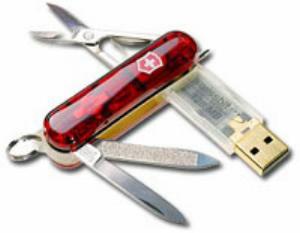 Yes, a scary thought is going through my head. Unlike certain other strange USB devices I genuinely do want one of these.
Link via Slashdot. (Where else, really?)
The oil-for-food scandal keeps bringing up some interesting although by no means surprising evidence that the program was corrupt.
A letter has come to The Wall Street Journal supporting allegations that among those favored by Saddam with gifts of oil was Benon Sevan, director of the U.N.’s Oil-for-Food Program. As detailed on this page on Feb. 9, Mr. Sevan’s name appears on a list of individuals, companies and organizations that allegedly received oil allocations or vouchers from Saddam that could then be sold via middlemen for a significant markup. The list, compiled in Arabic from documents uncovered in Iraq’s oil ministry, included many of Saddam’s nearest and dearest from some 50 countries, including the PLO, pro-Saddam British MP George Galloway, and French politician Charles Pasqua. (Messrs. Galloway and Pasqua have denied receiving anything from Saddam.) According to the list, first published by the Iraqi daily Al Mada in January, Mr. Sevan was another beneficiary, via a company in Panama known as Africa Middle East Petroleum, Co. Ltd. (AMEP), about which we have learned quite a bit.
There is more and the evidence is mounting. As Claudia Rosett puts it in her NRO guest comment:
U.N. officials have denied that this tidal wave of graft in any way seeped into their own shop, or that they even had time to notice it was out there. They were too busy making the world a better place.
Read the whole thing as they say. It appears that there is a positive side to totalitarian regimes… they are sticklers for bureaucracy and record-keeping.
Via Instapundit.
..members of the elite Special Air Service (SAS) were exposed to lead, teargas and explosions in training, and experienced high levels of physical trauma and stress.
– An Australian government report investigating the training of the SAS regiment, as reported in an Australian newspaper. (Well done to the guys who figured that out. Who could possibly have imagined that being in the SAS would involve stress and danger?)
(link via Geoff Honnor).
Surprise surprise:
The renewable energy industry suffered a setback today with the publication of a report showing that electricity from offshore wind farms will cost at least twice as much as that obtained from conventional sources.
According to research carried out by the Royal Academy of Engineering (RAE), the cheapest electricity, costing just 2.3 pence per unit, will be generated from gas turbines and nuclear power stations, compared with 3.7p for onshore wind and 5.5p for offshore. The Academy also emphasised the need to provide backup for wind energy to cover periods when the wind doesn’t blow. The study assumed the need for about 65% backup from conventional sources, adding 1.7p to the cost of wind power, bringing its price up to two and a half times that of gas or nuclear power.
The other alternatives are: coal, which is about to get blamed for frying the planet and to be made illegal, here anyway; and: nuclear power, which is horrid horrid horrid and will never be allowed no matter how sensible they manage to make it.
Accordingly, it won’t be long before we all freeze to death. And since there will not be any electricity, we will not even be able to blog about it.
Prediction: the idiots who between them achieved this will then blame capitalism, for, er, exploiting people’s desire to stay warm, that is to say, not exploiting it enough, er, drivel drivel, shiver shiver, …
Actually, this is not all bad news. The bad news would be if there was no news about it all, and it was just happening. The story here is not merely that environmentalists are driving us all enviro-mental with their idiotically contradictory policies. It is that boring sounding people like the Institution of Civil Engineers are starting to get nervous, and even rather angry.
Nuclear engineers are getting in on the act too. Here is a bit lower down in that Guardian story:
RAE vice-president Philip Ruffles acknowledged that the findings may sound surprising, especially as the cost of nuclear decommissioning had been included in the research.
“The weakness of the government’s energy white paper was that it saw nuclear power as very expensive,” he said. “But modern nuclear stations are far simpler and more streamlined than the old generation and far cheaper to build and run.”
But the mad hippy lunatic scumbag tendency has no time for talk like that:
The British Wind Energy Association, who last year gave full backing to the government’s wind, questioned the reliability of the data which the RAE used: “BWEA assumes that the figures quoted for nuclear power are based upon reactors that are yet to be built and is not aware of any market experience that proves the costs claimed by the Royal Academy of Engineering,” it said.
But the reason there is no market experience of wind farming, surely, is because no one has yet expressed any desire for its product, give what it costs. With talk like that, the more lunatic your entrepreneurial scheme, the more it would be entitled to government money, so that it could acquire ‘market experience’. But maybe I have misunderstood the man.
Be that as it may, the real reason I included that last bit was the presence in it of the glorious phrase (from which a word must surely be missing): “gave full backing to the government’s wind”.
Here at Samizdata, we never give full backing to the government’s wind.
Jesus in Beijing: How Christianity Is Transforming China and Changing the Global Balance of Power
David Aikman
Regnery, 2003
“[W]e have realised the heart of your culture is your religion: Christianity. That is why the West has been so powerful. … We don’t have any doubt about this (p. 5)”. Fifty three years after China went Communist, such is the view of a thirty-something Chinese social scientist in a top establishment in China’s capital. The former Chinese President, Jiang Zeming, asked what would be his last decree if it could be enforced, grinned and (according to an anecdote which cannot be dismissed out of hand), said, “I would make Christianity the official religion of China” (p. 17).
The first remark may not come as a shock to those who know their Weber and Tawney and combine it with a thorough disillusionment with Marxism, the presumed state of our Beijing academic. The second suggests that the ex-President was aware of the political U-turn, early in the fourth century, of Constantine the Great, son of the colleague of the Emperor Diocletian, last of the great Roman persecutors of Christians.
Aikman does not ask us to regard these reports as more than straws in the wind, but his own investigations lead him to state: “China is in the process of becoming Christianised … [i.e.] it is possible that Christians will constitute 20 to 30 percent of China’s population within three decades” (p. 285). His conclusion results from an intensive period of travelling and interviewing within China during 2002 and 2003 and an interest and residence in China off and on during the last three decades, including a stint as TIME’s chief in Beijing. He knows the language (though he also employs a translator) and, while plainly sympathetic to his subject, the state of Christianity in China today, is reticent regarding his own religious beliefs. → Continue reading: Christianity in China
I’ve just done a rather long posting on my Education Blog about a teacher called Francis Gilbert, who has written a book highly critical of government education policies. Put it this way, I classified the post under one of my most frequently used headings: “Sovietisation.” The guts of Sovietisation is when the measuring system imposed from the centre completely overwhelms the activity it is supposedly measuring. In the old USSR, people spent all their time fulfilling quotas, by hook or by crook, as opposed to doing useful work. Now, more and more teachers are pushing, and faking, children through exams. And as also happened in the old USSR, everyone knows that this is happening, but nobody except a few very unusual dissidents can afford to go out on a limb and admit it.
While I was linking to articles by and about Gilbert, and to his recent book, Kit Taylor was simultaneously emailing me, twice, about a radio performance that Gilbert did today.
Email one:
Teacher Francis Gilbert was on Radio2’s Drive Time programme this evening (wednesday 10th March), promoting his book “I’m a Teacher Get Me Out of Here!”
Though he described himself as being of the left and wanting equality, he delivered a tirade against a crushing bureaucracy he likened to something out of 1984, and said that he was disillusioned by “what the left had done.” Notably, as questioned why schools weren’t free to devise their own curriculums, something utterly uncontroversial as far as I’m concerned but seemingly unthinkable in today’s political climate.
Host Johnnie Walker even chipped in agreeably, pontificating that anything the government tried to run it messed up!
All this on primetime national radio. Cause for optimism?
And then, just as I was going to press (having included email one at the last minute), in comes email two:
Actually, now I think on Francis Gilbert something even more interesting in the interview.
It was along the lines of –
“I can go to the corner shop, and I can buy a good quality jam or a cheaper one. I have that option. But if I want my daughter [aged three] to learn french or classics, the choices aren’t available.”
If advanced by the Tories, I’d be unsurprised if such a notion were attacked as Thatcherite extremism. What’s interesting is that Gilbert’s comments were not apparently derived from ideological dogma, but the product of a “man in the street” intuitively questioning why a system that was working well in one aspect of his life wasn’t being applied in another that wasn’t.
As I think I may already have been quoted here as saying, we do have one rather big advantage over our opponents, which is that reality is on our side.
Some of the Serbian paramilitary ‘heroes’ responsible for the mass murder of 192 Croatians in Vukovar in 1991 have been put on trial in Serbia.
This is a welcome development as not only does it brings bring these people to account, it will require Serbian society and the Serbian state to confront what really happened. In the absence of an externally imposed ‘denazification’ process, this could be exactly what Serbia needs and perhaps the start of a process that will de-legitimise vile creatures like Vojislav Seseji and other nationalists who do not have the widespread opprobrium they deserve within Serbia itself.
War crimes trials far off in the Hague simply cannot have the same effect as trials within Serbia itself. Forcing the painful truth to be brought out for all to see has to be a good thing as far too many people with the blood of the Balkans on their hands are still relaxing in the cafés of Belgrade. Perhaps this is the first sign that their days are numbered, but it would be premature to just assume this will be the case. Nevertheless, these trials are a very good start.
I frikkin’ met an Ayatollah! a real life Ayatollah, I watched him eat a banana and then he put his hands on my shoulder and prayed that I get married soon, my mom was beside herself with joy and I just couldn’t stop laughing.
The heretic fagot getting a blessing from an Ayatollah. that is how great those four days were.
– Salam Pax
|
Who Are We? The Samizdata people are a bunch of sinister and heavily armed globalist illuminati who seek to infect the entire world with the values of personal liberty and several property. Amongst our many crimes is a sense of humour and the intermittent use of British spelling.
We are also a varied group made up of social individualists, classical liberals, whigs, libertarians, extropians, futurists, ‘Porcupines’, Karl Popper fetishists, recovering neo-conservatives, crazed Ayn Rand worshipers, over-caffeinated Virginia Postrel devotees, witty Frédéric Bastiat wannabes, cypherpunks, minarchists, kritarchists and wild-eyed anarcho-capitalists from Britain, North America, Australia and Europe.
|







Recent Comments