We are developing the social individualist meta-context for the future. From the very serious to the extremely frivolous... lets see what is on the mind of the Samizdata people.
Samizdata, derived from Samizdat /n. - a system of clandestine publication of banned literature in the USSR [Russ.,= self-publishing house]
|
So we are going to given a referendum on whether or not to sign up to the EU Constitution. Or not. Or maybe. Possibly. Not yet, but soon. In principle. In theory. For certain, provided conditions are right.
Lord knows! Like everything else concerning Britain’s relationship with Brussels this whole referendum issue is buried deep within a fog of obfuscation, misinformation, confusion and misdirection.
What is certain is that the government/media lie-factory is being cranked up to over-production mode forging weapon-grade children for deployment in the propoganda war ahead [“I think we should be a part of Europe so that we can all live together in peace”, said Heidi, aged 10. Yes, it really will be that fatuous and buttock-clenchingly embarrassing.]
So now is to the time for the forces of truth and light to step up to the crease, ready to hit the opposition for six. Among the fearless volunteers are the team behind a new blog called, simply, EU Referendum.
These guys have got the real skinny on the fetid labrynth of EU politics and they tell it exactly like it is. Pay them lots of visits to read, learn, grow and become a better human being.
After an enjoyable day out with fellow libertarian troublemaker Andrew Ian Dodge, I settled in a for a quiet night in front of the television and watched about half of an interesting, if rather depressing, documentary about the late British comedian, Frankie Howerd.
He ranks alongside the late Peter Sellers and Terry Thomas in my pantheon of eccentric Brit funnymen. Howerd was the master of the double-entendre, teasing his audiences with riske jokes at a time when censorship of the press and popular entertainment was still relatively strong by modern standards. He is probably best known for his role as a comic slave in the Roman comedy, “Up Pompei!”, accompanied by his usual refrains such as “No missus!” or “Titter ye not”. (He’s an acquired taste, I will admit).
The programme on Howerd’s life focussed on his private life, which was not particularly pleasant. Howerd was a homosexual and in the post-war years up to the 1960s before gay relationships were legalised. In consequence, Howerd conducted his personal life on the fringes of the law, and at times was vulnerable to blackmail.
With all the current concerns about state ID cards, European Union cross-border arrest warrants and the like, it is easy to become despondent about the threats to our individual freedom. But we should not forget that in that much maligned decade, the 1960s, a group of people like Frankie Howerd were liberated from the bigotry of the law. In certain areas, the cause of liberty has taken a leap forward, and we should not forget that fact.
Oooooh, shut yer face!!
The Guardian reports that thousands of Muslim women will be exempted from having to show their faces on identity cards as the Government moves to allay fears among British Muslims that the new cards will be used to target them in the ‘war on terror’.
As David Blunkett, the Home Secretary, faced attack for not allowing enough debate over the introduction of the first ID cards in Britain since the Second World War, officials made it clear that if Muslim women do not want to reveal their faces in public, that would be respected. Instead of a photograph, there would be an exemption for certain people, who would only have to give fingerprint and iris-recognition data.
How about wearing a veil and refusing to be taken a photo on ‘religious grounds’. It may be worth a try…
This story is already being well bounced around the blogosphere. Let me give it another bounce. Here is what Jacob Sullum of Reason online says:
Although prosecutors admitted Paey was not a drug trafficker, on April 16 he received a mandatory minimum sentence of 25 years for drug trafficking. That jaw-dropping outcome illustrates two sadly familiar side effects of the war on drugs: the injustice caused by mandatory minimum sentences and the suffering caused by the government’s interference with pain treatment.
Paey, a 45-year-old father of three, is disabled as a result of a 1985 car accident, failed back surgery, and multiple sclerosis. Today, as he sits in jail in his wheelchair, a subdermal pump delivers a steady, programmed dose of morphine to his spine. But for years he treated his pain with Percocet, Lortab (a painkiller containing the narcotic hydrocodone), and Valium prescribed by his doctor in New Jersey, Steven Nurkiewicz.
Insane.
I got to this by going to Instapundit and then to National Review.
War on drugs: insane; the blogosphere: sane.
I think I smell another variant of the real-work-unreal-work fallacy. You know the one I mean. It said, a few centuries ago, that making real, edible food was real work, but fiddling about with bits of metal was unreal. Then when fiddling about with metal starting to move to faraway places, fiddling about with metal (especially if it was heavy enough or hot enough to do you serious damage if you mishandled it) was real, but shovelling paper this way and that was unreal.
But now, hear this, a comment from Neal of Margate on a BBC report about the rise in Britain of working at home, made possible by the rise of broadband. I have already commented on this report at my Education Blog, because it will surely make home education easier, but that is another story. Here is Neal of Margate:
This infuriating subject is back, is it? Please do tell me, how should dustmen work from home? Street sweepers, can they work from home? Factory workers? District nurses? Casualty department staff?
The only people who can work from home are those who do an unnecessary job. Can surgeons work from home? Ambulance drivers? Firemen? If you can work from home full time, you have a pointless job.
Maybe not, yet. (Although, give it a century or two …) But an offshore banker can work for the whole world from a West Indian island, on the beach, let alone at his mere home. But according to Neal, pure information manipulation counts for nothing. It has to be combined with, you know, doing something.
This Neal character has just got to be rabidly anti-capitalist. You couldn’t believe in the benefits of markets and of the division of labour and believe stuff as daft as this.
So, it is good to know that something as seemingly benign as some people being able to get a day’s work done without spending a couple of hours of what is left of the day stuck in traffic jams or crammed into metal tubes makes this particular anti-capitalist’s brain hurt.
The Home Secretary, David Blunkett, has once again pledged to introduce a compulsory national ID card scheme saying that ID cards were an essential tool in the fight against global warming.
Speaking to the BBC today, Mr. Blunkett denied that ID cards were merely a fetish and emphasised that they were a much-needed response to a fast changing world:
“Everbody understands the need to take serious steps to tackle the growing menace of global warming but we cannot even begin to do this without a proper national ID card system”.
Mr. Blunkett was also dismissive of the scheme’s critics:
“These so-called civil libertarians who try to suggest that there is no link between ID cards and global warming are simply dangerous and deluded. They are terrorists in all but name.”
According to a recent opinion poll, every single person in the UK has pledged that they will murder their own children and then kill themselves horribly unless the government issues them with a biometric ID card immediately.
The state of New South Wales, Australia (which contains the city of Sydney) is in some ways irritating. If anything, the state government is even worse than the government of the United Kingdom in attempting to over-regulate every aspect of its citizens lives. Carrying weapons of any kind is completely illegal. (I like to carry a Swiss Army Knife, and technically doing even that is contrary to the law). If you want to go into a supermarket and buy a bottle of wine, or a newspaper, or anything but the mildest of medicines, there are laws preventing you from doing so. (Liquor stores, newsagents, and pharmacies are all granted local monopolies). And heaven forbid if you want to go to a quite cozy bar for a drink. But there are some compensations, as fellow Samizdatista Scott Wickstein and I discovered yesterday evening.
Scott and I ventured to what is now named “Telstra Stadium”, which was the main stadium for the 2000 Sydney Olympics, which is now sponsored by a telephone company. (More than 50% of the shares of said telephone company belong to the Australian federal government, but I digress….). It was a beautiful evening, and after a beer or two in a nearby bar, we headed for the stadium.
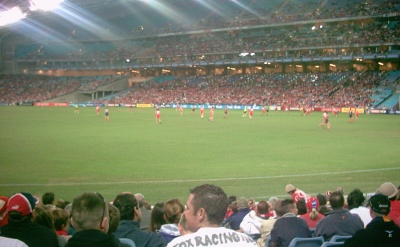
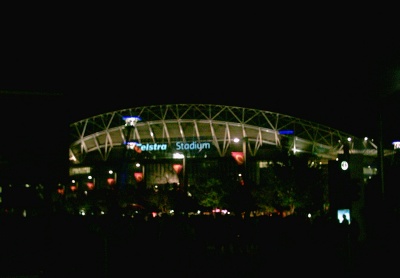 The game was an Australian rules football game between the Sydney Swans and the Melbourne Demons. The atmosphere inside the ground was extraordinarily pleasant. Unlike in certain sports I could mention, the home and away supporters were not segregated from each other, and the atmosphere was enormously pleasant, however fanatical were the Melbourne supporters. (And boy, are the Melburnians fanatical). With 18 players on each side, seven umpires, and certain strange figures called “runners”, who carry messages from the coaches to the players while the game is going on there are as many as 45 people on the field at once.
The game is lightning fast, and completely incomprehensible to foreigners. While many Australians think that Aussie rules football is a matter of life and death, in global terms the game is incredibly insignificant. Both teams could probably be bought for what Roman Abramovich spent to bring Damien Duff to the Chelsea Football Club in London.
As it happened my team, the Swans, ended up losing. But there are some compensations. Sydney people are enormously proud of their lifestyle, which involves going to the beach a lot, eating fine food, relaxing, and simply enjoying what life has to offer. And that applies at football matches as much as anywhere else.
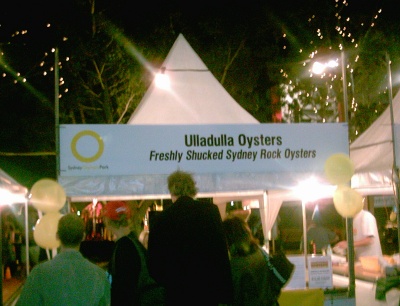
And however many millions Mr Abramovich has spent, I seriously doubt that there is a bar where Chelsea supporters can enjoy oysters together after the game, as there is in Sydney. And even if there is (ha), they are certainly not this reasonably priced. And even if they are that, I am sure they are not freshly shucked.
According to super-rich, property magnate Will Hutton, we are all Europeans now:
There are strong reasons for Britain to want more than a common market like the rest of Europe, and to try, in the process, to create the European public realm we currently lack. We share, despite a multiplicity of languages and histories, the same core values – a belief in the social contract, an adherence to the idea of the importance of the public realm and shared views that capitalism must be fairly run.
Hutton’s Europe: a land of permanent paternalism.
I wonder if Mr. Hutton’s tenants have to tug their forelocks and call him ‘sir’?
Today I bought a great book in a remainder shop. It is a year by year history of London, strong on strange and intriguing events, not heavy with the theorising. Lovely.
It is a blogger’s delight. I have already culled three postings from it – two for here and a ‘how very odd’ posting here.
Here is another fascinatingly odd factoid, entry number six for the year 1729:
WIFE-SELLING IN THE CITY
It was reported that ‘Last Wednesday one Everet, of Fleet Lane sold his wife to one Griffin of Long Lane for 3 shilling bowl of punch; who, we hear, have since complained of having a bad bargain.’
A salutary reminder that ‘Christian’ men could be fairly primitive to Christian women, not so long ago. Many Muslims still are, of course. But if we Christians can mend our ways, they surely can too.
A team from the EU Commission is hotfooting it off to North Korea in the wake of that ‘minor-train-incident-which-never-happened-and-anyway-even-if-it-did-it-was-caused-by-reactionaries‘:
Development spokesperson Jean-Charles Ellermann-Kingombe said on Friday that a representative from the EU’s humanitarian assistance team in North Korea will visit the site late tonight (early morning local time) to assess the situation.
They may have to fly in some emergency directives. But, on to the truly pant-wettingly, hilarious, quote-of-the-week bit:
Asked whether the EU representative would be allowed to get a clear picture of the situation on the ground given the secrecy of the Pyongyang regime and the time elapsed since the accident occurred, Mr Ellermann-Kingombe pointed out that they had been invited by the authorities to visit the site.
“We have no reason to question their intentions”, he said.
And probably no motive either.
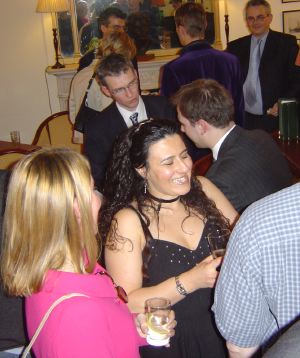
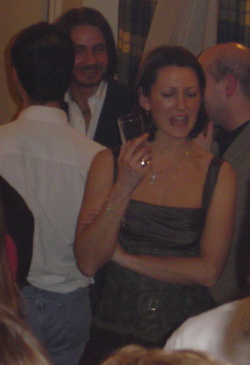
St. George’s Day Party at the New Cavendish Club, ergo more drinking and less blogging 
Glenn Reynolds has reported some recent photos purportedly showing flag drapped coffins at Dover Air Force Base are a hoax. According to a NASA headquarters statement, the pictures are actually of the coffins of the Challenger astronauts:
An initial review of the images featured on the Internet site www.thememoryhole.org shows that more than 18 rows of images from Dover Air Force Base in Delaware are actually photographs of honors rendered to Columbia’s seven astronauts.
Apparently a number of news outlets fell for it hook, line and sinker.
|
Who Are We? The Samizdata people are a bunch of sinister and heavily armed globalist illuminati who seek to infect the entire world with the values of personal liberty and several property. Amongst our many crimes is a sense of humour and the intermittent use of British spelling.
We are also a varied group made up of social individualists, classical liberals, whigs, libertarians, extropians, futurists, ‘Porcupines’, Karl Popper fetishists, recovering neo-conservatives, crazed Ayn Rand worshipers, over-caffeinated Virginia Postrel devotees, witty Frédéric Bastiat wannabes, cypherpunks, minarchists, kritarchists and wild-eyed anarcho-capitalists from Britain, North America, Australia and Europe.
|






Recent Comments