We are developing the social individualist meta-context for the future. From the very serious to the extremely frivolous... lets see what is on the mind of the Samizdata people.
Samizdata, derived from Samizdat /n. - a system of clandestine publication of banned literature in the USSR [Russ.,= self-publishing house]
|
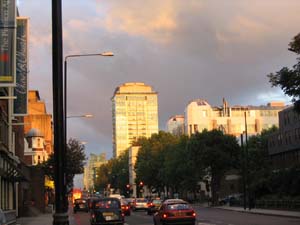
The evening sun that illuminated one of my favourite views near where I live was especially dramatic this evening. And this little photo of how things looked is surprisingly effective I think. Even the little thumbnails I got I scrolled through all the pictures in Photoshop to choose a good one looked rather impressive.
But if you would like to see this rather bigger, then click on it.
I suppose there are some readers of this blog who will say, when confronted by images like this: what has this got to do with blah-blah-blah-ism (or whatever word they choose to give to the political assumptions and axioms we tend to favour here)? But, even though many readers may be puzzled, the fact is that our standing orders here are to write about what is on our minds. And what was on my mind when I went shopping earlier this evening was not the EU or the level of taxation or the importance of consenting relationships. It was how beautiful that usually quite mundane building over towards the river can look when it catches the evening sun just so, and especially when the sky behind it is also doing dramatic things of its own.
This kind of thing does make me want to have a more expensive camera, though, plus some lessons in how to use it. Because what my cheap little camera shows you is only a pale shadow of what I myself saw.
We have a posting category called “How very odd!”. Now I want one for “How very beautiful!” Meanwhile, “Architecture” will have to do.
I recommend this article about the Organization for Economic Cooperation and Development (OECD).
It reminds us here, if any of us need reminding, that even if we do manage to shake our country loose from the EU, there is still a ghastly alphabet soup of international organisations lying in wait for us.
Representing mostly high-tax European nations, the OECD thinks it is unfair when jobs and investment move from high-tax to low-tax nations. The bureaucrats are particularly upset that so-called tax havens provide a refuge for oppressed taxpayers from welfare states like France, Germany, and Sweden. As part of its anti-tax competition project, the OECD met in Berlin for a two-day conference during the first week of this month, hoping to bully tax havens into helping high-tax nations track and tax flight capital.
Using various threats, the OECD is pushing low-tax countries into providing information about nonresident investors to foreign tax authorities, meaning that any benefit of investing elsewhere disappears once European tax collectors can impose taxes on money invested outside their borders.
Acting as the Gambino family of the tax world, the OECD has pressured places like Anguilla and Panama to sign “commitment letters” pledging to participate in something called “information exchange” – an odd term for a one-way flow of data from “tax havens” to high-tax governments.
The writer of this, Joel Mowbray, focuses on the US contribution of $50 million per annum to this evil enterprise. But what this makes me think of is the fact that, following their recent electoral success, Britain’s UKIP is now being challenged by its enemies to work out some other policies, besides merely saying a big NO to the EU. And I say to such challengers, be careful what you wish for.
The great canard of the collectivists holds that a free-market in healthcare will assuredly result in healthcare providers hungrily pursuing maximum profits while abandoning the poor, the elderly and the vulnerable to a wretched and untreated fate.
So often and so passionately has this big lie been repeated that it is now accepted by most people in this country as an incontrovertibe truth. Nationalised healthcare, they say, puts people’s needs at the top of the agenda where there is no room for ugly money-grubbing.
Only they forgot about ugly bed-grubbing:
A nurse has been jailed for five years for trying to kill two elderly patients at a Cheshire hospital.
Barbara Salisbury, 47, was found guilty of trying to kill them to free up more beds at Leighton Hospital, in Crewe.
Rationed resources require desperate measures. In fact, and given the governmental obsession with reducing waiting times for hospital treatment, I am a little surprised that the Department of Health has not pinned a medal on this woman.
When she finally emerges from her time in stir, Ms Salisbury may well find herself being offered a job back in the NHS as a senior consultant.
Yesterday Michael Jennings introduced me to Skype, a sort of instant messaging program that is very good at voice communications. This is part of an ongoing trend which is seeing computer networks challenge the traditional telephone networks for business.
Because rather then pay a large sum of money to make an international phone call, I’m now able to speak with Michael in London from my Australian home, for free, and with a better sound quality then I was able to do before.
So as you can imagine, it is a time of fast change in the telephone business. This has implications wider then the share prices of telephone companies.
To encourage take up of VoIP, legislation has been introduced in the US Senate, by Senator John Sununu. The VoIP Regulatory Freedom Act of 2004 is designed to exempt this technology from most state and federal regulations.
Needless to say there’s been plenty of opposition to this. Much of the opposition comes from self-interested telephone companies, but the US Dept of Justice is not happy either.
The VoIP Regulatory Freedom Act of 2004, sponsored by Senator John Sununu, would exempt VoIP service from a wire-tapping regulation called the Communications Assistance for Law Enforcement Act, or CALEA, commonly used to listen in on traditional telephone calls, said Laura Parsky, deputy assistant attorney general for the DOJ’s criminal division.
“I am here to underscore how very important it is that this type of telephone service not become a haven for criminals, terrorists and spies,” Parsky told the Senate Commerce, Science and Transportation Committee Wednesday. “If any particular technology is singled out for special exemption from these requirements, that technology will quickly attract criminals and create a hole in law enforcement’s ability to protect the public and national security.”
You can read Laura Parsky’s complete testimony here
What this statement is all about is that the Dept of Justice has got quite accustomed to using the wiretap to track down undesirables and is most unhappy that this legislation might prevent them from doing so in the future.
This is part of a wider trend that I suspect we will see more of, with people taking the opportunity to try out new ways of communicating with each other, and regulatory agencies scrambling to keep up. In the United States, there are US Senators who seem, like Senator Sununu, who consider privacy issues and freedom from regulation important. I fear that when the EU catches up, as it surely will, that those issues will be the least of the concerns of the people who draft the regulations.
So far, I have not been all that enthused by the Euro 2004 European Championship football tournament being held in Portugal at the moment but finally, it appears, the sporting event has sparked into life. This evening, Croatia came close to beating the former champions France, in a thrilling game. Earlier in the day, England, who lost their first game in the last minutes to France, managed after some hiccups to overwhelm Switzerland.
All to the good. I must say that watching some of the matches has reminded me of why, despite my annoyance at the antics of highly paid sportsmen, I still love watching football, and why I despise those who think it is amusing to sneer at we plebs and our love of what Brazil’s Pele called the “Beautiful Game”.
Take this piece of drivel from an anti-sports snob, for instance:
The players are even more loathesome than the fans. All professional sportsmen are more or less imbeciles, of course, but only footballers manage to be so utterly charmless with it. They are essentially overgrown spoilt children, diving and rolling around pretending to be injured, and practically wetting themselves whenever someone scores. There is a general, and sometimes quite fantastic, ugliness. If I had my way, I would have them all shot.
I wonder if the author of this piece would like to pass on his profound thoughts to one of the England team? Seriously though, for all that I despise the moronic behaviour of certain England football “fans” causing mayhem, I also despise a certain kind of anti-sport snob who imagines he or she is being terribly daring and original by sneering at the pleasures of the ordinary guy and his enthusiasm for team sports.
Oh well, come on England!
I have known for quite a while that the hierarchy of Roman Catholic Church in England has decided that it no longer wishes the Church to be a force for moral suasion but would rather simply act as a political lobby, seeking to use the force of the state to compel behaviour it approves of rather than allow moral choices to remain in hands of thier parishioners (or anyone else for that matter). It is good to see articles in the mainstream press saying much the same thing and holding them up to a spotlight.
I would hope that Roman Catholics who view the political secularisation of their church do not just meekly sit in their pews and listen to the advocacy of coercive statism without a murmur. If the Church wants to act like a political organisation, people should have no compunction treating them like nothing more than that… and there are few ways better to get an institution’s undivided attention than starving it of funds.
If the leaders of the Church in England want the state to take your money regardless of how you feel about that, rather than bending their efforts to urging you to give it to charitable works of you own free will, then might I suggest to Church-goers that they remember that when the collection plate comes around during mass… but do not just decline to part with your funds, tell your priest that you will not do so and why.
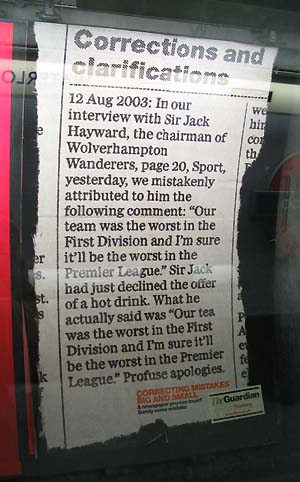
Here is a poster I snapped in the London Underground the other day, through the Jubilee Line glass screen at Waterloo. It is quite amusing, but should they really be boasting about things like this?
And look down at the bottom. Is this a conclusion they really ought to be proud to be drawing? Or is the implication that if they ever do make any mistakes, they are all just typos?
Detail of the bottom corner, with a bit of help from Photoshop to make it more readable:
So, may we now expect a poster with a big mistake corrected?
We have been supporting state centralised socialistic stupidity and stagnation for, you know, a long time. We were wrong. Sorry and all that. Capitalism has its problems, but it is, we now realise, much better.
DifferentNow guardian.co.uk
Such will not, I suspect, be the substance of my next posting here.
Tomorrow afternoon I am off to Los Angeles… and thence to the Mojave desert to watch SpaceShipOne head for space. I will try to post some more when I get to Rand Simberg’s place in LA.
In the meantime, you can get a copy of the Aldridge Commission Report here. You do not know what it is? Well, then, follow the link! As for me, I am off to bed… there are some rather long days ahead.
It is fashionable to accuse the US of being an imperialist nation due to its extensive activities and interests overseas. The US, though, is sadly short of exotic tropical possessions, in contrast to one of its biggest and most self-righteous detractors, France, which is still a true imperialist, presiding over a bona fide colony of brown-skinned natives who have had the temerity to express a desire for independence.
Now, I am not sure exactly what the political arrangements are with respect to Tahiti. It is interesting to see that the French are placing their own self-interest ahead of Tahitian independence.
France is likely to oppose any move towards independence. Thousands of French troops and civil servants are based on Tahiti.
And a sweet posting that must be. 
“French Polynesia is part of France’s aspirations to have a presence in every ocean and any loss of territory would have an impact on their status as a power with global reach,” said Mr Maclellan. “The territory also has a huge exclusive economic zone, with rights to fishing and sea bed minerals.”
Classic imperialist/exploitative greed, non?
The Tahitians have been heavily subsidized by France, a way of getting French taxpayer to foot the bill for the aforementioned sweet civil service postings and for whatever sweetheart deals French businesses get for all those fish and minerals. However, in a real shocker “allegations of corruption, poor economic management and a desire for fresh political blood” have led to a political victory for the pro-independence party over the political hacks who stood for continued subjugation to the French imperium. In the punchline, the new leader is aligning himself more closely with the nearby Anglosphere nations.
Will the usual suspects who decry US imperialism at every turn show up to protest the real item when practiced by the French? Will there be international objections to the heavy-handed tactics the French bureaucrats will employ to defend their perquisites? Will one of the last outposts of colonialism disappear? Stay tuned.
This past weekend, I took a friend’s baby daughter for a long walk (or, more accurately, a long push – she can’t yet walk, so was in a buggy/stroller). The ducks that reside at a nearby lake are usually a safe bet when one wants to keep this particular child entertained, so that’s where we headed.
As the baby clapped and giggled at the animals – They’re not that funny, I sniffed. She kept laughing anyway. Kids, eh? A man arrived on the shore carrying a cage that contained a baby duck. He had rescued the animal the week before, he told me, after a member of the public had called the Folly Wildlife Rescue to report that the duck was caught in some fishing line. Initially, it was believed that the duck would have to have its leg amputated, but fortunately the vets were able to save the animal’s life and its leg.
I asked the man about Folly Wildlife Rescue, and he told me that it is an exclusively volunteer effort, with absolutely no form of government subsidy or other state support. It relies entirely on donations from the public and its own fund-raising activities. He himself is not paid a penny for the time and effort he puts in to this endeavour, and neither is anyone else involved.
In addition to the entirely noble goal of trying to educate the public about how they can prevent accidental injury to animals and caring for those animals when they do get hurt, I approve wholeheartedly of people taking the initiative to launch and maintain this kind of volunteer effort. It is refreshing to see Folly Wildlife Rescue performing such an admirable service without relying on the state to write the cheques. And I am pleased that they get enough donations to treat thousands of animals and inform the public about the dangers posed to wildlife by seemingly innocuous activities.
For years, Folly Wildlife Rescue – including its intensive care unit and other medical facilities – has been run from the home of Annette and Dave Risley in the Kent and East Sussex borders area of South East England. Due to the huge volume of animals they are treating, this is an impractical set of circumstances, both presently and in the long term. Because the price of property in this area of England is so high, it is expected that Folly Wildlife will have to spend at least £400,000 (more than $730,000US at current exchange rates) in order to buy suitable premises for their operation.
If you are at all impressed with the dedication shown by the volunteers who run and raise funds for this rescue operation that is untainted by money taken from taxpayers, I would ask you to consider throwing a few ducats their way. If you are not able to do that, you could support them by using their Amazon affiliation link when you shop at that online store, or simply drop them an email (address here) to let them know you are behind them and wish them luck. After all, someone has got to give injections to sick badgers and put bandages on injured hedgehogs, and I am pretty glad it is not me.
More to the point, Folly Wildlife Rescue is the kind of thing any supporter of a smaller government should gaze upon with gratitude. Please consider doing what you can to communicate that gratitude to the people behind the effort.
As our long time readers know, I spent much of the 1980’s as an academic research scientist at Carnegie-Mellon University. Because of this, I am a member of the academic pension fund organizations called TIAA and CREF. As with any such organization, they have annual elections, proxies and oft-times one or more ‘Participant Proposals’ up for vote. Academia being, well, academia… such proposals are most often of the form “divest of stock in companies doing business with X” or “any business that makes Y”, where X and Y belong to the set of Politically Correct causes.
So imagine my surprise when I found the following:
Resolved: No Funds shall be invested by CREF in any entity brought to its attention that publically advocates firearm control legislation or repeal of the Second Amendment to the U.S. Constitution.
I voted for it, just for badness. I actually quite agree with the Board of Trustee’s statement that investments should be made on a purely financial basis.
The measure will not pass… but it is the thought that counts.
Yesterday afternoon, I visited my mother, and elder brother Toby also dropped by. He was a UKIP local council candidate in the recent elections, and did quite well, that is to say about as well as UKIP candidates did in the rest of the non-London southern part of England.
He said a number of interesting things, interesting to me anyway. He said that the EU’s accounts have not been audited for a decade (i.e. it is a criminal gang, financially speaking). He said that when canvassing, you do not waste time by arguing. You just say you are from UKIP and say please vote for us, and leave it at that. (Talk about their flowers.) He said that Kilroy had helped UKIP a lot. He said that UKIP had done well in a great doughnut, so to speak, of places which are not London itself, but which are all around London – the South East, the South West, the Midlands, East Anglia. He said that UKIP people and Conservative people get along really well with each other, and that the Conservatives often now talk and behave as if they and UKIP are on the same side, which for all practical purposes most Conservative activists are. (UKIP gives them a stick to beat their leaders with, and an exit if their beating up of their leaders gets nowhere.)
I found all this pretty interesting, although maybe this was because he is my brother, and we have always got on well, and also because I do not now read the newspapers as avidly as I might, every day.
But the most interesting thing Toby said concerned UKIP’s money. UKIP has, he said, a lot of money. → Continue reading: Why Toby Micklethwait is so optimistic about UKIP
|
Who Are We? The Samizdata people are a bunch of sinister and heavily armed globalist illuminati who seek to infect the entire world with the values of personal liberty and several property. Amongst our many crimes is a sense of humour and the intermittent use of British spelling.
We are also a varied group made up of social individualists, classical liberals, whigs, libertarians, extropians, futurists, ‘Porcupines’, Karl Popper fetishists, recovering neo-conservatives, crazed Ayn Rand worshipers, over-caffeinated Virginia Postrel devotees, witty Frédéric Bastiat wannabes, cypherpunks, minarchists, kritarchists and wild-eyed anarcho-capitalists from Britain, North America, Australia and Europe.
|






Recent Comments