We are developing the social individualist meta-context for the future. From the very serious to the extremely frivolous... lets see what is on the mind of the Samizdata people.
Samizdata, derived from Samizdat /n. - a system of clandestine publication of banned literature in the USSR [Russ.,= self-publishing house]
|
Vanguard Response Systems, a Canadian company, is now testing equipment for containment and mitigation of the effects of radiological weapons.
This type of weapon, now commonly mis-labeled a ‘dirty bomb’, is a conventional explosive device packed with bits and bobs of medical or other radiological sources in place of bolts and nails. Such bombs would kill few if any persons not killed in the initial blast. They are weapons of mass annoyance rather than destruction and have entered the WMD lexicon due to the modern phobia of all things ‘nuclear’.
Vanguard supplies various sizes of containment ‘tents’ which are placed around the weapon. The tents are then filled with a foam. Should the device explode, the kinetic energy is soaked up by the foam and tent. They claim all of the bomb fragments are thus contained.
We noted that Our Man in Basra, spurred to action by some less than informed commenter(s), to put it mildly, in the comments section of our post expressing outrage that the government has not greatly reinforced UK forces in Iraq. As he has so courageously by-passed his ‘handler’ and put much interesting information in a comment, I shall give you the full juicy goodness of Our Man in Basra (perhaps I should take this opportunity to rename him to Our Man in British Army), herewith:
As I notice I am being referred to, under my pseudonym “Our Man In Basra” (not I am no longer working, I should say) I thought I would throw my two-pence worth in.
Do UK troops need more equipment? Absolutely, enough personal radios, body armour, working Land Rovers – I could go on for hours. (In fairness, where I was the food was excellent). Some more helicopters would be hugely useful, but beyond fantasy as a hope.
However, more troops – abso-bloody-lutely. I cannot comment in detail for reasons that I take to be obvious, but to give generic examples of why more troops would be useful in a counter-insurgency
- More patrols, at more frequent intervals, so you can dominate the ground, throw uncertainty into your enemy, and essentially take the initiative. As all the military experts commenting above must know, having the initiative is the key to winning any kind of military confrontation. And if all your troops are tied up guarding your bases and vulnerable points, you cannot do anything to get the initiative. You cannot reduce the number of bases (much) or vulnerable points, so you need extra troops. QED.
- More (reliable) troops to guard the vital infrastructure, i.e. the electricity and oil lines. Not necessarily by sitting on them, but by frequent unpredictable patrols.
- Troops to act as dedicated QRF (Quick Reaction Forces), so that you can react rapidly to any enemy action- so that eventually he learns that any attack by him gets a very rapid response, thereby reducing the scale and effectiveness of what he can try.
- More guards for your own installations – not necessarily to boost the number on guard, but so you can rotate them more regularly, and keep them fresher/more alert.
- Crowd control. One man with a machine-gun can shoot a loot of people. But if you need to control a large angry crowd with sticks and stones, and you do not want to shoot – well then you need a lot of hard men with batons. Crowd in Iraq are in the 100s and up. That means you need a lot of troops – crowd control is labour-intensive. Unless you want to take the capital-intensive solution, and start shooting.
I am sure readers can think of plenty of other tactical uses for extra troops. At the higher level, the more troops you have, the better you can rotate them and manage their morale, thereby avoiding the kind of cynicism and depression. Soldiers thinking I hate this hole, I’ve been here 9 months, I’m exhausted and I’m not leaving for another 6 months. Who gives a shit what happens to the Iraqis? undermines the basis of counter-insurgency, hearts and minds. The British rotate our troops far more frequently than the Americans (average 4 months versus over a year), which IMHO is one reason for our relative success at hearts and minds.
The idea is not to carpet the country with troops, Boer War-style – although it may be worth noting that such an approach would actually work if we had enough troops. No, the idea is to have enough troops to do what we are doing now effectively.
To address some ‘issues’ raised by a particular commenter that goes by name Charlie who says: But if there were more soldiers, that would mean more opportunities for opportunistic attacks and therefore more casualties.
So, if there were no troops, there would be no opportunity for opportunistic attacks? True, but the point is not just to minimise casualties, or else why go there? The mission (should) come first, followed very closely by what our American cousins call “Force Protection”. And that means you need enough troops to do the job.
In this case, the job is not protecting our troops, it is protecting the poor average Iraqi from all those who seek to prey on them, from ex-Saddamites to gangsters to religious fanatics (or at least those who claim religious backing for their own grab for power).
There is an amount required to do the job. At present it might be thought that a great deal of what we are doing is being driven by a desire to minimise our troops numbers and expense, rather than to actually do what is best for Iraqis (and in the long term for us).
Of course, one way to make do with fewer troops is to use what are known as “force-multipliers”, anything that increases the effectiveness of your troop numbers. A good example is the helicopter, because it enables you to dominate larger areas of ground with fewer troops. But the UK has nowhere near the helicopter numbers of the US, because of far smaller funding. Another potential force multiplier would be reliable British Arabic translators. But to have lots of those ready to go would require more funding for Defence languages. You get the idea.
Also, in this type of operation in particular, the distinction between “combat” and “non-combat” troops is spurious. The RMP [ed. Royal Military Police] took a lot of casualties, I do not think they would appreciate being told they are not needed to fight. They, and many other supporting troops, are in great demand to, for example, run PW camps, which I would suggest is better than giving the job to reservists, as well as all kinds of other tasks – from advising the infantry on how to effect arrests while on patrol, to helping to train the Iraqi Police Forces.
That said, more infantry would be good as it would avoid the need to use other troops, such as RMP or Artillery, to perform patrolling functions, in which the Infantry are the specialists. As another commenter, Jacob, actually correctly points out, you can always use more soldiers in any kind of fighting situation. This point was made quite simply by Field Marshal Slim, one of the greatest military minds in history. I highly recommend his book “Defeat into Victory”, I think mentioned on Samizdata before. The more you use, the fewer you lose.
Unfortunately, having said all the above, there simply are not that many soldiers left in the Army [ed. British Army], and there are still many commitments elsewhere – from Northern Ireland to the Balkans, not to mention Afghanistan, Sierra Leone, etc etc. The “Harmony Guidelines” which said that for the sake of their families soldiers should get at least 18 months at their home base between operations are already a poor joke. We might need to send more soldiers, but unless we cancel everyone’s leave, we haven’t got them.
Sorry, rather longer than I planned, but I thought it was worth saying.
If you meet Liberal Democrats trying to claim that after the local government elections that Britain now has three-party politics, tell them that after the European elections it actually has four-party politics; and their party is fourth.
I have long thought that Liberal-Democrats deserved to be rounded up and kept in high security prisons. However, a friend suggests a more useful alternative. Why don’t we use genetic engineering to breed a four-headed hydra with the likenesses of Hayek, von Mises, Friedman and Reagan? It could seek out Liberal Democrats, wrap itself around them, and suck the collectivism out of them. The discarded husks could then be shredded and recycled as packaging for the fast food industry.
The story of the next general election is one of three party politics
Charles Kennedy, Liberal Democrat leader
Sure, Tories, Labour and… UKIP? 
Skiing in Australia might seem rather like sunbathing in Britain, but just as there are actually beaches in the UK, so there are indeed ski slopes to be enjoyed in Australia. And the Australian skiing industry has been around for quite a while in its own quiet little way. In some sections of the Australian community, it is an annual feature to have a trip to the ski slopes in August or September.
The industry lives in terror of global warming, which is forecast to reduce the amount of snow available. However, since even the most rabid statist accepts that there is no way for the government to change the climate, the Australian ski industry has conceded that there’s no point pestering the government about it, and have decided instead to do something about it.
But the crucial factor in sustaining the industry is an increase in, and better application of, snow-making.
“Each of the resorts told us what type of depth they would like throughout the year, and we were able to use a model to show that that profile throughout the year would tend to become lower, and to compensate for that they would need to invest in between 11 and 200 per cent more snow guns,” says Hennessy.
Colin Hackworth, managing director of Australian Alpine Enterprises, which runs the Victorian snowfields at Mount Hotham and Falls Creek, says snow-making is now vital to attracting crowds.
“As the industry has embraced snow-making, we have been able to provide a more consistent product, which has given people more comfort when booking a ski holiday,” he says.
Hackworth says snow-making technology continues to improve and artificial snow can now be produced at up to 10C.
It’s not the only challenge that the Australian ski-industry faces, but once again they are trying to solve their own problems, rather then whine about it.
It’s funny how that happens, isn’t it?
It has been reported that the 700 strong 1st battalion of the Princess of Wales’s Royal Regiment has been in contact with the enemy every day for the past six weeks, racking up 250 seperate combat incidents.
Capt Justin Barry, a military spokesman, is quoted in the Daily Telegraph:
The fighters engaged were basically terrorists and gangsters – people who are out to destabilise the area, drive out the Coalition and suck as much out of Iraq as they can. But at the end of the day, we got the better of them. The Princess of Wales’s Royal Regiment were engaged in very heavy hand-to-hand fighting and bayonets were fixed. There’s a great sense of satisfaction among the men with the way this turned out.
Indeed, but no thanks to Tony Blair. The fact the government has not greatly reinforced UK forces is nothing short of a national scandal.
The Guardian reports that a number of VIP clubbers at a Barcelona nightclub have been implanted with a chip in their upper arm. Steve van Soest, spokesman for the club explains:
One of our owners wanted to do something special for our new VIP section. He’d read about the chip in newspapers, so we started to see if it was possible and legal here in Spain. It was.
Since its launch, 25 people have had the chip injected into their upper arm by a registered doctor at the club, which also plans to use the technology in its sister club in Rotterdam.
Now, however despicable and unacceptable I find compulsory tagging and identification, this is voluntary. These people have chosen to have the chip injected and I see no reason to get excited about that. I will, however, object to the state or other institutions forcing me to do it either by straightforward coercion backed by law or by not giving me a choice.
… and leading directly on from how the state uses cameras to mess people around, here is another story (from the same source – top right column again – June 3rd) about a capitalist-supplied camera that helps motorists, and also anyone they might otherwise fail to notice and drive into.
Simply, on the very front of the car, some capitalists have attached a camera that can see sideways in both directions. Inside the car, there is a screen showing the (two) results to the grateful driver.
At the home where I grew up, and where my mum still lives, driving out past those high hedges and that high wall and across that very narrow pavement into the road was and is still a perpetual worry, with much craning of the neck forwards and asking of any front seat passenger to help by doing likewise. I do not use a car now, but when I did, I used constantly to think how handy such a camera would have been. Well, if I ever get another car, I may be able to have just such a camera on it.
Apparently these gadgets are already very big (metaphorically speaking – they are of course literally tiny) in Japan, where they were first devised and have first been made available. Japan is a land, I would guess, with many awkward little corners and hard-to-negotiate exits. As is ours.
The state is not your friend. Business has to be, or it goes out of business.
Patrick Crozier’s Transport Blog has a valuable service at the top right of the blog, in the form of links to transport related articles. (Most of the media do not seem to have a special category for “transport” stories, the way they do for “education” or “arts”.) Patrick adds very little in the way of accompanying commentary to these links, but others can comment, and on this story, several people did. I missed this when it first came out, but it seems to me worth making a fuss of, even if belatedly:
A pensioner who warned motorists of a police speed trap was convicted of wilfully obstructing a constable in the execution of his duty, banned from driving and ordered to pay £364 costs yesterday.
Stuart Harding, 71, was attempting to slow motorists down as they approached a Sunday morning car boot sale where many people were crossing the road.
Noticing that police were parked nearby with an officer using a hand-held laser speed camera, he decided that a warning stating “Speed Trap – 300 yards ahead” would be the most effective way of getting drivers to reduce their speed. But as soon as the officers noticed his placard he was cautioned for committing an offence.
And there seems little doubt that it was this sign that was the “offence”.
Robert Manley, prosecuting, said: “In displaying this sign the defendant was giving motorists advanced warning of a road safety camera being operated by the police 300 yards further along the road.”
The supposed idea of speed cameras is to dissuade people from breaking the speed limit. Mr Harding was also dissuading people from breaking the speed limit. Yet this is something that a prosecutor considers it proper to denounce Mr Harding for doing. And what is more, the court agreed.
I suppose you could just about argue that if we were all allowed to put up signs about speed cameras, we would all be at it, and we would all accordingly only have to obey the speed limit where there was a warning sign, instead of all the time as we should.
But I prefer Andy Wood’s explanation, which he links back to in his comment on this story. The income from speed cameras goes to local police forces, and they use cameras, and place their cameras in the first place, to raise revenue rather than to dissuade dangerous driving, the problem with dissuasion being that if it succeeds they get no money out of it.
So, watch out. If someone is committing an offence for which he is liable to be fined, do not, whatever you do, try to dissuade him. You will be “wilfully obstructing” the police in their attempts to fleece us of our money whenever they can.
I suppose the next question is: would it be wrong to encourage people to commit such offences? Would the police have any objections to that? Presumably not.
More seriously, this illustrates the general principle nowadays, that the state would rather tax and torment and generally mess with law-abiding, and even, as in this case, actively law-upholding citizens, rather than go after real criminals. Criminals are just too much bother to deal with. Moral: be a criminal. Seriously. The government is always jabbering away about how this or that measure might “send the wrong message” – usually what they say is that if they do not forbit some harmless and utterly unaggressive thing they might be interpreted as encouraging it. Well, what kind of message does prosecuting Mr Harding send?
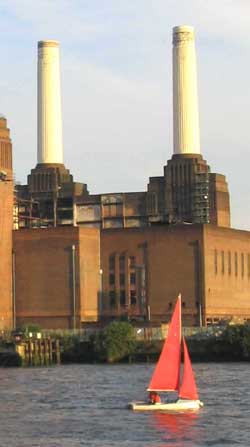
Trade here seems to be rather thin (although since I first put that it has got a bit thicker), just as it seemed to be this time yesterday. And this time yesterday I started concocting a posting (for my Culture Blog and to link to from here) about the strange things to be seen on or from Chelsea Embankment, just to the south of Samizdata HQ (which I was visiting the other day for reasons that need not concern you). This morning I finished it. Thinking about this posting some more, I now consider the ducks to be rather mundane. But the red sailed sailing boats and the bus are quite fun, I think.
Here is one of the red sailed sailing boats.
The point is that you do not see little sailing boats on the river in London very often. I seldom do, anyway. Follow the link above to get to a bigger version of this picture, and for the bus and the ducks, and for further commentary.
The UKIP has just become a significant force in British politics. Will it last? I have no idea. But the fact is that the UKIP is now a major player in the European Parliament and allegedly gained almost 16% of the vote where they stood.
And yet this appearance of a new political force in Britain seems to be almost a footnote in most of the articles in the press. Oh, it is being covered, but the fact this upstart party is being examined in such muted matter is itself quite worth pondering. Although I am hardly an uncritical admirer of the UKIP in many ways, I do share their antipathy to the EU and I think that their success does show that a deep vein of disaffection is beginning to come to the surface even amongst Britain’s typically ovine electorate.
And the fact the sensationalist British press is not treating this into a sensation is itself rather interesting.
Nick Denton of Gawker, Gizmodo (etc. etc.) fame is perhaps the best known face on the commercial blog scene and certainly the most quoted these days. I also think he is quite incorrect in his understanding of why people read blogs, which means I think his business model is not one I would care to follow myself. Do I think all of what the redoubtable Denton does is wrong? No, not at all, but I do not really think the foremost advocate of blogging-for-business really understand blogs that well and I do not think he understand the blogosphere at all.
Most people do not look at something because they want to have advertisements shoved in front of them. Old style ‘interruption marketing’ might work when people have few options, say just a few TV channels, and are willing therefore to accept advertising as the ‘price’ for something else they value, but what Nick Denton seems to be saying is that there are lots of people who actually like reading ad-copy and will read blogs that are just well packaged advertisements (or ‘advertainment’ if you prefer) when the Internet is awash with places giving content away and doing no such thing. I simply do not believe that is true. Yet I do believe that there is a role for commercial blogging.
People read blogs to get a different perspective, even if they do not always agree with it. If people want to read a blog which is largely advertisement dressed up in well written urban hip and blog-speak rather begs the question, why would such a person not just stick to established media channels which are filled with endless marketing? Are blog readers really so dim as to not pick out the fact they are just being handed the same old interruption marketing message dressed up in a slightly different way?
I think for a commercial blog to succeed, it must do the same thing as a successful non-commercial blog, and that means it must be interesting and credible to its audience. In fact I would say a blog is a ‘credibility machine’. To use the words of the Cluetrain Manifesto, a blog must speak with the author’s authentic voice if it is to be believed… and it is a rare company indeed who can be authentic if all people hear from them is what their marketing and PR department say.
For a companies and other institutions to blog successfully, and people like Macromedia, The Adam Smith Institute, Microsoft and others do indeed blog successfully, then they actually have to speak in ways that are a long way from a press release that has been carefully worded by the PR department, and a million miles away from copy produced by an advertising agency. No one actually believes that crap any more and sticking it on a blog just makes it stand out like poop on a pool table.
No, if a company wants to blog, it needs to decide that it wants to be forthright and talk to people like human beings… if you have desirable or difficult or complex products and have interesting things to say about them, people might actually be interested in hearing what you have to say if you can convince them you are not just parroting the same old sales pitches served up for the Google Generation.
|
Who Are We? The Samizdata people are a bunch of sinister and heavily armed globalist illuminati who seek to infect the entire world with the values of personal liberty and several property. Amongst our many crimes is a sense of humour and the intermittent use of British spelling.
We are also a varied group made up of social individualists, classical liberals, whigs, libertarians, extropians, futurists, ‘Porcupines’, Karl Popper fetishists, recovering neo-conservatives, crazed Ayn Rand worshipers, over-caffeinated Virginia Postrel devotees, witty Frédéric Bastiat wannabes, cypherpunks, minarchists, kritarchists and wild-eyed anarcho-capitalists from Britain, North America, Australia and Europe.
|





Recent Comments