We are developing the social individualist meta-context for the future. From the very serious to the extremely frivolous... lets see what is on the mind of the Samizdata people.
Samizdata, derived from Samizdat /n. - a system of clandestine publication of banned literature in the USSR [Russ.,= self-publishing house]
|
After his oath to protect the Constitution of the United States President Bush made a speech in which he said he wished people in other nations to be free in their own way.
I hope he meant this, as the examples of the broad American way of freedom that President Bush gave in his speech were ‘the Homestead Act’, the ‘Social Security Act’ and ‘the G.I. Bill of rights’.
The Social Security Act (a government pyramid scheme) speaks for itself. As does free education for ex-servicemen (to call this the ‘GI Bill of Rights’ was an insult to the real Bill of Rights – rights as limits on government power, not excuses for it).
As for the Homestead Act – well this (in 1862 I believe) was an effort by President Lincoln to copy some of the ideas of Jefferson (as expressed in the North West Ordinance) of breaking up land into small farms. In the West it was a terrible mistake – as much of the land was not (and is not) environmentally suitable for farming (as opposed to the big ranches that would have naturally envolved). ‘Water mining’ and soil damage (remember the dust bowl of the 1930’s) were the result of the Homestead Act.
The Social Security Act at least was unconstitutional (or the Tenth Amendment does not mean a thing – and there is no need to list the powers of the fed government in Article One, Section Eight of the Constitution – as the “General Welfare” has been declared a power rather than what is actually the case, that “the common defence and general welfare” being the purpose of the powers).
In short, like most recent Presidents, Mr Bush does not have a clue about the document he swore to defend.
Oh well Presidents do not write their own speeches, and at least there was no plan to go to war with Lower Slobovia to make sure they have got a Social Security Act.
Peter Cuthbertson has some pretty clear views about those who would control us for ‘our own good’
Any Brit who turns their television on to ITV or Channels 4 or 5 now will sooner or later see a vile new National Health Service advertisement, funded by their own tax money. Showing a young man running around bars and shopping centres spraying foul smells into the air and onto the clothes of others, it literally urges people that just as they would not tolerate anyone who does that, they should fight against the freedom of smokers to light up in bars and pubs. An obvious prelude to the government’s campaign to stop restauranteurs and landlords from allowing smoking on their own property, it is no doubt hoped the advertisement will edge public opinion in the nannying direction.
It is difficult to fathom the petty, narrow mind of the sort of otherwise unemployable bureaucrat who came up with this one. But one comes to understand the idea of people feeling aliens in their own country when one sees such things. What a profoundly un-British little broadcast it was. What a sickening way to impose the morality of the elite’s stateless global citizen onto a country whose famous tolerance and fair-mindedness is probably what left-liberal nannies feel necessitates such propaganda – sorry, such a campaign of public education – in the first place. One can only hope enough independently-minded people are emboldened by such spiteful nonsense to take stands on behalf of smoking, one of the few remaining mass activities that genuinely is not in some way anti-social, in an age where it seems few Britons can enjoy themselves in a group without being obnoxious to others.
Somehow worse than this, however, one sees explicit use of taxpayers’ money to campaign for one side on politically controversial areas, over behaviour that is perfectly legal and normal. This is a precedent that should worry everybody.
In any reporting on a quasi-tyranny, the state’s control and use of the media is usually cited to show that a country cannot be a genuine liberal democracy. Chile’s slide into dictatorship in the early 1970s is exemplified by Salvador Allende’s decision to eliminate criticism of his regime by nationalising the press. Today’s Russia is now widely described with the euphemism ‘managed democracy’ to a considerable degree because so much of its television is under state control: the elections themselves are free, but the state-run television stations campaigned strongly for Vladimir Putin in advance of last March’s Presidential election.
It’s because the use by the state of the media to advertise its own virtues and ideals is so symbolic of a wider lack of freedom that it is such a good indicator of the health of a society. The state is effectively limitless in its power to take by taxation anything people earn and produce. When it also feels free to use that money to take political stands, often stands opposed by the very people who pay these taxes, that is a signal of an overmighty government, wherever it exists.
When the state, as distinct from any political party, takes on the role of encouraging people to have the correct views and oppose the right habits, the liberty of everyone is made immediately more precarious. There is a very great supply of petty nannies with a favoured cause, and altogether more dangerous authoritarians and social engineeers with their own pet projects, who would love to get their hands on the power the NHS is now abusing. Rest assured, they will find ways of doing so if the precedent now being set is not reversed.
Although I may not live to see it, I am nonetheless very confident that the day will come when the idea of compelling children to attend schools will be regarded with the same contempt and revulsion that is now directed at the idea of slavery.
That day is hastening:
A school in Swansea is considering tagging its pupils because of a shortage of assistants who can supervise lunch breaks.
The idea is for children at Lonlas Primary to wear the tags all day, with a buzzer sounding if they leave.
I welcome this development and I sincerely hope it spreads because it will make it impossible to deny that state schools are anything other than day-prisons.
The Labour government is planning to introduce ceremonies for ‘citizenship’ and ‘coming of age’ to add the imprimatur of The State to being ‘British’. Yet surely one of the things that has always made the British so different from many of the people’s of Continental Europe who live with the legacy of Napoleon is that we have not really needed the state to tell us via ceremonies and ID cards that we are British… or that we are in reality ‘subjects’, a far more honest term that ‘citizen’. Even the United States has its strange hand-on-heart ceremonies in some schools in which they pledge of allegiance not just to the principles of constitutional governance but also to a bit of coloured cloth. Yet in Britain such notions of social identity have generally been, well, social and not some propagandising artifice of the state.
This is yet another part of moving Britain into the more Napoleonic traditional in which the state is the core around which everything rotates in a politicised fashion and the highest virtue is political engagement (not a view I share, to put it mildly, given my view of politics). Such things are alien in this country and yet another sign that our political masters are obsessed with the fetishizing democracy as a way to make as many aspects of life as possible political in nature and requiring the intermediation of the state for ever more things. Such ‘ceremonies’ may be banal but what they represent is far from trivial.
I like airplanes, but am rather suspicious of this huge new Airbus that they have just rolled out, handsome though it does look and useful though it will surely be in many circumstances. In particular, I suspect that the A380 is costing Europe a whole lot more than is being officially suggested, and that Boeing decided not to build a similar aircraft for good, loss-avoiding reasons.
Well, I still do not know very much about Airbus finances, but this story certainly backs up the costing-more-than-they-are-admitting aspect:
TSUNAMI-struck Thailand has been told by the European Commission that it must buy six A380 Airbus aircraft if it wants to escape the tariffs against its fishing industry.
I realise that it is carrying the search for a silver lining to absurd lengths to say such a thing, but one good thing about this whole Tsunami horror is that it has brought this EU vileness rather more out into the open than would have happened otherwise. As it is, the combination of nastiness and lack of political sensitivity being shown by the EU is extraordinary even by their low standards. Do they not see that the Tsunami has somewhat changed things?
The Thai trade negotiators, not unreasonably, seem to betting that things are indeed now rather different. They seem to be calculating that, if they simply expose the nature of the deal they are now being faced with by the EU, the EU will back down in the face of worldwide disgust, not least within Europe itself. The Thais will get their aid. They will be allowed to sell their keenly priced fish products without punitive tariffs being slapped on them. And they will not have to buy six of these damned great airplanes unless they decide that they want to. All of which is a lot to hope for, but at least they may get more of what they want than they would have done if the Tsunami had no struck.
The EU Referendum Blog has more on this whole sordid episode:
The aircraft will cost Thailand some £1.3 billion – nearly the amount that all 25 EU members states have pledged in tsunami aid to the whole affected region.
Richard North also points out that Thailand was being shafted before the Tsunami in a similar manner. This is not about the EU getting nasty; it is about it remaining nasty.
But that is the EU, naked in tooth and claw. While workers from across world are on the ground, helping to rebuild the Thai economy, EU officials are also right in there – undermining the basis of any recovery.
And according to North, Thailand is not the only country that is being “encouraged” to buy Airbuses with EU trade policy concessions.
The irony is that by swapping a bit of freer trade for aircraft orders, the EU is agreeing, reluctantly, to do itself a favour. It is agreeing to impose the terrible burden of cheaper goods upon itself. But even when it does good things, it cannot seem to help stirring in bad things, like flogging unwanted airplanes.
The decline of post-Soviet Russia continues apace and an article on the Weekly Standard site points out that one of the major exacerbating factors in that decline is Vladimir Putin. The crushing of the media, the confiscation of a large company because it was owned by a political rival on trumped up charges, the failed attempt to direct the result of the Ukrainian elections and the pathetic reaction by the Kremlin to the Beslan atrocity are described at the key indicators of the probably terminal decline of the current regime.
The article is summed up at the end from a very narrowly ‘American policy’ perspective but the most interesting point for me was author Ander Aslund’s contention that the Putin regime is not long for the world. Whilst the Russia of 2005 may be a banana republic without bananas, political instability in a nuclear power that may well be unable to protect its nuclear weapons (Russia’s corrupt and famously inept military are somewhat like the ‘Keystone Cops’ with live ammunition) is something that is of interest to the rest of the world. I wonder when the focus of attention will start shifting away from the Middle East…
“We’re reckless arrogant stupid dicks. And the Film Actors Guild are pussies. And Kim Jong Il is an asshole. Pussies don’t like dicks because pussies get fucked by dicks, but dicks also fuck assholes. Assholes who just wanna shit on everything. Pussies may think that they can deal with assholes their way, but the only thing that can fuck an asshole is a dick, with some balls. The problem with dicks is that sometimes they fuck too much, or fuck when it isn’t appropriate, and it takes a pussy to show ’em that. But sometimes pussies get so full of shit that they become assholes themselves. Because pussies are only an inch and a half away from assholes. I don’t know much in this crazy crazy world. But I do know that if you don’t let us fuck this asshole, we’re gonna have our dicks and our pussies all covered in shit”
– said by a member of Team America in the movie of that name. Says Christopher Price, who posted this in a comment here this morning: “Its got one of the best explanations of US foreign policy that I’ve seen in a long time. Kind of like what Condaleezza Rice was saying yesterday, but more succinct.”
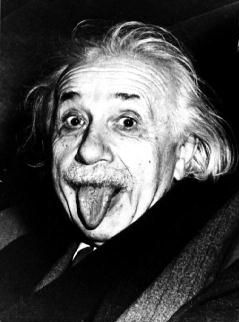
There can be little doubt that Albert Einstein was one of the most influential figures of the 20th Century, as his enduring appeal to so many indicates. How many other people in such arcane fields as theoretical physics and mathematics can generate such interest? Not many.
Yet sometimes I think Albert Einstein is also the poster boy for the axiom ‘stick to what you know’. Of course in Einstein’s case, what he knew was rather a lot: E=MC2 is a legacy that will speak to the centuries.
But then all you have to do is read much of what he wrote about economics and politics to realise how clueless Einstein when it came to many things, with an attachment to nightmarish notions of supranational government. I share Einstein’s distain for nationalism but the cure for the excesses of governments is not super-nationalism but rather a culture of individualism that demands less government rather than yet another tier of it to regulate our lives and take our money.
Likewise in his apologia for socialism, he got it spectacularly wrong in 1947 when he wrote that…
Private capital tends to become concentrated in few hands, partly because of competition among the capitalists, and partly because technological development and the increasing division of labor encourage the formation of larger units of production at the expense of the smaller ones.
…when in fact technology and capitalism means that small business and diffusion of capital have expanded vastly more that ‘one size fits all’ big business since 1947. Technology has created diseconomies of scale in ways that Einstein never imagined in spite of the evidence already being there (pity he did not spend some time with Frederic Hayek). Globalisation (rather than ‘supernationalisation’) of capital markets has likewise put hitherto unheard of quantities of capital into the hands of small businesses beyond counting. He even bought into the daftest and most pernicious economic absurdity of them all, the ‘fixed quantity of wealth’ fallacy.
Albert Einstein. A fascinating genius for sure, but like everyone, he had his limitations.
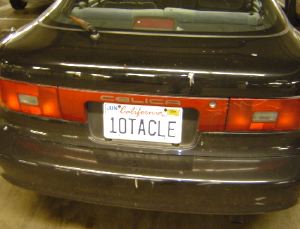
He moves amongst us… in a Celica?!
Down with Kim Jong-il. Let’s all rise to drive out the dictatorial regime.
– written on a Kim Jong-il poster in a North Korean factory
Echoing what our own Johnathan Pearce said about The Aviator, an emailer to Instapundit, Doug Levene, said this about the movie:
What struck me about the Aviator is that it’s the first Hollywood movie I’ve seen in quite a while that portrayed a business man – a filthy rich, ruthless entrepreneur yet – as the hero, and the crusading, anti-war-profiteering, corruption-exposing Senator … as the villain. Am I the only one to have noticed this peculiarity?
Well, Johnathan certainly got the hero bit of that in his review, but the only villains he referred to were Katherine Hepburn’s ghastly family.
The Aviator has just been nominated for 14 BAFTAs, i.e British Oscars, and looks set to do very well at the real thing.
Will there now be more wacky but true-life entrepreneur movies? If there is one thing Hollywood loves even more than its own silly lefty opinions, it is money.
The Conservatives are promising tax cuts. Good for them.
Tax cuts are always more popular than political chatterers think they ought to be, and tax increases are always more unpopular than political chatterers think they ought to be. The chatterers talk a lot and persuade themselves that their opinion about these things is shared, but come election time, provided there are any politicians who have remained unbullied by them, the chatterers are always baffled and disappointed.
Promised tax cuts are appealing to voters, because they have a quite good chance of materialising, and once they do, the voters get to keep the money and spend it how they want.
But when it comes to tax increases, and the accompanying promises of better public services, the picture is very different. From time to time, surveys of the sort that political chatterers take very seriously ask voters a question along the following lines: Would you be willing to accept increased taxes in exchange for better public services? And often the answer comes back: Yes, we would.
However, reality does not ask voters this question. What the promise of increased taxes in exchange for promised better public services actually means is the certainty of increased taxes, but the mere possibility that public services will actually get any better in exchange. The voters’ money might be spent better, but it is at least as likely to be spent on idiotic make-work schemes and political pay-offs. Faced with that question, voters tend to vote: No.
So I say that this is a smart Conservative move. They do not look like they can win any time soon, but this may soften the next blow quite a bit. On the other hand, if the government steals this policy the way it has stolen so many other Conservative policies, that will plunge the Conservatives into further confusion. But I would be quite pleased.
If such tax cuts occur, public services will be no better and no worse than they would have been otherwise. This is because tax cuts are actually a cut in the rate of taxation, rather than in the total amount of tax collected. If tax rates are reduced, the economy cheers up a bit, and the total tax take, from all taxes combined, is as big as ever. On the other hand, if tax rates are increased, as the Liberal Democrats are threatening, the economy stalls, and although the yield from the increased taxes increases, the yield from all the other unchanged taxes declines, and the total tax take remains stagnant. Which is yet another reason why the tax-increases-in-xchange-for-better-public-services idea is so foolish, and why voters are so right to shun it.
|
Who Are We? The Samizdata people are a bunch of sinister and heavily armed globalist illuminati who seek to infect the entire world with the values of personal liberty and several property. Amongst our many crimes is a sense of humour and the intermittent use of British spelling.
We are also a varied group made up of social individualists, classical liberals, whigs, libertarians, extropians, futurists, ‘Porcupines’, Karl Popper fetishists, recovering neo-conservatives, crazed Ayn Rand worshipers, over-caffeinated Virginia Postrel devotees, witty Frédéric Bastiat wannabes, cypherpunks, minarchists, kritarchists and wild-eyed anarcho-capitalists from Britain, North America, Australia and Europe.
|





Recent Comments