We are developing the social individualist meta-context for the future. From the very serious to the extremely frivolous... lets see what is on the mind of the Samizdata people.
Samizdata, derived from Samizdat /n. - a system of clandestine publication of banned literature in the USSR [Russ.,= self-publishing house]
|
This is an interesting titbit, in today’s Guardian:
Peter Mandelson has attacked the BBC’s coverage of Europe and accused Today presenter John Humphrys of “virulently anti-European views”.
In a letter to BBC chairman Michael Grade, Mr Mandelson, the European trade commissioner, says the corporation has a “specific problem with the anti-European bias of some presenters” and said it was failing in its charter obligation to promote understanding of European affairs.
I seldom listen to the Today show, but it is clear from further remarks of Mandelson’s that the Guardian goes on to quote that what Mandelson means by “anti-European views” is “anti-EU” views, which is a typically sneaky piece of EUrophilia. Has Humphrys been denouncing French cuisine, or Italian opera, or German engineering? Has he been saying that the French are all rude, the Italians rotten at driving, and the Germans all crypto-Nazis under a veneer of politeness. Has he been saying bad things about Estonians? No, of course not.
What Mandelson has accused Humphrys of is making EUroscepticism sound convincing, in the following rather interesting way:
The former trade secretary, who was appointed to the European commission last year, says the BBC gives too much coverage to moderate Eurosceptics and not enough airtime to extreme Eurosceptics such as UKIP.
So Mandelson has now become a UKIP supporter. How is that going to look? No doubt it is all part of some cunning plan designed to split the anti-EU camp and present it as all bonkers, xenophobic, etc., but it sounds to me like a somewhat high risk strategy. What if UKIP gets more airtime, in accordance with Mandelson’s demands, and uses it to be rather persuasive?
I wonder if Mandelson also thinks that this man should have more airtime?
People love to demonize greedy bosses who don’t care for their workers. However, after going through this bout of downsizing my company, I know that my surviving employees are not unhappy about the change, because it was accompanied by a renewed sense of discipline and focus. Employees – or, at least, my employees – have understood and responded positively to their boss’ determination to succeed financially. A boss who tolerates low financial returns will not deliver the wherewithal to provide raises and job security. In retrospect, my biggest sin was not in laying people off during my bout of downsizing – despite the pain involved – but in not demanding enough of them or myself previously. In short, I should have been more greedy … I would have been more socially useful.
– Friedrich Blowhard last Saturday, in the course of explaining why he has been obliged to stop blogging for a while
… is also sauce for the gander, so the old saying goes.
The preposterous EU proposal to extend the ban the symbols of the German Worker’s National Socialist Party that is already law in France, Germany and elsewhere, has prompted a move to also ban communist and socialist symbols.
So now let us also ban Imperial Roman symbols (they were a slave owning political system), Christian symbols (Inquisitions, religious wars and sundry other nastiness), Confederate Flags… oh hell, let’s just ban all symbols except the ‘peace symbol’ and the EU symbol.
Via Rex Curry.
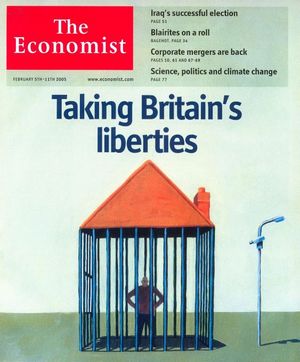
The cover of print version of The Economist is titled ‘Taking Britain’s Liberties’ and the issue discusses many of the very serious abridgements of our civil rights that have recently taken place.
But rather than link to any specific article, what interests me is that the truly grave situation is finally ‘front page news’ in a fairly mainstream publication. It is nothing less than amazing that it has taken this long for the seriousness of the situation to reach the collective editorial consciousness of any significant element of the media outside the blogosphere and other elements of the activist fringe.
Until today I knew nothing of Pete Doherty, but this poor woman knew far too much about him. She had the extreme misfortune to live next door to him.
Ms Latteck, who shared a wall of her maisonette in Bethnal Green, east London, with Doherty, said she had decided to speak out after being incensed by the glorification of the singer as a modern rock legend. “He is presented as some kind of hero. He is not. The truth is that he made me very sick with incessant loud music, day and night,” she said. “It was like having a 100 watt speaker at full volume in my bedroom. The walls and furniture would shake.”
That is the Telegraph version of this horrible creature.
Here is the kind of thing that Ms Latteck was complaining about:
He went into jail rambling and incoherent, but is set to emerge as a poet. Pete Doherty, the drug-addict pop star, will find himself pursued by publishers as well as paparazzi when he emerges from HMP Pentonville tomorrow after being jailed following a rumpus that left a documentary-maker with two black eyes and a broken nose.
Already famous for his drug-fuelled antics as the former frontman for The Libertines, as well as his on-off relationship with the supermodel Kate Moss, Doherty is being seen as a hot property after agents learnt that he had been scrawling volumes of verse since his teens. Publishing houses are bidding to sign up the wayward star, who is due to be released tomorrow on bail after being charged with robbery and blackmail. A source close to Doherty, 25, said that he had been approached by a number of publishers.
Now I know what you are thinking. How good is the Horrible Creature’s poetry? Well, ask a stupid question.
I would like to see the Horrible Creature’s poems make an enormous amount of money, and for all the money to be given to Ms Latteck, with just enough set aside to enable the Horrible Creature to buy enough drugs to kill himself. That is surely what the wiser sort of publishers would prefer. The Horrible Creature is the kind of person who does more good for his fellow humans when dead. When he does die, which surely will not be long now, those who want to can enjoy his poetry and have fun telling each other what it all means, without anyone having any longer to put up with him. Art is often like that, I think.
Rows of dutiful school children in matching desks and matching school uniforms can then study his poems for their GCSE English exams.
Tonight, for about the twentieth time, they showed the movie Pretty Woman on the TV, on ITV2. I like this movie, but I do not like the slurs cast upon the ancient and noble, and thoroughly beneficial, art of asset stripping.
The Richard Gere character is an asset stripper. He buys companies, takes them apart and sells the bits, for more than he paid for all the bits when they were bundled together. This character is contrasted unfavourably with the old man whose warship building company the Richard Gere asset stripper character is busy buying as the movie proceeds. The asset stripper wants to take over the warship company and turn the land it occupies into a place where people will live, in houses and flats. But eventually, we are asked to believe, the asset stripper sees the error of his asset stripping ways, and switches to helping the old bloke to make yet more warships.
Yes, you got that right. Asset stripping is presented as worse than arms manufacturing. And the Pretty Woman herself, the Julia Roberts character, says that the Richard Gere character is just like her. Both screw people for money. This is a cheap shot, based on two different meanings of the word “screw”. But screwing – as in having sex for money – is not that terrible either. And assets strippers do not screw people in a bad way. They buy their property, usually for a better price than they would get from anyone else.
Just where prostitution fits into the wider economic scene I will leave for another day and another argument. No doubt it contributes to economic wellbeing in all sorts of ways that I cannot now think of, although it is not a job I would fancy. But what I do know is that asset strippers do something very valuable. When economic resources are tied up in activities with an insufficient economic future to justify their use in this way, it makes perfect sense for someone to unbundle them and release them into the wild, separately. That there are people who specialise in doing this, who are always on the look-out to ply their trade, injects huge vitality into the economy of the world. Asset strippers ensure that existing resource uses are always questioned, and that the future, when it does emerge unmistakably, is not smothered by the past.
Another of my friends has succumbed to the inevitable and started a weblog, this time my Austin, Texas-based pal Alan R. Weiss. Alan is a tremendous dynamo of a character; he is a former vice president of the Free State Project and still closely involved in that venture. Alan is also a businessman an innovator who has harnessed cutting-edge venture capital financing techniques to accelerate the writing achievements of noted libertarian author and campaigner, L. Neil Smith. My girlfriend and I spent a wonderful long weekend in Austin staying with Alan’s great family last September during a marathon trip around the country. I can strongly recommend Austin as a place to visit.
Oh, and he is also a big Firefly fan. Does the guy have no flaws?
I am aware of the arguments in favour of home-schooling. The educational standards tend to be higher. Children are usually brought up as reasonable human beings and not part of a pack of savages. In principle, home schooling allows for an upbringing that is tailored to each child. The conscription of children in schools is removed.
And then something like this comes along.
There are two benefits of even the most useless schools. Children meet other children their own age, which is useful if one is not intent on becoming a hermit.
Of course there is plenty of unreported abuse that occurs in full view. In some schools abuse is ignored or even inflicted. But most basically of all, a 12 year-old child turning up weighing 35 pounds with burn marks and bruises in rags might be noticed. So having children turn up somewhere where their disappearance or injury will be noticed is a valuable function of schools. Perhaps they need to open twice a month for roll-call and then let them go home?
Shell, the Anglo-Dutch oil company, is reporting very healthy profits which the Daily Express sensationally reported as £300 per second and there has been a chorus decrying this as ‘obscene’ (sundry Labour MPs) and according to Martin O’Neill (chairman of the trade and industry select committee) ‘beyond the dreams of avarice’.
So let me make sure I understand this… of the approximately 80p per litre (about $5.70 per US gallon) charged for gasoline at the pump in Britain, only about 16p is what the oil company charges: the rest is all tax.
And the politicians, who are responsible for four fifths of what is paid by British motorists to fill up their fuel tanks, are stamping their feet and threatening additional ‘windfall’ taxes on the companies responsible for the remaining one fifth of what is paid.
These politicians and their baying supporters are so wrapped up in a culture of value destroying appropriation and predation that they cannot see the true obscenity. To see that they need do nothing more than look in a mirror.
The company should have a large sign on the forecourt of every single petrol station they own in Britain with the following message:
Dear Motorists,
Do you think you are paying too much for your petrol? Well about 80% of what you are paying is tax, so if you want to pay less, do not come to us, go to your MP and ask him why you have to pay so much… and remember his answer next time you get the urge to vote.
Have a nice day.
Royal Dutch Shell
The problem is not Big Oil, the problem is Big Government.
A truly bizarre article has appeared in the American Prospect arguing that President Bush’s proposed social security privatization should be opposed. Why? Because social security privatization has happened in Britain and has been a disaster.
How odd. I live in Britain and work in an economic think tank, and I never knew that Britain had privatized social security. Indeed, the Inland Revenue (Britain’s equivalent of the Internal Revenue Service) wrote to me recently on the subject of my state pension.
Social Security Privatization was floated as an idea after Labour came to power, but it has never become government policy. It was advocated by Frank Field MP, then the Minister for Welfare Reform, who soon after left the Cabinet.
The Prospect article is, frankly, drivel. Social security privatization has not happened in Britain.
Dr Eamonn Butler has more on the UK’s pensions on the ASI Blog.
He may not be the sort of man who gets the attention of the ordinary citizen, or the sort of man one talks about down the Dog and Duck on a Friday night, but New York Attorney General Eliot Spitzer, wannabe Democrat politician and formidable lawyer, is making quite a name for himself as a legal terror of big Wall Street businesses, launching a flood of suits against insurers, brokerages, fund management companies and banks.
Some of his suits may have an element of justice behind them and no doubt he has calculated that bashing the Gordon Gekko classes makes for good copy and will no doubt endear him to the sort of folk who regard Michael Moore as a political seer. To the rest of us, however, who make a living in the financial markets, his zeal is troubling. Take the recent so-called “scandal” surrounding the case of mutual fund firms which allowed certain types of quick-fire trades to happen in and out of their funds. The activity, while not illegal, is considered harmful because it can damage the long term investments of ordinary investors. Well maybe, maybe not. I find it worrying, however, that the cumulative impact of Spitzer’s energies will be to push up the costs of doing business in the U.S. capital markets, and drive many smart would-be financiers into other fields.
We tend to forget that despite high-level scandals such as the collapse of energy giant Enron, the world economy has greatly benefitted from the efficiencies and new products driven by the entrepreneurs of the modern age. My worry about the whole raft of laws spawned in recent years, such as Sarbanes-Oxley or even the awful Patriot Act, is that financial innovation will be curbed. And as a result, many businesses will shun the public listed stock market and choose to go private instead if that is the way to avoid the glare of the Eliot Spitzers of this world.
Regulatory growth is not a sexy subject, I admit, but let’s not forget that the destruction of wealth and entrepreneurial morale will end up biting us in the economic behind if we don’t take a full regard to the effects.
…an angry digital lynch mob. Many fellow bloggers have been attacked by waves of trackback spam by some thieving vermin peddling online ‘texas holdem’ to idiots stupid enough to click those links and part with their money. We have been hit by over 450 trackbacks (which we de-spam swiftly via MT Blacklist every time they change their payload URLs).
What is to be done about this? If left unchecked this will simply destroy the trackback system and the beneficial network effect it brings. Presumably the spammers are being directed by companies to drive traffic to target sites, so if a digital lynch mob was to attack those target sites (who are presumably owned by the ones at the end of the chain who pay the spamhaus to do the dirty work), it might impose some cost on their actions, which at the moment involve stealing bandwidth and defacing private property with impunity. As the people involved in this are criminals, it seems to me that the best way to discourage them would be to hurt their ability to make their money.
Any ideas?
|
Who Are We? The Samizdata people are a bunch of sinister and heavily armed globalist illuminati who seek to infect the entire world with the values of personal liberty and several property. Amongst our many crimes is a sense of humour and the intermittent use of British spelling.
We are also a varied group made up of social individualists, classical liberals, whigs, libertarians, extropians, futurists, ‘Porcupines’, Karl Popper fetishists, recovering neo-conservatives, crazed Ayn Rand worshipers, over-caffeinated Virginia Postrel devotees, witty Frédéric Bastiat wannabes, cypherpunks, minarchists, kritarchists and wild-eyed anarcho-capitalists from Britain, North America, Australia and Europe.
|







Recent Comments