We are developing the social individualist meta-context for the future. From the very serious to the extremely frivolous... lets see what is on the mind of the Samizdata people.
Samizdata, derived from Samizdat /n. - a system of clandestine publication of banned literature in the USSR [Russ.,= self-publishing house]
|
For just over a year now, the younger of my two Goddaughters has been a student at the Royal College of Music, learning to be a mezzo-soprano. The two of us just shared supper in Chelsea, and while we consumed it she told me something very bizarre and rather sinister, about the chaos that was apparently inflicted, earlier this evening, upon her and her colleagues at the RCM by the latest James Bond film London premiere. This jamboree took place just across the road from the RCM, at the Royal Albert Hall, and it seems that the RCM was commanded to evacuate all its practice rooms that overlooked this premiere activity (quite a lot of which was outside the Royal Albert Hall on those big steps at the back), to stop anyone seeing it, and in particular, presumably, to stop them filming it or photographing it. These RCM practice rooms are in constant use, and alternatives are very hard to come by. Neither the students nor the teachers of the RCM were at all amused by this intrusion into their already stressful and hardworking lives.
How the hell can a mere bunch of movie people insist on barging into other people’s buildings and ordering them around like this? I thought James Bond was all about defending the liberties of British citizens, not violating them. According to GD2, the Royal College of Music did not agree to this arrangement. It was merely informed of it, by Westminster City Council. If the College did consent voluntarily to this arrangement, in exchange for a cash payment, for instance, rather than simply being forced to submit to it, they didn’t tell any of their inmates about that fact.
You can see what the people who inflicted all this upon the RCM were thinking. It was their event. They owned it. Nobody whom they did not invite or control should be allowed to film it. But, I say that if you want total control of the filming or photographing of an event, don’t hold your event in a public place, out in the open air, and then impose your control on places that merely overlook this public place. If you do bizarre things in public, you are fair photographic game, to anyone in the vicinity who chooses to snap you or video you.
GD2 is my only source for this story, and maybe she, or I in reporting what she said to me, have it wrong. I’d welcome comments about this or similar events, corrective if necessary. (I could find nothing about this event, other than about it simply happening, on the www.) But if what GD2 told me is right, and if my recollection of what she told me about it is also right, well, I am not impressed.
This circumstance reminded me of the crap inflicted on London when the Olympic Games came to town.
Brussels is effectively offering landowners money to advertise the EU. Then again, that’s the reason that a lot of people in Britain agree to support the EU: NGOs, charities, big corporations and universities.
– Daniel Hannan
Uber might have won a court case, but Transport for London are still threatening to regulate all sorts of silly things. But you can have your say, by copying and pasting the link below and filling in the survey which is full of free-form text boxes. I am deliberately not linking directly to it as I do not want them to be tempted to analyse where their traffic is coming from.
consultations.tfl.gov.uk/tph/private-hire-proposals/consultation
Along the way you get to be entertained by the barmy, Soviet-style ideas they have for meddling in the intricacies of other people’s affairs, and the absurd justifications thereof. My answers made much of customer choice, the regulator’s inability to predict individuals’ needs and how some of the proposals would discriminate against minorities. I feel better now.
A gentleman living on the Isle of Wight took his school-age daughter on holiday to Florida in term time. The child’s absence from school was noted…
The Local Education Authority issued him with a fixed-penalty notice for £60, for failing to ensure that his child attended school regularly. He refused to pay this ‘penalty’ (a bureaucratic alternative to prosecution). The ‘fine’ was doubled (by the bureaucrats) to £120, he refused to pay, so he was summonsed to the Magistrates’ Court by the authority to face a charge under Section 444 of the Education Act 1996 (from John Major’s time).
Sure enough, he argued, my daughter wasn’t in school, big deal. The offence was not made out. Here is the wording in question.
Offence: failure to secure regular attendance at school of registered pupil.
(1)If a child of compulsory school age who is a registered pupil at a school fails to attend regularly at the school, his parent is guilty of an offence.
So, for those (many) parents harassed, threatened and fined by bureaucrats, they have been acting as if the law required total attendance at school.
The rule of law has prevailed, the offence was not made out, on the prosecution’s case, the case failed. What troubles me is that I find that, in England in 2015, refreshing.
But as Mrs Thatcher once said ‘Just rejoice at that news!‘.
Party politics in Britain now is conferring retrospective significance upon a generation of – and this is putting it very mildly – bad mannered behaviour by lefties.
Here is an example:
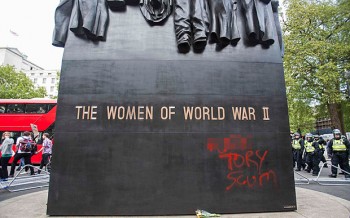
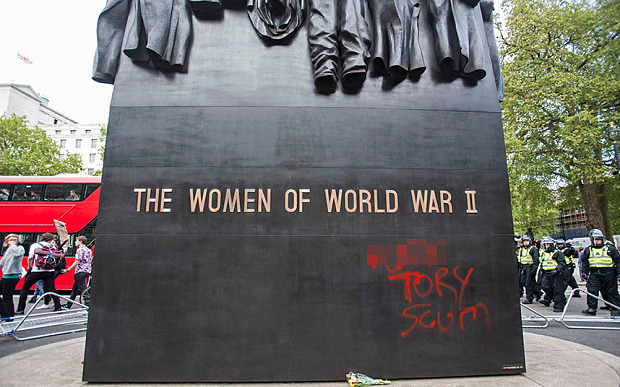
This picture was used by London Mayor Boris Johnson to illustrate an article about what is now happening to the Labour Party. It is a cleaned-up snap of what some lefty moral projectionist did to a war memorial in May of this year, during an anti-austerity demo.
The Boris Johnson article was posted last weekend at the Daily Telegraph website, to which links from here are not encouraged. Its title is: “Labour directs its impotent fury at all but those responsible – itself”. It is about how, because they dare not now discuss their own self-inflicted failures and perplexities accurately and clearly, Labourites instead now prefer to blame others for these things.
At the time it happened, the above-illustrated piece of moral decrepitude was not hugely significant. Some people now behave like this. Why? Insert preferred causal theory. Mine might have involved the expansion of the universities and of the welfare system, and perhaps also a reflection on what spraycans have done to our world. Religious people might have murmured something about the decline of religion as a moral force in our society. Those who think that history is now taught badly in Britain’s schools might have talked about that. Most feminists, torn between denouncing what is on several levels a horrible anti-woman insult or, on the other hand, denouncing a fellow lefty moral projectionist for perpetrating it, presumably remained mute.
But that picture now interests me more than it did in May, or would have had I seen it then, just as it recently interested Boris Johnson. Maybe I did see it back in May, but now, I am doing something else. I am noticing it. I even did some googling and found an uncensored version of what had been done. You pretty much knew already what the Boris version of this piece of rudeness was concealing, but I want now to spell it out:

I found this here. This did not take me long.
→ Continue reading: Expletive undeleted
Dear NHS worshippers, sorry to be a killjoy, but look, the NHS is not ‘yours’, and never has been. You have no control over it. You feel like you are in control when you spin your little toy wheel, but try steering the car in any direction other than the one where it is already heading, and see what happens. The ones who really drive the car are the political class and the medical establishment. ‘Democratic accountability’ is a mirage. All it really means is that healthcare managers answer to bureaucrats, who answer to other bureaucrats, who also answer to other bureaucrats, who, after some more detours, answer to some politician. That’s democratic accountability. Feel powerful now? Accountability through the political system is about the weakest form of accountability one could imagine, and in healthcare it is even weaker than in other areas.
– Kristian Niemietz, who stonks the NHS in an article from 2014 called The Maggie Simpson delusion: the NHS is not ‘ours’
For the benefit of my foreign readers, I should make clear that despite the protestations of the current dork masquerading as the Archbishop of Canterbury, the Church of England is not the national religion, it is the NHS! The people of Britain (dread words!) kneel and pray to it in adoration despite it being the biggest Ponzi scheme ever invented – well, it was but those ‘damn Yankees’ have out-done us again with their ludicrous ‘Obamacare’ nonsense. But perhaps the financial tectonic plates just shifted and finally reality will bring the temple crashing down.
– David Duff
The point of free markets is to allow free action in the economic sphere so that people (individually and working together) can achieve their objectives. For some this might be more family life and less work; for others an interest in eating organic produce; some people might want to work for a co-operative (even if their productivity and wages were lower); and so on. All sorts of people – not just women – make choices that reduce their measured productivity, hours worked and wages and so do not maximise measured economic growth.I work for a charity and not a hedge fund; my wife teaches French and decided not to be a lawyer. My wife works shorter hours than me. We both work shorter hours than the Chief Executive of Goldman Sachs. Would Nicky Morgan have a problem with this?
In a free society, labour market outcomes are a product of preferences. Women may well prefer to work more flexible hours, shorter hours, closer to home, in jobs that fit in better with child care, and so on. Some women may wish to give up work altogether for a period of time (perhaps for life). Others might not. But, if women choose to combine family-friendly work with family life, this does not damage the economy or reduce productivity. It is the outcome of people’s own preferences: and, acting in accordance with their preferences, people maximise their welfare. These decisions are often taken despite the fact that the state heavily weights the dice against women choosing to work at home, both by the shape of the tax and benefits system and the existence of state-subsidised childcare.
– Phil Booth, knocking it for six at the IEA
These bureaucratic new rules will not improve your ride. They’re designed to address the concerns of black cab drivers, who feel under pressure from increased competition. But the answer is to reduce the onerous regulations cabbies face today – not increase them for everyone else
– Uber spokesman
Zac Goldsmith is the far-left of the Tory Party, purest château bottled shit
– Perry de Havilland
Class War claims to represent a local community that is sick of rising house prices and an influx of wealth from overseas. However, Cereal Killer employs people from the local community, and many more residents come to the café to socialise and bond over a bowl or two of Coco Pops. The café remains defiant in the face of bullying and intimidation, and locals have since rallied behind it, with other businesses dropping off care packages for the owners. Moncrieff told me that footfall has actually increased since the attack.
The Fuck Parade was made up of a small core of balaclava-wearing pillocks and a lot of posers. People who rail against gentrification are, thankfully, the minority, and they have no right to speak for residents who are probably too busy enjoying new amenities and job prospects to protest.
Gentrification is not part of some conspiracy against the poor. Opportunities for people in Shoreditch to improve their lives are growing, and that is no bad thing. Fortunately, a bunch of idiots throwing cornflakes at a shopfront won’t change that.
– George Harrison
|
Who Are We? The Samizdata people are a bunch of sinister and heavily armed globalist illuminati who seek to infect the entire world with the values of personal liberty and several property. Amongst our many crimes is a sense of humour and the intermittent use of British spelling.
We are also a varied group made up of social individualists, classical liberals, whigs, libertarians, extropians, futurists, ‘Porcupines’, Karl Popper fetishists, recovering neo-conservatives, crazed Ayn Rand worshipers, over-caffeinated Virginia Postrel devotees, witty Frédéric Bastiat wannabes, cypherpunks, minarchists, kritarchists and wild-eyed anarcho-capitalists from Britain, North America, Australia and Europe.
|






Recent Comments