We are developing the social individualist meta-context for the future. From the very serious to the extremely frivolous... lets see what is on the mind of the Samizdata people.
Samizdata, derived from Samizdat /n. - a system of clandestine publication of banned literature in the USSR [Russ.,= self-publishing house]
|
I suppose my biggest beef with Hilton’s book is that it identifies an endless stream of ideas for decentralising government, in order to make the statist beast better behaved, when I’d just kill it. You can’t personalise Leviathan. It doesn’t do cuddly.
– Graeme Leach
Or as we have been saying here since November 2001… the state is not your friend.
The UK Labour government mentioned is that of Wales. One of the advantages of devolution is that it allows people to compare the results of different laws in the various constituent countries of the UK. The Welsh Government wants to promote and protect the health of Welsh people in the same way that it has promoted their education since devolution. Very badly.
Wales to introduce e-cigarette ban
Electronic cigarettes are to be banned in enclosed public spaces and workplaces as part of a raft of radical health plans announced by the Welsh government.
The law would be the first such restriction in the UK and would be hugely controversial among thousands of users, producers and campaigners who believe the use of e-cigarettes can help smokers of conventional cigarettes quit.
Other measures proposed by the Labour-controlled government is the creation of a compulsory national licensing system in relation to acupuncture, body-piercing, electrolysis and tattooing.
Weirdly, or perhaps not so weirdly, the archetypal fake charity ‘Action on Smoking and Health’, which gets less than 2% of its funding from public donations, is actually on the side of health:
Action on Smoking and Health a charity that works to eliminate the harm caused by tobacco, said it did not support the sort of ban proposed by the Welsh government.
It said there was emerging evidence that e-cigarettes helped people quit smoking and there was little evidence they encouraged “never smokers” to take it up. A spokesperson said: “We think they should be appropriately regulated. That does not include banning in public places.”
1) Which side will win?
2) Which side should win?
…an uneasy alliance of former enemies, having marshalled massive forces and waged a skilful campaign involving unprecedented levels of deception, was victorious in its battle to keep Britain in the Common Market.
Tim Worstall pointed me in the direction of this article by Mark Herbert of the British Council, the 3,934,561st in a series of 79,804,227 about the dire state of foreign language teaching in British schools. Tim Worstall’s post is followed many entertaining comments from people who have learned, taught and forgotten foreign tongues. But I liked my own comment enough to bring it round here, chop it up and add stuffing until it became a post in its own right.
The trouble with Mr Herbert’s article is that, like 95% of articles about the state of foreign language learning in Anglophone countries, it’s saying things that are just not true. He writes, “We need far more of our young people to learn languages in order to boost their own job prospects and to ensure the UK stays competitive on the world stage.”
In real life the job and salary prospects of most native English speaking pupils are almost unaffected by having studied a foreign language. Of course there are exceptions – one of my children is one – but for the vast majority of students a language qualification simply adds to your UCAS points total or local equivalent. A language qualification has some extra value as an unfakeable subject, but no more than a STEM qualification does. As for the objective of ensuring the UK “stays competitive on the world stage”, (a) who gives a damn about UK competitiveness in their personal choices? (b) if bureaucrats do care, that objective is vastly better advanced by getting the brats to study some subject related to an area in which the UK has a comparative advantage. Which, famously, ain’t languages.
A later comment by MyBurningEars describes the major reason for the decline in the study of languages by English speakers succinctly:
“The costs and benefits of learning languages are very asymmetric – it is clearly worthwhile for many Danes to learn English, often to a high level, yet this renders it almost completely futile (from a professional standpoint) for a Brit to learn Danish. London has hundreds of bilingual speakers of every major language, and many minor ones to boot. What would the point be for me to learn Urdu or Mandarin, an exercise which (to reach worthwhile levels at a professional level) would take years of solid study – far higher than GCSE or A level?”
Exactly. The decline that Mr Herbert laments is not happening because Brits and Yanks are becoming more arrogant or more stupid. It is happening because they are consistently making a rational judgement of a changing situation regarding the likely benefits to them, as individuals, of language study. Or as the famously well-travelled Michael Jennings put it in a comment to this post by Brian Micklethwait on the triumph of English,
“What is new, is that lingua francas other than English are in most places dying as lingua francas. In most places on earth, where two people from different cultural groups needs to communicate, they now do this in English.”
Some lingua francas (linguae francae?) other than English are still gaining ground regionally, such as Swahili. But this trend is only likely to continue while East Africa remains relatively isolated from the world economy. Globally, the rise of English has reached and passed a tipping point. English will now be the first world lingua franca, something humanity has never had before. Nothing human lasts forever, but it won’t be easily dislodged from that position, certainly not by a change as minor as China becoming economically dominant. The retooling costs are too great, particularly if Chinese sticks with its current beautiful but impractical writing system. English already gets you the world and there are no more worlds to conquer. What might dislodge it? Worldwide economic collapse, worldwide tyranny, or machine translation (both written and spoken) much better than we have now.
My feelings about the triumph of English are not particularly triumphant. Yes, if there is to be a world language I would prefer it to be mine. That does not mean I rejoice to see the slow strangulation of rival languages. Perhaps I had better pray for translation software – or brain augmentation – to get so good that all this, the rise and fall of “Empires of the Word”, ceases to be a zero-sum game.
Meanwhile, back in the real world, the choice of what subject to spend several years of your finite supply of life studying is fairly close to a zero-sum game and the choice between languages even closer to one. It is not entirely a zero-sum game; it is reasonable to suppose that study of all kinds exercises the brain, and learning one foreign language certainly makes learning others easier. But the fact remains: to learn a new language is hard. Most people only do it because they have to. English speakers don’t have to. The monetary return on investment of learning another language is not that great for English speakers. Promises to the contrary are not true. People should stop making them.
I am vastly more sympathetic to apparently airy-fairy justifications for learning foreign languages, like “you will gain an insight into other ways of thinking”, or “you will enjoy your time abroad”, or “when you meet attractive foreign persons your suit will be more likely to prosper”. These promises are quite likely to be true if you apply yourself. The “you will have proved to yourself and others that you can learn something difficult” factor can also be honestly promised.
There’s a story appearing in the Times and the Guardian upon which anti-semites and proto-totalitarian atheists are feasting like flies on dung. Read the comments to see what I mean, and bear in mind that those you see are the ones the mods did not think bad enough to delete. Yet the story that has brought forth such rage does not describe any sort of religiously-inspired persecution, cruelty or mutilation. No one is being forced to do anything. If it were not for the malign involvement of one particular sinister organisation this same story would raise a slightly condescending chuckle from the average broadsheet reader at the eccentricities of religious enthusiasts, before being forgotten.
The sinister organisation that is stirring up religious hatred is Her Majesty’s Department of Education. Sorry, Department for Education. Don’t blame me for not keeping up; the D of E / DfEE / DfES / DCSF / D for E changes its name more often than an outfit selling dodgy timeshares.
Back to the story. Apparently there is an Ultra-Orthodox Jewish sect called the Belz, some of whose adherents live in Stamford Hill, a part of North London where many Hasidic Jews of several different denominations make their home. This particular sect, the Belzers (both that name and “the Belz” seem to be in use), run a couple of schools. It seems that the Belzer top rabbi sent out a decree saying that women should not drive and that children attending the sect’s schools would be turned away if their mums turned up to collect them by car. Absent the government’s interference this would have been quietly dealt with in the obvious manner as described in the Times story “However, several women drove large people-carriers, apparently to collect their children from school, but parked some distance away”, and that would have been an end to it. But no. Woop-de-do, the government is on the case:
Nicky Morgan, the education secretary, has begun an investigation into an ultra-Orthodox Jewish sect whose rabbis have banned women from driving children to school.
and
Mrs Morgan, who is also minister for women and equalities, said: “This is completely unacceptable in modern Britain. If schools do not actively promote the principle of respect for other people, they are breaching the independent school standards.”
Consider that for a moment. A government minister pronounces on whether the voluntary and entirely legal behaviour of certain British women is “acceptable” to “modern Britain”, the role of giving or refusing acceptance on behalf of sixty-four million individuals having apparently been added to the DfE’s ever-changing remit while nobody was looking. The minister then adds that failure on the part of a so-called independent school to actively promote an officially approved emotion is in breach of some official standards.
Now the Belzers could be said to have brought this interference upon themselves if they either accepted government coin to run their “independent” schools or signed up for these “independent school standards”, whatever they are. (The papers seem remarkably coy about whether these schools are truly private or wholly or partially state-funded. I expect they are hiding something damaging to the narrative.) But when the government regularly uses legal harassment to make it next to impossible to run a private organization without accepting some government “help” and acceding to government-set standards, it is hard to blame those running the Belz schools if they did give in to the men from the Ministry. They were probably told that if they paid this symbolic tribute then they would be left alone.
What business is it of anyone else if a woman chooses to accept, or to pretend to accept, a religious ruling not to drive? Is driving compulsory now, that choosing to cease doing it is “unacceptable” to the Secretary of State? What business is it of anyone else if independent schools and independent parents come to an agreement about which pupils shall attend a particular school that is based on conditions mutually acceptable to them? So the religious ruling and the conditions of attendance seem absurd to you and me? So we and Nicky Morgan would order our acceptably modern British lives better than these relics do? So what?
I am usually a sceptic towards the idea of “dog whistles”. This is a political metaphor from the States which is meant to describe the way that allegedly racist Republicans allegedly use coded language that seems harmless but carries a secret nefarious meaning at a frequency that only fellow racist Republicans can hear. Oh, and Democrat newspaper columnists can hear it too, for some reason. Coded racism can really occur, as can racist Republicans, but most of the time this is just a way of accusing people of racism for political advantage without the necessity of providing any evidence.
But I could come round to the belief that political dog-whistles do exist. There must be some explanation of why the trivial doings of this homeopathically tiny Jewish sect of a sect are bringing forth such passionate denunciations from journalists and their readers. I think it is because the Belz act towards women like Muslims do but are not Muslims. By righteously raging at the Belz for their half-hearted pretence at oppression of women you get to demonstrate how you totally would rage at their Muslim equivalents for their much more effectively enforced actual oppression of women – only they don’t happen to be in the newspaper today. And how convenient that the Belz are few in number, low in the hierarchy of victimhood favoured by the left, and do not turn to violence when criticised.
As a bonus the last paragraph of the Times story contains a tacked-on paragraph showcasing a completely different way that the state, working in partnership with people of faith, can stir up resentment between Jews and non-Jews:
Aurelie Fhima, 23, has won £16,000 damages from Travel Jigsaw of Manchester, a travel firm, after her job application was rejected. She had said that she did not want to work on Saturdays because she observed the Jewish law of not working on the sabbath.
Congratulations, Aurelie, for your pioneering and profitable use of discrimination law. Who would have guessed that a working for a travel agent would involve working on a Saturday, the only day when most working people are free to visit travel agents? Good thing for you that the travel agents were not gay; your unprogressive religion would not have scored highly enough to trump them then.
As expected, the ghastly Snooper’s Charter is back and this time Dismal Dave will probably find it easier to push through.
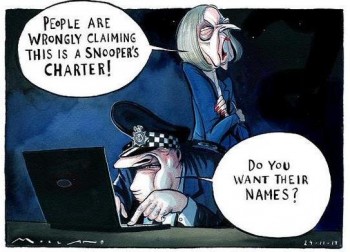
To protect the children of course.
This gem of a remark is to be found here in an article about people planning to protest against largely trivial ‘cuts’ in state expenditure (but note, lower state spending is not “austerity” and I refuse to call it such).
Please come along and let them know that we have no intentions of accepting this oppressive, draconian lifestyle they are trying to impose
This thug wants the state to impose his tax funded lifestyle on other people purse, yet sees a life with less state looted largess as being ‘imposed’ on him? Most parasites have a shameless sense of entitlement and this one is clearly no exception.
Oh how I wish these turgid excuses for ‘conservatives’ we have truly stuck it to them, with genuine cuts that hacked entire limbs off Leviathan, for then I truly would bathe my smiling face in their salty tears each morning. Sadly I cannot see Cameron doing more than fiddling around at the edges.
We seem to shy away from constitutional matters at Samizdata. I think in part this is because we have a distaste for government and would like to see an end to the whole shebang.
I can’t argue with that but it seems to me that freedom is a slow process and the state is going to hang around for a good while yet. So, how it is set up is something we probably ought to concern ourselves with.
Amongst all the other rows engulfing UKIP last week, one concerned whether they should accept so-called “Short” money. This is money handed out to opposition parties to help them with their parliamentary duties. If memory serves, the argument is that the government has an army of civil servants to help them, so the opposition needs the help to even things up a little. For us libertarians, there would be no need for Short money if we had less government but there you go.
All this can be traced back to 1910. Before then, as I understand it, MPs weren’t paid a penny: no salary, not even expenses. The problem was what to do with these newfangled Labour MPs. They tended to be less well off and were unable to support themselves by either private means or by moonlighting as barristers or journalists as figures like Carson and Churchill were able to do. The obvious solution was to allow trade unions to pay them. But this fell foul of the principle that MPs could not be bought.
Scared of the implications of denying Labour voters representation – riots were a frequent occurrence at the time – MPs started paying themselves. Pity. The great advantage of the previous system was that energetic statists had to do something useful before becoming MPs. This meant they had some idea of the difficulties of running a business. While we can’t prove that it was a bulwark against socialism it is difficult to imagine it did a great deal of harm.
By the way, on the question of UKIP and Short money I understand they decided to take no money at all. If this turns out to be true, good for them.
“Bring back self-defence classes for women – it’s the feminist thing to do”, writes Rhiannon Lucy Cosslett in the Guardian. That’s right, Rhiannon Lucy Cosslett, more typically to be found writing such gloriously quotable effusions as “Why it’s OK to cry about this election”, is writing kick-ass pieces about kicking ass in the Guardian. This is strange but good.
The Times reports (paywalled):
Christian bakery guilty of discrimination over ‘gay cake’
A bakery whose Christian owners refused to make a cake carrying a pro-gay marriage slogan has been found guilty of discrimination after a landmark legal action.
Ashers Baking Company discriminated against Gareth Lee when it refused to create the cake featuring the Sesame Street puppets Bert and Ernie, with a slogan “Support Gay Marriage”, a judge has found.
Ruling in the case that has split public opinion in Northern Ireland, Isobel Brownlie, the district judge, said: “The defendants have unlawfully discriminated against the plaintiff on grounds of sexual discrimination.”
So, you can be forced to say “Support Gay Marriage”, on the grounds that if you don’t say it someone will be left feeling “like a lesser person”, to quote Mr Lee, the plaintiff in this case.
How might this principle be extended?
Added later: in answer to my own question, a scenario:
Following the Labour victory in the closely-fought election of 2020, the new prime minister made good on the pledge made to the Muslims who had formed such a reliable part of the winning “coalition of the oppressed”. (In fact the promise to outlaw Islamaphobia had first been made by Ed Miliband back in 2015.) The relevant amendments to the Equality Act 2010 having been made, it seemed a natural next step for many Muslims to press for the UK to follow the example of several Canadian cities and give legal weight to the verdicts of the existing informal network of Sharia tribunals to which Muslims could choose to bring civil cases as an alternative to the regular channels of English or Scottish Law. It was as part of the campaign for this that the plaintiff, Mr A, approached the Rainbow Baking Company, run as a family business by the defendants Mr B & Mr C. The judge ruled that “The defendants have unlawfully discriminated against the plaintiff on grounds of religious discrimination” when they refused to bake a cake bearing the message “SUPPORT SHARIA LAW”.
As it happens I am not in principle opposed to parallel systems of arbitration running in parallel to the ordinary law, so long as they are strictly voluntary. But my imaginary gay bakers might well profoundly object to being obliged to make a cake bearing that slogan. However by then the precedent that they can be forced to by law will have been set.
The Government has quietly ushered through legislation amending the anti-hacking laws to exempt GCHQ from prosecution. Privacy International and other parties were notified of this just hours prior to a hearing of their claim against GCHQ’s illegal hacking operations in the Investigatory Powers Tribunal.
– Privacy International
So basically the state broke the law, got caught breaking the law, and then when challenged, changed to law so exempt themselves from the law they broke.
|
Who Are We? The Samizdata people are a bunch of sinister and heavily armed globalist illuminati who seek to infect the entire world with the values of personal liberty and several property. Amongst our many crimes is a sense of humour and the intermittent use of British spelling.
We are also a varied group made up of social individualists, classical liberals, whigs, libertarians, extropians, futurists, ‘Porcupines’, Karl Popper fetishists, recovering neo-conservatives, crazed Ayn Rand worshipers, over-caffeinated Virginia Postrel devotees, witty Frédéric Bastiat wannabes, cypherpunks, minarchists, kritarchists and wild-eyed anarcho-capitalists from Britain, North America, Australia and Europe.
|