We are developing the social individualist meta-context for the future. From the very serious to the extremely frivolous... lets see what is on the mind of the Samizdata people.
Samizdata, derived from Samizdat /n. - a system of clandestine publication of banned literature in the USSR [Russ.,= self-publishing house]
|
Has the Bank of England finished its campaign of driving down UK base rates and forcibly impoverishing savers ? On the evidence of last week’s Radio 4 programme ‘How low can rates go ?’ hosted by my dear and highly valued friend Martin Wolf, the answer is unclear. But a host of government-appointed technocrats from around the world, including Mr. Kuroda, were wheeled out in defence of a monetary policy that severed any ties it might once have had with the real world quite some time ago. (Victor Hill, reviewing the programme, calls it ‘Alice in Wonderland’ economics.)
– Tim Price writing about Monetary Terrorism.
The SNP’s majestic advance to state surveillance of every child in Scotland has been slowed.
The Guardian reports:
Scottish plan for every child to have ‘named person’ breaches rights
Judges at the supreme court have ruled that the Scottish government’s controversial “named person” scheme for supporting children risks breaching rights to privacy and a family life under the European convention on human rights, and thus overreaches the legislative competence of the Holyrood parliament.
The supreme court has given the Scottish government 42 days to correct the defects in the legislation, which has been described as a snoopers’ charter by family rights campaigners, but said that it recognised that the aims of the scheme were “unquestionably legitimate and benign”.
The Scotsman has a slightly different, and I regret to say more realistic, take on the story:
Court rules against Scottish Government’s named person policy
The Scottish Government insists controversial new measures to appoint a named person for every child will still go ahead despite the UK’s highest court ruling the legislation at present is “incompatible” with European human rights laws.
[…]
The court ruled that information-sharing provisions proposed under the 2014 Act may result in disproportionate interference with Article 8 rights under the European Convention on Human Rights – the right to a family and private life.
Note that the European Convention on Human Rights predates the European Union and its predecessors and is adhered to by several states outside the EU.
Perusing the NME’s sad, stuffy, small-c conservative freakout over this big change in British politics got me thinking: Brexit is actually the most rock’n’roll thing to have happened in a generation. What we have here is ordinary people, including vast swathes of the working class, saying ‘No’ to the status quo, sticking two fingers up at an aloof elite, channelling Rotten and Vicious to say screw you (or something rather tastier) to that illiberal, risk-averse layer of bureaucracy in Brussels. It makes the student radicals of the 60s and even the anarchic punks of the 70s look like rank amateurs in comparison. Sure, those guys might have waved flowers against the Vietnam War or put safety pins through their snouts, but did they send the political class, the chattering class and the business elite into an existential tailspin by delivering a severe sucker punch to these people’s favourite institution? No, they didn’t. Brexit did, though.
– Brendan O’Neill
The statistical correlation between both age and relatively low levels of education, on the one hand, and a vote to leave on the other, was much remarked upon, not only in Britain but throughout Europe and the rest of the world. Age and lack of education were usually taken by commentators as a proxy for stupidity. The majority vote to leave was therefore a triumph of stupidity: for those who vote the right way in any election or referendum have opinions, while those who vote the wrong way have only prejudices. And only the young and educated know what the right way is.
While age is certainly not a guarantee of political wisdom, the ever-increasing experience of life might be expected to conduce to it. But in the wake of the vote, there were even suggestions that the old should have no vote because they wouldn’t have to live as long with the consequences of it. The reaction to the referendum exposed the fragility and shallowness of that each person’s vote should count for same.
The relation between political wisdom and levels of education is far from straightforward. It was educated people who initiated and carried out the Terror in the French Revolution. The Russian Revolution, and all the great joy that it brought to the Russian people, was the denouement of decades of propaganda and agitation by the educated elite. There was no shortage of educated people among the Nazi leadership. And the leaders of the Khmer Rouge were also relatively highly-educated, as it happens in France. The founder of Sendero Luminoso, who might have been the Pol Pot of Peru, was a professor of philosophy who wrote his doctoral thesis on Kant.
– Theodore Dalrymple
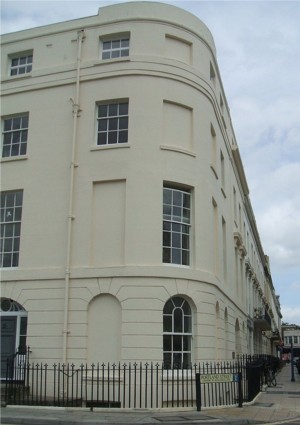
If you type “window tax” into google, and click on “images”, you get images like this one:
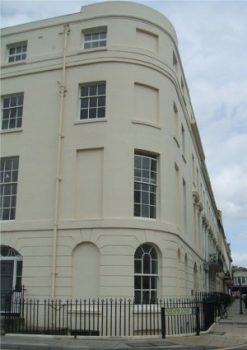
That being the first image that wikipedia shows you, in their entry on the Window tax.
Says wikipedia about this tax:
The window tax was a property tax based on the number of windows in a house. It was a significant social, cultural, and architectural force in England, France, Ireland and Scotland during the 18th and 19th centuries. To avoid the tax some houses from the period can be seen to have bricked-up window-spaces (ready to be glazed or reglazed at a later date). In England and Wales it was introduced in 1696 and was repealed in 1851,
London, and presumably all the other cities of Britain, still contain many such bricked-up windows, that date from this time.
But yesterday, I saw a new block of flats, still in the process of being constructed, just a few dozen yards from my own front door.
The front of which looks like this:

Let me be clear. There is a vertical row of bricked-up windows there, in between the real windows. And you can clearly see that this is a brand new building, not even yet occupied.
Here is a close-up shot of an individual bricked-up window:

I have long known the bare outlines of this window tax story, as I guess most of my fellow Brits do also, especially if they live in towns or cities. Windows were taxed, so people filled the windows in, to avoid paying the tax.
So, my first – outraged and spasmodic – reaction to this new building, when I saw these non-windows was: My God, have they brought back the window tax?
But, on further reflection, I further guess that this is isn’t the first time that recent property developers have created bricked-up windows, or what look like bricked-up windows, to create, pretty cheaply, the suggestion of antiquity in an otherwise blandly modern building.
When I see other bricked-up windows, I will no longer assume that they date from the time of the window tax. Maybe they merely allude to this time.
But, am I missing something? Is there a more practical purpose to such non-windows? Is it helpful to create windows that can later be un-bricked-up (bricked-down?), at some future date? Does it help to think about maybe wanting a window that you don’t want now, beforehand, just in case?
Is this a mere part of the construction process. Will these bricked-up windows all turn into real windows very soon, before anyone even moves in?
Or are there quite different reasons for making a new bricked-up window, which I am unaware of? Perhaps so. In fact, probably so. And if so, I hope that commenters will perhaps enlighten me.
Comparisons have been made between the popular uprisings on both sides of the Atlantic — some of them lazy. Boris Johnson, the UK foreign secretary and leading Leave campaigner, and Mr Trump may have shaken up their respective establishments, but blond hair is one of the few things they have in common. Brexit and Trumpism are not one and the same.
– Sebastian Payne
Andrew Kennedy writes at Conservative Home about how the Conservative Party has seen a post-Brexit surge in membership. Commenters point out that the same thing has happened in the other British political parties. But why? None of the parties performed in recent weeks in a particularly attractive manner, so what’s happening?
I think that commenter David Webb, a recent (re)joiner of the Conservative Party, nails it:
I rejoined post-referendum because of a feeling that politics mattered again. Within the confines of the EU, nothing much was worth debating, as nothing much could be changed. Apart from the continuous drift to the bureaucratic European superstate, inertia ruled.
With Brexit, the stagnant pool has been replaced by a running stream … that’s not to say everything will be wonderful, but once again ideas count, and things can get done.
But then, I would think that David Webb nails it, because I said something very similar in my posting here at the time when the referendum result was becoming clear. I didn’t say that all the political parties would now have a membership surge, but I could have and should have, because it was the logical thing to deduce from what I was then realising. Political debate matters again, not just for me and for all those who think as I do, but for everyone with any sort of political opinion.
As David Webb says, “ideas count” means that bad ideas also now count for somewhat more than they did, unless they are the bad ideas that the EU stood for and imposed upon us, in which case they now count for slightly less.
It will be interesting – and no doubt in some ways rather scary – to see what British public opinion now consists of, given that for the last few decades much of it has been sedated by our EU membership. First out of the blocks were the racists, who perhaps imagined that Britain voting Leave meant that all the bloody foreigners now had to leave.
But what other political ideas will emerge? As I also said in that earlier posting: good times for blogs like Samizdata, where our good ideas will be celebrated anew and the bad ideas of others will be denounced. Again, speaking for myself, I find that the urge to blog is now stronger. Because it will count for a bit more than it did.
Perhaps the most important next discovery about another bit of British public opinion will concern the forthcoming Labour leadership contest. Labour has also, see above, had a post-Brexit surge in membership. But are those new members yet more Corbyn supporters, or are they anti-Corbynists, wanting a nicer and more traditional Labour Party? My guess is that the Labour leadership contest will be closer than it was last time around, with quite a few who voted for Corbyn last time voting against Corbyn this time around, but not close enough to unseat Corbyn. The Labour collapse will continue. But, what do I know? We shall see.
I am not the only one who perceives a Caesarian theme to modern British politics. This portrait of political treachery chilled me to the marrow:
Entry into vegetable competition in summer fête in London
Seumas Milne remains on the staff of the Guardian and Observer while Labour pays him to work as its director of strategy. As a colleague on leave, he has the right to be treated with a gentleness journalists would not usually extend to spin doctors who do not enjoy his advantages. I therefore write with the caution of a good corporate man and the cheeriness of a co-worker when I say Milne could not do a better job of keeping the Tories in power if rogue MI5 agents had groomed him at Winchester College, signed him up at Oxford University and instructed him to infiltrate and destroy the Labour party.
– Nick Cohen
“She’s got dyed blonde hair and pouty lips, and a steely blue stare, like a sadistic nurse in a mental hospital.”
– British Foreign Secretary Boris Johnson, talking about Hillary Clinton back in 2007
This is going to be so good 😀
In truth, the appointment of Boris as Foreign Secretary is just about the most awesome thing ever.
In another Telegraph column, in November 2007, Mr Johnson described Hillary Clinton as having “a steely blue stare, like a sadistic nurse in a mental hospital”.
How perfect is that? Words can scarcely describe how much I am looking forward to seeing this unfold 😀
Of course the appointment that really matters is David Davis to head up Brexit. I simply cannot imagine a better choice for he is staunchly free market and was known in EU circles as the “charming bastard“.
I have been banging on for weeks to anyone who will listen that all this talk about the importance of getting good trade deals is nonsense. All that is needed is unilateral free trade.
Just now I stumbled upon an article in the Guardian, of all places, discussing just that. Even talking about “the unilateral free trade option”.
A group called Economists for Brexit seem to have got it in the paper. Jolly good work!
|
Who Are We? The Samizdata people are a bunch of sinister and heavily armed globalist illuminati who seek to infect the entire world with the values of personal liberty and several property. Amongst our many crimes is a sense of humour and the intermittent use of British spelling.
We are also a varied group made up of social individualists, classical liberals, whigs, libertarians, extropians, futurists, ‘Porcupines’, Karl Popper fetishists, recovering neo-conservatives, crazed Ayn Rand worshipers, over-caffeinated Virginia Postrel devotees, witty Frédéric Bastiat wannabes, cypherpunks, minarchists, kritarchists and wild-eyed anarcho-capitalists from Britain, North America, Australia and Europe.
|