While we are on the subject of reminiscences… The moment they knew.
And here is the St Crispin’s Day speech from Henry V.
|
|||||
|
While we are on the subject of reminiscences… The moment they knew. And here is the St Crispin’s Day speech from Henry V. June 23rd, 2017 | 61 comments - (Comments are closed)
 BBC Radio 4 puts out a well-regarded programme on statistics called “More or Less”, in which presenter Tim Harford looks at uses and abuses of statistics. The most recent episode was a topical one covering the general election just past. Here’s a link to the “Post-Election Special” on BBC iPlayer: http://www.bbc.co.uk/programmes/b08wr7ss
If you cannot or prefer not to listen to the programme, I have transcribed the section I wanted to post about below. Typing it all out was slow work. I bothered doing the work for two reasons. One, the BBC came much closer than it usually does to saying out loud that that the Labour Party knowingly lied on an important matter during the election campaign. We can tell with unusual clarity that Labour knew they were lying because they were lying in exactly the same way that the Tories had lied in 2010, only then the Tories were called out on it. Two, that there has been an interesting change in the chances of such a lie being challenged before it is too late. When the Tories were telling this particular lie in 2010, they were doing so in the pages of the press and on TV, seen by millions all at once – and talked about all at once. But when Labour told their equivalent lies in 2017, they did it on Facebook posts that are passed between individuals. Though a great number may eventually see the original video, they do so as individuals. If they find it convincing, they pass it on to other individuals, and there is no reason why the recipient should be any better informed than the sender. Compared to a broadcast or news article, or even a blog post, it is less likely to come to the attention of those who know enough to rebut it. Even if it does and they do, the rebuttal is less likely to ever come to the attention of those who saw the original. Often this sort of campaign by social media ends up as “a tale told by an idiot; full of sound and fury, signifying nothing”. People who already agree with each other are stimulated to agree ever more vehemently only to discover the morning after the election that the people who didn’t already agree weren’t listening. However when, as in this case, the video appears to be heavy with facts and to come from a non-partisan source, it can work very well. Time I got round to talking about the specific claims at issue. The section of the election episode of “More or Less” that I’m interested in starts at 17:35 and lasts until 23:06. Tim Harford, the presenter, says, “It is widely believed that the youth vote boosted the Labour party and one of the things that may well have been influencing young people were viral videos on social media. In the last few days before the election, we were contacted by a loyal listener who had seen one of these videos. It was on Facebook and it was being promoted by the Labour party. And it had received 1.4 million views. “Unfortunately we weren’t able to get to it before the election, but these elections seem to be a bit like buses; there may well be another one along in a minute. And in any case, there’s never a bad time to talk about the truth. “The video in question featured an event where an official from the trade union Unison, Ben Priestley, was giving a speech. Mr Priestley represents union members who work for the police or as prison officers, and he was sitting next to Shadow Cabinet minister Keir Starmer. “Here’s a clip from the speech.” We then hear the voice of Ben Priestley saying, “Since 2012/13 there’s been a 29% increase in possession of weapons. This is police recorded crime. These are the crimes that the police themselves, through a rigorous process, have deemed to be crimes. A 29% increase in possession of weapons. A 65% increase in violence against the person. A 38% increase in assault with injury. Sexual offences are up 97%. Public order offences are up 54%. “Now, if those figures weren’t shocking enough, this government which has claimed repeatedly, and also claimed in the Conservative party manifesto, that crime is falling. But nothing could actually be further from the truth. The government relies on the Crime Survey for England and Wales, which is an opinion poll which disregards homicide, it disregards sexual offences, it disregards crimes against business. It is a very, very small proportion of overall crime. “So the government relies on those figures to tell the electorate that crime is falling, whereas recorded crime figures tell exactly the opposite story.” Then it cuts back to Tim Harford, who says, “Strong stuff. And Jeremy Corbyn’s twitter account tweeted a link to the speech with the text ‘Watch: national police officer Ben Priestley destroys Tory lies on crime rates.’ (Here is that video: https://www.facebook.com/JeremyCorbyn4PM/videos/1707133912914014/. Note that Ben Priestley is not a “national police officer” in the sense of being a policeman himself. He isn’t even a trade union representative for police officers, who are forbidden to join ordinary trade unions. Mr Priestley is Unison’s National Officer for Police and Justice, dealing with the workplace rights of civilian employees of the police. Whether intentionally or not, the description of him as a “national police officer” in Jeremy Corbyn’s video stream was misleading.) Hartford continues, “But are they lies? The accusation here is that the government is ignoring police recorded crime statistics and relying on the Crime Survey for England and Wales and that this is a lie because police recorded crime is a better measure. But that’s wrong. Neither method is perfect, but most crime stats nerds will tell you that the survey is better. “The UK Statistics Authority looked at police recorded crime statistics in 2014 and decided that they were so unreliable that they should no longer be counted as an official national statistic. On the other hand, the Crime Survey for England and Wales is an official national statistic. It is not a small ad hoc opinion poll, it’s a nationally representative survey that measures the extent of crime by asking households whether they’ve experienced any crime in the last twelve months. In 2016/2017 approximately 50,000 households will be selected to take part in this research. “And it’s just bizarre to suggest that it covers a very, very small proportion of overall crime because it captures more than twice as many crimes as the police data. “But what about the shocking figures that the video quotes from the police recorded crime stats? Is that a true rise in crime or just a rise in the recording of crime? Since the Statistics Authority criticised the police recording of crime stats there’s been a big rise in the reporting of crimes that the police were not recording properly, such as low level violence and public order offences. The Office for National Statistics is very clear. They say, ‘Due to the renewed focus on the quality of crime recording by the police, this crime series is not currently believed to provide a reliable measure of trends, owing to the ensuing efforts of police forces to tighten recording practice and improve recording processes.’ “So the video suggests crime is rising by using cherry-picked, unreliable statistics, while dissing the more reliable statistics that serious policy wonks pay attention to. The true picture? Well, I think we got that from the crime policy writer Tom Gash, earlier on in our series. ” Tom Gash then speaks, saying, ” I think what we’ve seen over the last twenty five years is this very, very steady fall in crime. Over the last two or three years we’ve certainly seen a plateauing of that fall in crime in a number of areas, but particularly in terms of serious violence.” Back to Tim Harford, who concludes, “These videos are important. You often see them after your friends share them, so they come with a recommendation. “What’s interesting about this claim of Tories lying about crime figures is that Labour politicians weren’t making it in debates or in political interviews. It was made in a Facebook video of a press conference, where it was far less likely to be challenged. “In 2010, the then Conservative shadow Home Secretary, Chris Grayling, made a similar criticism about crime under the Labour government, using police recorded crime stats rather than the Crime Survey. But because his claims were made in a more public forum they were rebutted by the then Home Secretary Alan Johnson, and in a letter from Sir Michael Scholar, then Chairman of the UK Statistics Authority, who said, ‘I must take issue with what you said yesterday about violent crime statistics, which seems to me likely to damage public trust in official statistics.’ “But in the era of social media, all political parties can make claims that are far less likely to get properly examined – unless, of course, our loyal listeners put us on the case. ” One might wish they had got round to following up on what their loyal listener had alerted them to before the election. Remember it was mentioned that the man who was sitting next to Ben Priestley when he made that speech was Keir Starmer, or to give him his proper title, Sir Keir Starmer KCB QC MP? You can see him sitting on Mr Priestley’s right on the Labour video, looking at his hands and taking the odd note. Well, Keir Starmer isn’t just any old member of the Cabinet. He has specialist knowledge. Back in 2010 when the Tories made their false claims about crime statistics, he was Director of Public Prosecutions. Analyses of how the final figures for convictions were related to numbers of prosecutions and the underlying crime rates must have came across his desk almost daily. Here he is in 2013 writing for the Guardian about just these issues in relation to rape and violence against women. I find it hard to believe that as Sir Keir Starmer listened from two feet away to Ben Priestley’s claims about the National Crime Survey being merely an “opinion poll”, he did not know better, and that he did not also know that Mr Priestley’s claims about a 97% rise in sexual offences and so on were rubbish. I find it hard to believe that he did not remember from 2010 the cutting response made by the then Labour Home Secretary to similar hyped-up allegations when they came from the Tories:
Yet he remained silent. Is he happy to be associated with this video? June 21st, 2017 | 22 comments - (Comments are closed)
So is Barclays Bank effectively being prosecuted for having refused a tax funded state bailout in 2008? Perhaps I misunderstand something but that sure as hell looks like what is happening here, at least when I read between the lines. Am I getting this completely wrong? June 20th, 2017 | 27 comments - (Comments are closed)
The actions of radical Islamophobes should not be used to condemn the peaceful Islamophobe majority – Allum Bokhari, tweeting the situation with great panache 😀 June 19th, 2017 | 40 comments - (Comments are closed)
It has finally happened. Here in Britain, a man has driven a van into a group of people he sees as evil. Clarification: it has finally happened in Britain that a man has driven a van into a group of muslims. If we followed PC precedent, we should be as cautious in assuming this man was not a muslim as we were told to be of assuming earlier perpetrators were muslim. How could it be safer to treat a reported shout of “I want to kill muslims” as more decisive than a reported shout of “Allahu Akbar”? Murder of a gang rival with collateral damage; killing a group of not-muslim-enough muslims with ingenious collateral propaganda advantage; anything is possible. But I suspect he wasn’t a muslim. In the well-armed US, it has not yet happened – that I have heard, and I think it would have been blazoned forth by the media (no doubt will be if and when it does). But the US is exceptional. In third world countries (whose cultures it is racist to regard as more flawed than our own), tit-for-tat retaliation has long been part of the culture. In its quieter, understated way, British exceptionalism has always been as proud as US exceptionalism – and as hated by the politically correct. They decided to “rub the British people’s noses in diversity” in order to get rid of it. We are less exceptional today than we were yesterday. June 19th, 2017 | 37 comments - (Comments are closed)
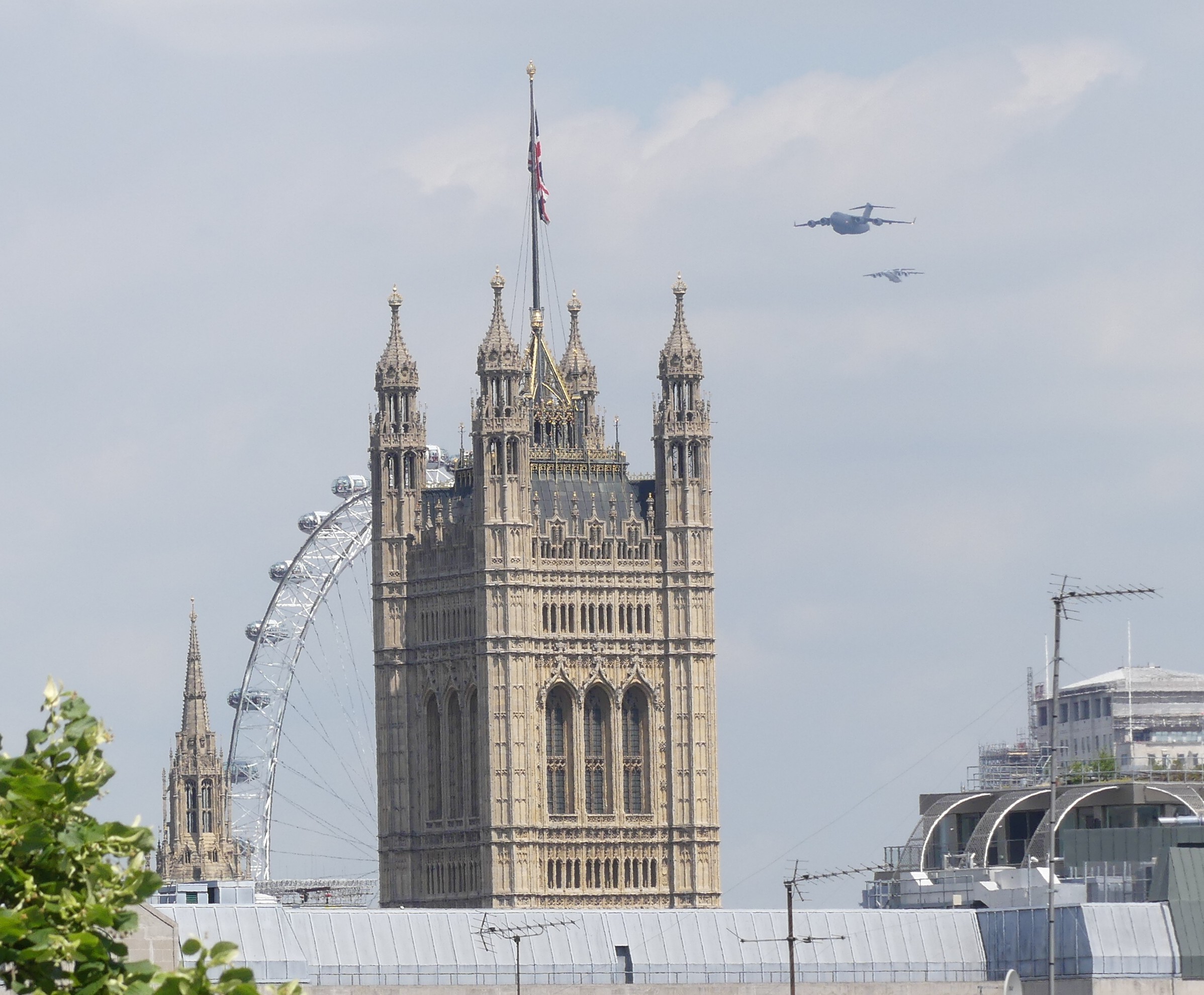
Earlier today I chanced upon Trooping the Colour on the telly, which is the big old military parade they have in London on the Queen’s “Official” Birthday. Mention was made of a flypast that was about to happen, and I immediately grabbed my camera and ran up to my roof, to photo what whatever of it that I could from there. I had to wait a while, until 1pm. There was much helicopter activity, which seemed promising. Our Armed Forces keeping their eyes out for surface-to-air missiles, and suchlike devilry? Perhaps. Maybe just pretending to be doing that, in order to deter it. Whatever, eventually, I spied, way out beyond the multi-pointed Parliament Tower, two real airplanes, flying together. Which could only mean a flypast. No planes approaching Heathrow would ever bunch up together, like that, by which I mean like this:
That photo was taken with maximum zoom, but eventually these two airplanes trundled towards me, and I got a rather better shot of them, although still with quite a lot of zoom:
When I watched the television highlights of the show in the evening, they said that the biggest of the planes in this next photo was the biggest plane the RAF possesses:
To me, it just looks like a Boeing Dreamliner in plain clothes. Don’t they have any properly big planes? It occurs to me that the Dreamliner may be bigger than I had thought. But at least I got to take semi-adequate photos of this dreary plane and its little sidekicks, and of its predecessor and its sidekick, above. I had less luck with these guys:
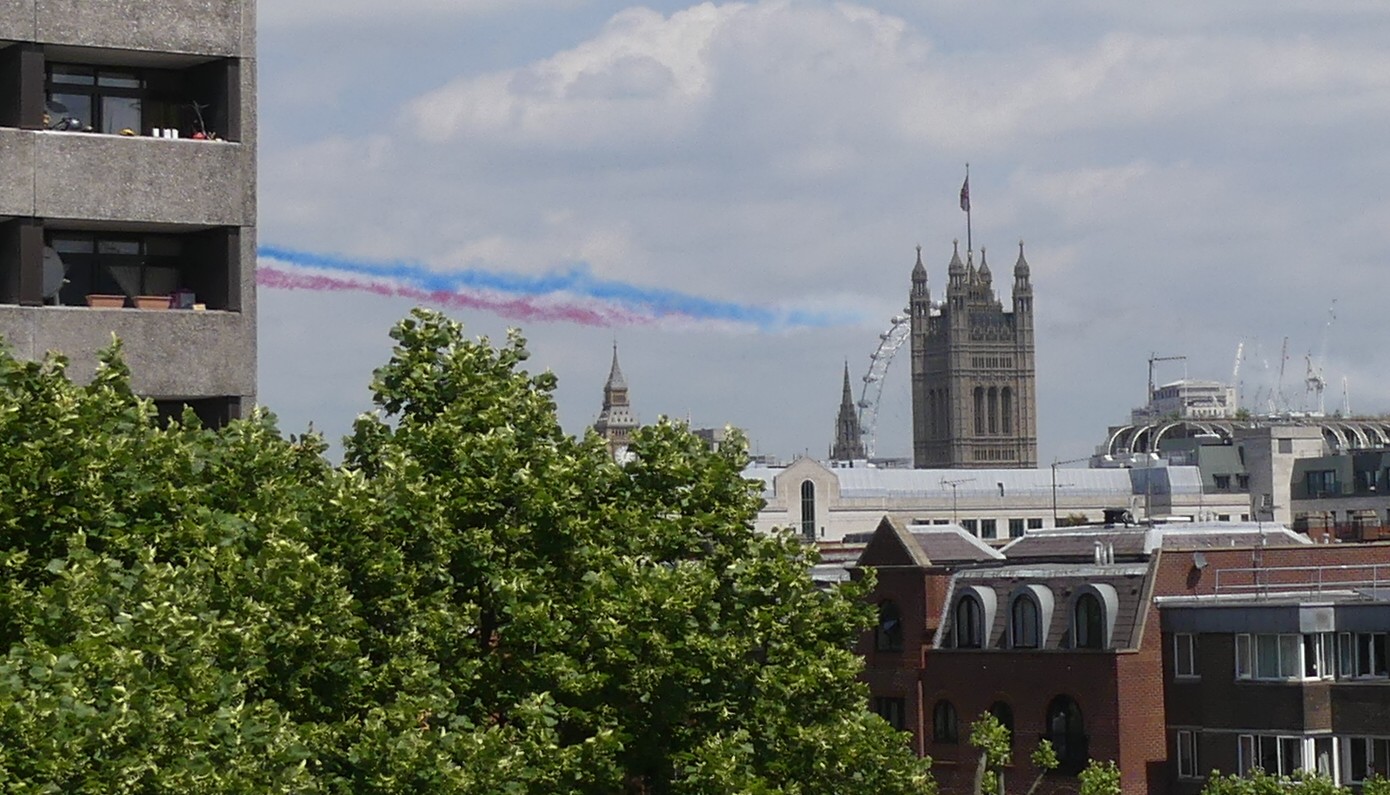
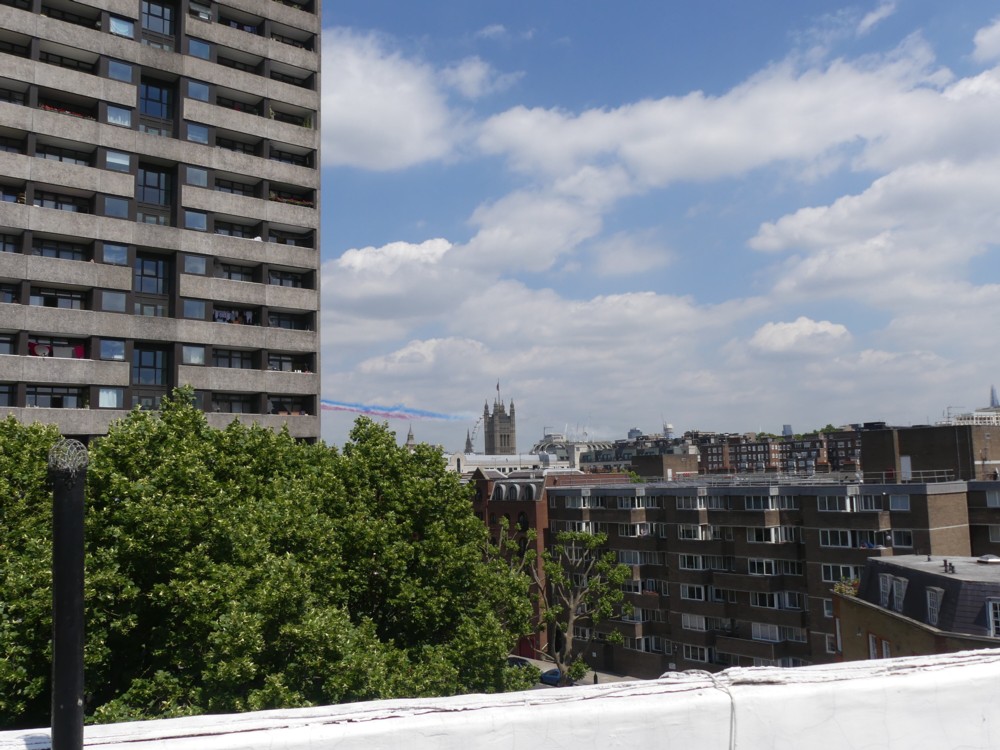
That’s a heavily cropped close-up of them, as the Red Arrows (for it was they) vanished behind the big tower block in the middle of the square I live on the edge of, leaving only their jets of patriotic-coloured smoke. Here is the original photo that the above is cropped from:
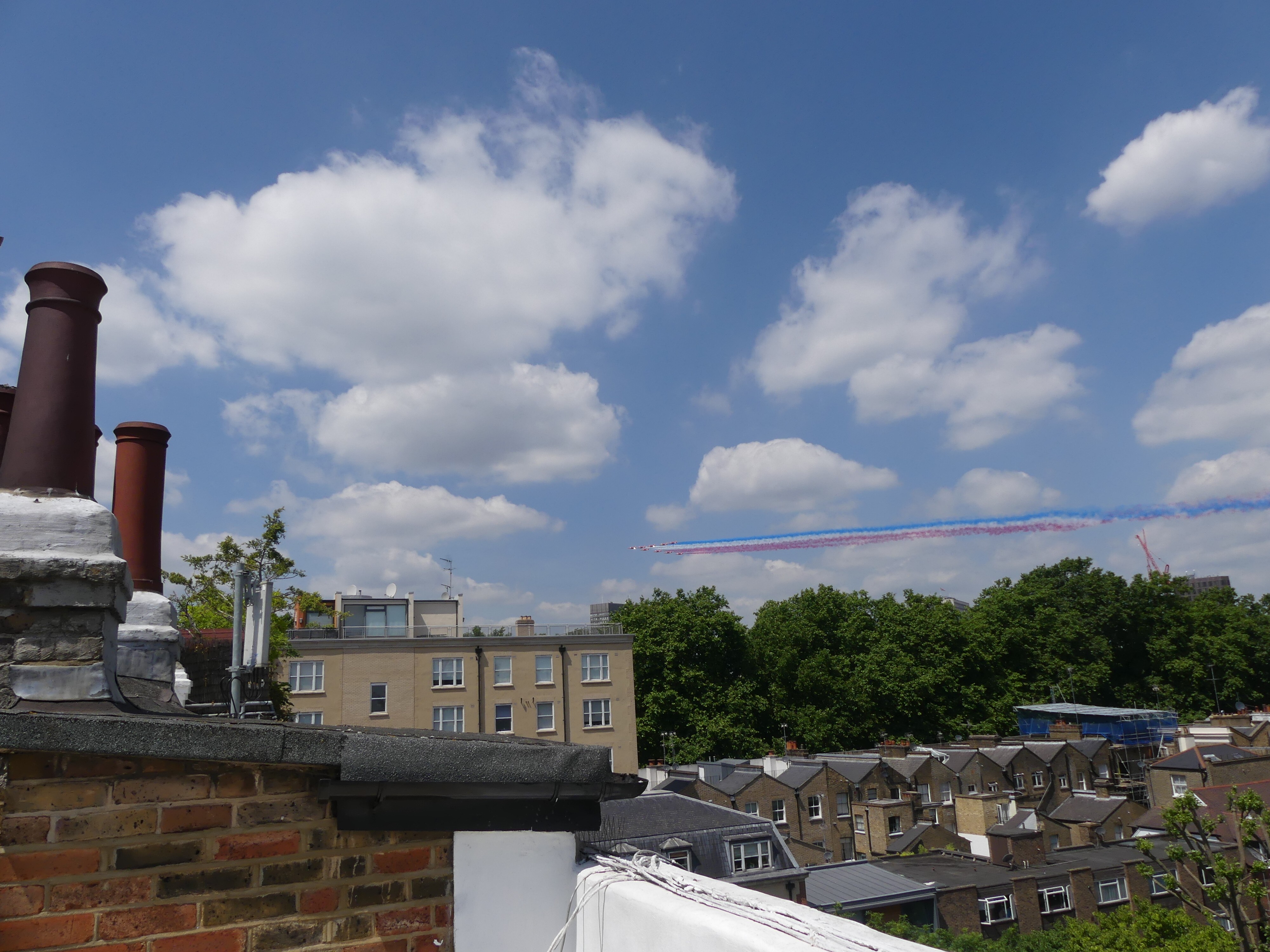
Which gives you an idea of how far away all this was happening, and how the direction of travel of whatever it was determined whether I would ever see it properly or not. Unlike the earlier boring jets, the Red Arrows didn’t disappear from London in a westerly direction, i.e. past me. They went north. And this was as close to an actual photo I got of them:
I never saw anything like this:
Whch is how the Red Arrows looked on my telly. According to that same telly, a couple of Hurricanes and a Spitfire, or maybe it was the other way around, flying in a formation, were also part of the show. But I never laid eyes or lens on them. Nevertheless, I account the trip upstairs a success. My purpose was to see how one of these London Queen’s Birthday flypasts looked like from up on my roof, and I did. It wasn’t nearly as good as the Farnborough Air Show, but I didn’t expect it to be. It wasn’t even as good as the New Year’s Eve fireworks that I photoed from the same spot last New Year’s Eve. But then, a firework occupies a lot more sky at any particular moment than an airplane does, and its entire purpose is to be extremely visible. I actually find it quite reassuring that the British state’s version of a ceremonial flypast over its capital city is so very modest, and that by far its most impressive moment features guys who are basically aerial ballet dancers. June 17th, 2017 | 23 comments - (Comments are closed)
The left are about intentions. They treat their own good intentions as evidence they will do good – and that we, who oppose them, have evil intentions. We notice incentives. If the planned road to utopia rewards freeloading while punishing those who pay for it, it will not get there. “Why did I bother!” is what Natalie’s exasperated neighbour said when the Tory manifesto came out. That neighbour is one of the goodies: never rich but she paid her way (plus taxes), raised her kids, worked at many a humble low-paying job (as her neighbours’ cleaned kitchens could testify) and ends up with a house, a life she can respect, and no other major assets. May’s intention was presumably to balance the budget. But taking that neighbour’s house to pay alike for her care and freeloaders’ care incentivised her to demand, “Why did I bother!” Theresa May was stuffing envelopes for the Tory party when she was twelve years old. But maybe that’s the problem. Given my family background, it is mere lucky chance I was not stuffing envelopes for Labour at that age. Almost 5 years separated my reaching voting age from the next general election – which is why I can tell you I have never voted Labour. I had to work out, as the years and days to that first election ticked down, why I should not do what I would have done on my 18th birthday. That is why, today, I could not look at a policy proposal without the thought occurring, “What incentives will this create?” Evidently, Theresa May can. [ADDED LATER: should Natalie’s neighbour have been so exasperated? My thoughts are here.] June 17th, 2017 | 25 comments - (Comments are closed)
We don’t even know how many souls perished in the Grenfell Tower inferno, and yet already they are being marshalled to party-political ends. Already Labour-leaning commentators and campaigners are using them, using the freshly dead and the unspeakable horrors they experienced, to make mileage for their party, to brand the Tories evil and Jeremy Corbyn saintly. In the 20 years I’ve been writing about politics, I can’t remember a national tragedy being exploited for party-political gain so quickly. The time between a calamity occurring and the use of it to harm one’s political enemies and fortify one’s political allies is shrinking all the time. It’s now mere hours, minutes even, courtesy of social media June 16th, 2017 | 20 comments - (Comments are closed)
Politics Home reports,
[…]
In case you were wondering, the people made homeless by the Grenfell Tower fire are not going to be turfed out on the street. They will be rehoused by Kensington & Chelsea Council, in accordance with its statutory obligations. Mr Corbyn knows this perfectly well. The point of his remark was not to help these people but to use them as disposable weapons in his quest to breach the principle of secure property rights under law. Socialists always start by seizing the property of the rich to give to the poor, because that’s where the votes are. They always end by seizing the property of the poor to give to the rich, because that’s where the money is. Consider the People’s Republic of China: From 2006:The big steal
From 2010: China violence over property seizures
Once the rule of law is breached, it is hard to fix again. Property rights are needed more by the poor than the rich. The rich have other resources. June 15th, 2017 | 45 comments - (Comments are closed)
Alison Hernandez was a little too open to new ideas:
A Police and Crime Commissioner is “an elected official in England and Wales charged with securing efficient and effective policing of a police area”, rather than an actual police officer, so do not be misled into thinking that openly expressed crimethink has reached the police. But it has reached people who officially talk to the police. June 13th, 2017 | 63 comments - (Comments are closed)
I believe economics, and the way economics has shaped society in the past 15-20 years, plays a major role. Sure the young Corbyn supporter doesn’t understand economics, but point me towards a demographic that does. Every government in every western country is staring down the barrel of ballooning deficits, a debt which will take millenia to pay off, and not a single major party anywhere wants to even talk about it, let alone do anything about it. A simple reduction in planned expenditure increase is dressed up as a savage cut by damned near everyone: the Tories’ supposed austerity isn’t some fringe issue on the left, it is a widely accepted truth across the whole electorate. The people pointing out that these cuts are anything but are basically a handful of cranks on the internet. Like, erm, me. If any government program is threatened with a cut taking expenditure levels back to what they were in, say, 2010 half the country screams that medieval times are making a comeback and the other half believe them. The knowledge of economics among electorates is woeful, and almost all of them have signed up fully to the belief that all government expenditure is necessary, good, and wise and any cuts are bad. Nobody wants to even think about the size of the deficit and the national debt, it just keeps racking up. So if we’re going to criticise the young Corbynistas for not understanding the consequences of unsustainable economics demanded by ignorant voters, we might perhaps want to first ask where they got such ideas from. It’s too easy to blame Marxist indoctrination in schools when supposedly conservative governments, backed fully by the supposedly conservative middle classes, have been so irresponsible with public finances for several generations. Conservative governments might not be quite as reckless as Corbyn would be, but we’re talking about the difference between disaster and a catastrophe here. June 11th, 2017 | 41 comments - (Comments are closed)
The Conservative party gave me absolutely nothing in their manifesto that would make me inclined to vote for them. They have done nothing while they have been in power that would make me inclined to vote for them. The only thing that they had going for them was that they were not Labour. As far as I can see, the hung parliament is a result of his party being utterly rubbish and running an utterly rubbish campaign. They took the electorate for granted when they sowed and this election result is just what they deserved to reap. – Commenter Stonyground remarking over on Longrider. This strikes me as a near perfect and succinct summation of why the Stupid Party was almost defeated by the Evil Party. Personally I supported the idea of the election, but even given my loathing of Theresa May, I was stunned by how badly May came across during the campaign, snatching near defeat from the jaws of victory. June 10th, 2017 | 45 comments - (Comments are closed)
|
   |
||||

All content on this website (including text, photographs, audio files, and any other original works), unless otherwise noted, is licensed under a Creative Commons License. |
|||||



Recent Comments