We are developing the social individualist meta-context for the future. From the very serious to the extremely frivolous... lets see what is on the mind of the Samizdata people.
Samizdata, derived from Samizdat /n. - a system of clandestine publication of banned literature in the USSR [Russ.,= self-publishing house]
|
Maybe you recall that this time four years ago much was made here of the Rugby World Cup. This was because England fans like me genuinely reckoned England could win the thing. England went into the tournament on the back of two great wins in the Southern Hemisphere against the might of Australia and New Zealand, and when the tournament began they were the top ranked side in the world. If England played as well as they were capable of, they would win in some style. Actually, they did not play quite that well, but they still won, by the skin of their teeth and a famous Jonny Wilkinson drop goal in the final minute of extra time.
This time, it was all completely different. The only Samizdata coverage of this event so far has been Johnathan Pearce’s piece about how the shirts worn by New Zealand and Scotland in their group match were impossible to distinguish (I felt just the same).
I for one make no apology for this. I think that the way to enjoy sport is to pay close attention when your team is winning, but otherwise to relax and treat it all as only the game that it is.
England arrived at this current tournament in a state bordering on shambles. They won their first game against the USA, a rugby union minnow, but scored no points at all in the last half hour of the game while the USA even managed a try. And in the next game England hit rock bottom, being utterly annihilated by South Africa by the crushing scoreline of 36-0. Meanwhile, the other Southern Hemisphere sides were storming through their early games, winning by cricket scores. Any thought that England might be able to make a serious defence of their title was, frankly, ridiculous. → Continue reading: Quelle surprise!
I have quite enjoyed watching the rugby so far; the Argentinian side has been a revelation; some of the South Pacific sides have played with their customary bravery and gusto; even England, after a stuttering start, look a bit better. The side that is – supposedly – fancied to win the contest this year by many observers are the New Zealand All-Blacks.
So you can imagine my befuddlement yesterday afternoon when I watched the game with friends down in deepest Suffolk. The shirts of the ‘All-Blacks’ were covered in a sort of grey-blue, while the Scots, instead of their old, neat blue shirts with the old Thistle emblem, instead had some weird grey-blue stripes on top of some other colours. At a distance, it was actually pretty hard to tell the two sides apart, colour-wise. I understand all the marketing stuff that goes on in sports these days but is not a fairly basic notion that you can tell one side apart from the other? I mean, during the thick of a rugby match, for example, it might actually be a good idea for teams to be easily able to recognise one another. As a friend of mine put it yesterday, the referee should have ordered one side off the pitch to change into recognisable shirts.
The whole thing was bizarre. Mind you, New Zealand won by a large distance, to no-one’s great surprise.
(Alert: if you are bored by sport or just want to read about politics and supposedly more serious stuff, scroll down).
The England football team need to win their match this week’s match against Israel – yes – to qualify for the European Championship tournament next year. I guess it says something about the state of what is often regarded as the country’s national game that England are in this situation. But this week, I have tried to freeze out the dire state of our national game and have been reading a bit about a man from England’s glorious football past, both in terms of how he played the game, and the sort of person he was and still is.
Bobby Charlton. It is a tired cliche, but they just don’t make em like that any more. His thoughts in his new autobiography about colleagues Denis Law and the late George Best are wonderful and in the case of Best, who was without doubt a sporting genius, very moving.
The presence of Andrew O’Hagan, the novelist and columnist, remains something of a mystery to me in the Daily Telegraph. This week’s offering is a bleat about why we stingy Brits cannot get more excited about the 2012 London Olympic Games:
A wonderful Olympic Games – such as those held in Sydney – requires a vast harnessing of common belief, as well as a momentous investment of private and public sector funding. If we cannot rise to these occasions, we should not have bid for the Games. If we don’t get our collective finger out, the terrible (and unsporting) truth is that we will end up looking like a cheap little place with no quality or inspiration to offer the world, and that is sad, too sad to bear, when we are faced with such a gold-getting opportunity.
Ah, yes, we must get our “collective finger out”. We must stop moaning about the cost of these wonderful Games, put on a cheery smile, put a big hand in the wallet and pony up. Well sorry, Mr O’Hagan, that is not quite good enough. If the Games are quite as wonderful as he claims them to be, they should have had no trouble getting funding via the market. Within a few yards of the Games, there is Canary Wharf, with its huge investment banks and legions of financiers versed in the arts of financing long-term infrastructure projects. For example, if the facilities built for the Games could be used for 30 years or more, then why don’t the organisers issue 30-year bonds, rather like in the days of the 19th Century railway boom? It always makes me suspicious when some character like this says what a tremendous idea X is, but then immediately demands public funding for it, as if no one would pay for X out of their free will. And that of course is the problem; the OIympics will not be commercially viable – not if the incompetents who run it can help it.
As the late, great Milton Friedman once put it in Free To Choose, it is – I paraphrase – so much more fun spending other people’s money.
The other week, I wrote about the Bridge card game ploy known as the Yarborough – taken from the third James Bond story, Moonraker. The names given to various card game gambits can be wonderful. Consider this one:
The author has an amusing, though unkind, name for a holding of Ace King. He calls it ‘Kournikova’ because it is very pretty but never wins.
Well, I rather liked her.
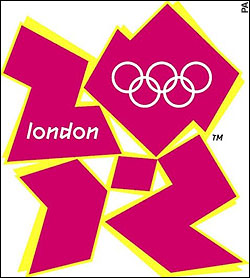
The new logo for the 2012 London Olympics has been unveiled and it has produced howls of outrage. Yet I beg to differ. I think it is perfect.
What does it look like to you? To me it is obvious: a collapsing structure of some sort, perhaps a building at the moment of demolition. The sense of downwards motion towards the bottom of the page is palpable.
Breathtaking. I mean what truly magnificent symbolism. The entire Olympic endeavour has been a massive looting spree with already grotesque cost over-runs (and it is only 2007), so surely something that conjures up images of collapse and disaster is really on the money… and speaking of money, at £400,000 (just under $800,000 USD) for the logo, it perfectly sums up the whole ‘Olympic Experience’ for London taxpayers.
No, if ever there was ‘truth in advertising’, this is it. Well done Lord Coe, I salute you.
Some of the more innovative and exciting buildings these days are linked to the world of sport. This may not be surprising given the vast sums of money – alas, sometimes taxpayers’ money – that swirls around sport these days. Take this picture of the Barcelona FC stadium, for example. Ever since the Roman days, in fact, sports stadia have been among the most impressive buildings in human civilisation (the arena at Arles, in the South of France, has a spooky, imposing quality of its own, for example).
But of course today, if you are a sport-loving Englishman like yours truly, today matters because the FA Cup Final is being held at its traditional home, Wembley (for non-Brits, this is in west London). The new stadium looks pretty damned impressive. The project to build it has not gone at all smoothly (a sign of the possible difficulties we might expect from the London Olympics). But the wait is worth it. It is magnificent.
One of my happiest days as a youngster was in 1978, when my local team, Ipswich Town, beat Arsenal 1-0 to win the FA Cup (the Blues won the European UEFA Cup three years later. Ah, those were the days). Even watching the game on the television, you were struck by the atmosphere. In 2000, when Ipswich were promoted in a playoff, I went with friends to the stadium in the last fully competitive game to be held before the old stadium was pulled down.
Update: a pity the match between Manchester United and Chelsea did not live up to the billing. Chelsea won. Well done to them (I think one or two Samizdata contributors will be rather chuffed about that).
Guy Herbert this morning posted a piece commenting on Australian Prime Minister John Howard’s decision to “ban” the Australian cricket team from touring Zimbabwe later this year. I generally have little time for Mr Howard, but in this case I can not personally be very harsh on him. What clearly happened is that the Australian Cricket Board (which these days prefers to call itself “Cricket Australia”) begged him at length the make such an announcement, and he eventually gave in despite considerable resistance, and he did this because the alternatives open to him were probably worse. I have no disagreement with Guy that the outcome is essentially a dishonourable one, but the other easy options were worse. Some background.
In international cricket, there are only three countries for who the game is directly profitable. These are India, Australia, and England (in decreasing order of profitability). The other countries that regularly play international cricket make money by playing the national teams of these three countries, and then selling television rights and other sponsorship opportunities for these matches. Thus it is very important to (say) Sri Lanka for (in particular) India and Australia to regularly tour Sri Lanka and play matches.
In order to assure its members of some sort of regular cricket and regular income, the International Cricket Council (ICC) has in recent years created a mandatory tour program, requiring each of its members to play each other both home and away over a five year period. Reactions to this rule have varied, and compliance with it has been variable. The rule allows two sides to postpone a series if both are in agreement, which has allowed India and Australia to at times get their way by offering more money or more matches if the matches are played at some undefined “later”. However, if a team takes a hard line, then (at least theoretically) the other side must tour, or must pay a fine to the ICC which will be then forwarded to the host team as compensation for the lost revenues from the matches that were to have been played. The ICC’s rules allow for two situations in which a fine is not payable: firstly in cases where there is a genuine issue of safety – tours of both Sri Lanka and Pakistan have been called off for this reason in times of high political tension and terrorist threat – and in cases where a government forbids a tour. This second rule has come into play more in cases where Zimbabwe were potentially the touring side, most notably when Zimbabwean players were refused visas by the government of New Zealand.
Zimbabwe are a full member of the ICC. In the mid 1990s Zimbabwe had quite a decent cricket team (of mostly but certainly not entirely white players) but in the years since then Zimbabwean cricket has gone the way of most other things in Zimbabwe. At the demand of the government, white players were pushed out of the team, as were any non-white players who dared to say anything critical of the government. Officials who ran the game and actually cared about cricket were replaced with compliant government yes-men. The organisation of cricket in Zimbabwe became a shambles, and we are not sure right now to what extent the domestic cricket is even taking place. (The Association of Cricket Statisticians and Historians has recently been complaining about being unable to get scorecards for the domestic Logan Cup, which it has documented with no trouble for over a century). Inevitably, the standard of the national team has dropped from “decent, but not world beating”, to utterly woeful. Their performance in the recently completed World Cup was dreadful, and they have dropped to 11th in the world rankings, way behind the rapidly improving Bangladesh, and behind even Ireland, a side just consisting of part time Australian and English expatriates and who are not a full member of the ICC.
However, through all this Zimbabwe has maintained its full membership of the ICC. Zimbabwe has been “temporarily suspended” from playing test matches due to its declining standards, but it is still playing one day international cricket, and other teams are expected to tour in order to play these games. Australia was scheduled to tour Zimbabwe this year.
The obvious thing to do would be to expel Zimbabwe from the ICC, not necessarily on political grounds explicitly, but simply because cricket in Zimbabwe is no longer being administered and organised properly, that the board is no longer independent of government, and because selections are no longer taking place on the basis of merit. However, there are two reasons why this has not happened. The first is that there is a “third world” versus “first world” divide in international cricket, and some aspects of the administration of the game are a post-colonial nightmare. For many years Australia and England (and, prior to their expulsion from international cricket in the apartheid days, South Africa) had the right of veto over any decisions made in the ICC, and the other countries still have a lingering resentment of this. Once this veto was abolished, the Asian cricketing powers were eager to elevate other countries to membership of the ICC so as to gain a voting majority against the former “colonial” powers, and this is one factor that led to the elevation of Zimbabwe in the first place. Expelling Zimbabwe would increase the voting power of the “first world” bloc, and many people in India, Pakistan, and Sri Lanka do not want this.
Secondly, what are the objections to Zimbabwe playing international cricket? For one thing, Zimbabwe is ruled by a dictatorship that restricts civil liberties. Well, other members of the ICC include Bangladesh and Pakistan, who are not exactly wonderful on this score either. South Africa is ruled by people who consider Robert Mugabe to be one of their old comrades in arms. If Zimbabwe were kicked out of world cricket on these grounds, then this would “set a bad example” to Pakistan and Bangladesh in particular. Did I mention that the governing body of cricket in Pakistan is traditionally a branch of the army and the head of its board is usually a general? That complicates matters further, and rules out the “We should expel Zimbabwe because the government controls cricket in the country” argument. The government of Sri Lanka appoints that nation’s cricket board too (although not through the army). As for “Zimbabwe selects players on something other than merit”, well, South Africa does that too. (Affirmative action with respect to black and coloured players). One would think that “Zimbabwe should be expelled because Zimbabwean cricket is a shambles” might be enough, but the organisation of cricket in a number of countries is a shambles (most notably Pakistan again, also (sadly) the West Indies). The ICC is also a shambles, having demonstrated in its organisation of the recently completed World Cup that it is an organisation that could not collectively get pissed in Porto)
Australia was scheduled to tour Zimbabwe later this year. The Australian players did not want to make the tour. The Australian government definitely did not want the tour to go ahead. → Continue reading: On cricket, Zimbabwe, John Howard, the ICC, Pakistan and Bob Woolmer
John Howard, Australia’s Prime Minister, is quite rightly critical of the Mugabe regime in Zimbabwe, and does not like the idea of the Australian cricket side touring there. He has had to struggle with his conscience:
“I am jammed between my distaste for the government getting involved in something like this and my even greater distaste for giving a propaganda victory to Robert Mugabe.
But not that much of a struggle. The next sentence:
Obviously if there is a way legitimately that the tour can be cancelled and there not be an exposure by Cricket Australia to any fine, then we’ll go down that path.”
Later in the week this was backed by threatening to withdraw the players’ passports, and the federal government undertaking to pay any ICC fine.
What a pity. Mr Howard plainly understands that the administration of sport is not the government’s business; but he feels bound in the pursuit of maintaining Australia’s national image to intervene in private sphere. Talk of the tour being a victory for Mugabe is just justifying cant: a ban is a much bigger target for racialised anti-colonial rhetoric. The quasi-ban – notably exercised by bullying and bribery rather than any lawful power – is a lurch of Zimbabwe-style arbitrary government and propagandising state action.
Western politics is not so far from the world of Comrade Bob, and we forget that at our peril.
There is an old and wise saying that ‘an armed society is a polite society’. It is also the case that a private society remains a private society as well. That is, the importance and respect paid by governments to a citizen’s right to privacy flows on to the rest of society. In contrast, when a government disregards the right of its citizens to keep matters private, other organisations in society will take their cue from the government’s lead.
Take gambling for example. The online sports betting industry in Australia has sprung up like mushrooms after autumn rain in Australia since the advent of the Internet. People used to like to have a wager on a football or cricket game in the friendly environment of a pub, but since the online bookmakers have opened, the betting habits of Australians have increased markedly.
It is not only Australians that have been bitten by the sports betting bug either. But it is illegal in many parts of the world, and that has created more problems then it has solved. When a market is not allowed to be filled by honest business folk, it is instead filled by organised crime figures and all the baggage that this brings. One of the biggest items of luggage is the curse of match-fixing in popular sports.
→ Continue reading: People go where governments lead
He is an admirable character in many ways. He has achieved tremendous success in his professional life; he is by all accounts a devoted husband and I have read that he is good company. It therefore rather a shame even for the most one-eyed follower of Chelsea FC that Jose Mourinho is such a petulant jerk. It takes quite a lot to make me sympathise with Alex Ferguson, the long-standing manager of Manchester United, or for that matter, his highly-paid football stars, but I think the Chelsea boss has achieved that feat.
Class continues to be a sore point in English sport (I am not really qualified to know about how this works in Scotland or Wales). Football has traditionally been thought of as a working-class game although these days the cost of buying a season ticket are beyond the reach of all but the fairly affluent. Cricket is a mixture; rugby union is thought of as middle class, tennis is the same, yachting is for the posh, ditto polo, etc. (I am not quite sure if Formula 1 fits a neat mould any more. It used to be quite posh, since only rich people could afford to drive fast cars). But in football, there is still a strong working class aspect. So I really do not understand why, if the Chelsea manager is going to insult someone, he brings up poverty and humble origins as a reason to abuse someone. In fact, if a person comes from humble origins and becomes an international sports star, like George Best, Tom Finney or Bobby Charlton, that usually counts in their favour.
As sporting competitions go, it may not be one of the most visually enthralling, but the America’s Cup yachting race festival – held this year in Valencia in Spain – has to be up there as one of the most prestigious and oldest. Started in Victorian Britain, the prize to win he massive trophy got its name from the fact that, for more than 150 years or so, America managed to win the series of race matches without a break until, in 1983, the Australian-backed team led by skipper John Bertrand beat a yacht helmed by legendary US race maestro Dennis Conner.
I love the shape and design of 12-metre yachts, and the J-class yachts that were raced in the 1920s and 1930s are arguably some of the most beautiful creations to be struck from the hand of man. I often find that people who do not know much about sailing like to put prints of J-Class vessels on their walls. I think there is something about the aesthetic of such a racing boat that appeals to us in much the same way that a sleek aircraft does. In many respects the design of a modern yacht has a lot in common with the design of aircraft, so perhaps it is not surprising that some of the top aircraft designers, such as Thomas Sopwith, were keen sailors too.
Largely due to the lack of time and of course money, I do not do as much sailing as in my younger days but I hope to get in some time afloat later this year, possibly including the race around the Isle of Wight, part of the Cowes Week yatchting series. I always seem to return from a yachting holiday or race feeling absolutely knackered but also refreshed by getting completely away from the office. You love it or you hate it. For me, sailing is as addictive as nicotine or booze. I intend to take the shore-based Yachtmaster navigation course this winter and eventually go for the full ticket.
Anyway, I will be interested to see if the USA can win back the America’s Cup trophy this year. I do not think Britain stands much of a chance, unless some rich-as-Croesus character decides to fund a serious challenge for the trophy.
|
Who Are We? The Samizdata people are a bunch of sinister and heavily armed globalist illuminati who seek to infect the entire world with the values of personal liberty and several property. Amongst our many crimes is a sense of humour and the intermittent use of British spelling.
We are also a varied group made up of social individualists, classical liberals, whigs, libertarians, extropians, futurists, ‘Porcupines’, Karl Popper fetishists, recovering neo-conservatives, crazed Ayn Rand worshipers, over-caffeinated Virginia Postrel devotees, witty Frédéric Bastiat wannabes, cypherpunks, minarchists, kritarchists and wild-eyed anarcho-capitalists from Britain, North America, Australia and Europe.
|