We are developing the social individualist meta-context for the future. From the very serious to the extremely frivolous... lets see what is on the mind of the Samizdata people.
Samizdata, derived from Samizdat /n. - a system of clandestine publication of banned literature in the USSR [Russ.,= self-publishing house]
|
The basic facts are given in this Wikipedia page: Poisoning of Sergei and Yulia Skripal, and there is a BBC “What we know so far” piece here. I keep hoping to read somewhere that they are beginning to recover. I keep not doing it.
What should the UK government do? What do you think about the measures it has taken so far?
Here are some opinions from several different points of view to get you started:
What can Theresa May do about Russia over the Salisbury poisoning? – Dominic Waghorn, Sky TV.
After the Skripal attack, talk of war only plays into Vladimir Putin’s hands – Simon Jenkins in the Guardian.
Alex Salmond: Don’t shut down my TV show over spy attack – Andy McLaren, STV News.
From Hansard:
Early Day Motion 392
JOHN PILGER AND KOSOVO
Session: 2004-05
Date tabled: 14.12.2004
Primary sponsor: Smith, Llew
Sponsors:
That this House welcomes John Pilger’s column for the New Statesman issue of 13th December, reminding readers of the devastating human cost of the so-termed ‘humanitarian’ invasion of Kosovo, led by NATO and the United States in the Spring of 1999, without any sanction of the United Nations Security Council; congratulates John Pilger on his expose of the fraudulent justifications for intervening in a ‘genocide’ that never really existed in Kosovo; recalls President Clinton’s Secretary of Defense William Cohen claimed, entirely without foundation, that ‘we’ve now seen about 100,000 military-aged [Albanian] men missing…..they may have been murdered’ and that David Scheffer, the US ambassador-at-large for war crimes, announced with equal inaccuracy that as many as ‘225,000 ethnic Albanian men aged between 14 and 59’ may have been killed; recalls that the leader of a Spanish forensic team sent to Kosovo returned home, complaining angrily that he and his colleagues had become part of ‘a semantic pirouette by the war propaganda machines, because we did not find one mass grave’; further recalls that one year later, the International War Crimes Tribunal, a body de facto set up by NATO, announced that the final count of bodies found in Kosovo’s ‘mass graves’ was 2,788; believes the pollution impact of the bombing of Kosovo is still emerging, including the impact of the use of depleted uranium munitions; and calls on the Government to provide full assistance in the clean up of Kosovo.
(Emphasis added.)
Signatures include:
Name: Corbyn, Jeremy. Party: Labour Party. Constituency: Islington North. Date Signed: 15.12.2004.
Name: McDonnell, John. Party: Labour Party. Constituency: Hayes & Harlington. Date Signed:
15.12.2004.
From yesterday’s Guardian:
Ratko Mladić convicted of war crimes and genocide at UN tribunal
The former Bosnian Serb commander Ratko Mladić, nicknamed the ‘butcher of Bosnia’, has been sentenced to life imprisonment after being convicted of genocide, war crimes and crimes against humanity.
More than 20 years after the Srebrenica massacre, Mladic was found guilty at the United Nations-backed international criminal tribunal for the former Yugoslavia (ICTY) in The Hague of 10 offences involving extermination, murder and persecution of civilian populations.
Edit: In the comments Jacob asks, “I was wondering what the massacre perpetrated by a Bosnian Serb in Bosnia had to do with Kosovo…” Fair point; in my efforts to make a Drudge-style snarky juxtaposition I failed to make the link clear. Given that we are talking about mass murders rather than day-to-day political point-scoring, I should have done so.
The link is that Mladic’s war crimes in Bosnia were part of the Yugoslav War(s), in which Slobodan Milosevic played a notorious role, which included egging on the Bosnian Serbs as well as his own crimes in Kosovo. The British Hard Left turned a blind eye to it all.
My intention was to point up how tawdry EDM 392, and by extension the whole business of soft-pedalling the crimes in former Yugoslavia, looks now in the light of yesterday’s conviction of Mladic.
A display of ‘airmanship‘, the sort, but not the pattern, that was needed in Operation Taxable on D-Day, appears to have fallen on ‘stony ground’ as it were, it looks like a pilot will be having a hard time.
US Navy officials have said it was “absolutely unacceptable” that one of their pilots used a jet’s contrail to draw a penis in the sky.
What else could, or should, he have used? Wider reaction is mixed:
Ramone Duran told the Seattle Times newspaper: “After it made the circles at the bottom, I knew what it was and started laughing.”
But one householder told KREM 2 she was upset about having to explain to her children…
However, the good news is that the Brylcreem Boys beat the Yanks to it:
In August this year, an RAF fighter pilot drew a 35-mile penis on radars monitoring skies over Lincolnshire, England.
Just wondering if they did that in the Cold War, and what the Soviet spy trawlers reported back.
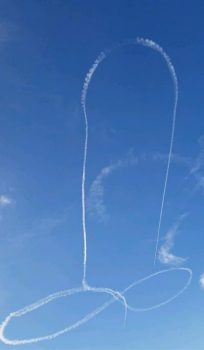
Photo credits: ‘jon’, and, of course, the Secretary of the United States Navy.
By “we” I mean the American government of course.
Let’s try some Q and A:
Does North Korea currently possess the means to destroy cities in South Korea, Japan and even the United States?
I’m guessing that’s a “no”. My understanding is that building a missile is one thing, building an atomic bomb another thing and combining the two really difficult.
If not, are they likely to acquire those means any time soon?
Well, they seem to have spent a hell of a long time just getting to this stage. So, it could be a while yet.
Were they to acquire them how likely would they be to use them?
I suppose the question here is whether or not the threat of instant nuclear annihilation would deter them. The point is that the Norks are atheists. They do not have a heaven to go to. They want to receive their rewards in this world. There is no upside to being nuked. So, they can be deterred.
Of course, I say they are atheists but their system of government is clearly a hereditary monarchy. Monarchies tend to have gods attached. But as yet (to the best of my knowledge) the Norks haven’t come up with a heaven. But when they do… watch out.
So, the best approach is probably to do nothing and let deterrence do its thing?
Probably. Of course, it doesn’t have to be the US doing the deterring. Japan and South Korea could do much the same, after they had developed nuclear weapons of course.
Getting back to this god stuff, the Iranians aren’t atheists are they?
No they’re not. And they believe in heaven. And they believe they would go to heaven if they nuked Israel. And rumour has it that the Norks are helping them with the tech. But my guess is that the Israelis have the means to deal with this threat before it becomes serious.
So, what you’re saying is that the US’s best approach is to do nothing?
Yes, I guess I am.
I would just add that it is remarkable how difficult smaller tyrannies find it to replicate 60-year old technology.
The ADC is a fire-eater and longs for the fray.
– Douglas Haig, Diary entry for 20 July 1917 commenting on a meeting with American Commander-in-Chief Pershing and other members of his staff.
And the name of this fire-eating ADC?
George S. Patton.
When dealing with complex political issues I often find it useful to ask myself what would happen in the absence of the state. This is not because I think that the glorious libertarian revolution is just around the corner but because such an exercise can at least give us some clues as to what the state should be doing in the here and now.
So, what do I mean by private roads?
Roads where the owners may decide who uses them, under what circumstances and have the means to enforce their decisions. The type of ownership could include purely commercial enterprises – out for a profit, individually-owned roads and – what I think will be the most common form – club-owned roads.
A lot would depend on people’s propensity to tolerate acts of terrorism. My guess is that this would be pretty low but I could be wrong. But that’s the great thing about the free market: it is a wonderful way of finding out what people really want. If the propensity is high then I would guess the outcome would be very similar to what we have now. Terrorism would simply be something that people would have to get used to. But let’s assume that the propensity is low. A commercial road owner would therefore have a very strong incentive to prevent terrorism.
Why?
Because, if a competitor was better at preventing terrorism then more people will want to use his roads.
But what of a road owned by a club?
This is an important example if I am right that most private roads would be in this form. The governance rules might be in the form of one frontage one vote. But it may be that the number of votes is proportional to the fees charged.
Now a road club will not have the same incentives as a commercial road – they would not exist to make money. But they would have incentives enough. The principal one would be that their members would want to preserve the value of their properties and one factor in that would be how likely it was that their properties became subject to terrorism.
Individual road owners, we can assume, would be in much the same position as clubs.
So, assuming there are strong incentives to prevent terrorism how would road owners go about it?
Obviously they would want to stop the terrorists. But they would also want to make it as easy as possible for non-terrorists to go about their business. And they would want to keep the costs down.
A key moment is what happens when someone enters the road – or road network – from one of the inevitably large number of frontages. You could have a guard on every frontage searching every person entering the road. However, this would be expensive. Not only that but it would be unlikely to be effective. Guards would get bored and become inattentive and would themselves become likely targets.
Another approach might be to deny access to anyone suspected of being an active terrorist. But this is fraught with difficulty. How would you know who is who?
Far simpler and more effective would be to ban anyone harbouring any terrorist sympathies whatsoever. Effective terrorist campaigns can always rely on a sea of sympathisers who are not themselves terrorists to aid and abet those who are. These sympathisers are usually easy to identify. Exceptions might be granted for children and members of the older generation. Or maybe there would be a system of vouching for people, guarantees of good behaviour or even the taking of hostages. The chances are that if private roads came about tomorrow terrorist sympathisers would wake up to find their properties surrounded by barbed wire.
The next issue would be those seeking entry from another road i.e. a road owned by another entity. What you would probably see is a system of guarantees. One road owner would guarantee the non-terrorist nature of their road users to other road owners. Obviously, there would be some fairly hefty compensation should one road owner’s users engage in acts of terrorism on another road owner’s territory. That would mean that road owners would be very careful who they let out.
There is a precedent for this – sort of. Those familiar with the movie The Day of the Jackal will recall that the idea that they might be letting a terrorist loose on foreign soil scared the living daylights out of the British government.
So, what would happen to the terrorist sympathisers?
It is difficult to see how terrorist sympathisers would be allowed to use non-terrorist-sympathiser roads. They would therefore only be allowed to use terrorist-sympathiser roads. As terrorist sympathisers tend to be poor and geographically concentrated, they would have an immediate problem over what to do for an income especially in the absence of a welfare state. Faced with poverty some would choose to leave for terrorist-sympathiser majority countries while others would choose to change their beliefs. Of course, there is the issue as to whether such conversions would be genuine. I have no answer to this.
But what if the terrorists engaged in acts of terrorism from their own roads?
They could for instance mortar bomb non-terrorist-sympathiser roads. My guess is that they would get mortar-bombed back. Just to greater effect.
In this earlier posting about a book I had been reading, I talked about how reading can turn sort of knowledge into knowledge of a more solid sort. The author says something which you already sort of knew, but as soon as he says it, you know it much better. Often such knowledge consisted of things you already knew about separately, but you hadn’t connected them in your mind.
Recently this happened to me again. Like many others, I have lately been reading Homo Deus by Yuval Noah Harari. And I soon learned that Harari, like Steven Pinker, has noticed that the world has been becoming a lot less warlike.
I already agree with Harari that a major reason for this reduction in warfare is nuclear weapons. On page 17 of my paperback edition of Home Deus, he says this:
Nuclear weapons have turned war between superpowers into a mad act of collective suicide, and therefore forced the most powerful nations on earth to find alternative and peaceful ways to resolve conflicts. …
Quite so. But next comes this thought, which I had not, until now, put together in my mind:
… Simultaneously, the global economy has been transformed from a material-based economy into a knowledge-based economy. Previously the main sources of wealth were material assets such as gold mines, wheat fields and oil wells. Today the main source of wealth is knowledge. And whereas you can conquer oil fields through war, you cannot acquire knowledge that way. Hence as knowledge became the most important economic resource, the profitability of war declined and war became increasingly restricted to those parts of the world – such as the Middle East and Central Africa – where the economies are still old-fashioned material-based economies.
I knew that war is diminishing, in fact I have written blog postings about what a big change that is for humanity. And I knew that the knowledge economy is now becoming a bigger deal than the mere possession of agricultural or resource-rich land. Who now does not? But call me dumb, as maybe some tactless commenters will, but I had never – or never very clearly (only “sort of”) – made the causal connection between these two things. Taken together, the rise of the knowledge economy and the arrival of nuclear weapons, themselves a consequence of recently acquired knowledge, amount to a transformation in the cost-to-benefit ratio of war. It used to be that war incurred some costs, heavy costs if you did badly, but if you did well, war might yield handsome gains. Not any more, except when it comes to places still stuck in the logic of quarrelling over physical resources.
A more respectable reason, besides me being dumb, why I had not made this rather obvious connection is that there has been another process that has masked the peaceful nature of knowledge-based economies, which is that when “knowledge” first arrives in a society, its first impact is not to cause peace to happen, but rather that particular sort of war that is so misleadingly categorised as “civil”, i.e. war of the worst sort. Look at sixteenth century Germany, seventeenth century Britain, eighteenth century France and twentieth century Russia and China. All were in those times cursed by newly “educated” generations who each fervently believed that they possessed knowledge, of why and how they should rule the world, but who were really themselves possessed by various sorts of ideological frenzy. So maybe I can be forgiven, as can others who took a while to see or who still do not see the connection between knowledge and peace. It’s because the connection between knowledge and peace takes a while to even happen, and at first it goes in the wrong direction rather than the right one. To put it another way, it takes quite a while for “knowledge” to shed its sneer quotes. To put it yet another way, there are experts and there are “experts”.
What will the West gain when Montenegro’s membership in NATO becomes official? Not much. Barely half a million people live there. The Boise, Idaho, metropolitan area is more populated than that. With roughly 2,000 soldiers, its miniscule army will hardly boost NATO’s military capacity by an iota.
Vladimir Putin wants it and needs it much more than we do, badly enough to assassinate an elected head of state and instigate a regime-change. That’s precisely why he shouldn’t have it.
For years now, the Kremlin has been violently expanding its power, its influence and even its territory in Europe and Asia. Every time Putin racks up a victory and gets away with it, he grows more confident that he can take more. That’s how it goes with expansionist dictators everywhere. So if you don’t want to go to war against Russia—and only an insane person would—the fewer wins in Putin’s column, the better.
– Michael Totten
If you needed yet another reason to reject the EU as an utterly toxic organisation, here is an absolute corker:
European Commission President Jean-Claude Juncker said on Thursday that Europe must not cave in to U.S demands to raise military spending, arguing that development and humanitarian aid could also count as security.
No doubt Jean-Claude Juncker feels that NATO should deploy Oxfam, Save the Children & Charlotte Church to Riga, Vilnius and Tallinn in order to deter any Russian incursions into the Baltic states.
It is reported in the Guardian that the career of a noted creative artist is coming to an end.
… the offences of Phil Shiner, the human rights lawyer who has just been struck off by the solicitors’ disciplinary tribunal, are worse even than they appear at first sight. It is hard to comprehend the nightmare faced by British soldiers he wrongly accused of torture and murder in Iraq. But he did not only fail those he traduced in court. He failed Iraqis who believed they had a case; he failed genuine victims of abuse who will face a harder fight in future. And his dishonesty and deception, and the bringing of baseless cases, risks tainting the whole case for human rights.
There is quite a bit to agree with in this editorial, but the insouciance of the writer takes my breath away. Will the Guardian, so long his leading patron and publicist, be holding a retrospective exhibition of its own extensive Phil Shiner back catalogue?
News reaches us from the Telegraph of rumblings in Rome, where an expansionist Pope appears to have burst the bonds set up by Mussolini and, setting his sights on the smallest ‘state’ within Rome, persuaded the British head of the International Sovereign Military Order of Malta, Grand Master Matthew Festing, to resign. Unlike a previous situation of Argentine aggression against a small group of islands sitting peacefully in a deep blue sea, this has passed off far more peacefully and entirely within Rome.
The background to this dispute is, we are told:
Mr Festing and the Vatican have been locked in a bitter dispute since one of the order’s top knights, Grand Chancellor Albrecht Freiherr von Boeselager, was sacked in December in the chivalric equivalent of a boardroom showdown – ostensibly because he allowed the use of condoms in a medical project for the poor.
Is the article hinting that the ‘condoms’ issue is a bit of a stretch?
When Festing fired von Boeselager, he accused the German of hiding the fact that he allowed the use of condoms when he ran Malteser International, the order’s humanitarian aid agency.
Von Boeselager and his supporters say the condom issue was an excuse by Festing and Cardinal Raymond Leo Burke, an arch-conservative who has accused the pope of being too liberal, to increase their power.
Well since neither the Swiss Guard nor the St John’s Ambulance have got involved, it all seems rather peaceful. But the Pope seems to brook no dissent, not even in his last satellite ‘state’.
Francis has said he wants the 1.2 billion-member church to avoid so-called “culture wars” over moral teachings and show mercy to those who cannot live by all its rules, especially the poor.
Perhaps this is the Pope’s version of the Brezhnev Doctrine?
When forces that are hostile to socialism try to turn the development of some socialist country towards capitalism, it becomes not only a problem of the country concerned, but a common problem and concern of all socialist countries.
From Instapundit (my emboldenings):
The miniature Perdex drones, different from larger, more common remotely piloted vehicles (RPVs) like the well-known Reaper and Predator, operate with a high degree of collective autonomy and reduced dependency on remote flight crews to control them. The large group of more autonomous Perdex drones creates a “swarm” of miniature drones. The swarm shares information across data links during operation, and can make mission-adaptive decisions faster than RPV’s controlled in the more conventional manner.
In a statement released by the U.S. Department of Defense, Strategic Capabilities Office Director William Roper said, “Due to the complex nature of combat, Perdix are not pre-programmed synchronized individuals, they are a collective organism, sharing one distributed brain for decision-making and adapting to each other like swarms in nature,” Director Roper went on to say, “Because every Perdix communicates and collaborates with every other Perdix, the swarm has no leader and can gracefully adapt to drones entering or exiting the team.”
Doctor Who fans will know exactly where this sort of thing leads:
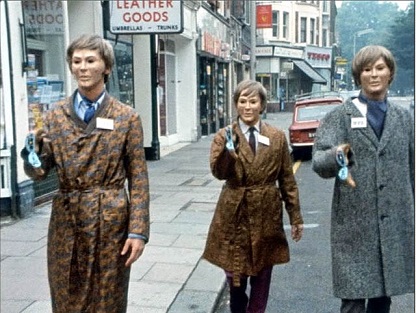
You have been warned.
|
Who Are We? The Samizdata people are a bunch of sinister and heavily armed globalist illuminati who seek to infect the entire world with the values of personal liberty and several property. Amongst our many crimes is a sense of humour and the intermittent use of British spelling.
We are also a varied group made up of social individualists, classical liberals, whigs, libertarians, extropians, futurists, ‘Porcupines’, Karl Popper fetishists, recovering neo-conservatives, crazed Ayn Rand worshipers, over-caffeinated Virginia Postrel devotees, witty Frédéric Bastiat wannabes, cypherpunks, minarchists, kritarchists and wild-eyed anarcho-capitalists from Britain, North America, Australia and Europe.
|




