A sample text widget
Etiam pulvinar consectetur dolor sed malesuada. Ut convallis
euismod dolor nec pretium. Nunc ut tristique massa.
Nam sodales mi vitae dolor ullamcorper et vulputate enim accumsan.
Morbi orci magna, tincidunt vitae molestie nec, molestie at mi. Nulla nulla lorem,
suscipit in posuere in, interdum non magna.
|
I will start by saying that there is no doubt whatsoever that Jeffrey Epstein carried out multiple sex offences against children. He was justly convicted in 2019, and should have been brought to justice earlier than he was.
But I was disturbed by one aspect of the way this story about Epstein that appears on the BBC website was reported: Epstein housed abuse victims in London flats, BBC reveals
Sex-criminal financier Jeffrey Epstein housed women who say he abused them in several London flats in the years after UK police decided not to investigate him, the BBC can reveal.
We found evidence of four flats, rented in the affluent borough of Kensington and Chelsea, in receipts, emails and bank records contained within the Epstein files. Six of the women housed in them have since come forward as victims of Epstein’s abuse.
Many of them – from Russia, eastern Europe and elsewhere – were brought to the UK after the Metropolitan Police decided not to investigate Virginia Giuffre’s 2015 allegation that she had been a victim of international trafficking to London.
The Met said it followed “reasonable lines of inquiry” at the time, interviewing Giuffre on multiple occasions following her complaint and co-operating with US investigators.
Some of the women housed in the London flats were coerced by Epstein to recruit others into his sex trafficking scheme, as well as regularly transported to Paris by Eurostar to visit him, according to emails in the files.
The BBC searched through millions of pages of records gathered by the US Department of Justice in its investigation of the disgraced financier, and released as part of the Epstein files, in order to piece together the most detailed picture yet of his operation in the UK.
It shows how the operation grew more extensive than was previously known – with more victims, established infrastructure such as housing, and frequent transportation of women across borders – right up to Epstein’s death, despite warnings to UK police.
We are not publishing any details about the young women to protect their anonymity as the victims of sexual abuse.
Our investigation found British police had other opportunities to open an inquiry into the disgraced financier’s activities in the UK, in addition to Giuffre’s complaint that she had been trafficked and forced to have sex with Andrew Mountbatten-Windsor in 2001. Mountbatten-Windsor has always denied any wrongdoing.
Just a few months before his arrest on charges of trafficking children for sex, and his death in jail awaiting trial, our investigation found that Epstein was messaging a young Russian woman on Skype who was living in one of the London flats he paid for.
He sent her an image which is not included in the files but which seems to have been a picture of himself. The woman jokingly asked who the good-looking man in the picture was.
Epstein said it was her landlord – but said that unlike most landlords, he pays rather than collecting the rent.
The woman later went on to ask Epstein for money to pay for her English classes in London and to help buy cutlery and furniture for the apartment. She also asked for visa advice for another Russian woman who was due to come and stay.
The 2019 exchange reveals how Epstein remained in touch with the women he housed in London right up until his arrest and death in jail, and how involved he was in the detail of their lives.
In contrast to the photos released in the Epstein files, which are often decades old, we found the women housed by him in London pictured in Instagram posts, on Russian social media and in high-end fashion shoots.
The exterior of the flat mentioned in the Skype chat is pictured in one of these photographs. In the background a doorbell with the name of the building is visible, which enabled us to find the tenancy agreement in the Epstein files.
A shipment of gifts recorded in the files led us to another apartment. Details of yet another, rented in 2018 and 2019, were buried in a 10,000-page credit card bill. It also recorded the daily living expenses of the woman staying there, who had her own card on Epstein’s account with a $2,000 (£1,477) monthly allowance.
The thing that disturbed me about the BBC’s reporting was the uncritical way in which these adult women were described as “victims” and the way that their claim to have been coerced was reported as absolute fact.
Why should that disturb me? Not because I think that Epstein was incapable of such a crime: we know he was a twice-convicted sexual predator. I also know that sexual coercion can be combined with lavish gifts and a luxurious prison. And I utterly reject the barbaric belief that sexual coercion “does not count” if the victim had previously agreed to sex, including sex that was paid for. Allegations of this type of crime must be taken seriously. As I have said many times, “taken seriously” means “carefully investigated”, not “automatically believed”.
A pity my first reaction upon reading this story was to laugh.
Related posts:
Believe or disbelieve individuals, not whole groups – about Neil Gaiman.
The feminist movement denies rape victims justice
If you don’t care whether a rape really happened, you don’t care about rape
“Comedians tell ministers lack of funding is no laughing matter”, says the BBC headline writer. Do not judge him too harshly; hanging would suffice. The article continues,
Comedian Tom Walker, who portrays the fictional journalist Jonathan Pie, said the government needs to recognise comedy “as an important cultural thing from grassroots to sitcoms on the BBC”.
Walker suggested changing how stand-up comedians and others in the industry are viewed, explaining: “Essentially every stand-up comedian is a small business, they are an entrepreneur and that should be rewarded and acknowledged.”
“Should be rewarded”, that’ll get a laugh from the actual entrepreneurs. According to the Cambridge dictionary, an entrepreneur is “a person who attempts to make a profit by starting a company or by operating alone in the business world, esp. when it involves taking risks”. Get it? They take the risk, they get the profit if it works out, and they take the loss if it does not. By definition, no one who has a guaranteed income from the state is an entrepreneur.
Ro Dodgson said comedy is “often based on risk” and clubs and promoters who are struggling financially are less able to take a chance on new acts.
The comedian said if the government agreed funding to clubs “as almost a form of insurance” to keep trying new acts and supporting emerging talent “then we’d have an industry that can sustain itself”.
By definition, no industry that has a guaranteed subsidy from the state sustains itself.
[AIUI etc, etc.]
In the beginning there were wireless sets. But the government worried that these could be used by spies for a foreign power. So it demanded that wireless owners took out licences. The licences were free the government just wanted to know who had a wireless. Just in case.
Then someone came up with the idea of broadcasting. Music, lectures, news, that sort of thing. The government came up with a scheme. They would charge a fee for the licence. It would also demand that wireless manufacturers make a contribution. To sugar the pill it would make it illegal to sell a wireless set that wasn’t made by a member of the British Broadcasting Company.
The minister responsible for this? One Neville Chamberlain.
And so in late 1922 the BBC, in the shape of such regional broadcasters as 2LO, came into being. And it was very popular – save for the fact that building one’s own set was illegal. But the arrangement had an expiry date. And a committee was set up to decide what to do next.
A hundred years ago it reported and as you can probably guess, the manufacturers were ditched with the recommendation that a public body to be known as the British Broadcasting Commission be put in its place financed entirely through the licence fee.
Why? I seem to remember being told that the Company was in dire financial straits. But there’s not a hint of it in the report as published in The Times. Actually, there is very little justification at all. Although they do say this:
Notwithstanding the progress which we readily acknowledge, and to the credit of which the company is largely entitled, we are impelled to the conclusion that no company or body constituted on trade lines for the profit, direct or indirect, of those composing it can be regarded as adequate in view of the broader considerations now beginning to emerge.
So you are getting rid of something you “readily acknowledge” is a success for something that might work?
We do not recommend a prolongation of the licence of the British Broadcasting Company or the establishment of any similar body composed of persons who represent particular interests.
I’ve got some bad news about how that’s going to work out.
We think a public corporation the most appropriate organization. Such an authority would enjoy a freedom and flexibility which a Minister of State himself could scarcely exercise in arranging for performers and programmes, and in studying the variable demands of public taste and necessity.
The Times’s own report of the report has this to say:
The British Broadcasting Commission will be appointed by the Crown, and the Committee feel that the proposal is an interesting development in the application of the principle of public ownership.
So, the whole thing was a communist experiment. Great. And then there was this doozy:
It is felt that that principle can be easily applied in this instance, because broadcasting must of its very nature be a monopoly.
Clearly that argument falls because it is not true that broadcasting is a monopoly. But even if it were, as a libertarian, in principle I would prefer such things to exist in an unfettered free market.
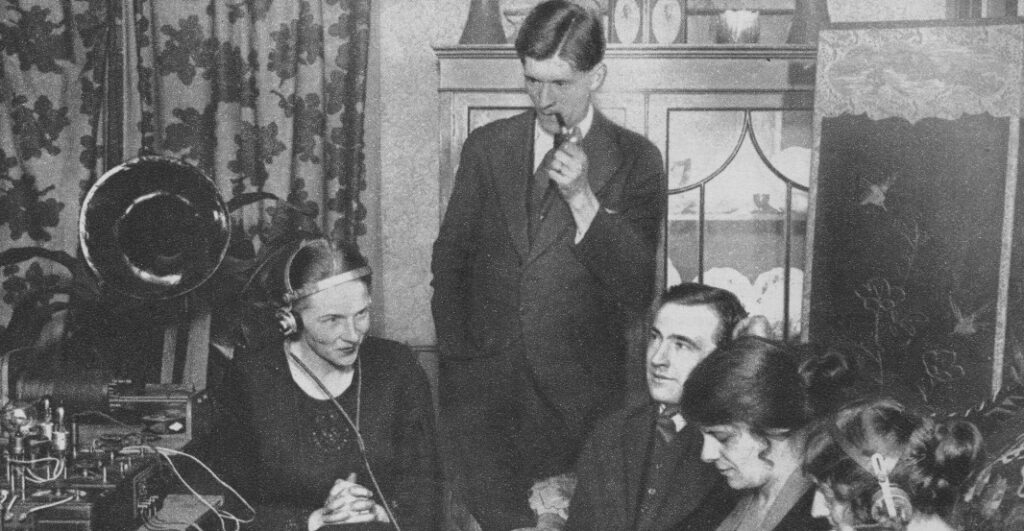 Before it became Lenin in the lounge Update 10/4/26. Incredulity has been expressed over the idea that d-i-y wireless sets were illegal. They were but only for about a year or so. And I don’t think there were any prosecutions. Oddly enough, when “interim” licences were first issued – for just such sets – the number of licences doubled more or less overnight.
“The toughest job facing the new head of Ofcom: tackling the blatantly partisan GB News”, writes Polly Toynbee in the Guardian.
She writes,
Labour feels more sure-footed. A stronger sense of its own identity flows from standing up to Donald Trump, his war and his insults. MPs are less often looking over their shoulders at the right and its media.
Here comes one test. Selecting a new chair of the media regulator Ofcom is in its final phase: which of two reported frontrunners is appointed will reveal the government’s frame of mind. Ofcom has been moribund, weak to the point of invisibility. One key area is the regulation of online harms, as the government seeks to toughen up on the safety of children and the sanity of the nation, against a libertarian right that defends aggressive notions of free speech, and permits fact-free dangers, such as vaccine and climate denial. Kemi Badenoch is a free-speecher who argued for the weakening of the Online Safety Act in 2022 by removing the ban on “legal but harmful” material for adults, claiming it was “legislating for hurt feelings”. Keir Starmer is strengthening the law by banning addictive algorithms.
and
Try to imagine the revolt on the right if Labour sanctioned an upstart broadcaster with, say, George Galloway as its main nightly presenter (he’d be as good at it as Nigel Farage), a string of leftists paid large sums by a benefactor founder and a news agenda focused on far-left tropes. Beyond that scenario, it’s hard to devise a leftist channel as aggressively poisonous as GB News, which pours out Farage, Matt Goodwin, Lee Anderson, Darren Grimes, Martin Daubney and Richard Tice, and is frequently accused of breaking rules about accuracy and impartiality.
Toynbee is right to say that George Galloway could find an audience, but wrong to present the scenario of him being employed by a mainstream outlet as unthinkable. Alongside his work for Iran’s Press TV and Russia Today, Galloway hosted shows for talkSPORT and talkRADIO for several years. But we don’t have to imagine “a string of leftists paid large sums by a benefactor founder and a news agenda focused on far-left tropes”, we can see it in Ms Toynbee’s own newspaper, which has been financed by the Scott Trust since 1936. That’s fine by me. I don’t object to “a string of leftists and a news agenda focused on far-left tropes” if it is paid for by a benefactor or by other leftists who like their tropes. I start objecting to a string of leftists and a news agenda focused on far left tropes when I am forced to pay for it via my television licence.
“Never mind leading the free world, if Donald Trump were your ageing father, when would you take away his car keys?”, asks Gaby Hinsliff in the Guardian.
She writes,
Imagine, purely for the sake of argument, that the 61% of Americans (according to Reuters-Ipsos) who think their president has become more erratic with age and the 56% who don’t think he has the mental sharpness now to deal with challenges (according to recent polling for the Washington Post) were not wrong. Suppose that, much as they did with an octogenarian Joe Biden, millions of Americans had sensed something through their TV screens that genuinely did affect their president’s capacity to send thousands of young soldiers to their potential deaths in the Middle East, whether or not that something amounted to a clinical diagnosis.
Imagine they were right to suspect that the lives of countless people around the world rested in the hands of someone whose judgment might not be entirely up to this – including the 45 million estimated to be at risk of acute hunger if farmers can’t get enough fertiliser, a crucial byproduct of a now badly disrupted Gulf gas industry, to grow food. What would it take, hypothetically, for the system to challenge an elected president’s will?
It’s strange that this has become a subject seemingly too delicate to discuss in public, given what is at stake.
It is not strange at all. I think that Ms Hinsliff knows perfectly well why the delicate “cannot discuss” Trump’s possible senility. Her own delicacy in introducing the elephant to polite company demonstrates that. “Suppose that, much as they did with an octogenarian Joe Biden, millions of Americans had sensed something through their TV screens”. Yeah, suppose the sensing-through-the-TV screens had happened before. Suppose your newspaper – suppose your entire media establishment – had frantically squashed the ballooning obvious until it burst like an exploding colostomy bag. Imagine, purely for the sake of argument, that Americans had concluded that either Vice President Kamala Harris was complicit in covering up her boss’s senility or that she was too stupid to notice it. Imagine, purely for the sake of argument, that them voting for Donald Trump in preference to her was a rational decision.
You can’t imagine it; that’s your problem. The cloud of smoke you made to hide Biden’s senility has blinded you.
I was going to say that Guido’s headline cannot be improved upon, but, on second thoughts, the headline-writer really should have mentioned that the hamster was dressed as Godzilla. Details matter.
Taylor Lorenz is the one who doxxed Libs of TikTok, who came this close to lionising the murderer Luigi Mangione, and who for some reason habitually lies about her age, but she makes some excellent points in this article: “The world wants to ban children from social media, but there will be grave consequences for us all”.
Excerpt:
While social media bans may seem like a prudent measure to protect children, they are not only ineffective, they endanger both children and adults. There is little evidence that social media is driving any type of widespread mental health crisis in children. Studies have repeatedly shown the opposite. Removing anonymity from the web, which will inevitably happen when tech companies are required to identify and ban children, allows for easier government tracking and censorship of journalists, activists and whistleblowers, who rely on online anonymity.
And while some claim the laws would curb big tech’s power, only the largest tech companies have the resources to shoulder the extensive costs of age verification systems. Non-profit and indie platforms could be forced to close, consolidating big tech’s power further. Mass surveillance systems, once constructed, could also be easily leveraged by governments and bad actors.
If we want to fix the problems with social media, the place to start is through comprehensive data-privacy reform and consumer protections. Governments could also take action to break up big tech companies and prosecute them for anti-competitive behaviour. Lawmakers, who claim to care about children, could pass broader social and economic policies that we know would meaningfully improve children’s lives. Social media is a lifeline, especially for marginalised youth such as LGBTQ+ teens. Any policies that limit online access should centre on the most vulnerable children and adults.
To enact the social media bans being proposed around the world requires some system of age verification, which inherently means expanding surveillance technology. Because algorithmic systems cannot accurately estimate age, verifying a user’s age also requires collecting highly sensitive data or government documents to support the biometric data harvested. The laws being considered don’t all stipulate which system will be used, but there are significant privacy and safety concerns with all of them.
“How to detoxify the immigration debate” is the title of an LSE (London School of Economics) blog post by Hana Kapetanovic.
The debate is being dominated by the loudest voices with the most strongly held views; the voices of the majority aren’t being heard. It would sound very different if they were. In British Future’s segmentation of public attitudes to immigration, the biggest group by far is the “Balancer Middle”, with around half (49 per cent) of the public falling into this group. This group is not fundamentally opposed to immigration, but wants it to be “controlled and fair”.
and
As much as public perceptions are shaped by the media, political and information landscape, we mustn’t forget that public perceptions in turn shape media and political debates. The media publishes articles they think people will read. Politicians move to where they think the votes are, and yet are still faced with low trust. We need to break this democratic doom loop.
Breaking the democratic doom loop and detoxifying the debate sounds nice, but her proposal to do this is to take a group of a few dozen voters – a group that is a representative sample of the electorate but is self-selected in that the group is made up of the sort of people who want to participate and have time to do it – show them lots of briefings by government approved experts, have them converse for a few days guided by a government facilitator, and declare that whatever curated consensus the group comes to after this exercise has greater democratic validity than either the discourse of MPs who have actually been elected or the myriad private debates of the un-detoxified mass of the electorate.
This process is called a “Citizens’ Assembly” or a “Citizens’ Jury”. If all these grand titles boil down to is a bigger than average focus group, fine. Endearingly worthy, in fact. But the minute this “Citizens’ Assembly” starts to displace the powers of the old sort of assembly voted in by all the citizens, or the “Citizens’ Jury” starts to think that it can make decisions that affect other people’s lives as if it were a jury jury, then…
No.
“UK minimum wage is raising youth unemployment, Bank of England’s Mann says” – Reuters, Feb 15th 2026
Do you remember your first crappy job? Today’s young people would wish for half your luck, writes Gaby Hinsliff in the Guardian, Feb 20th 2026:
This week, unemployment rates for 18- to 24-year-olds hit a high not seen outside the pandemic since 2015. School leavers are now competing for work stacking shelves or pulling pints with overqualified new graduates who can’t find graduate jobs, at a time when pubs, shops and cafes don’t seem to be hiring. Even those employers strong enough to have survived lockdown routinely complain that it’s getting too expensive to hire staff – especially young ones.
The Centre for Policy Studies thinktank calculates that it will cost 26% more to hire an 18- to 20-year-old by this spring than it did in 2024. That reflects government decisions taken for perfectly good reasons, including hiking employers’ national insurance to fund the NHS, plus two chunky rises to the minimum wage for the under-20s (now £10 an hour) in line with manifesto promises to level it up with the higher adult rate (now £12.21) over the course of a parliament. No matter how noble the motive, once it costs the same to hire four teenage Starmers as it once did to hire five, there are likely to be consequences. Yet until this week, when an internal Labour argument about whether they could be inadvertently pricing young people out of work spilled on to newspaper front pages, political debate over why so many young people don’t have jobs has mostly involved blaming them for being anxious snowflakes. Injury, meet insult.
I am truly, non-sarcastically impressed that Ms Hinsliff and a few other left-wing commenters are now willing to admit that “there are likely to be consequences” to increasing the minimum wage. Hearing that word, “consequences”, enter left-wing discussions of workers’ pay is like a glimpse of a little mammalian form scurrying through the dust kicked up by a brontosaurus.
Soon Brits will need Starlink + VPN to read the news. Like Iran
– Douglas Carswell
In times past, people in these islands went to great lengths to conceal that their ancestors were “lowborn”, or non-prestigious foreigners, or, worse yet, unknown. Social climbers would frequently change their names to something more aristocratic and perhaps pay some impoverished scholar to fake them up a coat of arms and insert a fictional ancestor or two into the historical record. Then along came steam engines and trousers and we moved to saying that a man or woman should be judged on their own deeds, never mind who their ancestors were. I thought we all agreed this was a good change.
So why have we gone back to acting as if having upper class ancestors who lived here is an important component of a modern British person’s status if that person happens to be black – so important that it needs to be lied about?
BBC Told To Avoid “Clunky” Color-Blind Casting & “Preachy” Anti-Colonial Storylines In Drama Series
The BBC has been urged to rethink color-blind casting “tokenism” and “preachy” storylines about the UK’s colonial history in scripted series, according to a major study commissioned by the broadcaster.
Conducted by former BAFTA chair Anne Morrison and ex-Ofcom executive Chris Banatvala, the thematic review of “portrayal and representation” across BBC output found that “clunky” depictions of race can cause more harm than good.
The 80-page report revealed audience complaints about Doctor Who casting Nathaniel Curtis as Sir Isaac Newton in the 60th anniversary special “Wild Blue Yonder,” as well as the 2023 Agatha Christie series Murder Is Easy, which featured an allegory on colonialism.
The review noted that color-blind casting was a matter of controversy for commentators and some viewers. Urging commissioners to “consider their choices carefully,” the report said that good intentions to increase diversity can lead to inauthentic outcomes — outcomes that can sometimes be damaging to the communities they are attempting to serve.
“In depicting an anachronistic historical world in which people of colour are able to rise to the top of society as scientists, artists, courtiers and Lords of the Realm, there may be the unintended consequence of erasing the past exclusion and oppression of ethnic minorities and breeding complacency about their former opportunities,” the review said.
“What needs to be avoided is ethnic diversity which looks forced and tick box, and we found our interviewees of colour as emphatic on this point as those who were white.”
Good.
However, the writers of this review made an argument in defence of the black Newton that shows they don’t understand science fiction:
Though Doctor Who was referenced, the report raised an eyebrow about the specific concerns regarding Curtis, saying that a mixed-race Newton “seems much less of a stretch” in a universe in which the central character is a time-travelling extra-terrestrial, who regenerates into different actors.
It doesn’t work that way. In a genre such as opera that makes no attempt at realism (read a plot summary of The Love of Three Oranges sometime), or in much of Shakespeare, the extra degree of divergence from reality involved in having the passionate soliloquy in which a nominally European character pours out his heart in rhyming couplets be delivered by a black performer really is trivial, but the whole point of science fiction is that the premise can be as wacky as you like, but the consequences of that premise are worked through with rigour.
OK, maybe not with rigour in the case of Dr Who, but certainly with an attempt at naturalism.
I have no complaints about the acknowledged alternative universe of Bridgerton. (“The series is set during the early 19th century in an alternative London Regency era, in which George III established racial equality and granted aristocratic titles to people of color due to the African heritage of his wife, Queen Charlotte.”) With all the dystopian alternate timelines out there, it makes a nice change. In a similar way, the Doctor meeting the black Newton of a Bridgertonesque timeline wouldn’t have bothered anyone. Five seconds of script and the word “quantum” would have been enough to avoid the collective national wince when viewers realised they were having that line of false history pushed at them again.
Sometimes the Twitter and YouTube algorithms send me grainy film clips of life in Britain many decades ago; street scenes with policemen directing traffic, workers leaving factories, and the like. One notices several differences from the present. Working class women are wrapped in shawls. Every adult male, however poor, is wearing a hat. And, of course, everyone in sight is white. There is no logical reason why knowledge of this obvious historical truth – the fact that the vast majority of British people were white as late at the 1960s – should cause hostility to present-day black British people, but these days the comments to those historical clips quickly fill up with variations on the words “Notice anything?” I notice that human beings dislike being lied to.
As I said in a post called The Great Retcon,
This desperate retconning of the odd Phoenician, Libyan or Egyptian who turned up in British history as “black”, and the whole trend to exaggerate the number of black people in British history, has two effects, both of which increase racism. White people from the majority population resent seeing the history of their ancestors falsified and even erased, as the Mayor of London, Sadiq Khan, did when he said that “This city was built by migrants.” For black people, and indeed anyone of any colour whose ancestors did not come from these islands, it cements the idea that a person cannot truly be Welsh [the post was prompted by a tweet from Welsh Labour that said “The paths of Black History and Welsh history are indivisible”] or British unless they can point to examples of people with enough genes in common with them having lived in those places centuries ago.
So why was the UK, US and European media so obsessed with this one shooting? Because it was done by an ICE officer, and ICE has been painted as Donald Trump’s personal law enforcement agency, ignoring the fact that it was created by George W Bush in 2002.
I make no defence of Donald Trump. I make no defence of the violent actions of ICE in so many US cities, but to pretend that this one incident was more important than the nascent revolution going on in Iran is laughable. And that’s what too many media organisations were doing.
I can look myself in the eye because almost from the start of the protests, I was covering them on my LBC show. Indeed, we’ve devoted hours and hours to them – more I suspect that any of the 24 hours news channels up until the last couple of days.
If you wanted any real-time coverage of what’s happening in Iran you had to go to live Youtube channels, like Mahyar Tousi’s TOUSI TV, which has been brilliant at informing people about what’s really going on.
– Iain Dale
|
Commentary
Economics
Politics
Specialist
Tech
|