We are developing the social individualist meta-context for the future. From the very serious to the extremely frivolous... lets see what is on the mind of the Samizdata people.
Samizdata, derived from Samizdat /n. - a system of clandestine publication of banned literature in the USSR [Russ.,= self-publishing house]
|
“The toughest job facing the new head of Ofcom: tackling the blatantly partisan GB News”, writes Polly Toynbee in the Guardian.
She writes,
Labour feels more sure-footed. A stronger sense of its own identity flows from standing up to Donald Trump, his war and his insults. MPs are less often looking over their shoulders at the right and its media.
Here comes one test. Selecting a new chair of the media regulator Ofcom is in its final phase: which of two reported frontrunners is appointed will reveal the government’s frame of mind. Ofcom has been moribund, weak to the point of invisibility. One key area is the regulation of online harms, as the government seeks to toughen up on the safety of children and the sanity of the nation, against a libertarian right that defends aggressive notions of free speech, and permits fact-free dangers, such as vaccine and climate denial. Kemi Badenoch is a free-speecher who argued for the weakening of the Online Safety Act in 2022 by removing the ban on “legal but harmful” material for adults, claiming it was “legislating for hurt feelings”. Keir Starmer is strengthening the law by banning addictive algorithms.
and
Try to imagine the revolt on the right if Labour sanctioned an upstart broadcaster with, say, George Galloway as its main nightly presenter (he’d be as good at it as Nigel Farage), a string of leftists paid large sums by a benefactor founder and a news agenda focused on far-left tropes. Beyond that scenario, it’s hard to devise a leftist channel as aggressively poisonous as GB News, which pours out Farage, Matt Goodwin, Lee Anderson, Darren Grimes, Martin Daubney and Richard Tice, and is frequently accused of breaking rules about accuracy and impartiality.
Toynbee is right to say that George Galloway could find an audience, but wrong to present the scenario of him being employed by a mainstream outlet as unthinkable. Alongside his work for Iran’s Press TV and Russia Today, Galloway hosted shows for talkSPORT and talkRADIO for several years. But we don’t have to imagine “a string of leftists paid large sums by a benefactor founder and a news agenda focused on far-left tropes”, we can see it in Ms Toynbee’s own newspaper, which has been financed by the Scott Trust since 1936. That’s fine by me. I don’t object to “a string of leftists and a news agenda focused on far-left tropes” if it is paid for by a benefactor or by other leftists who like their tropes. I start objecting to a string of leftists and a news agenda focused on far left tropes when I am forced to pay for it via my television licence.
“Never mind leading the free world, if Donald Trump were your ageing father, when would you take away his car keys?”, asks Gaby Hinsliff in the Guardian.
She writes,
Imagine, purely for the sake of argument, that the 61% of Americans (according to Reuters-Ipsos) who think their president has become more erratic with age and the 56% who don’t think he has the mental sharpness now to deal with challenges (according to recent polling for the Washington Post) were not wrong. Suppose that, much as they did with an octogenarian Joe Biden, millions of Americans had sensed something through their TV screens that genuinely did affect their president’s capacity to send thousands of young soldiers to their potential deaths in the Middle East, whether or not that something amounted to a clinical diagnosis.
Imagine they were right to suspect that the lives of countless people around the world rested in the hands of someone whose judgment might not be entirely up to this – including the 45 million estimated to be at risk of acute hunger if farmers can’t get enough fertiliser, a crucial byproduct of a now badly disrupted Gulf gas industry, to grow food. What would it take, hypothetically, for the system to challenge an elected president’s will?
It’s strange that this has become a subject seemingly too delicate to discuss in public, given what is at stake.
It is not strange at all. I think that Ms Hinsliff knows perfectly well why the delicate “cannot discuss” Trump’s possible senility. Her own delicacy in introducing the elephant to polite company demonstrates that. “Suppose that, much as they did with an octogenarian Joe Biden, millions of Americans had sensed something through their TV screens”. Yeah, suppose the sensing-through-the-TV screens had happened before. Suppose your newspaper – suppose your entire media establishment – had frantically squashed the ballooning obvious until it burst like an exploding colostomy bag. Imagine, purely for the sake of argument, that Americans had concluded that either Vice President Kamala Harris was complicit in covering up her boss’s senility or that she was too stupid to notice it. Imagine, purely for the sake of argument, that them voting for Donald Trump in preference to her was a rational decision.
You can’t imagine it; that’s your problem. The cloud of smoke you made to hide Biden’s senility has blinded you.
Maybe I imagined it.
I thought I saw the first few seconds of a scary video, either put out by the Home Office “Prevent” scheme or by some NGO with a similar remit. The video featured a teenage actor – white and male, obviously – portraying a boy lamenting that he had got a criminal record after impulsively posting hate speech online. I remembered the title as being something like “It just takes a few seconds to get a criminal record” or “It only takes a few words to get a criminal record”. From what little I saw of it, the video seemed more sinister than 99% of the hate speech it aimed to combat – because it was not put out by some Twitter-addled rando with thirteen followers but by His Majesty’s government, or an organisation closely associated with the same.
Ya know how it is. I just saw a second or two and thought, “I might blog about that”, but I was too busy to note it down. And now it’s disappeared. I put a query into CoPilot, which might have been unwise, and got this:
🔗 Official Home Office Video Link
🎥 “It Just Takes a Few Words to Get a Criminal Record” — UK Government (Prevent)
YouTube (Official UK Government Channel): https://www.youtube.com/watch?v=G8hE1G9FqJw (youtube.com in Bing)
This is the authentic version of the video you’re looking for. It’s produced as part of the UK Government’s counter extremism and online safety messaging aimed at young people.
📌 What this video covers
• Warns young people that posting extremist or hateful content online can lead to:
o Arrest
o Prosecution
o A criminal record
• Uses a serious, cautionary tone
• Shows teen actors in realistic online scenarios
• Designed to discourage impulsive posting of harmful content
The link https://www.youtube.com/watch?v=G8hE1G9FqJw says “This video isn’t available anymore”
That “anymore” suggests it did once exist, but I am beginning to wonder if I did not hallucinate the whole thing and spur the A.I. to join in my hallucination by means of my prompts.
Assuming I did not imagine it, can I get this video back from the void? I’ve tried the Wayback Machine without success.
UPDATE: That was quick. My thanks to commenter nbc who said, “This one?”
Yes. This one.
https://xcancel.com/Steve_Laws_/status/2029317472059359438
It took me about a second of scrolling down from that post to find views expressed by Steve Laws that I strongly disagreed with. For instance, he mocks Laurence Fox for saying, in the context of the child-killer Ian Huntley being attacked and killed by another prisoner, that even the most depraved criminals should be protected from vigilante justice in prison. Steve Laws appears to be an actual far-right person. They do exist. But as I have said before, “if there is a truth respectable people shy away from mentioning, do not be surprised when the despicable people who will say it aloud are listened to.”
The video appears to have been put out by the police rather than the Home Office, and shows a boy – not “a boy” in the sense of “a young man”; a child of about thirteen – tearfully saying “I just got all my devices taken away by the police. My mum couldn’t believe it. I might get a criminal record and not be able to go to college. I only shared a link. I just thought it was funny. But it was terrorist content, and that is not a game, it’s real life.”
That is a deeply sinister message for the police to be putting out, particularly in that it is aimed at children.
ANOTHER UPDATE: Ted Schuerzinger has provided a direct link to the video: https://www.instagram.com/terrorismpolice/reel/DVd1g1bkg7I/. It came from an Instagram account called “terrorismpolice”. The final frame shows a police logo and the words:
COUNTER TERRORISM POLICING
A.C.T.|ACTION COUNTERS TERRORISM
WHAT YOU SHARE LEAVES A TRACE
CLICK TO FIND OUT MORE
and the caption to the Instagram video says,
Has your child spotted our latest campaign on their feed? 👀
We’ve launched a digital campaign aimed at teenage boys to highlight the real-world consequences of sharing harmful extremist content online.
The content is being promoted on platforms young people already use, to reach them where they are.
Our message is simple: sharing extremist material can lead to serious legal and life-changing consequences.
It’s not just a laugh. What you share leaves a trace.
Learn more about the campaign and the message behind it via the link in our story.
Two questions occur to me:
1) Why was the video removed from YouTube? Hostile comments?
2) Is the video an accurate portrayal of the likely “real-world consequences of sharing harmful extremist content online” when the sharer is a child and the content is something the child shares because they think it is funny? If it is not an accurate portrayal, then the police officers or police employees who made the video are deliberately frightening children with misinformation regarding the law. People have had the police turn up at their doors to issue a “friendly warning” for less. If, however, it is an accurate portrayal of the real world – that is, if children really are being given criminal records for sharing (not creating, sharing) comic memes of whose extremist origin they were unaware, then we are further along than even I thought.
The day before yesterday I wrote, “Remember the names of those public figures, especially journalists, who say that this was acceptable behaviour by the BBC because it was done to Trump. These people think lying is acceptable. Assume they are lying to you; assume they would lie about you.”
One example is Adam Boulton. He is the former political editor of Sky News, among many other prestigious roles, and currently presents on Times Radio. Regular readers may recall that in 2023 he told BBC Newsnight that GB News should be shut down in order to protect the UK’s “delicate and important broadcast ecology”. Boulton’s response to the crisis at the BBC was this tweet:
Adam Boulton
@adamboultonTABB
For the record No words were put into Trump’s mouth. The quotes were him saying what he said.
9:36 AM · Nov 9, 2025
(Hat tip to the science fiction author Neal Asher.)
People in the replies to Boulton’s tweet have a lot of fun snipping out parts of what he said in order to reverse its meaning. But it is not really that funny. Leading journalist Adam Boulton thinks deliberate, carefully engineered selective quotation is an acceptable journalistic practice. Leading journalist Adam Boulton thinks lying is acceptable. Assume Adam Boulton is lying to you; assume Adam Boulton would lie about you.
Another journalist whose own words demonstrate that he thinks it is fine to use selective quotation to lie to his readers is Mikey Smith, Deputy Political Editor of the Mirror. Back in the days when he was Michael Smith, Mikey worked for Sky News and the BBC. On November 9th, he tweeted this:
Mikey Smith
@mikeysmith
It’s not an assault on the BBC. It’s an assault on facts.
The edit was only remotely a problem if your position is that Trump played no part whatsoever in encouraging January 6th. Which he plainly and obviously did.
7:37 PM · Nov 9, 2025
Leading journalist Mikey Smith thinks deliberate, carefully engineered selective quotation is an acceptable journalistic practice. Leading journalist Mikey Smith thinks lying is acceptable. Assume Mikey Smith is lying to you; assume Mikey Smith would lie about you.
Still, perhaps I was a little harsh about journalists in general in my earlier post. Sure, there are plenty of outright liars in the media, and plenty of people who upvote their lies and beg to be lied to some more. But perhaps a larger group is made up of caring, intelligent people who you’d probably really like if you met socially, in the unlikely event that you were invited to one of their social gatherings.
People like Jane Martinson. She is a Guardian columnist, a professor of financial journalism at City St George’s and a member of the board of the Scott Trust, which owns the Guardian Media Group. On November 9th she wrote this piece for the Guardian: “The BBC is facing a coordinated, politically motivated attack. With these resignations, it has given in”
Now the resignations of both Davie and the CEO of BBC News, Deborah Turness, have shown that baying for blood gets results.
The biggest shock is that this saga began just a week ago with the leak of a 19-page “devastating memo” from Michael Prescott, a former political journalist who spent three years as an external adviser to the broadcaster, published in the Telegraph. The dossier alleges BBC Panorama doctored a speech by Trump, making him appear to support the January 6 rioters, that its Arabic coverage privileged pro-Hamas views, and that a group of LGBTQ employees had excessive influence on coverage of sex and gender.
I admire in a technical sense the way that Professor Martinson uses the word “alleges”. The claims that the BBC’s Arabic coverage privileged pro-Hamas views and that a group of LGBTQ employees had excessive influence on coverage of sex and gender can be fairly called allegations. Even if one thinks these two allegations are probably true, as I do, whether the behaviour of groups of journalists over a period of years was fair or unfair is not a matter that can be assessed quickly at a distance. Two of the three items in Professor Hutchinson’s list of things that she says the dossier “alleges” truly are allegations, i.e. claims that remain to be proved. The first one is the cuckoo in the nest. Professor Martinson also categorises it as an “allegation” that Panorama misleadingly edited Trump’s speech. If she had wanted to, she could have verified the allegation as fact by watching a twenty-three second video. That particular clip was from news.com.au, but it is widely available. (I suppose we could enter a spiral of distrust and say that maybe that video was faked like the Panorama one, but that would involve admitting the Panorama one was faked, so this option is not available to Professor Martinson.)
Now, Prof. Martinson might complain that it is unfair to focus on that little evasion when later in the article she did go on to say,
None of this is to say that the BBC has not made mistakes. At the very least, the Panorama documentary appears to have included a bad and misleading edit of an hour-long Trump speech, which is unacceptable even if that speech was subsequently found to have encouraged insurrection.
But if she did so complain about relevant material being downplayed, I wouldn’t have to go to ChatGPT to find a smoothly written defence of the practice. Notice how even in the act of admitting that the Panorama edit was “bad and misleading”, she still puts in a little doubt that it actually happened. She writes, “the Panorama documentary appears to have included a bad and misleading edit“. “Appears to” – can we get BBC Verify onto that? It might be that Jane Hutchinson wrote “appears to” here and “alleges” earlier as part of a subtle attempt to cast doubt on politically inconvenient facts that she knew were true but would prefer her readers to doubt. However I think it more likely that it was a mere reflex; an involuntary flinching of the eyes and mind away from the thought that a situation could exist where Trump – Trump! – was the one being lied about and people like her were the liars, and, more embarrassing yet, that she and people like her might be the ones being lied to. And that this might have been going on for years, and she, a Professor of Financial Journalism, had not noticed.
Let us finish this discussion with a short prayer for Guardian journalists and those who love them:
“Protect me from knowing what I don’t need to know. Protect me from even knowing that there are things to know that I don’t know. Protect me from knowing that I decided not to know about the things that I decided not to know about. Amen.”
– Douglas Adams, Mostly Harmless
“BBC director general Tim Davie and News CEO Deborah Turness resign over Trump documentary edit”, reports the BBC about itself:
BBC director general Tim Davie and CEO of News Deborah Turness resign over Trump documentary edit
It comes after the Telegraph published details of a leaked internal BBC memo suggesting Panorama edited two parts of Trump’s speech together so he appeared to explicitly encourage the Capitol Hill riots of January 2021
In a statement, Davie says “there have been some mistakes made and as director general I have to take ultimate responsibility”
I used the tag “Deleted by the Woke Media” because fifty-four minutes of Trump’s speech on January 6th 2021 were deleted by the Woke BBC, and the trailing ends of the tape spliced together to make it appear as if he had said an inflammatory sentence he never said.
Remember the names of those public figures, especially journalists, who say that this was acceptable behaviour by the BBC because it was done to Trump. These people think lying is acceptable. Assume they are lying to you; assume they would lie about you.
The Telegraph has a story – with accompanying videos – that ought to finish several careers at the BBC: “Exclusive: BBC ‘doctored’ Trump speech, internal report reveals”.
What Trump actually said:
“We’re gonna walk down, and I’ll be there with you, we’re gonna walk down, we’re gonna walk down any one you want but I think right here, we’re gonna walk down to the Capitol and we’re gonna cheer on our brave senators and congressmen and women and we’re probably not going to be cheering so much for some of them because you’ll never take back our country with weakness, you have to show strength and you have to be strong…I know that everyone here will soon be marching over to the Capitol building to peacefully and patriotically make your voices heard.”
And 54 minutes later:
“Most people would stand there at 9 o’clock in the evening and say I wanna thank you very much, and they go off to some other life but I said something’s wrong here, something’s really wrong, can’t have happened, and we fight. We fight like hell and if you don’t fight like hell, you’re not gonna have a country any more.”
What the spliced-together BBC version made it look like Trump said:
“We’re gonna walk down, and I’ll be there with you, we’re gonna walk down, we’re gonna walk down any one you want but I think right here, we’re gonna walk down to the Capitol and we’re gonna cheer on our brave senators and congressmen and women and we’re probably not going to be cheering so much for some of them because you’ll never take back our country with weakness, you have to show strength and you have to be strong…I know that everyone here will soon be marching over to the Capitol building to peacefully and patriotically make your voices heard.”
And immediately afterwards:
“Most people would stand there at 9 o’clock in the evening and say I wanna thank you very much, and they go off to some other life but I said something’s wrong here, something’s really wrong, can’t have happened, and we fight. We fight like hell and if you don’t fight like hell, you’re not gonna have a country any more.”
In case your screen is not showing all the lines through most of the second version, the falsely edited BBC version made it look like Trump said,
“We’re gonna walk down to the Capitol and I’ll be with you and we fight. We fight like hell and if you don’t fight like hell, you’re not gonna have a country anymore.”
It seems like only yesterday that I posted this in 2021 :“The background and motive of yesterday’s attacks were unclear”.
And here we are again. It has been hours since the mass stabbing on a train travelling from Doncaster to Kings Cross. There were many witnesses. Two men have been arrested. No other suspects are sought. I find it hard to believe that the background and motive of yesterday’s attacks really do remain unclear to the police, the government, or the press. But they certainly have not been made clear to the public.
The Home Secretary has urged the public to “avoid comment and speculation at this early stage”. There are times when this is good advice. This is not one of them. “Nature abhors a vacuum” is never more true when the vacuum is one of information about a crime that makes millions think, “That could be me”. Did you learn nothing from Southport? The only thing that will dissipate the hurricane of speculation is to replace it with facts. It is not as if your strategy of politically correct evasiveness is working. It hasn’t worked for years.
Update: one of the arrested men was innocent and has been released. The only suspect for this crime has now been named as Anthony Williams, aged 32. This development makes the slowness of the police to release any details worse, not better. Williams is black. Those who were inclined to believe that the authorities were trying to avoid saying that the two suspects were Muslim are not going to say, “Oh, how foolish I was” when it turns out the only suspect is black. Furthermore official tardiness meant that an innocent man was under a cloud for long after it should have been clear that he was innocent. What were they playing at?
“Why is it so hard for the authorities to win public trust? Maybe because they keep lying to us”, Gaby Hinsliff writes in the Guardian:
If you were to invent a scandal expressly to convince conspiracy theorists they were right all along, the story of the Afghan superinjunction would be hard to beat.
A secret back door into Britain through which thousands of immigrants were brought, under cover of a draconian legal gagging order that helpfully also concealed an act of gross incompetence by the British state? It’s a rightwing agitator’s dream. “The real disinformation,” wrote Dominic Cummings on X, a platform notably awash with real disinformation, “is the regime media.” Yes, that Dominic Cummings.
She’s not wrong about dishonesty and censorship from the authorities causing people to rightly distrust them, but she cannot see the elephant in the room because she is looking at the room from inside the elephant.
In December 2023, I asked “Non-sarcastically, why am I so sure that this image is generated by AI?” and listed the reasons why I thought that a picture purporting to show gleeful Israeli soldiers in Gaza was a fake.
In July 2025, I must modify my question. Why am I mostly sure that this image, also purporting to show events in Gaza, is generated by AI?
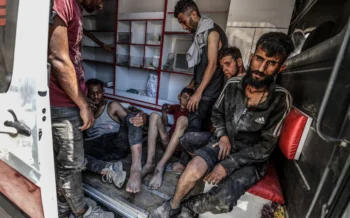
I saw the picture in a Telegraph story written by Melanie Swan and called “More than 90 dead in UN aid truck massacre in Gaza”. The caption says, “Injured Palestinians are taken to hospital after over 90 were killed waiting for humanitarian aid Credit: Ali Jadallah/Anadolu via Getty”.
Here are some of the reasons why I think the picture is AI-generated:
I always start by counting their fingers and toes. The left foot of the guy holding his knee appears to have six of the latter.
The little toe of the left foot of the bare-legged boy sitting in the centre looks wrong; too wide, no toenail – just a wedge of flesh.
Staying with the boy, his legs seem malformed – the distance from knee to ankle too long, the thigh too short and too narrow.
His right arm is too short and floppy, like the vestigial arm of a Tyrannosaurus Rex.
The little finger of the hand of the guy with the beard seated on the right of the picture does not join up to the hand correctly – either that or he was unfortunate enough to be born with his left hand where his right hand ought to be.
The writing on that white bag on the shelf is blurred in a way characteristic of A.I.
Moving back to the left of the picture, where is the long, thin arm pointing diagonally downwards coming from? In what position would a person be lying or standing in order to have their arm come out at that angle?
Compare the thin arm to the arms of the other people in the picture. It looks too long and thin to be true; an adult’s arm would be thicker, a child’s arm would be shorter. And, though I strain to see it, the hand looks almost as if it has two thumbs.
If you look at the picture under high magnification, it looks almost like someone has drawn around the figures with a Sharpie. These black outlines are particularly noticeable with the long-legged boy and the man clutching his knee.
This one is more speculative, but do the interiors of Israeli or Palestinian ambulances actually look like that? The (oddly sparse) contents of the shelves suggest a medical purpose, but the shelves themselves look like they come from someone’s kitchen.
Taken separately, all of the above points could be explained away. Lenses distort. Human bodies vary. Hunger makes people thin. Perhaps I will end up deleting this post in shame at having questioned the suffering of real human beings. Perhaps, but, having been able to find at least eight oddities, I think that Getty Images would be justified in putting a few pointed questions to Ali Jadallah.
However, I was right to say in 2023 that “this image is a great deal more realistic than those of only a few months ago. My spidey-sense for fake pictures will not last much longer”. It is even more true now.
Added 22/07/2025: Reading the comments to the Telegraph article, a lot of the commenters are saying, like me, that one of the photographs the Telegraph has used to illustrate it is fake. Only they are talking about a different picture. This one:
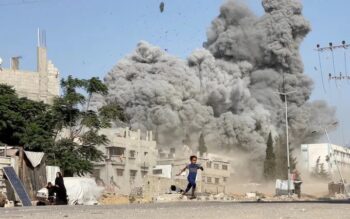
It shows a boy running away while a cloud of smoke rises from the buildings behind him.
With the picture of the men in the vehicle that I talked about above, my suspicions were raised the instant I saw it. The hyper-defined outlines and sharp colours gave a sort of slick, sweaty appearance to the flesh of the people depicted that I have often seen in A.I. art and noticed on that picture even before I started counting their digits. There is nothing like that in this second picture. The strange things about it suggest Photoshop rather than DALL-E or Midjourney. The border of the smoke cloud is at a suspiciously neat 45 degree angle. There is also something suspicious about the way the buildings to the left of the boy merge into the smoke. But the main problem is the running boy himself. The photographer appears to have caught him in mid-air – fine, that can happen when taking a photo of a person leaping or running, and catching that moment is usually considered the mark of a successful, dramatic picture – but he is too high off the ground to be plausible. And he has no shadow.
Or does he? There are two darker almost-horizontal lines or one slightly bent line below and to the left of him that could be his shadow. And before anyone brings up the similar horizontal lines to the right of him, those could be the shadow of a tree or pole just outside the picture. He is still suspended at an unlikely height, though. All in all, I am less convinced of the fakeness of this picture than of the other one – and the whole point of this post was that it is getting harder and harder to tell.
We are entering an age in which decisive authentication of a photograph will no longer be possible. The question will be whether one trusts the source. I do not trust anything coming out of Gaza.
Back when the world was still damp from the Flood and Peter Davison was Dr Who, I was in the University Officers Training Corps. I don’t know if the term is still used by the British Army, but back then a green, typewritten piece of paper headed “Part One Orders” was always on display on the unit noticeboard. Well, I think it was green. It was certainly typewritten, because everything was at that time – that’s how I knew at once that the people saying that the “Rathergate” documents that purported to have been written by an officer of the Texas Air National Guard in 1973 were fake had a very good case. The big thing about Part One Orders was that they were orders. You had to obey them, which meant you had to know what they were. You were under orders to read the Orders, specifically to check whether they had changed since you last read them. Reading a short document once a week was not an onerous requirement for Officer Cadet Solent but I gather that proper soldiers had to check ’em every day and woe betide them if they did not. On the other hand, the existence of Part One Orders meant that if some almighty balls-up happened because someone did not realise that circumstances had changed, the tide of woe could be diverted away from the immediate ballser-upper if he could show that the change had never been announced on the P1s.
Poor lefties. They are under at least as strict a requirement to keep abreast with changes to their orders as that imposed by Section 5.121 of the Queen’s Regulations (1975) but nobody will ever openly tell them that the orders have changed. Not even on Bluesky. Maybe on WhatsApp if they are very high ranking, but the foot soldiers of the progressive movement just have to know by osmosis.
That is why I can find some pity in my heart for the teachers at Bilton School in Warwickshire who sent home a twelve year old girl called Courtney White for wearing a Union Jack dress on Diversity Day, and then found themselves being condemned by a Labour Prime Minister. Not a lot of pity, but some. Nobody told them that the world had changed since 2022. Obviously, they should have been able to work it out from the fact that Reform are leading in the polls but maybe they were too busy putting up posters to notice.
“The Covid ‘lab leak’ theory isn’t just a rightwing conspiracy – pretending that’s the case is bad for science”, writes Jane Qiu in the Guardian.
That’s right. In the Guardian. My surprise at the location of the article was equalled by my surprise at the location of its writer: “Jane Qiu is an award-winning independent science writer in Beijing.” I didn’t know there were independent science writers in Beijing, but I guess there must be for an article on this particular topic written by someone describing themselves as such to appear. Anyway, she writes:
Some scientists assert evidence supporting natural-origins hypotheses with excessive confidence and show little tolerance for dissenting views. They have appeared eager to shut down the debate, repeatedly and since early 2020. For instance, when their work was published in the journal Science in 2022, they proclaimed the case closed and lab-leak theories dead. Even researchers leaning towards natural origins theories, such as the virus ecologist Vincent Munster of Rocky Mountains Laboratories in Hamilton, Montana, told me they lamented that some of their colleagues defend their theories “like a religion”.
No one embodies the crisis of trust in science more than Peter Daszak, the former president of EcoHealth Alliance. A series of missteps on his part has helped to fuel public distrust. In early 2020, for instance, he organised a statement by dozens of prominent scientists in the Lancet, which strongly condemned “conspiracy theories suggesting that Covid-19 does not have a natural origin”, without disclosing his nearly two-decade collaboration with the Wuhan Institute of Virology as a conflict of interest.
Similarly, he denies that his own collaboration with the Wuhan lab involved gain-of-function research, even though Shi Zhengli – the Chinese scientist who led the bat-borne coronavirus studies – has openly acknowledged that the lab’s work produced at least one genetically modified virus more virulent than its parental strain. (That work is not directly relevant to the origins of Covid-19.)
The documentary [Christian Frei’s Blame: Bats, Politics and a Planet Out of Balance, short title Blame] claims that attacks on EcoHealth Alliance and the spread of lab-leak conspiracy theories have fuelled distrust in science. In reality, it’s the other way round: public distrust in science, fuelled by the unresolved H5N1 gain-of-function controversy and by lack of transparency and humility from scientists such as Daszak, has driven scepticism and increased support for lab-leak theories.
This is not news to anyone who has read Matt Ridley and Alina Chan’s book Viral. Or to anyone who does not entirely get their news from the Guardian, the BBC and the New York Times, come to think of it. Still, better five years late than never. Why now, I wonder? Did someone at the Scott Trust take Katharine Viner to one side and gently suggest that it would be nice if the customary Guardian delay between “this is an absurd far right conspiracy theory” and “it’s the fault of the far right for talking about it before we did and using up all the available words” was not too far out of line with the nearly four years it took to admit Hunter Biden’s laptop was real and Joe Biden was senile? Or is something big about to break?
Today’s Guardian has up an article with the title “Climate misinformation turning crisis into catastrophe, report says” and the strapline “False claims obstructing climate action, say researchers, amid calls for climate lies to be criminalised”.
Quote:
Climate misinformation – the term used by the report for both deliberate and inadvertent falsehoods – is of increasing concern. Last Thursday, the UN special rapporteur on human rights and climate change, Elisa Morgera, called for misinformation and greenwashing by the fossil fuel industry to be criminalised. On Saturday, Brazil, host of the upcoming Cop30 climate summit, will rally nations behind a separate UN initiative to crack down on climate misinformation.
“It is a major problem,” said Dr Klaus Jensen, of the University of Copenhagen, who co-led the Ipie review. “If we don’t have the right information available, how are we going to vote for the right causes and politicians, and how are politicians going to translate the clear evidence into the necessary action?
|
Who Are We? The Samizdata people are a bunch of sinister and heavily armed globalist illuminati who seek to infect the entire world with the values of personal liberty and several property. Amongst our many crimes is a sense of humour and the intermittent use of British spelling.
We are also a varied group made up of social individualists, classical liberals, whigs, libertarians, extropians, futurists, ‘Porcupines’, Karl Popper fetishists, recovering neo-conservatives, crazed Ayn Rand worshipers, over-caffeinated Virginia Postrel devotees, witty Frédéric Bastiat wannabes, cypherpunks, minarchists, kritarchists and wild-eyed anarcho-capitalists from Britain, North America, Australia and Europe.
|




