Apologies for the sluggishness of the site recently, we have been under concerted attack from spammers.
|
|||||
The original Samizdat consisted of textual material intended to criticise and subvert repressive political regimes – it was surreptitiously copied and circulated in a “pass it on to your trustworthy friends” manner. Today’s samizdata – such as a certain hex string which, in the last month, has spread from one blog across Digg and thence to thousands of blogs and sites – is material which can now also be intended to subvert repressive data management regimes. In the days of the Cold War, samizdat was spread between people who typically knew each other, whereas today’s typical samizdata – even though it could conceivably propagate via USB memory sticks in a similar manner – employs more of a “scattergun” approach. This may well be down to the fact that secret police organisations in Cold War times were not omniscient; by contrast, today’s data management Politburos have access to Google, so the top priority for samizdata proponents is, as well as concealing their identities, ensuring that their data is propagated so widely that the probability of all the sites carrying the data being gagged becomes as close to infinitesimal as possible. Before the AACS product key, the last major piece of data management-subverting samizdata was DeCSS. DeCSS spread by website, newsgroup and T-shirt, the AACS key has spread much more quickly by blog, wiki and tag indexer. It is a sign of the times, although I am not about to predict that AACS product key T-shirts won’t happen soon. While the contribution of samizdat and its influence on populations to the eventual fall of various regimes is discussed in detail elsewhere, the effects of samizdata (online samizdata for the purposes of this discussion) are also not entirely straightforward; DeCSS and the falling cost of embeddable processing power clearly influenced AACS, particularly in the case of the upgradable key. However, as AACS could be broken once, on the grounds that key and encrypted material are stored together in a device under the physical control of the user, it can be broken again. The most accurate prediction I can make is that we’ll be seeing a lot more samizdata in future. May 8th, 2007 | 11 comments - (Comments are closed)
 It is no secret that I am opposed to conscription of any sort, be it military, judicial or educational. I am all for having armies, juries and schools, but not ones which depend on forcing the unwilling to become chattels of the state. Not only do I think it is morally indefensible, it produces strange results when people are compelled to do things they never agreed to do. Most people can be convinced that getting an education is a good thing, but to force who cannot see that to attend a school just means that they will disrupt the education of those who are willing to be there. You can lead a horse to water but you cannot make him drink. Moreover, state schools seem to bring out the most control obsessed aspects of people who run such places.
So children are going to be dragooned into coming to this place under threat of law but “Pupils won’t need to let off steam because they will not be bored”. Might I suggest arrogance and stupidity in equal measure. Might I suggest that they will indeed be bored and the way they will let of steam will be to trash this nice new school and run wild in classes… I sure as hell would. May 8th, 2007 | 29 comments - (Comments are closed)
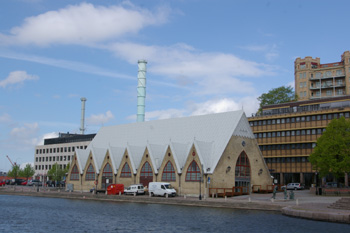 I took this photograph this morning in Gothenburg, Sweden. Is the building in the foreground:
The building still performs the function for which it was originally built. Answers on a postcard please. May 7th, 2007 | 3 comments - (Comments are closed)
France has elected Sarkozy and I must say I am curious to see what happens next. In the short term, will the anticipated riots in the banlieue happen? In the long term, will Sarko be France’s Thatcher and solve the serious structural problems created by decades of intrusive statism? Or will he be a disastrous Ted Heath, rearranging the deck chairs on the Titanic with no real understanding why things are so bad? Does he even have the perspectives needed to change the right things and move France in as more market/liberty oriented direction? And even if he does, will the System simply defeat any attempt to change it? I am dubious to say the least about the willingness of French society to break its addiction to other people’s money but we will see. What do you think? May 7th, 2007 | 35 comments - (Comments are closed)
To have a free and prosperous country, it is important to have strong institutions underpinning things like contract and property rights. Yet all too often we forget the roll of social attitudes and world-view in creating wealth and its handmaiden, liberty. There are two interesting articles in The Telegraph today (on the same page in the print version in fact) that shows that places like Russia and China may be vastly wealthier and freer than they were under the darkest days of Communism, but both those places have yet to develop either a culture that expects liberty, understands the implications of state money (they are hardly alone in that) or accepts the usefulness of profound outside influences. The Chinese government is trying to lure foreign educated Chinese back to China, which suggests at least the people at the top are aware that there is value in the way the rest of the world does things..
Which is interesting as that means most people still cannot live and work where they like, requiring internal passports and state residence permits. How can a place with such restrictions on a person’s ability to sell their own labour ever hope to become affluent and truly dynamic? Can they not see the link between the ability of individuals to make fundamental choices and the effectiveness of markets?
Which makes me wonder, do most Chinese people not realise how much more affluent the First World is than they are? I am guessing they do but this is trumped by the cultural imperative for Chinese-ness… the sort of mindless nationalism that is thankfully largely dead in much of the Western world. This suggests to me that regardless of how China’s leaders tinker around, if Chinese culture is that obsessed with China-is-always-best attitudes, there are serious limits to their ability to grow into a prosperous and civil society. Also in Russia, most of the institutions associated with advanced nations (courts, property rights, contract law etc.) are not known for their robustness or independence from politics. But also I wonder how much the culture in Russia allows people to imagine things any differently?
Which is interesting. But then…
I am sure Professor Kozlov is a very smart man, yet I wonder if it even crossed his mind that perhaps his Academy should respond to Putin’s power grab by refusing to take any more state money. If they are a centre of excellence as claimed, surely there must be companies and institutions around the world which would love to fund them and allow them to be truly independent of the state. Yet the notion that everything must happen top-down with the blessing of the state is probably so deeply ingrained that the reality of what is involved with making yourself independent does not track at all. May 6th, 2007 | 12 comments - (Comments are closed)
Continuing in movie-talk vein, one force that has swept through the western film industry to greater and lesser degrees is the current hatred of tobacco and the tobacco industry. The Michael Mann film, The Insider, starring Russell Crowe and Al Pacino – with a fine performance also by Christopher Plummer – is a good example. All the pieces are in place: a big, evil ciggie firm makes its products more addictive by dark scientific means; Crowe, who plays a scientist, leaves said evil organisation and blows the whistle on its practices. He is hounded, threatened, his marriage and career collapses. Pacino, as the hero-journalist, tries to expose all this, and in the process gets leant on by his big-bucks media empire bosses. The viewer comes away from the production in no doubt that cigarette companies are just a few inches short of being Nazis. If you take a random look at any major Hollywood production these days, you seldom see stars light up a cigarette, except possibly some of the more dubious or “troubled” characters. When I watched Steve Martin’s hilarious spoof film of 1940s film noir, Dead Men Don’t Wear Plaid, I was reminded of how in the movies of the time, everyone smoked. Even the pet dogs would have smoked, given half a chance. And the cinema audiences smoked like chimneys as well. This is now a distant memory. The modern James Bond in Casino Royale does not smoke his Morland Specials, whereas Connery smoked and of course 007’s creator, Ian Fleming, puffed away heroically. Bogart got through several packs of Luckies in a movie, and so did the various hot dames who acted with him. Spencer Tracy was unusual in that he did not smoke. Can you imagine Hugh Grant smoking, or George Clooney? Of course, there is a bit of a backlash from time to time, creating wonderful satire. Thankyou for Smoking, the film based on the humorous novel by Christopher Buckley, is one such. And the great Denis Leary tries to keep the flag flying. But for real defiance of the health-obsessives, the French cannot be beaten. Last night I watched the French cop film 36, starring the usual roster of craggy-faced Jules and Jacques with their Galoises and Gitanes attached permanently to their lower lips. I counted, or tried to count, the number of cigarettes smoked in the film and gave up at about the 200 mark. If Sarkozy is to be a great president of France, he needs to smoke. May 6th, 2007 | 24 comments - (Comments are closed)
It is has been a long-standing complaint from pro-market folk – like yours truly – that business and capitalism tends to get a pretty crummy deal in Hollywood and its equivalents around the world. Even one of my favourite movies, Wall Street, starring Michael Douglas as the corporate raider Gordon Gekko, is normally taken to be an anti-capitalist film, even though there is nothing in the magnificent “greed is good” speech with which I fundamentally disagree (it is like Ayn Rand on acid). In the main, businessmen are treated as shysters, or cold, or boring, and business is regarded as either vaguely venal or not very dramatic. The trouble is, I suppose, that the creative process of forming a business, running it and exploring a new market is not always full of obvious drama the same way that a crime story is, or at least not obvious to people who tend to view business in a hostile light. Some processes of bringing a new product to market might actually be very dramatic, and it is surprising that the arts world has not picked up on this more. People have of course speculated why business tends to get treated like this. In part, artistic people, including extremely intelligent and creative ones, will regard the process of raising funds for a film or play as a chore, and often resent the process of getting money and having to suck up to people to get it. Also, creative people often do not get close to the grubby necessity of having to pay bills, meet salary payrolls and so on. As a result, a lot of people in the arts world do not really understand business all that well. The results tend to bear this out. Take UK soap operas on television, like the terrible Eastenders, Coronation Street or the US shows Dallas and Dynasty. (The latter two cases were admittedly self-parodies to a degree). In almost every case, the businessman – it is usually a man – is presented as a crook, or brutal, shallow, uninteresting and generally unpleasant. And even in so-called “reality” business tv shows like The Apprentice, starring the Amstrad computer firm boss Alan Sugar, the impression is that being a great businessman means being a total wanker, which alas is the impression that Sir Alan conveys, although for all I know he is a much nicer man in real life and is just hamming it up for the cameras. So is there any hope? Well, this interesting blog item suggests that things might be brightening up. Why does it matter? It matters, I am afraid, because people these days seldom form their views by reading long books like Economics in One Lesson by Henry Hazlitt or Milton Friedman’s Capitalism and Freedom. For better or worse – and it is usually the worse – we get our opinions, our prejudices and our ideas from watching visual media. On a qualifying note, I should add that I do not, of course, want television dramas or films to become propoganda for the views that I like, as a reaction to propoganda for views that I detest. Rather, it is just that it would be nice to see entrepreneuriship given a bit of a fairer shake from the luvvies, once in a while. I can unreservedly plug this film, however, I can also repeat my admiration for this film as well. This old movie, Cash McCall, is worth a look although it might be hard to get hold of easily. May 5th, 2007 | 15 comments - (Comments are closed)
There is a very interesting article in The Weekly Standard by Stephen Schwartz called The Balkan Front, describing the struggle between Saudi backed Wahhabi Islam and the very moderate Bektashis and Rumi Sufi traditions in various parts of the Balkans. These are forms of Islam antithetical to the Wahhabis, and they are in the majority in places like Bosnia-Herzegovina (I have gotten drunk with enough Bosnians to know). Supporting them politically, financially and militarily, plus encouraging them to evangelise in areas infested by the Wahhabi pestilence, is surely a strategic move that should be supported by anyone who sees the spread of intolerant radical Islam as one of the major threats to civilisation in the world today. This is a subject on which the Serbian, Bosnian and Albanian governments, not to mention peoples, should be making common cause. It is in the interests of everyone who wants stability in the Balkans to oppose the presence of corrosive Wahhabi Islam and the Islamo-fascist politics that come with it. Tolerating Saudi money flooding into the region is like someone prone to cancer smoking cigarettes but given the areas fratricidal recent past, perhaps the malign Saudis can do a service by providing the Balkans’ fractious factions with something long needed: a legitimate and loathsome common enemy. May 5th, 2007 | 19 comments - (Comments are closed)
May 4th, 2007 | 3 comments - (Comments are closed)
In the beginning God covered the earth with broccoli, cauliflower and spinach, with green, yellow and red vegetables of all kinds so Man and Woman would live long and healthy lives. Then Satan created Dairy Ice Cream and Magnums. And Satan said, “You want hot fudge with that? And God created the healthy yoghurt that Woman might keep the figure that Man found so fair. So God said, “Try my fresh green salad”. God then said, “I have sent you healthy vegetables and olive oil in which to cook them”. Then God brought forth the potato, naturally low in fat and brimming with potassium and good nutrition. God then brought forth running shoes so that his Children might lose those extra pounds. Then God gave lean beef so that Man might consume fewer calories and still satisfy his appetite. And Man and Woman went into cardiac arrest. May 4th, 2007 | 15 comments - (Comments are closed)
It is understandable that many Russians view World War II era war memorials as being about resistance to the Nazis. Yet it is equally understandable the monuments to the Red Army have altogether different connotations in the countries conquered by the Soviet Union. The fact that Estonia has removed a statue of a Red Army soldier from downtown Tallinn, leading to violence and intimidation by ethnic Russians in Estonia and the Estonian embassy in Moscow being placed under a state of virtual siege, it does suggest a lot of Russians have not reconciled themselves to the fact the Soviet Imperium is a thing of the past. How can any of Russia’s neighbours ever trust Russia and allow mutually beneficial trade relations to develop if the Russian state feels it has any legitimate role in telling the former victims of Moscow’s rule what sort of symbols are appropriate for displace in a city centre? It is not hard to see why trade between the Baltic Nations and Russia has so quickly diminished in importance and been replaced by rapidly expanding commercial ties with the European Union. May 3rd, 2007 | 49 comments - (Comments are closed)
|
   |
||||

All content on this website (including text, photographs, audio files, and any other original works), unless otherwise noted, is licensed under a Creative Commons License. |
|||||

Recent Comments