We are developing the social individualist meta-context for the future. From the very serious to the extremely frivolous... lets see what is on the mind of the Samizdata people.
Samizdata, derived from Samizdat /n. - a system of clandestine publication of banned literature in the USSR [Russ.,= self-publishing house]
|
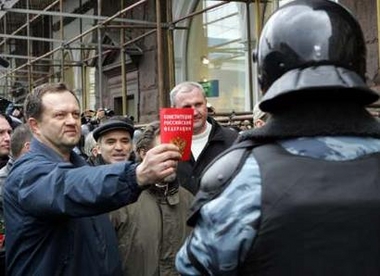
Blogger Rurrik at The Whims of Fate has a terrific collection of photos of the anti-Putin marches in Russia (including Kasparov being detained). There are so many images that I will not link to a specific article, just check out the whole blog (do not just look at the first page).
The sidebar statement about the Russian Federation on The Whims of Fate is:
- Brutally Suppressed Opposition
- Bureaucratic, Corrupt, Backwards Government
- By the Grace of God, Emperor Tsar
- Byzantine Justice
- Censorship
- Church as Arm of the State
- Extravagant Ruling Elite
- Huge Unwieldy Army
- Political Assassinations
- Powerful Secret Police
- Subservient Parliament
- Widespread Abject Poverty
Not a film review. Truth is more horrifying than fiction, sometimes.
The truth in question being the willingness of those close to power openly to advocate ever more interference with you and me, not ad hoc for venal, corrupt, human reasons, but in order systematically to enforce the currently approved good life on society.
From the BBC (Public Policy Research1 is by subscription, and I am not subsidising the bastards any more than I already do from taxes):
Jasper Gerard argues in PPR: “When it comes to booze, society seems to have lost its senses.”
He says current regulations are failing to tackle the growing trend of under age and binge drinking. By raising the age threshold, he claims: “It is at least possible that those in their early and mid teens will not see drink as something they will soon be allowed to do so therefore they might as well start doing it surreptitiously now.”
Alternatively, he proposes getting 18-year-olds to carry smart cards which record how much they have drunk each night and making it an offence to serve more alcohol to anyone under-21 who had already consumed more than three units. [Cant for a pint and a half of ordinary beer – or one decent cocktail – GH]
He conceded that no measure would stamp out youthful drinking entirely, but said it was time for a crackdown.
I note the BBC has this story under ‘health’, rather than ‘politics’. It does not have a ‘neo-Puritanism’ category (perhaps we should have). Medicalised bullying sails past the questioning pickets of journalism and gets straight into the credulous baggage train. As does technological bullying. And here we have medicalised state bullying enabled by technology. Woo-hoo!
One can not quote this fragment of C.S. Lewis too often:
Of all tyrannies, a tyranny exercised for the good of its victims may be the most oppressive. It may be better to live under robber barons than under omnipotent moral busybodies. The robber barons cruelty may sometimes sleep, his cupidity may at some point be satiated; but those who torment us for our own good will torment us without end, for they do so with the approval of their own conscience.
It may spoil the mesodiplosis, but those first too mays should be ises. The robber baron pursues his own whims and pleasures, regardless of others; the neo-Puritan is only happy when the lives of others are under control.
1 = The journal of the Institute for Public Policy Research, the tank in which New Labour thinking goes on.
The pope is publishing the first part of his book Jesus of Nazareth. An authorised biography, I guess.
It felt like a lion being savaged by Christians
– Madsen Pirie, when asked how it felt to be the only one in a room offering strongly dissenting opinions from the usual statist consensus.
Sometimes I read articles which seem to prove the existence of parallel universes. What I am curious about however is how does my web browser manage to access them from within this universe? I really must drop David Deutsch an e-mail and ask him to theorise.
For example, see this article sent from some alternate Earth, called ‘Britain counts cost of diplomatic furore over Berezovsky‘ (I apologise if the transdimensional shift causes your browser to crash):
The furore also probably extinguishes any hope that Russia will agree to let suspects be extradited to Britain over the London poisoning of former KGB agent Alexander Litvinenko
So by this I can only assume that some people think that if only Britain was ‘nicer’ to the Russian regime, there was at some point a ‘hope’ that the Russian leadership might allow the UK to extradite the people who could confirm the already obvious fact that the Russian state ordered Russian agents to assassinate Alexander Litvinenko in London.
Yes, I am sure the Russian authorities are really keen to do that. Not in this universe, of course, but I am sure that must be true in some other universe otherwise how else would it end up in a newspaper article?
I am fairly sure it is too late for an April Fool and I cannot detect humour at work in the writing so no doubt journalists Patrick Wintour and Laura Smith, the ones in this universe that is, are rather bemused by this transdimensional strangeness from their alter-egos from the universe in which politeness and pliability by Her Majesty’s Government can be expected to get Russian leaders to implicate themselves in murders on British soil.
I have a confession to make. I love the French TGV train that recently set an speed record of more than 350mph – that is quicker than some of the fighter aircraft of World War 2. It is a brilliant, sleek example of engineering and no wonder the French are proud of it. French civil engineering is in fact world-class, a fact that Frog-bashers would do well to remember. The French also played a part in that other magnificently quick and elegant beast – Concorde.
I read an interesting article on the TGV business in the UK weekly, The Spectator, last week, by Neil Collins (subscription-only). In this week’s Speccie, old-style socialist Neil Clark (defender of Milosovic, to his eternal shame) pops up in the letter’s page of the print edition to poke fun at privatised railways, arguing that the TGV example proves how splendid nationalisation is. It is a superficially appealing argument, but wrong on a number of grounds.
First of all, the TGV train has most of its fixed costs paid for by the state, ie, the French taxpayer. Taxes in France are high, some of the highest in the western world. It is all very well for Collins or Clark to wax lyrical about the ability of Monsieur and Madame to travel from Paris to Marseilles for under 20 euros, but that rather ignores the heavy tax bill that the benighted citoyens of France pay to keep this ultra-quick train system operating. When anyone talks about the ‘profits’ that the TGV might make, it is an abuse of economic language, since the initial investment into the railway was not an ‘investment’ in the sense that anyone spending their own money of their free will would understand it. And France, a less densely populated nation that Britain with a rather less respectful attitude towards property rights, can more easily punch straight railway lines across the land regardless of the objections of anyone who stands in the way. These are costs that lie on the debit side of the ledger.
The truth is, that many big state projects are often awe inspiring and people will therefore conclude that we should model the rest of our activity on that. When emergency planning methods were used to make war machines during WW2, socialists and others imagined that we should turn to such ‘rational’ methods in times of peace. How naive they now appear, but no more naive than those folk like Al Gore who claim that the State should take the credit for the internet, for example, as if such things as Google, YouTube or this blog would ever occur to a civil servant. In fact, just imagine how crap the internet would be if it was run by a state monopoly, like British Rail in the 1960s and 70s.
UK rail privatisation is often held up as an example of the supposed limits of ‘free market fundamentalism’, but given the botched way in which railways were sold off, the constant interference with the railways in the early years of Labour, it is a nonsense to claim that only state monopolies can run rail networks.
Tyler Cowen notes an unsavoury fact about the Chinese economic miracle:
…of the 3,220 Chinese citizens with a personal wealth of 100 million yuan ($13 million) or more, 2,932 are children of high-level cadres. Of the key positions in the five industrial sectors – finance, foreign trade, land development, large-scale engineering and securities – 85% to 90% are held by children of high-level cadres.
Cowen lifted the above quote from an interesting article that details how the regime in Beijing controls economic data coming out of the Middle Kingdom, which helps to prompt foreign investors to keep funding the great confidence trick that is the modern Chinese economy.
The family connections of China’s super-rich and captains of industry must be considered alongside rosy economic statistics provided that expound China’s development. These filial links between the commanding heights of China’s supposedly private sector and its government betray the fact that China Inc. is the unholy alliance of a dictatorial regime and the application of corrupted ‘free’ market ideals. Such an arrangement will fail in due course, and will probably fail spectacularly since it has come this far.
Russian tycoon Boris Berezovsky, who was granted asylum in the UK due to his treatment by the Russian state, had said he wants to engineer the overthrow of Vladimir Putin:
“We need to use force to change this regime. It isn’t possible to change this regime through democratic means. There can be no change without force, pressure.”
To which a Kremlin spokesman said:
“In accordance with our legislation [his remarks are] being treated as a crime. It will cause some questions from the British authorities to Mr Berezovsky. We want to believe that official London will never grant asylum to someone who wants to use force to change the regime in Russia.”
Yet the Kremlin seems to think it can murder its political opponents in London and at home and that is just fine and dandy. Who says Russian politicians do not have a sense of humour, eh?
What is sauce for the goose…
I wish I could play the piano well. What skill that you lack do you most wish you possessed?
Yesterday morning I caught myself committing two crimes simultaneously in a public place.
I emerged from Westminster underground station beside the Houses of Parliament wearing a NO2ID button, which almost certainly constituted an unauthorised demonstration contrary to the Serious Organised Crime and Police Act 2006. And, before proceeding southwards across the bridge to continue the same criminal conduct in Southwark and Lambeth on the way to where I was going, I took a leaflet from a young woman advertising a hairdresser, smiling and thanking her. If that is not ‘counselling and procuring an offence’ against the Environmental Protection Act 1990 (as amended by the Clean Neighbourhoods and Environment Act 2005), given that Westminster City Council has taken the powers granted by the new Schedule 3A to prohibit the distribution of free literature, then I do not know what is.
I am minded to get a haircut. Presumably that would make my payment the proceeds of crime, and the hairdressing business subject to sequestration under the 2002 Act.
If things like this can happen on a sunny spring day under the eyes of the armed police and surveillance cameras protecting our diligent legislators, then no wonder the government is ‘cracking down on crime’ for the several-dozenth time in its Serious Crime Bill. If people can communicate and have social intercourse just as they like , without a license or the fear of prosecution, then there could be chaos.
The PM is quite right, plainly. Society is being menaced by the liberal, laissez-faire, values of the ’60s. People showed respect for authority in the 1550s, before we went soft on witchcraft and heresy.
The government’s campaign to ban the rural practice of hunting foxes with hounds – motivated by a mix of sentimentality about animals, some genuine concern about cruelty and a lot of spite – has proven to be a waste of time, at least as far as I can judge from some news reports as well as direct personal experience. On the latter point, a foxhunt came across some open land that is owned by my father – what was left after he sold the bulk of the farm in Suffolk. The hunt did not ask my dad about coming across the land, and in fact caused a fair amount of damage to several hedges. My old man was, understandably, not very amused.
It is sometimes assumed that farmers and other folk who work the land must be in favour of hunting vermin and therefore support foxhunting. I ‘support’ it in the sense that I tolerate it. I tend to regard foxhunting as a mildly silly activity but there are lots of silly activities which make up the eccentric land of ours. Just because one might not enjoy a certain pursuit in no way justifies banning it. On practical grounds, if one wants to control wild animals like foxes, a rifle is arguably better use than a bunch of dogs. Riding to hounds across open fields and over high hedges might at one stage have been good training for a budding cavalry soldier. And Let’s face it, foxhunters chase foxes because they enjoy it; they enjoy steaming across the countryside, with all the adrenalin rushes and cameraderie that this brings. And a man and woman look pretty damn good in those riding clothes.
Even so, many farmers, such as tenant farmers, resent the hunt. When tenant farmers were more common than they are now, a landlord could ride across the tenant’s farm at will, and force said tenant to maintain the land in such a way as to keep up the supply of foxes, pheasants, partridges and other targets. Roger Scruton, in his ‘elegy’ to old England, defends the pattern of landholding in such terms (he denies the idea that one owns property in any absolute sense, but more as a sort of lease from the State). With the rise of owner-occupier farmers, however, it is not quite so simple for hunters to gallop across the land in pursuit of game come what may. The clash between foxhunters and farmers is rather ironic, given that some commenters tend to lump all country dwellers in the same mental category.
Respect for property rights is in decline in this nation, and from all quarters. The assault on property rights, such as telling owners of pubs that their clients cannot smoke even if no-one is forcing anyone to frequent a place, is only one such example. The ability of people to change their property is constrained as never before by planning laws. Landowners are also affected. All the more reason, then, why devotees of the hunt should respect the rights of people who are, in usual circumstances, tolerant of the men who chase the fox to the cries of Tally Ho!
Depending on the deals, could we see personnel queuing up to be arrested by the Iranians so that they could subsequently sell their story?
– ‘Lilotes’
|
Who Are We? The Samizdata people are a bunch of sinister and heavily armed globalist illuminati who seek to infect the entire world with the values of personal liberty and several property. Amongst our many crimes is a sense of humour and the intermittent use of British spelling.
We are also a varied group made up of social individualists, classical liberals, whigs, libertarians, extropians, futurists, ‘Porcupines’, Karl Popper fetishists, recovering neo-conservatives, crazed Ayn Rand worshipers, over-caffeinated Virginia Postrel devotees, witty Frédéric Bastiat wannabes, cypherpunks, minarchists, kritarchists and wild-eyed anarcho-capitalists from Britain, North America, Australia and Europe.
|





Recent Comments